
#FactCheck: 2023 Manipur Violence Video Falsely Shared as Indian Army Bombing Minority House
Executive Summary
A video showing a house collapsing after a massive explosion is being widely shared on social media with the claim that it shows the Indian Armed Forces bombing the house of a minority community in Manipur. CyberPeace Research Wing ’s research found that the claim is false. The viral video dates back to 2023 and shows a house being demolished in Churachandpur during the ethnic violence between the Kuki and Meitei communities in Manipur.
Claim:
An X (formerly Twitter) user shared the video with the caption: “This is Manipur, not Palestine. The Indian Army is destroying minority houses in Manipur.”
The post claimed that the visuals showed the Indian Army carrying out an attack on minority community houses in Manipur.
https://www.facebook.com/reel/1042491035382024

Fact Check:
To verify the claim, CyberPeace Research Wing conducted a reverse image search using keyframes extracted from the viral video. During the search, we found the same video shared by NDTV’s official Instagram account on July 21, 2024.
According to the caption of the post, the video was from 2023, when ethnic clashes broke out between the Kuki and Meitei communities in Manipur. The post stated that the incident took place in Churachandpur, where the house of Naorem Ibomcha Meitei was destroyed by the Kuki community during the violence.
https://www.instagram.com/reels/C9sQWeTSCFx/

Further research revealed that India Today had also shared the same video with similar details
https://www.instagram.com/reels/C9sRq1nSy51/

Conclusion:
The research found that the viral video is being circulated with a misleading claim. The footage does not show the Indian Armed Forces bombing a minority community’s house in Manipur. It is from 2023 and shows the demolition of a house in Churachandpur during the ethnic violence between the Kuki and Meitei communities.

Related Blogs

Introduction
Company law solved a version of this problem more than a century ago, and artificial intelligence regulation is now quietly borrowing the solution. When something goes wrong inside a company, the law generally cannot reach past the corporate entity to punish the people who ran it, because the company is treated as a legal person entirely separate from its shareholders and directors. Courts developed an exception for exactly the cases where that separation becomes a shield for wrongdoing, and lawyers now call it lifting, or piercing, the corporate veil. A growing body of legal scholarship argues that AI systems present a strikingly similar problem, and needs a strikingly similar fix. That emerging idea has come to be called lifting the AI veil.
Where the original doctrine comes from
The doctrine of lifting the corporate veil traces directly to the House of Lords decision in Salomon v. Salomon & Co. Ltd. in 1897. Aron Salomon, a leather and boot manufacturer, incorporated his existing business, sold it to the new company, and structured share ownership so that he and his family held nearly all the shares. When the company later failed, creditors argued Salomon should be held personally liable, since the company was effectively just him operating under a different name. The House of Lords disagreed, holding decisively that once validly incorporated, a company is a person in law entirely distinct from its subscribers, with its own rights and liabilities. That ruling established what remains company law's foundational principle: separate legal personality.
Separate personality is not, however, unconditional. Courts across common law jurisdictions, including India, carved out an exception for cases where the corporate form is used as a facade for fraud, to evade a statutory obligation, or to circumvent a legal duty that would otherwise apply to the individuals behind it. In such cases, a court will "lift the veil," looking past the company's separate legal identity to attribute liability directly to the directors or shareholders actually in control. India's Supreme Court, in Life Insurance Corporation of India v. Escorts Ltd., reaffirmed that this remains an exception applied only in narrow, exceptional circumstances, generally where a statute contemplates it, or fraud or improper conduct needs to be prevented. The doctrine has since found application well beyond fraud alone, including in tax matters, as seen in cases like State of U.P. v. Renusagar Power Co., where courts treated closely related corporate entities as one for the purpose of a specific statutory benefit.
Why AI creates the same structural problem
Scholarship examining AI liability has increasingly pointed to a near identical structural gap. As AI systems take on functions once reserved for human decision makers, board level analytics, automated lending decisions, algorithmic hiring, even proposed "robo-director" advisory roles, a familiar question resurfaces: who answers for the outcome when the AI system, rather than a named individual, produced the decision. A 2025 academic paper titled Lifting the AI Veil in Company Law argues explicitly that AI liability should be approached through an extension of existing doctrines, including directors' duty of care and precisely the piercing of the veil doctrine traditionally reserved for shareholders, rather than inventing an entirely new liability regime from scratch.
The concern driving this argument is not abstract. Commentary in outlets like MIT Technology Review has warned that granting AI systems anything resembling legal personhood risks handing companies a genuinely dangerous new shield, allowing a company to argue that a harmful outcome was the AI's autonomous decision, disconnected from any human actor's intent or negligence, much as a company might once have argued a harmful outcome was simply "the company's" doing and not any individual's. Critics of AI personhood proposals, writing in journals examining AI as legal persons, make the parallel explicit: while corporate veil piercing exists precisely to stop the corporate form being misused as a liability shield, the justification for extending similar legal personhood to AI is considerably weaker, since corporate personhood serves a clear economic purpose, enabling investment and risk pooling, that AI personhood does not obviously replicate.
How regulators have actually responded
The European Union's experience is instructive precisely because it shows the doctrine's underlying logic being adopted through legislation rather than judicial precedent. The European Commission originally proposed a dedicated AI Liability Directive in September 2022, intended to ease the burden of proof on claimants harmed by AI systems, including a rebuttable presumption of causality where a claimant could show an AI system breached EU AI Act obligations. That proposal was formally withdrawn in 2025, with the withdrawal notice published in the Official Journal on 6 October 2025, after member states failed to reach agreement. In its place, the revised EU Product Liability Directive now does much of the same underlying work through a different legal mechanism, explicitly treating AI software as a "product" for the purposes of manufacturer liability, meaning AI providers face strict liability for defective AI products without claimants needing to prove fault, applicable to AI products placed on the EU market from 9 December 2026 onward. Functionally, this achieves something close to piercing the AI veil by statute: instead of allowing a company to attribute harm to an autonomous algorithmic process and stop the inquiry there, liability is anchored back to the entity that built, trained, or deployed the system.
The Indian angle, and why it matters here
India has no AI specific liability statute at present, and no reported judicial decision has yet applied the corporate veil piercing doctrine by analogy to an AI system. But the underlying legal architecture is already familiar territory for Indian courts. India's jurisprudence on lifting the corporate veil, built through Escorts, Renusagar, and subsequent cases, already establishes the judicial comfort with looking past a formal legal structure to find the real, controlling actor when justice demands it. Indian courts have been consistently clear that this remains an exceptional remedy rather than a routine one, generally invoked where a statute contemplates it, where fraud or improper conduct needs to be prevented, or where a taxing or beneficial statute would otherwise be defeated by rigid adherence to corporate form. That same cautious, fact specific posture is likely to shape how any future Indian AI liability doctrine develops, applied sparingly rather than as a blanket rule.
As AI systems increasingly mediate lending decisions, insurance claims processing, and algorithmic hiring in Indian companies, the same reasoning that let Indian courts see through a corporate facade could plausibly extend to seeing through an "AI made the decision" defence, attributing responsibility to whichever human actor, developer, deployer, or governing board, exercised actual control over how that system was built and used. Given how central technology sector employment and AI deployment already are to India's economy, the absence of a clear domestic answer to this question is unlikely to remain untested for long.
The larger point
The doctrine of lifting the AI veil is less a wholly new legal invention and more a recognition that AI systems and corporations create the same essential problem: a formally separate entity that can, if left unchecked, absorb blame that properly belongs to the humans directing it. Company law solved this by refusing to let the corporate form become an alibi. AI law, whether through judicial doctrine, statute, or a hybrid of both as the EU's experience suggests, will likely need to reach the same conclusion, because the alternative is allowing genuine harm to disappear into a system nobody can be made to answer for.
References
- Bird & Bird, "Proposed EU AI liability rules withdrawn." https://www.twobirds.com/en/insights/2025/proposed-eu-ai-liability-rules-withdrawn
- LegalClarity, "AI Liability Directive: What It Was and Why It Was Withdrawn." https://legalclarity.org/ai-liability-directive-what-it-was-and-why-it-was-withdrawn/
- WCR Legal, "EU AI Liability Directive: Withdrawn, What Now Applies?" https://wcr.legal/eu-ai-liability-directive-withdrawn-pld/
- Verfassungsblog, "Anatomy of a Fall: On the Anticipated Withdrawal of the AI Liability Directive Proposal." https://verfassungsblog.de/anatomy-of-a-fall-aiact-aild-pld/
- MIT Technology Review, "Debates over AI consciousness are a trap." https://www.technologyreview.com/2026/08/20/1142571/ai-consciousness-debate-trap/
- ResearchGate, "Lifting the AI Veil in Company Law." https://www.researchgate.net/publication/393305638_Lifting_the_AI_veil_in_company_law
- Review of Law and Regulation, "Lifting the AI Veil in Company Law." https://rlr.iup.rs/wp-content/uploads/2025/07/04.pdf
- Bhatt & Joshi Associates, "Decoding the Jurisprudence on Lifting the Corporate Veil in Indian Court. https://bhattandjoshiassociates.com/decoding-the-jurisprudence-on-lifting-the-corporate-veil-in-indian-court/
- Mondaq, "Analysis Of Standard Of Proof For Lifting Of The Corporate Veil In Cases Of Fraud." https://www.mondaq.com/india/corporate-and-company-law/1259382/analysis-of-standard-of-proof-for-lifting-of-the-corporate-veil-in-cases-of-fraud
- Record Of Law, "Analysis of the theory of corporate veil lifting." https://recordoflaw.in/analysis-of-the-theory-of-corporate-veil-lifting/
- Suren Uppal Offices, "Lifting of Corporate Veil: Navigating Judicial Precedents." https://www.suolaw.com/lifting-of-corporate-veil-navigating-judicial-precedents/

Introduction
Intricate and winding are the passageways of the modern digital age, a place where the reverberations of truth effortlessly blend, yet hauntingly contrast, with the echoes of falsehood. The latest thread in this fabric of misinformation is a claim that has scurried through the virtual windows of social media platforms, gaining the kind of traction that is both revelatory and alarming of our times. It is a narrative that speaks to the heart of India's cultural and religious fabric—the construction of the Ram Temple in Ayodhya, a project enshrined in the collective consciousness of a nation and steeped in historical significance.
The claim in question, a spectre of misinformation, suggests that the Ram Temple's construction has been covertly shifted 3 kilometres from its original, hallowed ground—the birthplace, as it were, of Lord Ram. This assertion, which spread through the echo chambers of social media, has been bolstered by a screenshot of Google Maps, a digital cartographer that has accidentally become a pawn in this game of truth and deception. The image purports to showcase the location of Ram Mandir as distinct and distant from the site where the Babri Masjid once stood, a claim went viral on social media and has caught the public's reactions.
The Viral Tempest
In the face of such a viral tempest, IndiaTV's fact-checking arm, IndiaTVFactCheck, has stepped into the fray, wielding the sword of veracity against the Goliath of falsehood. Their investigation into this viral claim was meticulous, a deep dive into the digital representations that have fueled this controversy. Upon examining the viral Google Maps screenshot, they noticed markings at two locations: one labelled as Shri Ram Janmabhoomi Temple and the other as Babri Masjid. The latter, upon closer inspection and with the aid of Google's satellite prowess, was revealed to be the Shri Sita-Ram Birla Temple, a place of worship that stands in quiet dignity, far removed from the contentious whispers of social media.
The truth, as it often does, lay buried beneath layers of user-generated content on Google Maps, where the ability to tag any location with a name has sometimes led to the dissemination of incorrect information. This can be corrected, of course, but not before it has woven itself into the fabric of public discourse. The fact-check by IndiaTV revealed that the location mentioned in the viral screenshot is, indeed, the Shri Sita-Ram Birla Temple and the Ram Temple is being constructed at its original, intended site.
This revelation is not merely a victory for truth over falsehood but also a testament to the resilience of facts in the face of a relentless onslaught of misinformation. It is a reminder that the digital realm, for all its wonders, is also a shadowy theatre where narratives are constructed and deconstructed with alarming ease. The very basis of all the fake narratives that spread around significant events, such as the consecration ceremony of the Ram Temple, is the manipulation of truth, the distortion of reality to serve nefarious ends of spreading misinformation.
Fake Narratives; Misinformation
Consider the elaborate fake narratives spun around the ceremony, where hours have been spent on the internet building a web of deceit. Claims such as 'Mandir wahan nahin banaya gaya' (The temple is not being built at the site of the demolition) and the issuance of new Rs 500 notes for the Ram Mandir were some pieces of misinformation that went viral on social media amid the preparations for the consecration ceremony. These repetitive claims, albeit differently worded, were spread to further a single narrative on the internet, a phenomenon that a study published in Nature said could be attributed to people taking some peripheral cues as signals for truth, which can increase with repetition.
The misinformation incidents surrounding the Ram Temple in Ayodhya are a microcosm of the larger battle between truth and misinformation. The false claims circulating online assert that the ongoing construction is not taking place at the original Babri Masjid site but rather 3 kilometres away. This misinformation, shared widely on social media has been debunked upon closer examination. The claim is based on a screenshot of Google Maps showing two locations: the construction site of the Shri Ram Janmabhoomi Temple and another spot labeled 'Babar Masjid permanently closed' situated 3 kilometers away. The assertion questions the legitimacy of demolishing the Babri Masjid if the temple is being built elsewhere. However, a thorough fact-check reveals the claim to be entirely unfounded.
Deep Scrutiny
Upon scrutiny, the screenshot indicates that the second location marked as 'Babar Masjid' is, in fact, the Sita-Ram Birla Temple in Ayodhya. This is verified by comparing the Google Maps satellite image with the actual structure of the Birla Temple. Notably, the viral screenshot misspells 'Babri Masjid' as 'Babar Masjid,' casting doubt on its credibility. Satellite images from Google Earth Pro clearly depict the construction of a temple-like structure at the precise coordinates of the original Babri Masjid demolition site (26°47'43.74'N 82°11'38.77'E). Comparing old and new satellite images further confirms that major construction activities began in 2011, aligning with the initiation of the Ram Temple construction.
Moreover, existing photographs of the Babri Masjid, though challenging to precisely match, share essential structural elements with the current construction site, reinforcing the location as the original site of the mosque. Hence the viral claim that the Ram Temple is being constructed 3 kilometers away from the Babri Masjid site is indubitably false. Evidence from historical photographs, satellite images and google images conclusively refute this misinformation, attesting that the temple construction is indeed taking place at the same location as the original Babri Masjid.
Viral Misinformation: A false claim based on a misleading Google Maps screenshot suggests the Ram Temple construction in Ayodhya has been covertly shifted 3 kilometres away from its original Babri Masjid site.
Fact Check Revealed: IndiaTVFactCheck debunked the misinformation, confirming that the viral screenshot actually showed the Shri Sita-Ram Birla Temple, not the Babri Masjid site. The Ram Temple is indeed being constructed at its original, intended location, exposing the falsehood of the claim.
Conclusion
The case of the Ram Temple is a pitiful reminder of the power of misinformation and the significance of fact-checking in preserving the integrity of truth. It is a clarion call to question, to uphold the integrity of facts in a world increasingly stymied in the murky waters of falsehoods. Widespread misinformation highlights the critical role of fact-checking in dispelling false narratives. It serves as a reminder of the ongoing battle between truth and misinformation in the digital age, emphasising the importance of upholding the integrity of facts for a more informed society.
References
- https://www.indiatvnews.com/fact-check/fact-check-is-ram-temple-being-built-3-km-away-from-the-birthplace-here-truth-behind-viral-claim-2024-01-19-912633
- https://www.thequint.com/news/webqoof/misinformation-spread-around-events-ayodhya-ram-mandir-g20-elections-bharat-jodo-yatra
Executive Summary
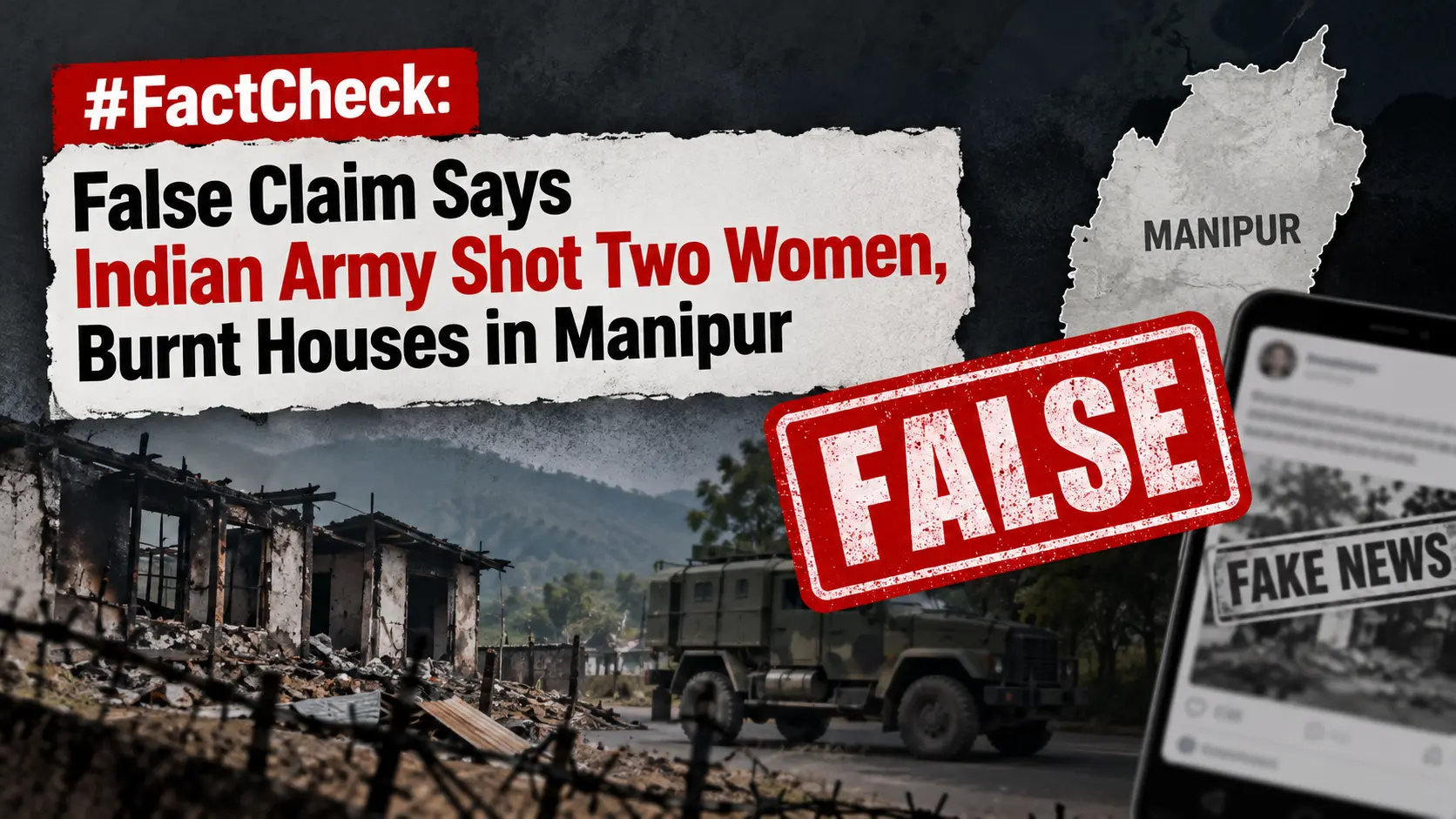
A claim is being shared on social media alleging that two women were shot dead and their homes were set on fire in Manipur. The post alleges that the Indian Army carried out the attack on the orders of Lieutenant General V. M. Bhuvana Krishnan, Commander of the Eastern Command. CyberPeace Research found the claim to be false. According to available reports, suspected militants attacked a hill village in Manipur’s Kangpokpi district. During an exchange of fire with security forces, the attackers set at least two houses on fire.
Claim:
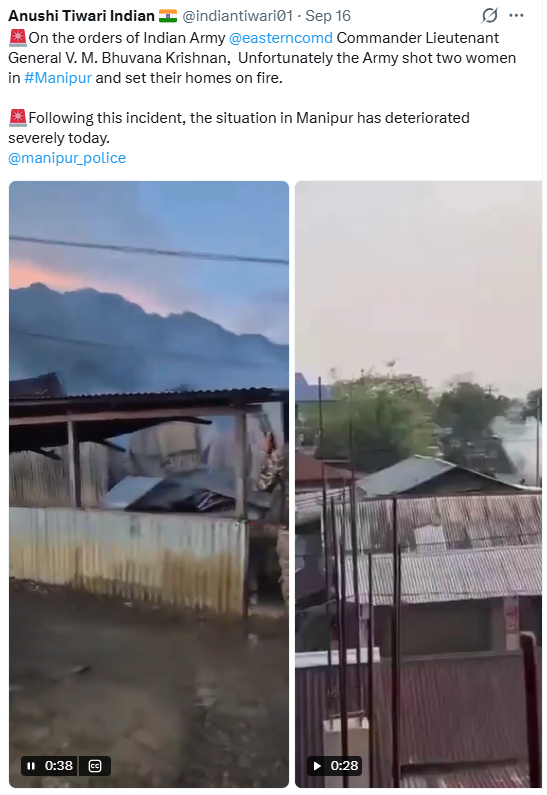
The Indian Army, on the orders of Eastern Command Commander Lieutenant General V. M. Bhuvana Krishnan, shot two women in Manipur and set their homes on fire, following which the situation in the state deteriorated severely.
https://x.com/indiantiwari01/status/2100204995425743103?s=20
https://archive.ph/SOm7I
Fact Check
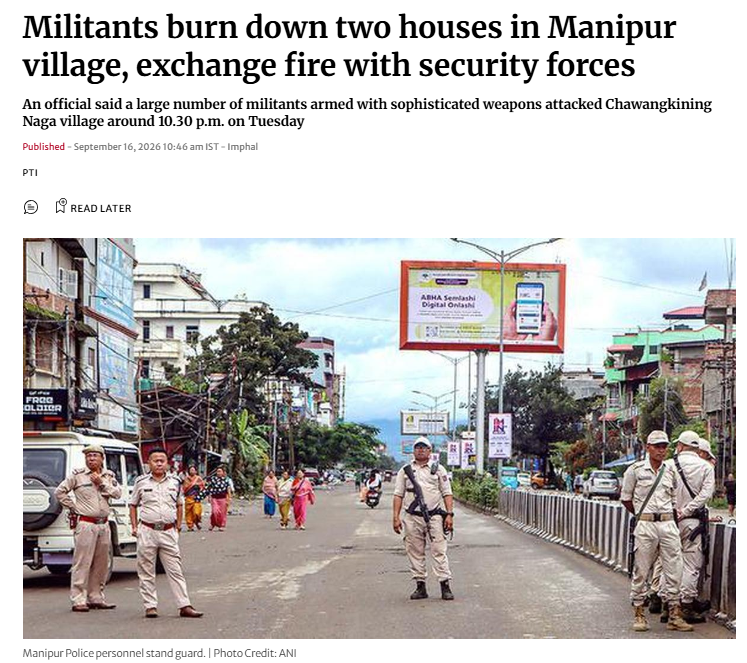
To verify the viral claim, we conducted a Google search using relevant keywords. During the search, we found a report published on The Times of India website on September 16, 2026. According to the report, suspected militants attacked a hill village in Manipur’s Kangpokpi district on Tuesday night and set at least two houses on fire. Security forces engaged the attackers in an exchange of fire during the incident.According to officials, a large number of militants armed with sophisticated weapons attacked Chawangkining Naga village at around 10:30 p.m. on Tuesday. The attack took place hours after two Kuki women were shot dead at Leisangphai village in neighbouring Tamenglong district.CRPF personnel deployed in the nearby area returned fire, triggering intermittent firing that continued for nearly six hours until around 4:30 a.m. on Wednesday.An official said, “Intermittent firing was reported for nearly six hours till 4:30 a.m. on Wednesday. The CRPF returned fire, preventing the militants from entering the village.” He added that two wooden houses on the outskirts of the village were nevertheless set ablaze.

As part of our further investigation, we conducted a reverse image search of keyframes from the video. During the search, we found the visuals from the viral video on the YouTube channel of @ukhrultimes. According to the accompanying information, intermittent firing continued for nearly six hours in Chawangkining Naga village in Manipur’s Kangpokpi district on the night of September 15, 2026. During the incident, two houses on the outskirts of the village were completely burnt down, while several others were damaged.According to local reports, suspected militants targeted the village despite the deployment of CRPF personnel in the area and engaged in an exchange of fire with security forces. Meanwhile, the Liangmai Naga Council, Manipur (LNC-M), condemned the attack and alleged that suspected Kuki militants operating from the Songtung Suspension of Operations (SoO) camp were behind the firing. However, these allegations regarding the identity of the attackers should be reported as allegations and should not be presented as independently verified facts.
https://www.youtube.com/shorts/QuZ2FoLyA5A

At the end of our investigation, we found a report published on The Hindu website on September 16, 2026. According to the report, officials said that suspected militants had attacked Chawangkining Naga village in Manipur’s Kangpokpi district. During the attack, they engaged in an exchange of fire with security forces and set at least two houses on the outskirts of the village on fire. The report quoted an official as saying that a large number of militants armed with sophisticated weapons attacked the village at around 10:30 p.m. on September 15. The incident took place hours after two Kuki women were shot dead in Leisangphai village in neighbouring Tamenglong district.
Conclusion
Our investigation revealed that separate incidents of the killing of two women and the burning of their houses in Manipur are being falsely shared on social media, claiming them to be actions taken by the Indian Army. According to available reports, on September 15, 2026, two Kuki women were shot dead by unidentified armed assailants in Leisangphai village, Tamenglong district. On the same night, suspected militants attacked Chawangkining Naga village, Kangpokpi district. Security forces exchanged fire, and two houses on the outskirts of the village were set on fire. No credible report has confirmed the links between these incidents and the orders of the Indian Army or Eastern Command Commander Lieutenant General V.M. Bhuvana Krishnan. Therefore, the claim that the Indian Army shot two women and set their houses on fire by linking the two incidents is false and misleading.
