
#FactCheck - AI-Generated Flyover Collapse Video Shared With Misleading Claims
Executive Summary
A video showing a flyover collapse is going viral on social media. The clip shows a flyover and a road passing beneath it, with vehicles moving normally. Suddenly, a portion of the flyover appears to collapse and fall onto the road below, with some vehicles seemingly coming under its impact. The video has been widely shared by users online. However, research by the CyberPeace found the viral claim to be false. The probe revealed that the video is not real but has been created using artificial intelligence.
Claim:
On X (formerly Twitter), a user shared the viral video on February 13, 2026, claiming it showed the reality of India’s infrastructure development and criticizing ongoing projects. The post quickly gained traction, with several users sharing it as a real incident. Similarly, another user shared the same video on Facebook on February 13, 2026, making a similar claim.

Fact Check:
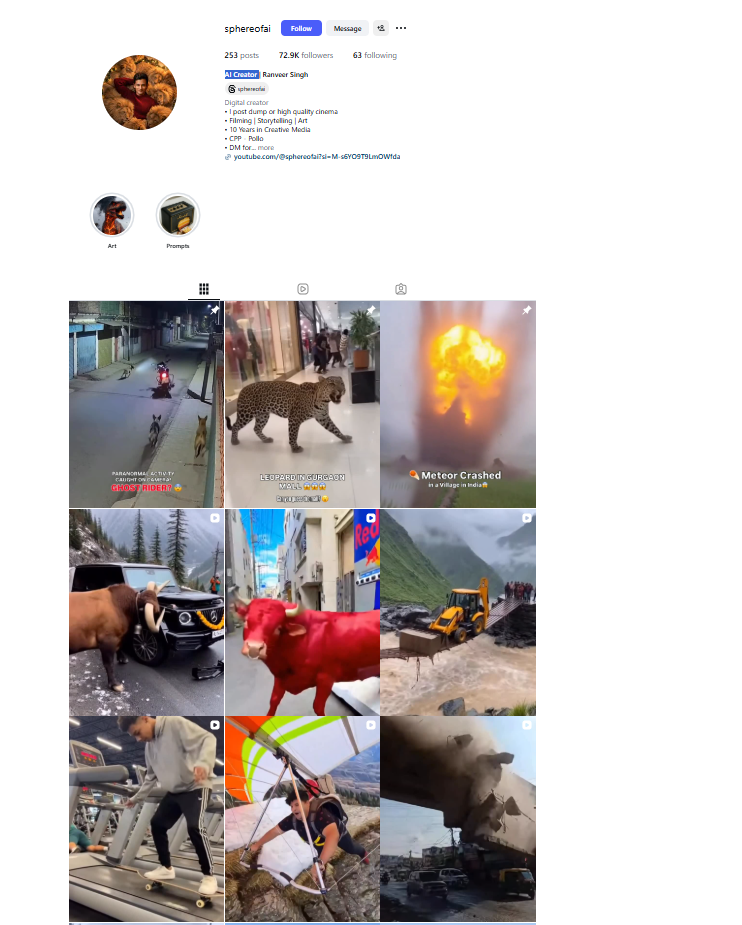
To verify the claim, key frames from the viral video were extracted and searched using Google Lens. During the search, the video was traced to an account named “sphereofai” on Instagram, where it had been posted on February 9. The post included hashtags such as “AI Creator” and “AI Generated,” clearly indicating that the video was created using AI. Further examination of the account showed that the user identifies themselves as an AI content creator.

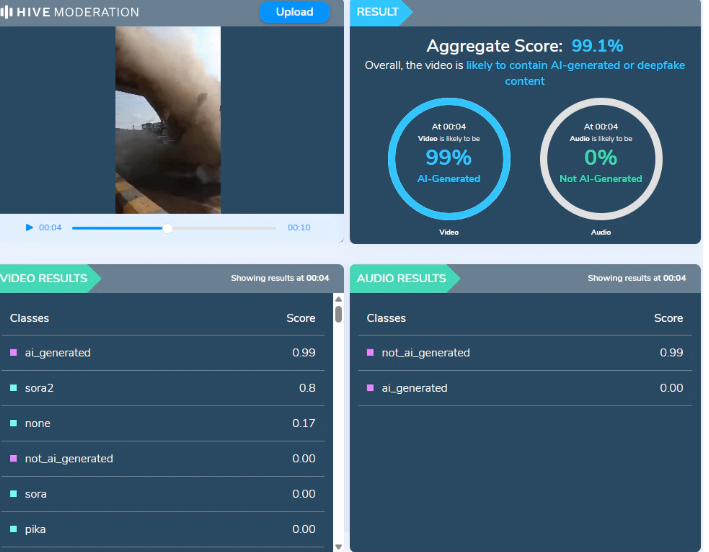
To confirm the findings, the viral video was also analysed using Hive Moderation. The tool’s analysis suggested a 99 percent probability that the video was AI-generated.
Conclusion:
The research established that the viral flyover collapse video is not authentic. It is an AI-generated clip being circulated online with misleading claims.

Related Blogs

India is the world's largest democracy, and conducting free and fair elections is a mammoth task shouldered by the Election Commission of India. But technology is transforming every aspect of the electoral process in the digital age, with Artificial Intelligence (AI) being integrated into campaigns, voter engagement, and election monitoring. In the upcoming Bihar elections of 2025, all eyes are on how the use of AI will influence the state polls and the precedent it will set for future elections.
Opportunities: Harnessing AI for Better Elections
Breaking Language Barriers with AI:
AI is reshaping political outreach by making speeches accessible in multiple languages. At the Kashi Tamil Sangamam in 2024, the PM’s Hindi address was AI-dubbed in Tamil in real time. Since then, several speeches have been rolled out in eight languages, ensuring inclusivity and connecting with voters beyond Hindi-speaking regions more effectively.
Monitoring and Transparency
During Bihar’s Panchayat polls, the State Election Commission used Staqu’s JARVIS, an AI-powered system that connects with CCTV cameras to monitor EVM screens in real time. By reducing human error, JARVIS brought greater accuracy, speed, and trust to the counting process.
AI for Information Access on Public Service Delivery
NaMo AI is a multilingual chatbot that citizens can use to inquire about the details of public services. The feature aims to make government schemes easy to understand, transparent, and help voters connect directly with the policies of the government.
Personalised Campaigning
AI is transforming how campaigns connect with voters. By analysing demographics and social media activity, AI builds detailed voter profiles. This helps craft messages that feel personal, whether on WhatsApp, a robocall, or a social media post, ensuring each group hears what matters most to them. This aims to make political outreach sharper and more effective.
Challenges: The Dark Side of AI in Elections
Deepfakes and Disinformation
AI-powered deepfakes create hyper-realistic videos and audio that are nearly impossible to distinguish from the real. In elections, they can distort public perception, damage reputations, or fuel disharmony on social media. There is a need for mandatory disclaimers stating when content is AI-generated, to ensure transparency and protect voters from manipulative misinformation.
Data Privacy and Behavioural Manipulation
Cambridge Analytica’s consulting services, provided by harvesting the data of millions of users from Facebook without their consent, revealed how personal data can be weaponised in politics. This data was allegedly used to “microtarget” users through ads, which could influence their political opinions. Data mining of this nature can be supercharged through AI models, jeopardising user privacy, trust, safety, and casting a shadow on democratic processes worldwide.
Algorithmic Bias
AI systems are trained on datasets. If the datasets contain biases, AI-driven tools could unintentionally reinforce stereotypes or favor certain groups, leading to unfair outcomes in campaigning or voter engagement.
The Road Ahead: Striking a Balance
The adoption of AI in elections opens a Pandora's box of uncertainties. On the one hand, it offers solutions for breaking language barriers and promoting inclusivity. On the other hand, it opens the door to manipulation and privacy violations.
To counter risks from deepfakes and synthetic content, political parties are now advised to clearly label AI-generated materials and add disclaimers in their campaign messaging. In Delhi, a nodal officer has even been appointed to monitor social media misuse, including the circulation of deepfake videos during elections. The Election Commission of India constantly has to keep up with trends and tactics used by political parties to ensure that elections remain free and fair.
Conclusion
With Bihar’s pioneering experiments with JARVIS in Panchayat elections to give vote counting more accuracy and speed, India is witnessing both sides of this technological revolution. The challenge lies in ensuring that AI strengthens democracy rather than undermining it. Deepfakes algorithms, bias, and data misuse remind us of the risk of when technology oversteps. The real challenge is to strike the right balance in embracing AI for elections to enhance inclusivity and transparency, while safeguarding trust, privacy, and the integrity of democratic processes.
References
- https://timesofindia.indiatimes.com/india/how-ai-is-rewriting-the-rules-of-election-campaign-in-india/articleshow/120848499.cms#
- https://m.economictimes.com/news/elections/lok-sabha/india/2024-polls-stand-out-for-use-of-ai-to-bridge-language-barriers/articleshow/108737700.cms
- https://www.ndtv.com/india-news/namo-ai-on-namo-app-a-unique-chatbot-that-will-answer-everything-on-pm-modi-govt-schemes-achievements-5426028
- https://timesofindia.indiatimes.com/gadgets-news/staqu-deploys-jarvis-to-facilitate-automated-vote-counting-for-bihar-panchayat-polls/articleshow/87307475.cms
- https://www.drishtiias.com/daily-updates/daily-news-editorials/deepfakes-in-elections-challenges-and-mitigation
- https://internetpolicy.mit.edu/blog-2018-fb-cambridgeanalytica/
- https://www.deccanherald.com/elections/delhi/delhi-assembly-elections-2025-use-ai-transparently-eci-issues-guidelines-for-political-parties-3357978#

Executive Summary
A graphic carrying the logo of Tamil news channel Sun News is circulating widely on social media, claiming that veteran South Indian actor Rajinikanth has been appointed as the new Governor of Kerala. The viral graphic features a photograph of Rajinikanth along with congratulatory messages, creating the impression that his appointment has been officially announced. However, the claim is false. An research by the CyberPeace ’s Research Wing found that the viral graphic is digitally manipulated and falsely attributed to Sun News.
Claim
A graphic bearing the Sun News logo is being widely shared on social media with congratulatory messages, claiming that actor Rajinikanth has been appointed as the new Governor of Kerala.
https://www.facebook.com/andisamy.puthur/posts/1456280999637808/

FactCheck
The CyberPeace ’s Research Wing investigated the viral claim and found no official notification or credible media report confirming Rajinikanth’s appointment as the Governor of Kerala or as the Governor of any other state. We searched relevant government sources and credible media reports but found no announcement regarding such an appointment. We also checked the official platforms of Sun News, but found no report confirming that Rajinikanth had been appointed as the Governor of Kerala. Further research revealed that the photograph of Rajinikanth used in the viral graphic is actually from a press conference held on March 12, 2020. A video of the original press conference shows Rajinikanth speaking about his political plans. During the press conference, he had clarified that he was not interested in becoming the Chief Minister of Tamil Nadu.
The original video of the press conference is available on YouTube.
https://www.youtube.com/watch?v=Vni3pxjWSR8

The research further found that the viral graphic has been digitally altered and falsely attributed to Sun News. The graphic was also found to have been created using an artificial intelligence (AI) tool.
Conclusion
The claim that Rajinikanth has been appointed as the new Governor of Kerala is false and misleading. There has been no official government announcement or credible media report confirming his appointment, and Sun News has not published any such report. The viral graphic is digitally manipulated and falsely attributed to the news channel.

A dark screen has always meant one thing to most of us: the television is off, and whatever we say in the room is ours again. A new investigation into LG's smart TVs suggests that assumption may no longer hold, and the findings are detailed enough, and corroborated widely enough, that they deserve a careful look rather than a shrug.
What the investigation actually found
On 7 September 2026, hardware review outlet Gamers Nexus published a 135 minute video investigation, the product of more than 500 hours of testing and roughly 70,000 dollars in resources, conducted alongside hardware channel Level1Techs and independent security researchers. The team tested retail LG OLED televisions, including the current flagship G5 model, using Wireshark, a widely used network packet analysis tool that lets researchers see exactly what data a device is sending and receiving.
What they reported was substantial. Using the UPnP protocol, a standard that lets devices on a network automatically discover one another, the televisions were found actively sweeping the entire home network, mapping phones, smartwatches, laptops, and other connected hardware that had nothing to do with the television itself, including devices belonging to people who were not part of the testing. The sets also collected information about neighbouring Wi-Fi networks, their names and signal strength, data that combined with other signals can help build a fairly precise picture of where a television physically sits and who else shares its environment.
The audio findings drew the most attention, and for good reason. Researchers reported pulling clear microphone audio from a television with a dark screen, in standby mode, and repeated the test after physically disconnecting the set's Ethernet cable. According to the investigation, speech spoken near the television during that disconnected period was stored locally and then uploaded automatically the moment connectivity was restored, with researchers reporting audio pickup from roughly 60 feet away through a wall. Muting the television's primary microphone through its settings menu reportedly did not fully solve the problem either, since the team said they were able to pull a usable recording from a second, less obvious microphone that the mute control did not appear to govern. Voice input, according to the reporting, was also converted into plain text and saved in on device logs, with the microphone said to remain active for ten to fifteen seconds after speech ended.
Separately, the investigation also examined Automatic Content Recognition, commonly called ACR, a longstanding smart TV feature that samples audio or video snippets and matches them against a reference database to identify what is being watched. Gamers Nexus reported that LG's implementation continued functioning even when the television was used purely as an HDMI monitor for a laptop or game console, meaning switching inputs away from the TV's own smart platform did not switch ACR off. The team also said security researchers identified unpatched remote access vulnerabilities in LG's webOS software, and separately found code associated with residential proxy functionality, which, if accurate, could theoretically allow a device's internet connection to be quietly used to route other people's traffic.
What LG has said
LG's public position predates this specific investigation and has not changed since. Responding earlier this year to a Texas lawsuit targeting several television manufacturers over ACR practices, the company stated that LG Electronics reaffirms that LG TVs do not collect, record, or store ambient conversations, describing voice recognition as an optional, user initiated feature that only processes voice data when a user activates it for a specific request. LG has reportedly not issued a specific response addressing the Gamers Nexus findings directly, though multiple outlets note the company was approached for comment. It is worth noting LG had already settled with Texas regulators earlier this year, agreeing to stop collecting viewing data without informed consent, a separate matter concerning ACR rather than the standby microphone claims raised in this newer investigation.
The commercial context that makes this matter
None of this data collection happens in a vacuum. LG Ad Solutions, the company's advertising division, openly markets first party ACR data and cross device advertising reach to advertisers, citing access to 49 million LG smart TVs in the United States and 363 million connected devices reachable through them. That figure confirms the scale of commercial value sitting inside the largest screen in most homes, though it is worth being precise here: that statistic describes LG's advertising reach broadly, and does not by itself prove that every one of those secondary devices was specifically discovered through a television's own local network scanning, a distinction some careful reporting on this story has been right to preserve rather than collapse into a single alarming number. Multiple LG Ad Solutions executives, according to footage referenced in coverage of the investigation, have spoken candidly about tying a household's viewing habits to the other devices under the same roof, describing the underlying business model in terms that leave little ambiguity about how central this data pipeline is to the company's advertising strategy. This is not a hidden side project; it is a openly promoted revenue stream built on exactly the kind of information the Gamers Nexus investigation says a television collects well beyond what a customer would reasonably expect from a screen they believe is switched off.
Why this extends well past the living room
Smart televisions and large connected displays are not confined to homes. They sit in hospital waiting rooms and patient areas, hotel rooms, corporate boardrooms, and office common areas, environments where the conversations happening nearby, and the information displayed on screen, frequently carry a genuine expectation of confidentiality. A device capable of logging speech and identifying on screen content in a home is the same device, running the same software, in every one of those settings.
What LG owes an honest answer to
Several questions remain squarely LG's to answer, and general reassurance language will not resolve them. Which specific models and firmware versions were affected, and under what settings. What precisely activates the microphone, and for how long it stays active. What is stored locally on the device, what gets transmitted externally, and under what circumstances. Whether any of this collection continues while the display is in standby rather than actively in use. And critically, whether an ordinary user, without specialised network analysis tools, has any reliable way to independently verify that microphone access, ACR, and cross device tracking are genuinely disabled once turned off in a settings menu.
CyberPeace Advisory
What owners can do while those answers are pending
Until LG addresses the specific findings in detail, several practical steps meaningfully reduce exposure.
- Disable voice recognition and ACR through the television's settings menu, even knowing the investigation raises questions about whether every microphone path is fully governed by that toggle.
- Review all privacy and data sharing permissions the television requests, and install the latest available security updates, since some of the vulnerabilities reported concern webOS software flaws LG could patch.
- Place the television on a separate guest or IoT network segment, isolated from computers, phones, and other sensitive devices, so that even if the TV's own network behaviour cannot be fully controlled, it cannot see or map everything else in the home.
- For genuinely sensitive environments, hospitals, boardrooms, and similar settings, the more reliable option is disconnecting the television from the network entirely and routing all content through a separately secured streaming device instead.
A dark screen has never meant a device is truly powered down in any technical sense, but this investigation is a useful, concrete reminder that the gap between how a device appears and what it is actually doing can be considerably wider than most people assume. Confirming exactly how wide that gap is, model by model and setting by setting, is now squarely LG's responsibility to demonstrate, not simply assert.
References
- Notebookcheck, "LG smart TVs caught logging audio with screen off and snooping on local devices." https://www.notebookcheck.net/LG-smart-TVs-caught-logging-audio-with-screen-off-and-snooping-on-local-devices.1391214.0.html
- Cybernews, "LG smart TVs may log voice commands and scan homes." https://cybernews.com/privacy/up-to-200m-lg-smart-tvs-could-be-secretly-listening-in-on-conversations/
- All About Cookies, "LG Smart TVs Caught Listening With the Screen Off and Snooping Around Your Wi-Fi." https://allaboutcookies.org/lg-smart-tvs-snooping
- Decrypt, "Your LG TV Might Still Be Listening to You, Even When It Looks Like It's Off." https://decrypt.co/377637/lg-tv-might-be-listening-even-when-off
- Yahoo Tech, "Your LG TV Might Still Be Listening to You, Even When It Looks Like It's Off." https://tech.yahoo.com/cybersecurity/articles/lg-tv-might-still-listening-214604684.html
- TechRadar, "LG's gaming monitors and TVs are facing a user revolt." https://www.techradar.com/televisions/lgs-gaming-monitors-and-tvs-are-facing-a-user-revolt
- Quest Review Center, "LG faces renewed privacy backlash over smart TV data collection and monitor practices." https://questreviewcenter.com/smart-home-tech/lg-faces-renewed-privacy-backlash-over-smart-tv-data-collection-and-monitor-practices/
- The CyberSec Guru, "LG Smart TV Spying Exposed: 216M TVs, Full Breakdown." https://thecybersecguru.com/news/lg-smart-tv-spying-investigation/
- Ynetnews, "Your LG TV may be listening: Researchers uncover audio recording and network scanning." https://www.ynetnews.com/tech-and-digital/article/bydiqhhume
- UNILAD Tech, "Major TV brand accused of snooping on customers while devices are supposed to be off." https://www.uniladtech.com/gadgets/lg-tv-accused-snooping-customers-devices-off-021514-20260907
