
#FactCheck -Viral Video of General Manoj Pande Misleading, Audio Found to Be AI-Generated
Executive Summary:
A video of former Army Chief General Manoj Pande is going viral on social media with the claim that he attacked the Modi government, saying that supporting Israel is causing significant harm to the Indian Army. The research by CyberPeace revealed that the audio present in the viral video is AI-generated. No such statement was made in the original video.
Claim:
On social media platform X, while sharing the viral video, users wrote, “Delhi: Former Army Chief General Manoj Pande (Retd.) said, ‘Do you know what the biggest loss of supporting Israel is? Our Indian Army was always trained as a moral force, but the current situation is turning it into an ethnic force. Remember my words, this situation is moving towards a complete rebellion. We have all seen what is happening in Assam.’ ‘The Israeli army stands against humanity, and brutality has become its identity. Our army is becoming like them due to its association. The Modi government and the Sangh Parivar are responsible for this. For both, Israel is an ideal country, and they are running an agenda to turn India into Israel.’”

Fact Check:
In the research of the viral video claiming that former Army Chief General Manoj Pande attacked the Modi government, we conducted a reverse image search with the help of keyframes. During this process, we found a video uploaded on March 14 on the X account of the news agency Press Trust of India (PTI).
The visuals present in the video matched those in the viral video.
In this video, former Army Chief General Manoj Pande was seen delivering a speech in Marathi and English. However, during this, he was talking about increasing new kinds of capabilities in view of the current situation and not mentioning Israel, as claimed in the viral video. In the approximately 1 minute 15 seconds long video, he did not give any such statement as present in the viral video.

While taking the research forward, we found a report published on March 15, 2026, on the website of ThePrint. This report mentioned the speech delivered by former Army Chief General Manoj Pande, but no report mentioned the statement shown in the viral video.

Conclusion:
Our research found that the audio present in the viral video is AI-generated. In the original video, he did not make any such statement.

Related Blogs

Executive Summary
A video showing a damaged building allegedly belonging to Amazon is going viral on social media. The clip is being shared with the claim that it depicts the aftermath of an Iranian missile strike on an Amazon data center in Bahrain on April 1, 2026. However, research by CyberPeace has found the claim to be misleading. While reports confirm that Iran targeted a U.S.-linked cloud infrastructure in Bahrain, the viral video itself is not real footage and has been created using artificial intelligence.
Claim
A Facebook user, “Tripti Speaks,” shared the viral video on April 2, 2026, with the caption:“Iranian attack on Amazon’s cloud computing data center in Bahrain. IRGC fired missiles at Batelco in Bahrain where AWS infrastructure is located, damaging servers and disrupting services.”
- Archived link::https://perma.cc/XH7S-QTX6

Fact Check
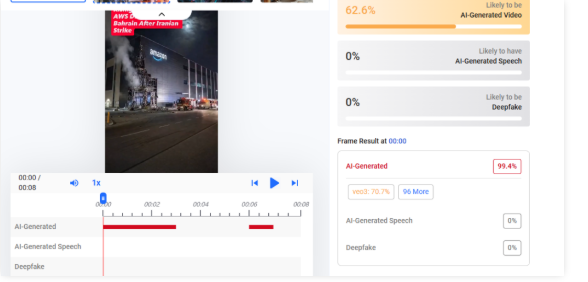
To verify the claim, we extracted multiple keyframes from the viral video and conducted a reverse image search using Google. However, we did not find any credible sources or reports featuring this specific footage. This raised suspicion about the authenticity of the video. We then analyzed it using the AI detection tool Hive Moderation, which indicated a 63% probability that the video is AI-generated.
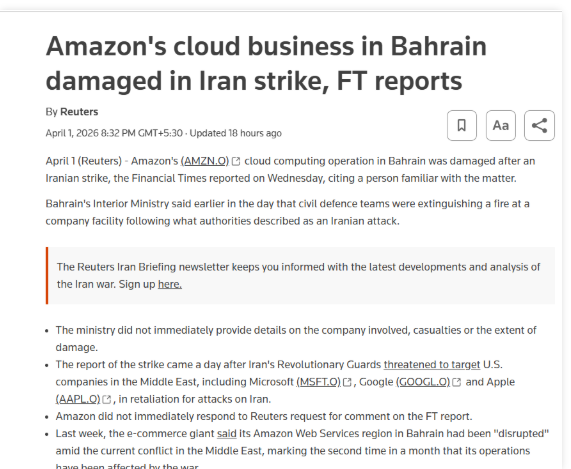
According to a report published by Reuters on April 1, 2026, Iran launched a missile attack targeting Amazon’s cloud computing operations in Bahrain. The Islamic Revolutionary Guard Corps (IRGC) had earlier warned that U.S.-linked companies in the Middle East—including Microsoft, Google, and Apple—could be targeted.
Conclusion
Our research found that while there are credible reports confirming an Iranian attack on cloud infrastructure linked to Amazon in Bahrain, the viral video circulating on social media does not depict the real incident. The footage shows no presence in verified news coverage and has been flagged by AI detection tools as likely artificial. Therefore, the video is AI-generated and misleadingly linked to the incident.

Introduction
Global cybersecurity spending is expected to breach USD 210 billion in 2025, a ~10% increase from 2024 (Gartner). This is a result of an evolving and increasingly critical threat landscape enabled by factors such as the proliferation of IoT devices, the adoption of cloud networks, and the increasing size of the internet itself. Yet, breaches, misuse, and resistance persist. In 2025, global attack pressure rose ~21% Y-o-Y ( Q2 averages) (CheckPoint) and confirmed breaches climbed ~15%( Verizon DBIR). This means that rising investment in cybersecurity may not be yielding proportionate reductions in risk. But while mechanisms to strengthen technical defences and regulatory frameworks are constantly evolving, the social element of trust and how to embed it into cybersecurity systems remain largely overlooked.
Human Error and Digital Trust (Individual Trust)
Human error is consistently recognised as the weakest link in cybersecurity. While campaigns focusing on phishing prevention, urging password updates and using two-factor authentication (2FA) exist, relying solely on awareness measures to address human error in cyberspace is like putting a Band-Aid on a bullet wound. Rather, it needs to be examined through the lens of digital trust. As Chui (2022) notes, digital trust rests on security, dependability, integrity, and authenticity. These factors determine whether users comply with cybersecurity protocols. When people view rules as opaque, inconvenient, or imposed without accountability, they are more likely to cut corners, which creates vulnerabilities. Therefore, building digital trust means shifting from blaming people to design: embedding transparency, usability, and shared responsibility towards a culture of cybersecurity so that users are incentivised to make secure choices.
Organisational Trust and Insider Threats (Institutional Trust)
At the organisational level, compliance with cybersecurity protocols is significantly tied to whether employees trust employers/platforms to safeguard their data and treat them with integrity. Insider threats, stemming from both malicious and non-malicious actors, account for nearly 60% of all corporate breaches (Verizon DBIR 2024). A lack of trust in leadership may cause employees to feel disengaged or even act maliciously. Further, a 2022 study by Harvard Business Review finds that adhering to cybersecurity protocols adds to employee workload. When they are perceived as hindering productivity, employees are more likely to intentionally violate these protocols. The stress of working under surveillance systems that feel cumbersome or unreasonable, especially when working remotely, also reduces employee trust and, hence, compliance.
Trust, Inequality, and Vulnerability (Structural Trust)
Cyberspace encompasses a social system of its own since it involves patterned interactions and relationships between human beings. It also reproduces the social structures and resultant vulnerabilities of the physical world. As a result, different sections of society place varying levels of trust in digital systems. Women, rural, and marginalised groups often distrust existing digital security provisions more, and with reason. They are targeted disproportionately by cyber attackers, and yet are underprotected by systems, since these are designed prioritising urban/ male/ elite users. This leads to citizens adopting workarounds like password sharing for “safety” and disengaging from cyber safety discourse, as they find existing systems inaccessible or irrelevant to their realities. Cybersecurity governance that ignores these divides deepens exclusion and mistrust.
Laws and Compliances (Regulatory Trust)
Cybersecurity governance is operationalised in the form of laws, rules, and guidelines. However, these may often backfire due to inadequate design, reducing overall trust in governance mechanisms. For example, CERT-In’s mandate to report breaches within six hours of “noticing” it has been criticised as the steep timeframe being insufficient to generate an effective breach analysis report. Further, the multiplicity of regulatory frameworks in cross-border interactions can be costly and lead to compliance fatigue for organisations. Such factors can undermine organisational and user trust in the regulation’s ability to protect them from cyber attacks, fuelling a check-box-ticking culture for cybersecurity.
Conclusion
Cybersecurity is addressed primarily through code, firewall, and compliance today. But evidence suggests that technological and regulatory fixes, while essential, are insufficient to guarantee secure behaviour and resilient systems. Without trust in institutions, technologies, laws or each other, cybersecurity governance will remain a cat-and-mouse game. Building a trust-based architecture requires mechanisms to improve accountability, reliability, and transparency. It requires participatory designs of security systems and the recognition of unequal vulnerabilities. Thus, unless cybersecurity governance acknowledges that cyberspace is deeply social, investment may not be able to prevent the harms it seeks to curb.
References
- https://www.gartner.com/en/newsroom/press-releases/2025-07-29
- https://blog.checkpoint.com/research/global-cyber-attacks-surge-21-in-q2-2025
- https://www.verizon.com/business/resources/reports/2024-dbir-executive-summary.pdf
- https://www.verizon.com/business/resources/reports/2025-dbir-executive-summary.pdf
- https://insights2techinfo.com/wp-content/uploads/2023/08/Building-Digital-Trust-Challenges-and-Strategies-in-Cybersecurity.pdf
- https://www.coe.int/en/web/cyberviolence/cyberviolence-against-women
- https://www.upguard.com/blog/indias-6-hour-data-breach-reporting-rule

Introduction:
Technology has become a vital part of everyone’s life nowadays, it occupies essential activities of a person’s life whether we are working or playing and studying. I would say from education to corporate, technology makes everything easier and simpler to achieve the goals for a particular thing. Corporate companies are using technology for their day-to-day work and there are many law-based foundations that are publishing blogs and papers for legal awareness, many lawyers use internet technology for promoting themselves which amounts to growth in their work. Some legal work can now be done by machines, which was previously unthinkable. Large disputes frequently have many documents to review. Armies of young lawyers and paralegals are typically assigned to review these documents. This work can be done by a properly trained machine. Machine drafting of documents is also gaining popularity. We’ve also seen systems that can forecast the outcome of a dispute. We are starting to see machines take on many tasks that we once thought was solely the domain of lawyers.
How to expand law firms and the corporate world with the help of technology?
If we talk about how lawyers’ lives will be impacted by technology then I would explain about law students first. Students are the one who is utilizing the technology at its best for their work, tech could be helpful in students’ lives. as law students use SCC online and manupatra, which are used for case laws. And during their law internships, they use it to help their seniors to find appropriate cases for them. and use it as well for their college research work. SCC and manupatra are very big platforms by which we can say if students use technology for their careers, it will impact their law career in the best ways.
A lawyer running a law firm is not a small task, and there are plenty of obstacles to that, such as a lack of tech solutions, failure to fulfil demands, and inability to innovate, these obstacles prevent the growth of some firms. The right legal tech can grow an organization or a law firm and there will be fewer obstacles.
Technology can be proven as a good mechanism to grow the law firm, as everything depends on tech, from court work to corporate. If we talk about covid during 2020, everything shifted towards the virtual world, court hearings switched to online mode due to covid which proved as a bone to the legal system as the case hearings were speedy and there was no physical contact due to that.
Legal automation is also helping law firms to grow in a competitive world. And it has other benefits also like shifting tedious tasks from humans to machines, allowing the lawyer to work on more valuable work. I would say that small firms should also need to embrace automation for competition in the corporate sector. Today, artificial intelligence offers a solution to solve or at least make the access-to-justice issue better and completely transform our traditional legal system.
There was a world-cited author, Richard Susskind, OBE, who talked about the future of law and lawyers and he wrote a book, Online Courts and the Future of Justice. Richard argues that technology is going to bring about a fascinating decade of change in the legal sector and transform our court system. Although automating our old ways of working plays a part in this, even more, critical is that artificial intelligence and technology will help give more individuals access to justice.
The rise of big data has also resulted in rapid identification systems, which allow police officers to quickly see an individual’s criminal history through a simple search.The FBI’s Next Generation Identification (NGI) system matches individuals with their criminal history information using biometrics such as fingerprints, palm prints, iris recognition, and facial recognition. The NGI’s current technologies are constantly being updated, and new ones are being added, to make the NGI the most comprehensive way to gather up-to-date information on the person being examined
During covid, there were e-courts services in courts, and lawyers and judges were taking cases online. After the covid, the use of technology increased in the law field also from litigation to corporate. As technology can also safeguard confidential information between parties and lawyers. There was ODR, (online dispute resolution) happening meetings that were taking place online mode.
File sharing is inevitable in the practice of law. Yet sometimes the most common ways of sharing (think email) are not always the most secure. With the remote office, the boom has come an increased need for alternate file-sharing solutions. There is data encryption to protect data as it is a reliable method to protect confidential data and information.
Conclusion-
Technology has been playing a vital role in the legal industry and has increased the efficiency of legal offices and the productivity of clerical workers. With the advent of legal tech, there is greater transparency between legal firms and clients. Clients know how many fees they must pay and can keep track of the day-to-day progress of the lawyer on their case. Also, there is no doubt that technology, if used correctly, is fast and efficient – more than any human individual. This can prove to be of great assistance to any law firm. Lawyers of the future will be the ones who create the systems that will solve their client’s problems. These legal professionals will include legal knowledge engineers, legal risk managers, system developers, design thinking experts, and others. These people will use technology to create new ways of solving legal problems. In many ways, the legal sector is experiencing the same digitization that other industries have, and because it is so document-intensive, it is actually an industry that stands to benefit greatly from what technology has to offer.
