
#FactCheck: Old Odesa Footage Falsely Linked to Recent Iran-US Military Conflict
Executive Summary
A video has recently gone viral on social media, with claims that it shows Iranian air defence systems intercepting attacks by US fighter jets. The video is being widely shared across various social media platforms, linking it to the ongoing military tensions between Iran and the United States. CyberPeace’s research found the viral claim to be misleading. The research revealed that the video is old and has no connection with the ongoing war between Iran and the US or any recent military action.
Claim:
A video shared on the social media platform X claims that Iranian air defence systems are responding to an attack by US aircraft.
https://x.com/tvir_X/status/2095185048567968013?s=20

Factcheck
As part of our research, we conducted a reverse image search of the keyframes from the viral video. During the search, we found the same video on The Sun’s YouTube channel, where it was published on November 16, 2024. According to the video’s description, the incident took place in Odesa, Ukraine, where Ukrainian air defence systems engaged in a heavy confrontation with Russian drones. The descr
https://www.youtube.com/watch?v=TxECQr27wng

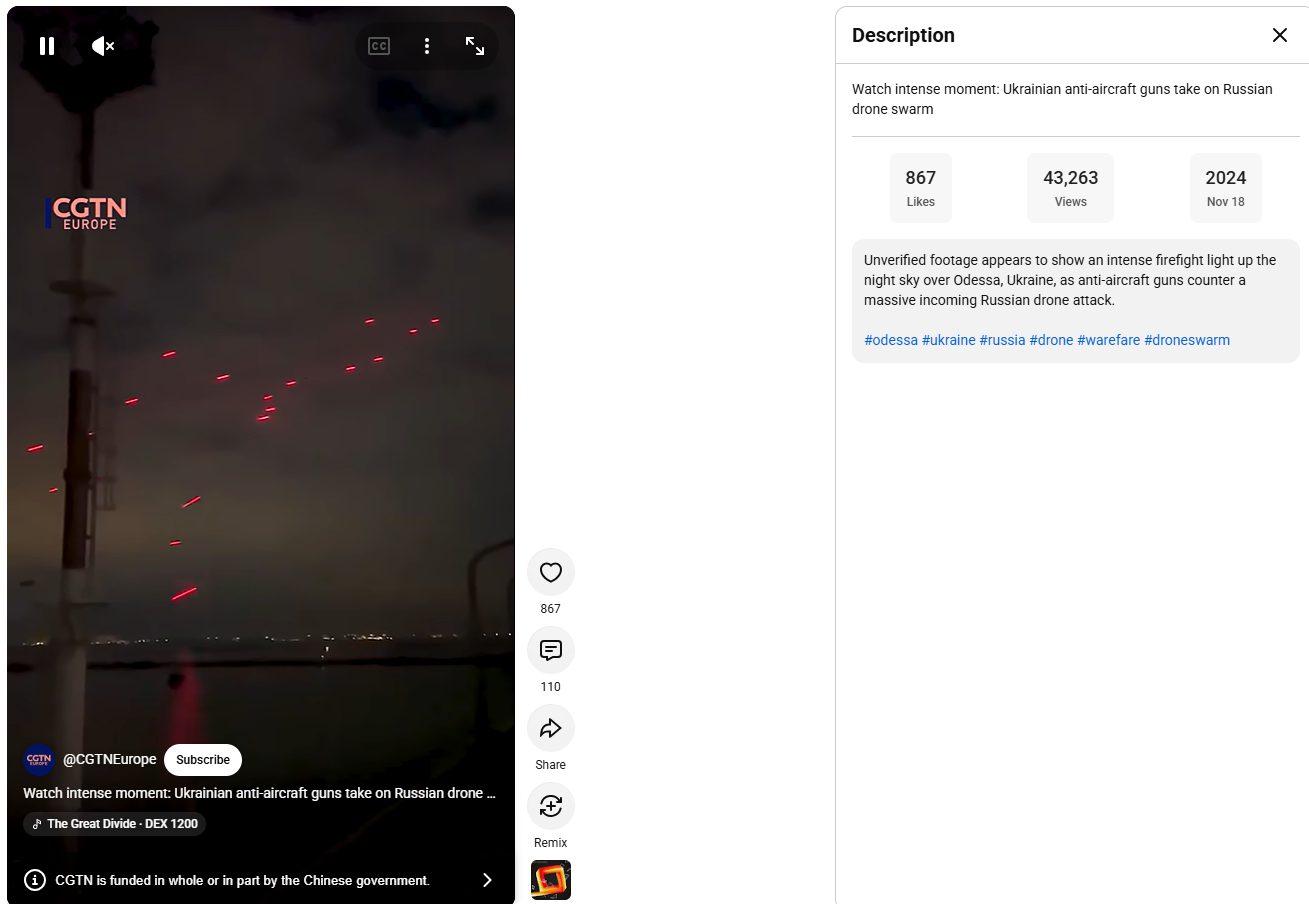
As part of our research, we found the video on the CGTN Europe YouTube channel, where it was published on November 18, 2024.The unverified footage appears to show heavy gunfire lighting up the night sky over Odesa, Ukraine. It is claimed that anti-aircraft guns were fired in response to a Russian drone attack.
https://www.youtube.com/shorts/Hq5P-UoPNHc
Conclusion:
The evidence gathered during our research makes it clear that the video circulating on social media is not related to the ongoing military tensions or any recent military action between Iran and the United States. A reverse image search revealed that the same video was published in November 2024. According to the video’s description, it shows Ukrainian air defence systems responding to a Russian drone attack in Odesa, Ukraine. Therefore, the claim that the viral video shows Iranian air defence systems intercepting attacks by US fighter jets is misleading.

Related Blogs

Executive Summary:
False information spread on social media that Flight Lieutenant Shivangi Singh, India’s first female Rafale pilot, had been captured by Pakistan during “Operation Sindoor”. The allegations are untrue and baseless as no credible or official confirmation supports the claim, and Singh is confirmed to be safe and actively serving. The rumor, likely originating from unverified sources, sparked public concern and underscored the serious threat fake news poses to national security.
Claim:
An X user posted stating that “ Initial image released of a female Indian Shivani singh Rafale pilot shot down in Pakistan”. It was falsely claimed that Flight Lieutenant Shivangi Singh had been captured, and that the Rafale aircraft was shot down by Pakistan.


Fact Check:
After doing reverse image search, we found an instagram post stating the two Indian Air Force pilots—Wing Commander Tejpal (50) and trainee Bhoomika (28)—who had ejected from a Kiran Jet Trainer during a routine training sortie from Bengaluru before it crashed near Bhogapuram village in Karnataka. The aircraft exploded upon impact, but both pilots were later found alive, though injured and exhausted.

Also we found a youtube channel which is showing the video from the past and not what it was claimed to be.

Conclusion:
The false claims about Flight Lieutenant Shivangi Singh being captured by Pakistan and her Rafale jet being shot down have been debunked. The image used was unrelated and showed IAF pilots from a separate training incident. Several media also confirmed that its video made no mention of Ms. Singh’s arrest. This highlights the dangers of misinformation, especially concerning national security. Verifying facts through credible sources and avoiding the spread of unverified content is essential to maintain public trust and protect the reputation of those serving in the armed forces.
- Claim: False claims about Flight Lieutenant Shivangi Singh being captured by Pakistan and her Rafale jet being shot down
- Claimed On: Social Media
- Fact Check: False and Misleading

Introduction
The Supreme Court of India recently ruled that telecom companies cannot be debarred from reissuing the deactivated numbers to a new subscriber. Notably, such reallocation of deactivated numbers is allowed only after the expiration of the period of 90 days. The Apex Court of India also mentioned that it is the responsibility of the user to delete their associated data with their number or any WhatsApp account data to ensure privacy. The Centre has recently also blocked 22 apps which were part of unlawful operations including betting and money laundering. Meanwhile, in the digital landscape, the Intervention of legislature and judiciary is playing a key role in framing policies or coming up with guidelines advocating for a true cyber-safe India. The government initiatives are encouraging the responsible use of technologies and Internet-availed services.
Supreme Court stated that telecom companies cannot be barred from reissuing deactivated numbers
Taking note of a petition before the Supreme Court of India, seeking direction from the Telecom Regulatory Authority of India (TRAI) to instruct mobile service providers to stop issuing deactivated mobile numbers, the Apex Court dismissed it by stating that mobile service providers in India are allowed to allocate the deactivated numbers to new users or subscribers but only after 90 days from the deactivation of the number.
A concern of Breach of Confidential Data
The Court further stated, “It is for the earlier subscriber to take adequate steps to ensure that privacy is maintained.” stating that it is the responsibility of the user to delete their WhatsApp account attached to the previous phone number and erase their data. The Court further added that users need to be aware of the Supreme Court ruling that once the number is deactivated for non-use and disconnection, it can not be reallocated before the expiry of the 90-day period of such deactivation. However, after the allotted time passes, such reallocation of numbers to a new user is allowed.
MEITY issued blocking orders against 22 illegal betting apps & websites
The government of India has been very critical in safeguarding Indian cyberspace by banning and blocking various websites and apps that have been operating illegally by scamming/dupping people of huge sums of money and also committing cyber crimes like data breaches. In recent developments, the Ministry of Electronic and Information Technology (Meity), on November 5, 2023, banned 22 apps including Mahadev Book and Reddyannaprestopro. The Centre has taken this decision on recommendations from the Enforcement Directorate (ED). ED raids on the Mahadev book app in Chattisgarh also revealed unlawful operations. This investigation has been underway for the past few months by the ED.
Applicable laws to prevent money laundering and the power of government to block such websites and apps
On the other hand, the Prevention of Money Laundering Act (PMLA) 2002 is a legislation already in place which aims to prevent and prosecute cases of money laundering. The government also has the power to block or recommend shutting down websites and apps under section 69A of the Information and Technology Act, 2000, under some specific condition as enumerated in the same.
Conclusion
In the evolving digital landscape, cyberspace covers several aspects while certain regulations or guidelines are required for smooth and secure functioning. We sometimes change our phone numbers or deactivate them, hence, it is significantly important to delete the data associated with the phone number or any such social media account data attached to it. Hence, such a number is eligible for reallocation to a new or early subscriber after the expiration of a period of 90 days from such deactivation. On the other hand, the centre has also blocked the websites or apps that were found to be part of illegal operations including betting and money laundering. Users have also been advised not to misuse the Internet-availed services. Hence, trying to create a lawful and safe Internet environment for all.
References:
- https://timesofindia.indiatimes.com/india/cant-bar-telecom-companies-from-reissuing-deactivated-numbers-says-supreme-court/articleshow/104993401.cms
- https://pib.gov.in/PressReleseDetailm.aspx?PRID=1974901#:~:text=Ministry%20of%20Electronics%20and%20Information,including%20Mahadev%20Book%20and%20Reddyannaprestopro

Recent Incidents:
Recent reports are revealing a significant security threat linked to a new infostealer based malware campaign known to solely target gaming accounts. This attack has affected users of Activision and other gaming websites. The sophisticated software has captured millions of login credentials, notably from the cheats and players. The officials at Activision Blizzard, an American video game holding company, are still investigating the matter and collaborating with cheated developers to minimize the impact and inform the accounts’ residents of appropriate safety measures.
Overview:
Infostealer, also known as information stealer, is a type of malware designed in the form of a Trojan virus for stealing private data from the infected system. It can have a variety of incarnations and collect user data of various types such as browser history, passwords, credit card numbers, and login details and credentials to social media, gaming platforms, bank accounts, and other websites. Bad actors use the log obtained as a result of the collection of personal records to access the victim’s financial accounts, appropriate the victim’s online identity, and perform fraudulent actions on behalf of the victim.
Modus Operandi:
- Infostealer is a malicious program created to illegally obtain people's login details, like usernames and passwords. Its goal is to enable cyberattacks, sell on dark web markets, or pursue malicious aims.
- This malware targets both personal devices and corporate systems. It spreads through methods like phishing emails, harmful websites, and infected public sites.
- Once inside a device, Infostealer secretly gathers sensitive data like passwords, account details, and personal information. It's designed to infiltrate systems being undetected. The stolen credentials are compiled into datalogs. These logs are then sold illegally on dark web marketplaces for profit.
Analysis:


Basic properties:
- MD5: 06f53d457c530635b34aef0f04c59c7d
- SHA-1: 7e30c3aee2e4398ddd860d962e787e1261be38fb
- SHA-256: aeecc65ac8f0f6e10e95a898b60b43bf6ba9e2c0f92161956b1725d68482721d
- Vhash: 145076655d155515755az4e?z4
- Authentihash: 65b5ecd5bca01a9a4bf60ea4b88727e9e0c16b502221d5565ae8113f9ad2f878
- Imphash: f4a69846ab44cc1bedeea23e3b680256
- Rich PE header hash: ba3da6e3c461234831bf6d4a6d8c8bff
- SSDEEP: 6144:YcdXHqXTdlR/YXA6eV3E9MsnhMuO7ZStApGJiZcX8aVEKn3js7/FQAMyzSzdyBk8:YIKXd/UgGXS5U+SzdjTnE3V
- TLSH:T1E1B4CF8E679653EAC472823DCC232595E364FB009267875AC25702D3EFBB3D56C29F90
- File type: Win32 DLL executable windows win32 pepe dll
- Magic: PE32+ executable (DLL) (GUI) x86-64, for MS Windows
- File size: 483.50 KB (495104 bytes)
Additional Hash Files:
- 160389696ed7f37f164f1947eda00830
- 229a758e232aeb49196c862655797e12
- 23e4ac5e7db3d5a898ea32d27e8b7661
- 3440cced6ec7ab38c6892a17fd368cf8
- 36d7da7306241979b17ca14a6c060b92
- 38d2264ff74123f3113f8617fabc49f6
- 3c5c693ba9b161fa1c1c67390ff22c96
- 3e0fe537124e6154233aec156652a675
- 4571090142554923f9a248cb9716a1ae
- 4e63f63074eb85e722b7795ec78aeaa3
- 63dd2d927adce034879b114d209b23de
- 642aa70b188eb7e76273130246419f1d
- 6ab9c636fb721e00b00098b476c49d19
- 71b4de8b5a1c5a973d8c23a20469d4ec
- 736ce04f4c8f92bda327c69bb55ed2fc
- 7acfddc5dfd745cc310e6919513a4158
- 7d96d4b8548693077f79bc18b0f9ef21
- 8737c4dc92bd72805b8eaf9f0ddcc696
- 9b9ff0d65523923a70acc5b24de1921f
- 9f7c1fffd565cb475bbe963aafab77ff
Indicators of Compromise:
- Unusual Outbound Network Traffic: An increase in odd or questionable outbound network traffic may be a sign that infostealer malware has accessed more data.
- Anomalies in Privileged User Account Activity: Unusual behavior or illegal access are two examples of irregular actions that might indicate a breach in privileged user accounts.
- Suspicious Registry or System File Changes: Infostealer malware may be trying to alter system settings if there are any unexpected changes to system files, registry settings, or configurations.
- Unusual DNS queries: When communicating with command and control servers or rerouting traffic, infostealer malware may produce strange DNS queries.
- Unexpected System Patching: Unexpected or unauthorized system patching by unidentified parties may indicate that infostealer malware has compromised the system and is trying to hide its footprint or become persistent.
- Phishing emails and social engineering attempts: It is a popular strategy employed by cybercriminals to get confidential data or implant malicious software. To avoid compromise, it is crucial to be wary of dubious communications and attempts of social engineering.
Recommendations:
- Be Vigilant: In today's digital world, many cybercrimes threaten online safety, Phishing tricks, fake web pages, and bad links pose real dangers. Carefully check email sources. Examine websites closely. Use top security programs. Follow safe browsing rules. Update software often. Share safety tips. These steps reduce risks. They help keep your online presence secure.
- Regular use of Anti-Virus Software to detect the threats: Antivirus tools are vital for finding and stopping cyber threats. These programs use signature detection and behavior analysis to identify known malicious code and suspicious activities. Updating virus definitions and software-patches regularly, improves their ability to detect new threats. This helps maintain system security and data integrity.
- Provide security related training to the employees and common employees: One should learn Cybersecurity and the best practices in order to keep the office safe. Common workers will get lessons on spotting risks and responding well, creating an environment of caution.
- Keep changing passwords: Passwords should be changed frequently for better security. Rotating passwords often makes it harder for cyber criminals to compromise and make it happen or confidential data to be stolen. This practice keeps intruders out and shields sensitive intel.
Conclusion:
To conclude, to reduce the impact and including the safety measures, further investigations and collaboration are already in the pipeline regarding the recent malicious software that takes advantage of gamers and has stated that about millions of credentials users have been compromised. To protect sensitive data, continued usage of antivirus software, use of trusted materials and password changes are the key elements. The ways to decrease risks and safely protect sensitive information are to develop improved Cybersecurity methods such as multi-factor authentication and the conduct of security audits frequently. Be safe and be vigilant.
Reference:
- https://techcrunch.com/2024/03/28/activision-says-its-investigating-password-stealing-malware-targeting-game-players/
- https://www.bleepingcomputer.com/news/security/activision-enable-2fa-to-secure-accounts-recently-stolen-by-malware/
- https://cyber.vumetric.com/security-news/2024/03/29/activision-enable-2fa-to-secure-accounts-recently-stolen-by-malware/
- https://www.virustotal.com/
- https://otx.alienvault.com/
