
#FactCheck- Viral video of fighter jet striking dam falsely linked to alleged Israeli attack on Iran; actually AI-generated content
Executive Summary
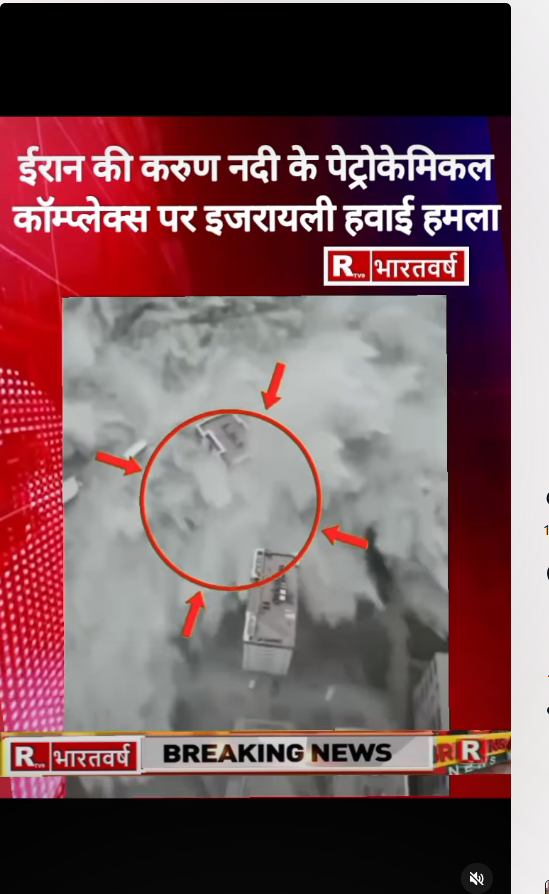
Amid escalating tensions between Iran and Israel, a video showing a fighter jet launching a missile at a massive dam, followed by its collapse and widespread flooding, is being widely shared on social media. Users are claiming that the video depicts a recent Israeli airstrike on a petrochemical plant located along Iran’s Karun River. CyberPeace Research Wing research found that the viral claim is false. The video is not related to any real-world incident and has been generated using artificial intelligence (AI).
Claim:
An Instagram user shared the viral video with a caption claiming that Israel carried out an airstrike on a petrochemical complex along Iran’s Karun River. The post further suggested that the facility is a key industrial site and that the attack caused widespread panic in the region. Post link:
https://www.instagram.com/reels/DZhNuiRx_v1/
https://www.instagram.com/reels/DZhNuiRx_v1/
Fact Check:
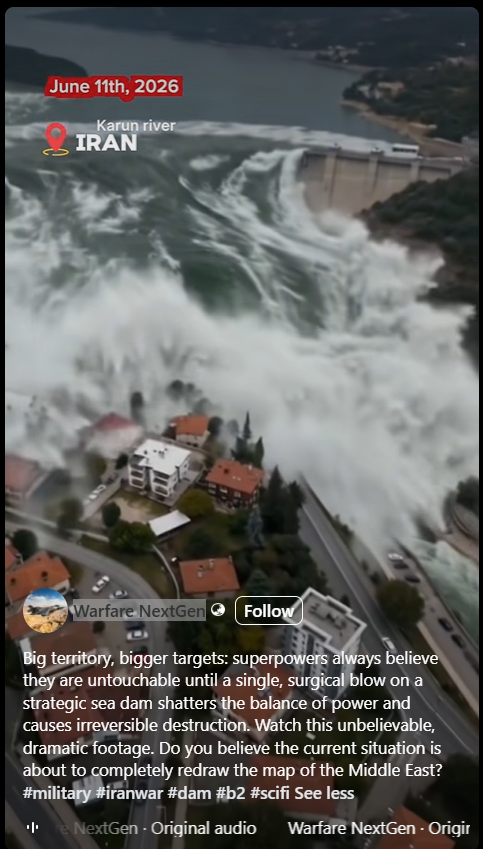
A reverse image search of keyframes from the video led to its appearance on a Facebook page named Warfare NextGen. The page clearly described the footage as “dramatic content,” indicating that it is not a real incident.
https://www.facebook.com/reel/1027249019882257
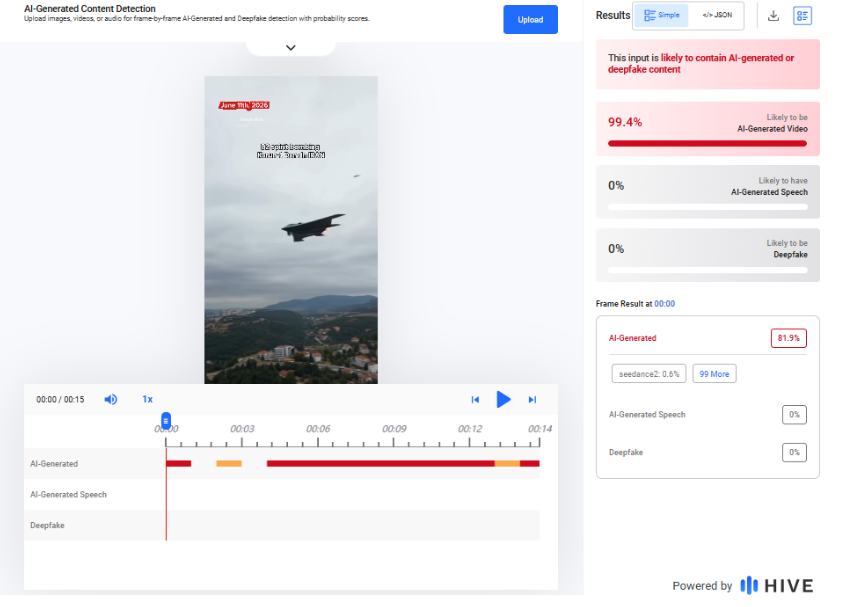
A closer analysis of the visuals also revealed several inconsistencies that raise doubts about its authenticity. To further verify the video, it was analyzed using the AI detection tool Hive Moderation, which indicated a 99.4% probability that the content is AI-generated.
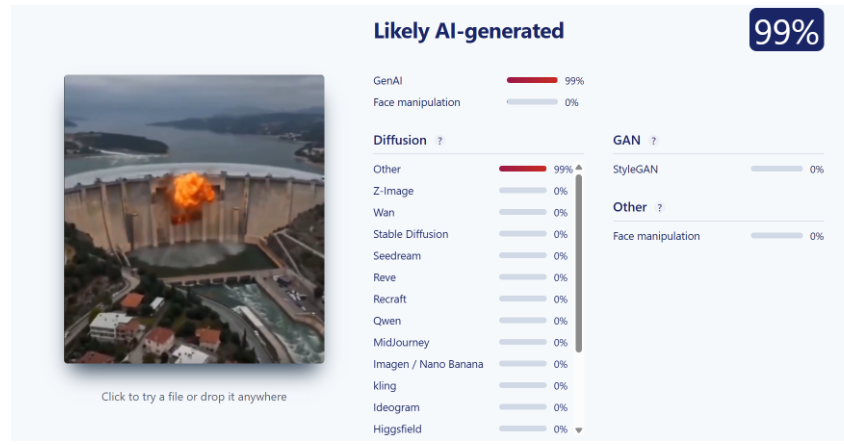
Additionally, a separate analysis using SIGHTENGINE also classified the video as approximately 99% AI-generated.
Conclusion:
The research confirms that the viral video is not a real incident. It has been created using artificial intelligence and is being falsely shared as a depiction of an Israeli strike on a petrochemical plant along Iran’s Karun River.

Related Blogs

Introduction
The Indian Computer Emergency Response Team, CERT-In, is the national statutory agency that responds to Cybersecurity Incidents under the Ministry of Electronics and Information Technology (MeitY) of the Government of India. CERT-In and Information Sharing and Analysis Center (ISAC) have joined hands to develop a focused pool of Cybersecurity Leaders through the National Cyber Security Scholar Program (NCSSP). This National Cyber Security Scholar Program is to create a pool of credible and ethical cybersecurity leaders in the country who prioritise national cyber security in their professional endeavours. This program allows both organisations to jointly issue joint certifications for Cohort 6 of the National Cyber Security Scholar Program (NCSSP). This certification is provided to cybersecurity professionals who complete one of the world’s leading cybersecurity management programs.
About the Program
The National Cybersecurity Scholar (NCSS) is a comprehensive 18-week, 160-hour Instructor-led program for emerging cybersecurity leaders. The ISAC will conduct the program with CERT-IN and KDEM as knowledge partners. This Cyber Security Scholar program aims to provide an extraordinary opportunity, for scholars, to gain hands-on experience in real-world scenarios through activities such as war games. It will allow scholars to acquaint themselves with roles such as that of stakeholders, including attackers, Security Operations Centre (SOC) teams, Forensicators, Chief Information Security Officers (CISOs), and CEOs, and engage in tabletop exercises that simulate a cyber crisis. This program would allow scholars to understand how responses to cyber crises impact the financial performance of an organisation, including, stock prices and sales. It offers a treasure trove of insights into the economic impact of cybersecurity decisions and the importance of proactive risk management.
The program invites applications from various scholars including Mid to senior-level leaders, diplomats and diplomatic corps officers, mid to senior-level government officials involved in homeland and cybersecurity operations, experienced executives from Managed Security Services Providers (MSSPs), faculty members who specialise in new and emerging technologies, cybersecurity professionals in CII sectors and post-doctoral or research scholars in cybersecurity.
CyberPeace Outlook
The National Cyber Security Scholar Program subsumes several key dimensions working towards building a resilient cybersecurity ecosystem for India.
- The program focuses on skill development and enhancing scholars’ knowledge in domains of network security, ethical hacking, cyber forensics, incident response, malware analysis, and threat intelligence.
- The partnership between CERT-In and ISAC, government and Industry entities, ensures that scholars are exposed to different policy-level frameworks and technical expertise, offering a unique blend of perspectives that cater to the country's national security goals and industry best practices.
- The scholar program encourages the development of new methodologies, tools, and frameworks that could be instrumental in tackling future cyber challenges and advancing India's position as a global leader in cybersecurity research and development. Research and innovation in cybersecurity are critical to the program.
- It plays a significant role in providing opportunities for career development by further providing networking platforms with professionals, researchers, and thought leaders in the cybersecurity field, giving them exposure to internships, job placements, and further academic pursuits.
This program aims to support upskilling India’s broader cyber defence strategy through the creation of highly skilled professionals. The scholars are expected to contribute actively to national cybersecurity efforts, whether through roles in government, private sector, or academia, helping to create a more secure and resilient cyberspace. The National Cyber Security Scholar Program is a major advancement in strengthening cybersecurity resilience in India. In a digital world where cyber threats crossing boundaries, such programs are essential for maintaining our national security and economic stability.
References
- https://theprint.in/ani-press-releases/cert-in-and-isac-collaborate-to-develop-focussed-pool-of-cybersecurity-leaders-through-the-national-cyber-security-scholar-program-ncssp/2318021/
- https://isacfoundation.org/national-cyber-security-scholar/
- https://cyberversefoundation.org/national-cyber-security-scholar/
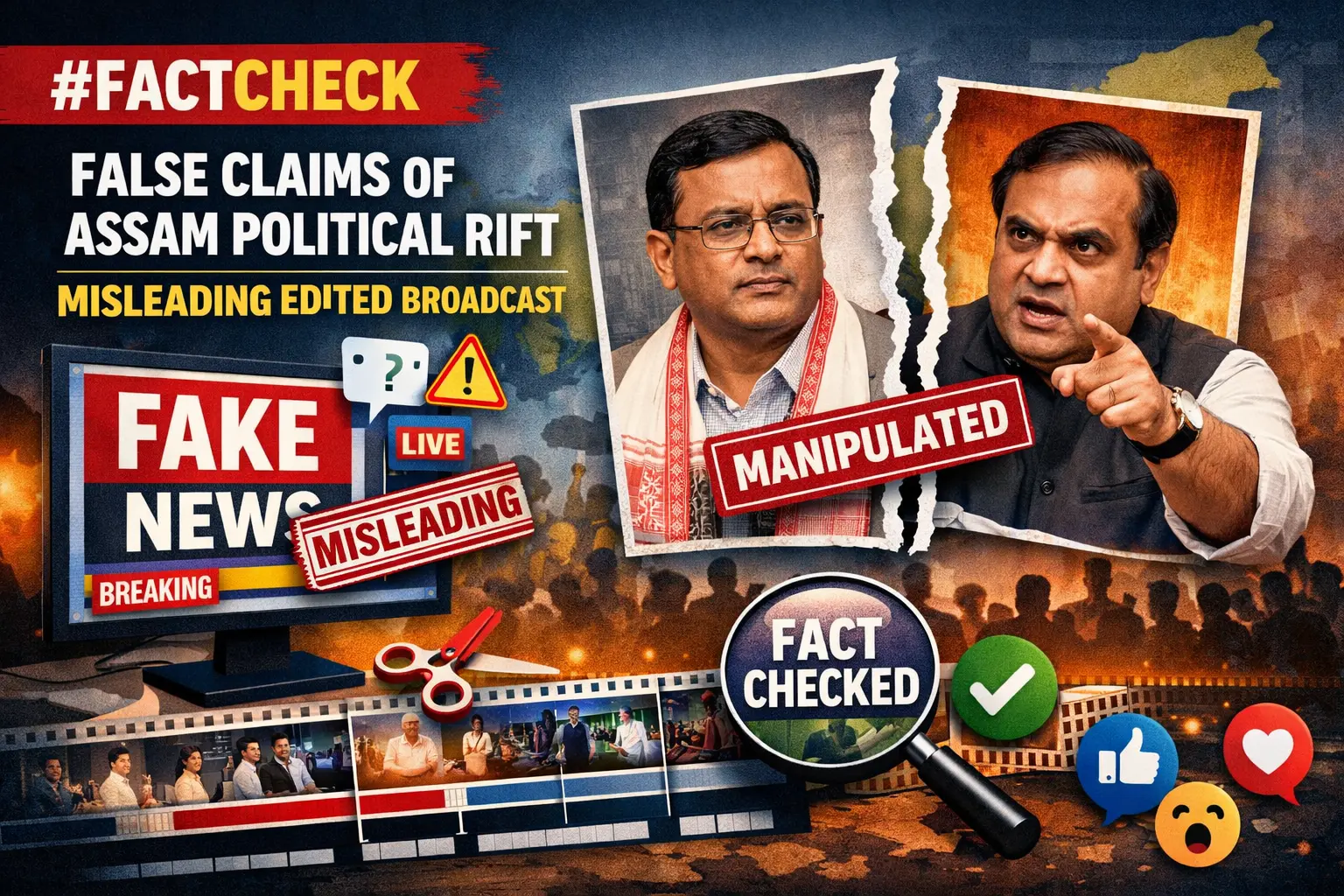
Executive Summary:
A video from an India TV news show related to the Assam elections is going viral on social media. In the clip, anchor Meenakshi Joshi is allegedly seen claiming that there is a rift between the BJP and the RSS in Assam. The video further suggests that RSS chief Mohan Bhagwat wrote a letter to Prime Minister Narendra Modi stating that former Congress members have taken over the BJP, and that RSS volunteers would not work for the party in Assam. However, a research by the CyberPeace found that the viral video is edited and misleading. The original video contains no such claims.
Claim:
A social media user Ajit Singh shared the video on X with the caption:“The core idea of today’s BJP is to capture power by any means. We have been saying this for long, and now even RSS has accepted that BJP in Assam has been taken over by Congress mindset.”
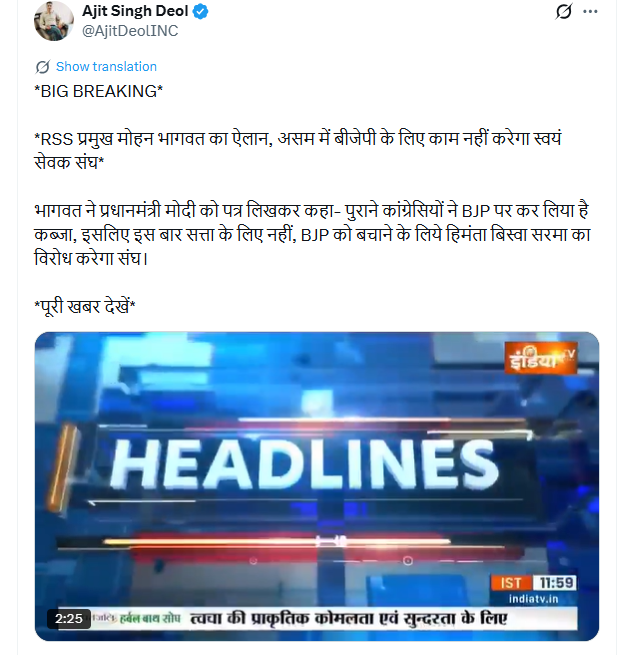
Fact Check:
To verify the claim, we searched relevant keywords about the alleged letter by RSS chief Mohan Bhagwat to Prime Minister Narendra Modi. However, we found no credible media reports supporting this claim. We then checked the YouTube channel of India TV but could not find the viral clip there. During the search, we did find a similar video from Meenakshi Joshi’s show. In the beginning of that video, the portion seen in the viral clip appears.
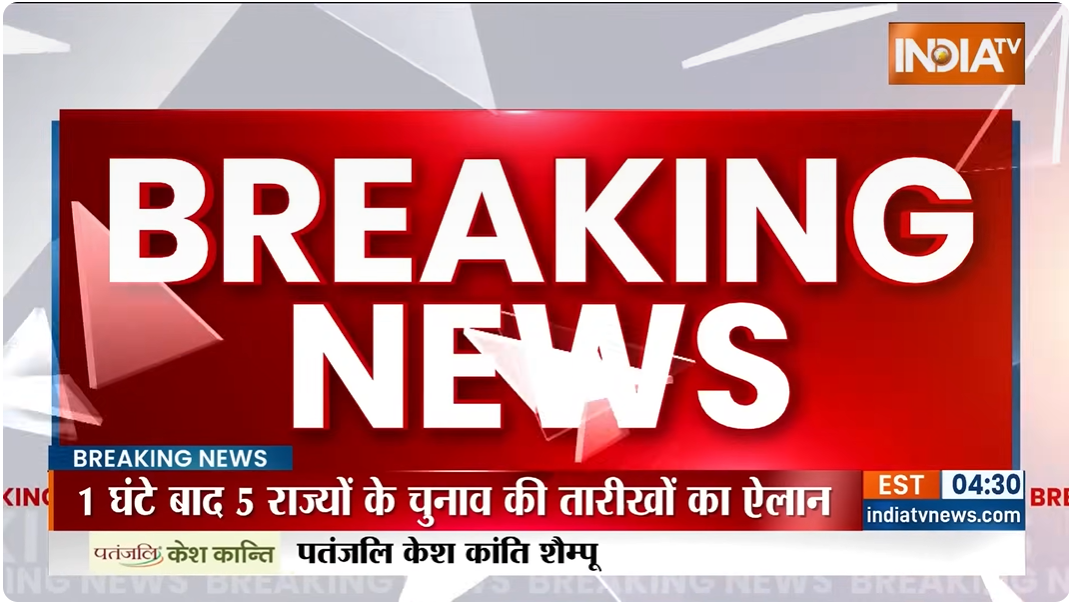
In the original video, the anchor is discussing the announcement of election dates in five states. There is no mention of any rift between the BJP and RSS in Assam.
Conclusion:
The viral India TV video claiming a rift between the BJP and RSS in Assam is edited and misleading. The original broadcast was about election dates in five states and did not include any such claims.
Introduction
The misinformation crisis has evolved from being merely an abstract risk to a clear-cut and measurable danger to individuals, families, institutions and the whole information ecosystem. The recent death hoax with the famous actor Dharmendra is a perfect illustration of how the monster of falsehoods rises, conquers the world and does damage before the mechanisms of correction have a chance to operate. The first week of November 2025 saw the first wave of reports from different social media accounts and even some online news outlets that claimed Dharmendra had died at the age of 89. The news travelled like wildfire, causing confusion, grief and emotional suffering in large circles of fans, one could say the whole world. But then, the family came to the scene with the loudest, clearest, and most conclusive denial of them all. This case is not a one-time event. It is part of a cycle of misinformation that goes through the stages from one unverified claim to the next due to the emotional value, the virality of platforms, and the accelerating online engagement.
How One Wrong Post Can Create Worry and Fear
This kind of false news spreads fast on social media because people share emotional posts without checking the source, and automated accounts often repeat the same claim which makes it look true. Such hoaxes create fear, sadness and stress for fans, and they place sudden pressure on the family who must deal with public worry at a time when they need calm and privacy. The message shared by Hema Malini who is the wife of the actor shows how hurtful and careless misinformation can be, and it reminds everyone that even one false post can create real emotional damage for many people.

Why This Hoax Spread So Quickly
- Sensationalism Drives Engagement: Rumours regarding the passing of a public figure, particularly someone who is universally loved, cause an immediate outburst of feelings. Such news is practically taken for granted by the online public, who are very likely to share it, most of the time without checking its authenticity, which, in turn, leads to viral spread.
- Very Fast Weaving-in on social media: Social media networks are very much made for swift sharing. Long before the official sources were able to either confirm or dismiss the matter, posts, reels, and messages ripped through the networks.
- Digital Users Not Verifying Source: A large part of the audience depends on screenshots, forwards, and unverified posts for keeping up with the news. This opens a very nice environment for the spreading of hoaxes.
- Weak Verification Protocols: Although there have been measures to inform the public about misinformation, most news companies still give priority to the speed of reporting rather than its correctness, though not all the time, especially for the more entertaining and attractive topics like the health or death of famous people.
- Algorithmic Amplification Risks: The engagement is mainly driven by algorithms that bring to the surface the posts that evoke strong emotions. In a way, it is very unfair because the false or sensational claims are getting in front at the same time as the corrective updates, hence, the public is getting misled. In the absence of algorithmic safeguards, misinformation is on the rise and becoming stronger.
Best Practices For Users:
- Make sure to verify before sharing, especially if the topic is about health or death.
- Get updates by following official accounts rather than through sharing of viral forwards.
- Be aware of the emotional manipulation tactics used in misleading information.
Conclusion
The rumour surrounding Dharmendra's death is yet another example that misinformation, whether promptly corrected or not, can still inflict distress, cause loss of trust and damage to reputation. It also emphasises the need for stronger information governance, responsible digital journalism, and platform intervention mechanisms as a matter of urgency. This incident, from clicks to consequences, points to a basic truth: misinformation in the digital age is quicker to spread than facts, and the responsibility of putting a stop to it falls on all the stakeholders’ platforms, media, and users.
References
- https://timesofindia.indiatimes.com/entertainment/hindi/bollywood/news/esha-deol-and-hema-malini-dismiss-dharmendras-fake-death-news-relieved-fans-pray-for-actors-speedy-recovery-aap-jld-se-jld-apne-ghar-aye/articleshow/125242843.cms
- https://www.altnews.in/media-misreport-bollywood-actor-dharmendra-hasnt-passed-away-yet/
- https://economictimes.indiatimes.com/news/india/dharmendra-death-news-bollywoods-veeru-and-he-man-passes-away-at-89/articleshow/125238900.cms
