
#FactCheck- Viral Image of Rescued U.S. Airman in Iran is AI-Generated
Executive Summary
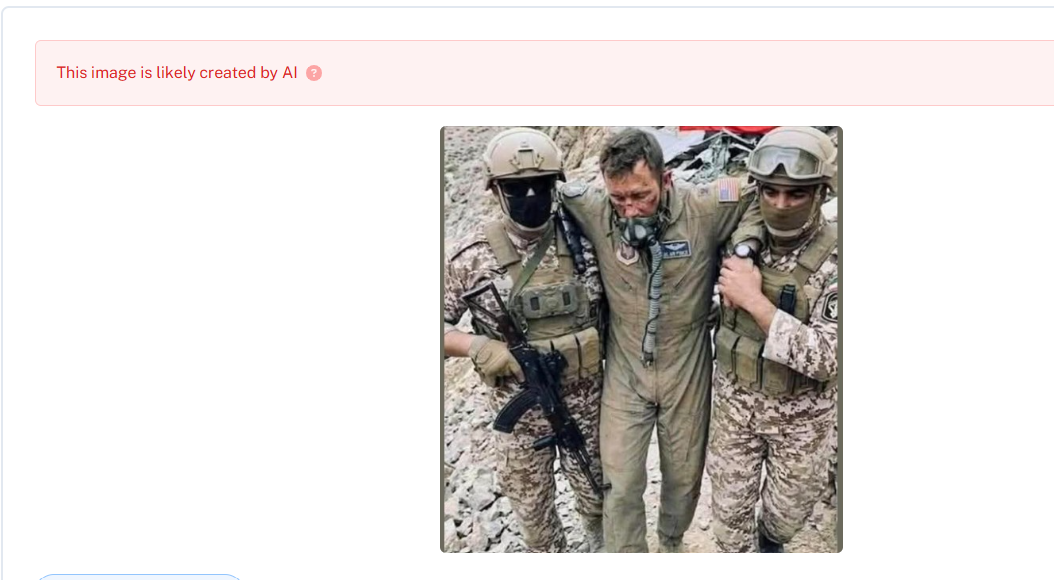
A claim is circulating on social media that the U.S. military successfully rescued a missing crew member of an F-15E fighter jet in Iran. Along with this claim, a photo is being widely shared, allegedly showing the rescued U.S. airman after the high-risk operation. However, researches reveal that the viral image is not authentic and has been generated using artificial intelligence tools.
The Claim
On April 6, 2026, a social media user named “July Gaytan” shared the viral image with the caption: “Here is the photo of the U.S. airman being rescued yesterday in Iran.”
The post quickly gained traction, with many users believing it to be genuine.
- https://www.facebook.com/photo/?fbid=1724007721903888&set=a.116284172676259
- https://perma.cc/URM4-KEJA

Fact Check
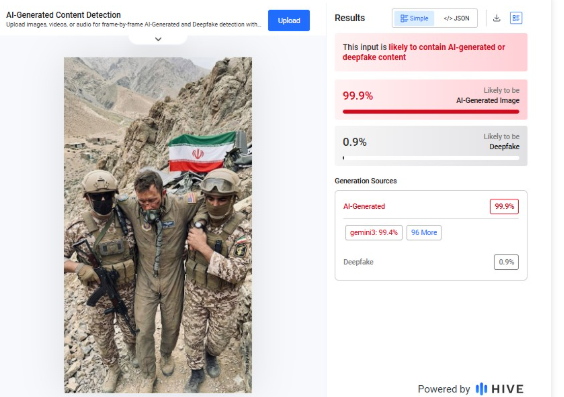
Despite extensive searches, no credible media report or official source has published any real image of the rescued crew members. This raised suspicion about the authenticity of the viral photo. Hive Moderation analysis indicated a 100% probability that the image was generated using Google’s Gemini AI.
A second scan using Undetectable AI also concluded that the image is AI-generated.
Reports indicate that a U.S. Air Force F-15E Strike Eagle was shot down in Iran. The aircraft had two crew members on board: a pilot and a Weapon Systems Officer (WSO).
- The pilot was rescued shortly after the incident.
- The WSO was initially missing and remained inside Iranian territory in an injured condition.
- The U.S. later carried out a high-risk rescue operation and successfully evacuated the WSO from Iran.
U.S. President Donald Trump also confirmed the “brave and risky” rescue mission in a detailed post on his platform, Truth Social. The statement was further shared by the official White House account.
- https://x.com/WhiteHouse/status/2040644451513598220?s=20

Conclusion
The viral image claiming to show a rescued U.S. airman in Iran is not real. It has been created using AI tools, likely Google’s Gemini. While it is true that the U.S. conducted a high-risk operation to rescue the missing crew member, no authentic image of the rescue or the personnel has been publicly released.

Related Blogs

Introduction
The mysteries of the universe have been a subject of curiosity for humans over thousands of years. To solve these unfolding mysteries of the universe, astrophysicists are always busy, and with the growing technology this seems to be achievable. Recently, with the help of Artificial Intelligence (AI), scientists have discovered the depths of the cosmos. AI has revealed the secret equation that properly “weighs” galaxy clusters. This groundbreaking discovery not only sheds light on the formation and behavior of these clusters but also marks a turning point in the investigation and discoveries of new cosmos. Scientists and AI have collaborated to uncover an astounding 430,000 galaxies strewn throughout the cosmos. The large haul includes 30,000 ring galaxies, which are considered the most unusual of all galaxy forms. The discoveries are the first outcomes of the "GALAXY CRUISE" citizen science initiative. They were given by 10,000 volunteers who sifted through data from the Subaru Telescope. After training the AI on 20,000 human-classified galaxies, scientists released it loose on 700,000 galaxies from the Subaru data.
Brief Analysis
A group of astronomers from the National Astronomical Observatory of Japan (NAOJ) have successfully applied AI to ultra-wide field-of-view images captured by the Subaru Telescope. The researchers achieved a high accuracy rate in finding and classifying spiral galaxies, with the technique being used alongside citizen science for future discoveries.
Astronomers are increasingly using AI to analyse and clean raw astronomical images for scientific research. This involves feeding photos of galaxies into neural network algorithms, which can identify patterns in real data more quickly and less prone to error than manual classification. These networks have numerous interconnected nodes and can recognise patterns, with algorithms now 98% accurate in categorising galaxies.
Another application of AI is to explore the nature of the universe, particularly dark matter and dark energy, which make up over 95% energy of the universe. The quantity and changes in these elements have significant implications for everything from galaxy arrangement.
AI is capable of analysing massive amounts of data, as training data for dark matter and energy comes from complex computer simulations. The neural network is fed these findings to learn about the changing parameters of the universe, allowing cosmologists to target the network towards actual data.
These methods are becoming increasingly important as astronomical observatories generate enormous amounts of data. High-resolution photographs of the sky will be produced from over 60 petabytes of raw data by the Vera C. AI-assisted computers are being utilized for this.
Data annotation techniques for training neural networks include simple tagging and more advanced types like image classification, which classify an image to understand it as a whole. More advanced data annotation methods, such as semantic segmentation, involve grouping an image into clusters and giving each cluster a label.
This way, AI is being used for space exploration and is becoming a crucial tool. It also enables the processing and analysis of vast amounts of data. This advanced technology is fostering the understanding of the universe. However, clear policy guidelines and ethical use of technology should be prioritized while harnessing the true potential of contemporary technology.
Policy Recommendation
- Real-Time Data Sharing and Collaboration - Effective policies and frameworks should be established to promote real-time data sharing among astronomers, AI developers and research institutes. Open access to astronomical data should be encouraged to facilitate better innovation and bolster the application of AI in space exploration.
- Ethical AI Use - Proper guidelines and a well-structured ethical framework can facilitate judicious AI use in space exploration. The framework can play a critical role in addressing AI issues pertaining to data privacy, AI Algorithm bias and transparent decision-making processes involving AI-based tech.
- Investing in Research and Development (R&D) in the AI sector - Government and corporate giants should prioritise this opportunity to capitalise on the avenue of AI R&D in the field of space tech and exploration. Such as funding initiatives focusing on developing AI algorithms coded for processing astronomical data, optimising telescope operations and detecting celestial bodies.
- Citizen Science and Public Engagement - Promotion of citizen science initiatives can allow better leverage of AI tools to involve the public in astronomical research. Prominent examples include the SETI @ Home program (Search for Extraterrestrial Intelligence), encouraging better outreach to educate and engage citizens in AI-enabled discovery programs such as the identification of exoplanets, classification of galaxies and discovery of life beyond earth through detecting anomalies in radio waves.
- Education and Training - Training programs should be implemented to educate astronomers in AI techniques and the intricacies of data science. There is a need to foster collaboration between AI experts, data scientists and astronomers to harness the full potential of AI in space exploration.
- Bolster Computing Infrastructure - Authorities should ensure proper computing infrastructure should be implemented to facilitate better application of AI in astronomy. This further calls for greater investment in high-performance computing devices and structures to process large amounts of data and AI modelling to analyze astronomical data.
Conclusion
AI has seen an expansive growth in the field of space exploration. As seen, its multifaceted use cases include discovering new galaxies and classifying celestial objects by analyzing the changing parameters of outer space. Nevertheless, to fully harness its potential, robust policy and regulatory initiatives are required to bolster real-time data sharing not just within the scientific community but also between nations. Policy considerations such as investment in research, promoting citizen scientific initiatives and ensuring education and funding for astronomers. A critical aspect is improving key computing infrastructure, which is crucial for processing the vast amount of data generated by astronomical observatories.
References
- https://mindy-support.com/news-post/astronomers-are-using-ai-to-make-discoveries/
- https://www.space.com/citizen-scientists-artificial-intelligence-galaxy-discovery
- https://www.sciencedaily.com/releases/2024/03/240325114118.htm
- https://phys.org/news/2023-03-artificial-intelligence-secret-equation-galaxy.html
- https://www.space.com/astronomy-research-ai-future

Introduction
India’s data centre sector is rapidly emerging as strategic national infrastructure at the centre of the country’s AI ambitions, fuelled by a combination of technological advancements and the global political economy. Estimates suggest that national data centre capacity is expected to rise from 1.2 GW in 2025 to almost 8 GW by 2030. With a funding of ₹10,372 crore, the IndiaAI Mission aims to establish domestic compute power and expand GPU infrastructure throughout the nation. Simultaneously, the Digital Personal Data Protection (DPDP) Act, 2023 has introduced a form of “soft localisation,” empowering the government to mandate domestic storage for sensitive categories of data.
Together, this push for infrastructure aims to transform India from a passive data market into an active shaper of global data flows. Yet India’s current policy model differs significantly from the approaches being adopted in other major digital economies. A comparison with Singapore and the European Union reveals that while India is focused on aggressive data centre expansion, other jurisdictions are increasingly prioritising sustainability, efficiency, and digital sovereignty.
This raises a critical policy question: can India scale its AI infrastructure ambitions while accounting for the governance and resource challenges that other markets are now attempting to correct?
India’s Incentive-Led AI Infrastructure Push
India’s current approach to data centre expansion is fundamentally facilitative. The state is acting as an enabler of rapid private investment through fiscal incentives and infrastructure prioritisation.
The Union Budget 2022 had classified data centres as “infrastructure,” which enables developers to access cheaper institutional financing and long-term capital. The Union Budget 2026 further introduced tax holidays for foreign cloud providers using Indian facilities for global operations. At the state level, governments such as Maharashtra and Uttar Pradesh are aggressively competing to attract hyperscale investments through electricity duty exemptions, expedited approvals, and “essential service” status designed to guarantee uninterrupted operations.
This approach reflects India’s broader strategic positioning. As global demand for AI compute accelerates, India seeks to establish itself not only as a major digital market, but as a sovereign compute hub for the Global South.
The IndiaAI Mission demonstrates this ambition clearly. By seeking to scale domestic GPU capacity to 100,000 units, the government is recognising that compute infrastructure is increasingly becoming geopolitically strategic. AI leadership will now depend on the ability to control and secure the physical infrastructure powering advanced AI systems.
However, while India’s policy framework strongly incentivises capacity creation, it remains relatively underdeveloped in areas such as sustainability benchmarks, resource management, and operational accountability.
Singapore and the European Union: Governance After Scale
Singapore and the European Union offer models of digital infrastructure governance as rapid infrastructure growth starts to raise resource and sovereignty issues.
With the limited energy resources and land at its disposal, Singapore has shifted from unrestricted data centre growth to a tightly managed sustainability-first model. Through the Data Centre Call for Application (DC-CFA) framework, only projects meeting strict efficiency and economic value criteria are approved. For instance, new facilities are expected to maintain Power Usage Effectiveness (PUE) levels of 1.3 or lower and submit detailed water efficiency plans to comply with advanced environmental standards. The country has also developed tropical cooling standards that allow facilities to run at higher ambient temperatures, reducing cooling energy consumption significantly. Rather than uninhibited growth, Singapore is now geared towards growth efficiency.
The European Union, on the other hand, is pursuing a sovereignty-oriented governance model in response to geopolitical pressures. However, it is still introducing energy reporting requirements and waste heat recovery rules into digital infrastructure rules through the revised Energy Efficiency Directive and proposed EU Cloud and AI Development Act. Simultaneously, the Digital Markets Act (DMA) is being used to investigate hyperscale cloud providers for potential “gatekeeper” behaviour, reflecting concerns about excessive concentration of digital infrastructure power in the hands of a few non-European firms. This approach shows that sovereignty and energy efficiency can go hand-in-hand.
These models illustrate an important trend: digital infrastructure governance is shifting from the promotion of investment to sustainability, competition regulation and strategic autonomy.
India’s Emerging Governance Challenge
India’s current trajectory and global geopolitical tensions suggest that pressures regarding sustainability and sovereignty are set to intensify over the next decade.
AI infrastructure is resource-intensive by design. For example, a single modern AI server rack can consume up to 250 kilowatts (kW) of power, compared to a traditional enterprise server rack which typically requires only 15 kW. Despite the use of water use effectiveness (WUE) technologies, the sheer volume of heat transfer means that AI data centres can still put immense pressure on local water resources, especially in warmer climates. These figures juxtaposed against hyperscale clusters mean the volumes of electricity, cooling systems, land, water, and high-density compute rise by significant orders of magnitude. Yet most Indian policies remain overwhelmingly focused on fiscal incentives rather than long-term resource governance.
This creates the risk of a reactive policy cycle in which sustainability standards are introduced only after resource pressures become acute. Urban concentration, grid stress, water scarcity, and energy reliability may eventually force abrupt regulatory interventions which can lead to higher compliance costs and uncertainty in operations.
At the same time, India’s push for sovereign AI infrastructure also raises broader questions around digital sovereignty and institutional capacity. Procuring GPUs alone does not create an AI ecosystem. Secure hosting environments, skilled infrastructure personnel, cybersecurity preparedness, and interoperable governance mechanisms are equally essential.
This makes workforce development a strategic human resource development issue rather than simply an industrial challenge. Without sufficient thermal engineers, cybersecurity professionals, and digital infrastructure specialists, India’s infrastructure ambitions may struggle to translate into long-term resilience.
Building Governance into the Expansion Phase
India’s current “pre-regulatory” moment also presents a significant opportunity. Because the sector is still evolving, both policymakers and infrastructure actors have the ability to shape governance standards before constraints become restrictive.
It is vital to establishing national sustainability benchmarks through public-private technical partnerships, possibly under the aegis of of NITI Aayog, the Bureau of Energy Efficiency (BEE) and MeitY, before the next resource pressures dictate reactive regulation. Pilot “sustainability sandboxes” focused on liquid immersion cooling, renewable integration, battery energy storage systems, and water-efficient operations could help create evidence-based policy frameworks tailored to Indian conditions. Similarly, Likewise, collaborations with skilling institutions like NSDC and NIELIT can contribute to the development of dedicated digital infrastructure academies for thermal engineering, cybersecurity, and AI infrastructure management.
This would support India to progress towards a sovereign AI infrastructure stack, bringing together compute capacity, sustainability, capacity building and governance resilience into a seamless ecosystem.
Conclusion
With AI systems become increasingly utilised in finance, healthcare, governance, and public services, the infrastructure ecosystem supporting them will become equally politically and strategically significant. The choices India makes today to operationalise sustainability, skilling, competition, and sovereign compute capacity will shape the foundations of its future AI economy.
The central challenge is no longer whether India can become a major AI infrastructure hub. It is whether the country can transition from an incentive-led expansion model toward a governance framework that balances scale with sustainability, sovereignty, democratic accountability, and long-term resilience.
That transition may ultimately define the success of India’s AI century.
References
https://indiaai.gov.in/news/cabinet-approves-india-ai-mission-at-an-outlay-of-rs-10-372-crore
https://www.midcindia.org/wp-content/uploads/2021/09/IT-ITES_Policy_2015.pdf
https://uplc.up.gov.in/en/page/uttar-pradesh-data-center-policy

Executive Summary
A video clip bearing the logo of News18 is being widely shared on social media with the claim that a serving Indian Army brigadier and his son were attacked in Delhi by an RSS-supporting mob for criticising the government over “Operation Sindoor.” The clip features an anchor allegedly explaining the motive behind the assault. However, research by the CyberPeace Research Wing found the claim to be false. The viral video has been digitally manipulated, with its audio altered to include misleading information.
Claim
An X user (@Mohammad776157) shared a video clip from Network18 on April 13, claiming that a serving Indian Army brigadier and his son were attacked in Delhi by an RSS-supporting mob for criticising the government over “Operation Sindoor.”
- https://x.com/Mohammad776157/status/2043691737609347166?s=20
- https://archive.ph/5EpbJ

To verify the claim, we extracted multiple keyframes from the viral video using the InVid tool and conducted reverse image searches via Google Lens. The same clip was found circulating across several social media platforms with similar claims.
- https://www.facebook.com/reel/2397972117364665
- https://www.instagram.com/reels/DXE4FFdjcnq/
- https://archive.ph/hjG3b
- https://archive.ph/9IkTY
Fact Check
Since the video carried the News18 logo, we examined the outlet’s official social media handles. We found the original video on its X account, where the visuals matched the viral clip. However, a detailed analysis of the original footage showed that the anchor never stated that the brigadier and his son were attacked for criticising the government over “Operation Sindoor.”
In the authentic version, the anchor reported that the assault took place in Delhi’s Vasant Enclave after the brigadier objected to two individuals consuming alcohol inside a car parked outside his residence. This clearly indicates that the audio in the viral clip was tampered with to insert a false narrative.

For further verification, we extracted the audio segment from the viral clip and analysed it using Resemble AI. The tool indicated that the portion describing the motive behind the attack had been digitally manipulated.

Conclusion
The viral claim is false. The video has been altered by modifying its audio to mislead viewers. In reality, the assault was not related to “Operation Sindoor” but occurred after the brigadier objected to public drinking near his residence.
