
When AI Hype Backfires: Builder.ai — From Billion-Dollar Unicorn to a Cautionary Tale
Artificial intelligence is growing at a rapid pace, with startups promising breakthroughs in industries and attracting billions in investment. Among these was Builder.ai, a London-based company founded in 2016 by an Indian entrepreneur. Once valued at over $1.5 billion, it was known for its game-changing platform that could let anyone build custom apps quickly and affordably with the help of AI.
Yet in 2025, Builder.ai collapsed dramatically, filing for bankruptcy across multiple countries and laying off nearly 80% of its workforce. What was once a celebrated unicorn has become a cautionary tale, exposing not only the risks of hype-driven growth in AI but also inflicting reputational damage on Indian founders in the global startup ecosystem.
The Rise: Big Promises, Big Investors
Builder.ai branded itself as a no-code/low-code app development platform, where its AI assistant “Natasha” would guide customers in creating apps without technical expertise. The pitch was simple and attractive: app development was made “as easy as ordering pizza.” The story resonated with major investors. Backed by SoftBank, Microsoft, and Qatar’s sovereign wealth fund, Builder.ai raised more than $450 million. It scaled rapidly, positioning itself as one of Europe’s most promising AI startups.
The Cracks Appear
Behind the glamour, the first cracks appeared as early as 2019, when The Wall Street Journal reported that Builder.ai’s platform depended far more on human engineers than on the AI automation it advertised. In reality, the much-hyped AI assistant “Natasha” was often just “a guy instead”, i.e., skilled developers in India manually writing code behind the scenes on whose backs the company expanded aggressively.
The real blow came from Builder.ai’s finances. The company was accused of inflating revenue figures by 300%, with alleged use of round-tripping tactics involving fake invoices that inflated financials. While it publicly projected revenues of $220 million in 2024, its actual figure was closer to $55 million. When this reality surfaced, investor confidence was lost quickly, and the company’s liabilities ballooned to nearly $100 million, with less than $ 10 million in assets remaining.
Collapse and Legal Scrutiny
By 2025, the company’s foundations had crumbled. The founder stepped down as CEO but retained the unusual title of “Chief Wizard.” Massive debts to AWS, Microsoft, and other partners mounted into the hundreds of millions. Assets were seized, and the company filed for bankruptcy in the U.S., UK, India, and the UAE.
For clients, the collapse meant abandoned projects. For employees, around 1,000 of them, it meant sudden unemployment. And for investors, it was a devastating loss. The Securities and Exchange Commission and U.S. Attorney’s Office in New York have since launched investigations into potential fraud and investor misrepresentation.
Reputational Damage: Impact on Indian Founders
Perhaps the most enduring consequence of Builder.ai’s downfall is the hit to the credibility of Indian founders on the global stage.
For years, Indian entrepreneurs have earned trust in global tech circles, with leaders heading companies from Google to Microsoft. Indian-led startups abroad were viewed as reliable, innovative, and growth-driven. Builder.ai’s collapse disrupts this narrative.
The allegations of inflated revenue, AI exaggeration, and questionable governance risk reinforcing skepticism among global investors regarding Indian organisational ethics. For other Indian founders seeking international capital, the road has now become tougher: stricter due diligence, harsher scrutiny of claims, and slower trust-building.
This reputational damage arrives at a critical time when India is positioning itself as a global hub for AI and leads the world in AI skill penetration. Rather than highlighting the strength of India’s entrepreneurial and talent ecosystem, the fall of Builder.ai has drawn attention to the risks of overpromising and underdelivering.
Conclusion
The fall of Builder.ai is more than the bankruptcy of one AI unicorn. It is a warning to companies against chasing hyper growth fueled by the riding of the AI wave. While the company’s downfall exposed flaws in governance and accountability, its deeper impact lies in how it dented trust. To drive AI and technology innovation, startups must move beyond flashy valuations and commit to authentic innovation, transparency, and financial integrity.
References
- https://www.moodys.com/web/en/us/insights/lending/moodys-early-warning-in-action-builder-ai.html#:~:text=Despite%20marketing%20itself%20as%20an,fake%20invoices%20that%20inflated%20financials.
- https://today-innovation.webflow.io/unveiling-the-power-of-natasha-an-ai-assistant-of-builder-ai-to-revolutionize-app-generation
- https://finance.yahoo.com/news/builder-ais-shocking-450m-fall-170009323.html
- https://www.pib.gov.in/PressReleasePage.aspx?PRID=2108810
- https://www.cnbctv18.com/technology/how-a-london-based-startups-artificial-ai-gambit-backfired-ws-l-19613692.htm#

Related Blogs

Executive Summary
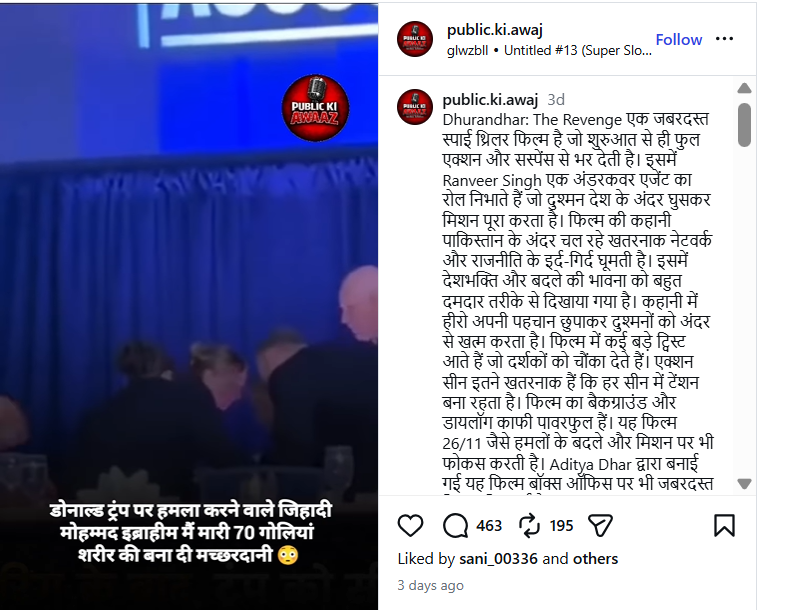
A social media post about the shooting incident during a dinner event for journalists covering the White House is going viral with the claim that the attacker was a Muslim man who was shot dead by security personnel. The accompanying video shows panic inside a hall and alert security officials responding to the situation. wHowever, research by the CyberPeace Research Wing found that the claim is false and misleading. The video is being shared with incorrect information about the identity and fate of the suspect.
Claim:
An Instagram user shared the video on April 26, 2026, claiming that the attacker who targeted Donald Trump was a “jihadi” named Mohammad Ibrahim and that he was killed after being shot multiple times.
Fact Check:
To verify the claim, relevant keyword searches were conducted online.
A report published by BBC on April 28, 2026, stated that the suspect accused of attempting to assassinate President Donald Trump during the Washington dinner event was identified as Cole Thomas Allen. The report said Allen lived with his parents in Los Angeles and was produced in court on April 28.

According to court documents cited in the report, Allen rushed past a security checkpoint carrying a semi-automatic handgun, a pump-action shotgun, and three knives. Authorities said one Secret Service agent was injured during the incident before Allen was subdued and taken into custody. A separate report published by NBC News on April 26, 2026, also identified the accused as Cole Thomas Allen and included visuals from the incident, showing the suspect after his arrest.

Conclusion:
The claim that the White House dinner party attacker was a Muslim man named Mohammad Ibrahim is false. The accused has been identified as Cole Thomas Allen, and he was arrested after the incident. Claims that he was killed are also incorrect.

Introduction
A new dawn in the realm of cyber security and criminal justice is on the horizon. Maharashtra's Deputy Chief Minister, Devendra Fadnavis, has recently announced the advent of the country's most sophisticated cyber lab—a bastion against the dark arts of cybercrime. This announcement, made with the gravitas befitting a statesman, was not merely a bureaucratic note; it was a clarion call to a future where technology and law converge to create a safer society.
The cyber lab, poised to be the largest and most modern of its kind, is not just a facility—it is a symbol of the state's commitment to harnessing the power of technology in the ceaseless battle against crime. Fadnavis, who also holds the state's home portfolio, underscored the significance of this initiative during a function where he also emphasised the need for the Maharashtra police to brace themselves for the enforcement of three transformative criminal laws set to take effect from the first of July 2024.
In compliance with the New Laws
These laws—the Bharatiya Nyaya Sanhita, the Bharatiya Nagarik Suraksha Sanhita, and the Bharat Sakshya Act—They are not mere statutory texts; they are the architects of a new edifice of criminal justice, designed with the mortar of modern electronic and technical evidence to buttress the conviction rates and fortify the legal system.
At the inauguration of the Evidence Management Centre (EMC) and the Evidence Dispatch Van (EDV) in Navi Mumbai, Fadnavis spoke with an air of prescience about the radical shifts these new acts will engender. The EMC, a paragon of innovation with its no-human-intervention ethos, is set to revolutionise the procedure of handling evidence, thereby amplifying the likelihood of securing convictions in an era increasingly marred by cyber frauds and hacking escapades.
Recent Trend
The Deputy Chief Minister's vision extends beyond the present, into a realm where blockchain technology becomes an ally of law enforcement, rendering evidence tampering an obsolete concern. Under the new legislative framework, expert collection of evidence is mandated for crimes with sentences exceeding seven years, a move that underscores the gravity with which digital and electronic evidence is now regarded.
The Cyber Lab
The Navi Mumbai police Commissionerate stands as the vanguard of this new legal era, being the first in the country to align with the upcoming laws. As digital transactions burgeon, so too does the evil of cybercrime. Fadnavis assures us that the cyberlaw, a veritable nexus of modernity, will bring together banks, non-banking financial companies (NBFCs), and social media platforms on a unified platform to detect and thwart crimes with alacrity.
This announcement was made in the presence of Maharashtra's Director General of Police, Rashmi Shukla, and Navi Mumbai's police commissioner, Milind Bharambe, both of whom are key figures in the conception of this project. Their attendance shows the collective resolve of Maharashtra's law enforcement to elevate its capabilities in cybercrime prevention.
Conclusion
The establishment of this cyber lab is a vivid thread woven with the intent to protect the digital integrity of its citizens. It is a testament to the state's foresight and its unwavering commitment to staying abreast of the evolving landscape of crime and technology. As we stand on the cusp of this new era, we are reminded that the fight against crime is perennial, but with such pioneering initiatives, victory is not just a possibility—it is an inevitability.
References
- https://indianexpress.com/article/cities/mumbai/navi-mumbai-cyber-lab-criminal-laws-fadnavis-9206801/
- https://www.the420.in/why-maharashtras-new-cyber-lab-could-be-a-game-changer-for-national-security/
- https://apacnewsnetwork.com/2024/03/navi-mumbai-to-host-indias-most-advanced-crime-busting-lab-boosting-conviction-rates-maharashtra-deputy-cm-fadnavis-announces/

Introduction
In recent years, India has witnessed a significant rise in the popularity and recognition of esports, which refers to online gaming. Esports has emerged as a mainstream phenomenon, influencing players and youngsters worldwide. In India, with the penetration of the internet at 52%, the youth has got its attracted to Esports. In this blog post, we will look at how the government is booting the players, establishing professional leagues, and supporting gaming companies and sponsors in the best possible manner. As the ecosystem continues to rise in prominence and establish itself as a mainstream sporting phenomenon in India.
Factors Shaping Esports in India: A few factors are shaping and growing the love for esports in India here. Let’s have a look.
Technological Advances: The availability and affordability of high-speed internet connections and smart gaming equipment have played an important part in making esports more accessible to a broader audience in India. With the development of smartphones and low-cost gaming PCs, many people may now easily participate in and watch esports tournaments.
Youth Demographic: India has a large population of young people who are enthusiastic gamers and tech-savvy. The youth demographic’s enthusiasm for gaming has spurred the expansion of esports in the country, as they actively participate in competitive gaming and watch major esports competitions.
Increase in the Gaming community: Gaming has been deeply established in Indian society, with many people using it for enjoyment and social contact. As the competitive component of gaming, esports has naturally gained popularity among gamers looking for a more competitive and immersive experience.
Esports Infrastructure and Events: The creation of specialised esports infrastructure, such as esports arenas, gaming cafés, and tournament venues, has considerably aided esports growth in India. Major national and international esports competitions and leagues have also been staged in India, offering exposure and possibilities for prospective esports players. Also supports various platforms such as YouTube, Twitch, and Facebook gaming, which has played a vital role in showcasing and popularising Esports in India.
Government support: Corporate and government sectors in India have recognised the potential of esports and are actively supporting its growth. Major corporate investments, sponsorships, and collaborations with esports organisations have supplied the financial backing and resources required for the country’s esports development. Government attempts to promote esports have also been initiated, such as forming esports governing organisations and including esports in official sporting events.
Growing Popularity and Recognition: Esports in India has witnessed a significant surge in viewership and fanbase, all thanks to online streaming platforms such as Twitch, YouTube which have provided a convenient way for fans to watch live esports events at home and at high-definition quality social media platforms let the fans to interact with their favourite players and stay updated on the latest esports news and events.

Esports Leagues in India
The organisation of esports tournaments and leagues in India has increased, with the IGL being one of the largest and most popular. The ESL India Premiership is a major esports event the Electronic Sports League organised in collaboration with NODWIN Gaming. Viacom18, a well-known Indian media business, established UCypher, an esports league. It focuses on a range of gaming games such as CS: GO, Dota 2, and Tekken in order to promote esports as a professional sport in India. All of these platforms provide professional players with a venue to compete and establish their profile in the esports industry.
India’s Performance in Esports to Date
Indian esports players have achieved remarkable global success, including outstanding results in prominent events and leagues. Individual Indian esports players’ success stories illustrate their talent, determination, and India’s ability to flourish in the esports sphere. These accomplishments contribute to the worldwide esports landscape’s awareness and growth of Indian esports. To add the name of the players and their success stories that have bought pride to India, they are Tirth Metha, Known as “Ritr”, a CS:GO player, Abhijeet “Ghatak”, Ankit “V3nom”, Saloni “Meow16K”.Apart from this Indian women’s team has also done exceptionally well in CS:GO and has made it to the finale.
Government and Corporate Sectors support: The Indian esports business has received backing from the government and corporate sectors, contributing to its growth and acceptance as a genuine sport.
Government Initiatives: The Indian government has expressed increased support for esports through different initiatives. This involves recognising esports as an official sport, establishing esports regulating organisations, and incorporating esports into national sports federations. The government has also announced steps to give financial assistance, subsidies, and infrastructure development for esports, therefore providing a favourable environment for the industry’s growth. Recently, Kalyan Chaubey, joint secretary and acting CEO of the IOA, personally gave the athletes cutting-edge training gear during this occasion, providing kits to the players. The kit includes the following:
Advanced gaming mouse.
Keyboard built for quick responses.
A smooth mousepad
A headphone for crystal-clear communication
An eSports bag to carry the equipment.
Corporate Sponsorship and Partnerships
Indian corporations have recognised esports’ promise and actively sponsored and collaborated with esports organisations, tournaments, and individual players. Companies from various industries, including technology, telecommunications, and entertainment, have invested in esports to capitalise on its success and connect with the esports community. These sponsorships and collaborations give financial support, resources, and visibility to esports in India. The leagues and championships provide opportunities for young players to showcase their talent.
Challenges and future
While esports provides great job opportunities, several obstacles must be overcome in order for the industry to expand and gain recognition:
Infrastructure & Training Facilities: Ensuring the availability of high-quality training facilities and infrastructure is critical for developing talent and allowing players to realise their maximum potential. Continued investment in esports venues, training facilities, and academies is critical for the industry’s long-term success.
Fostering a culture of skill development and giving outlets for formal education in esports would improve the professionalism and competitiveness of Indian esports players. Collaborations between educational institutions and esports organisations can result in the development of specialised programs in areas such as game analysis, team management, and sports psychology.
Establishing a thorough legal framework and governance structure for esports will help it gain legitimacy as a professional sport. Clear standards on player contracts, player rights, anti-doping procedures, and fair competition policies are all part of this.
Conclusion
Esports in India provide massive professional opportunities and growth possibilities for aspiring esports athletes. The sector’s prospects are based on overcoming infrastructure, perception, talent development, and regulatory barriers. Esports may establish itself as a viable and acceptable career alternative in India with continued support, investment, and stakeholder collaboration
