#FactCheck -Viral Humanoid Robot Video Actually Filmed at the Museum of the Future
Executive Summary
A video circulating widely on social media shows a man interacting with a humanoid robot and using abusive language, after which the robot asks him to maintain politeness. Several users shared the clip claiming that the incident took place during a recent AI summit in New Delhi. The video triggered strong reactions online, with some users demanding legal action against the individual. However, research by CyberPeace found the claim to be misleading.
Claim
Social media users claimed that the viral video showing a man abusing a robot was recorded during an AI summit in New Delhi, India.
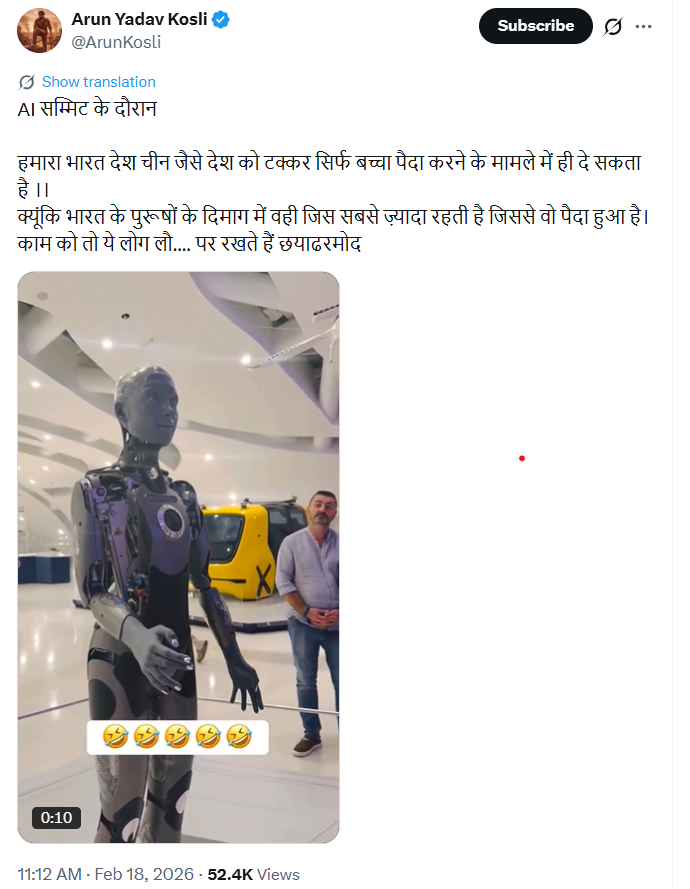
Fact Check
To verify the claim, we conducted a reverse image search of the individual seen in the video. The search led us to an Instagram post uploaded by a Pakistani account identifying the individual as Kashif Zameer.

Further keyword searches helped us locate his Instagram profile, where the same video had been uploaded on February 17, 2026. The post included hashtags such as “Dubai,” indicating the actual location of the incident. The profile also lists Lahore, Pakistan, as the user’s location and describes him as a businessman and social media personality.

To confirm the location shown in the video, we conducted additional searches using keywords such as “Dubai” and “humanoid robot.” The research revealed that the robot featured in the clip is “Ameca,” located at the Museum of the Future in Dubai.

Conclusion
The viral claim is false. The video is not related to any AI summit held in New Delhi. The incident occurred in Dubai, and the person seen in the video is not an Indian citizen.
Related Blogs

Introduction
As we delve deeper into the intricate, almost esoteric digital landscape of the 21st century, we are confronted by a new and troubling phenomenon that threatens the very bastions of our personal security. This is not a mere subplot in some dystopian novel but a harsh and palatable reality firmly rooted in today's technologically driven society. We must grapple with the consequences of the alarming evolution of cyber threats, particularly the sophisticated use of artificial intelligence in creating face swaps—a technique now cleverly harnessed by nefarious actors to undermine the bedrock of biometric security systems.
What is GoldPickaxe?
It was amidst the hum of countless servers and data centers that the term 'GoldPickaxe' began to echo, sending shivers down the spines of cybersecurity experts. Originating from the intricate web spun by a group of Chinese hackers as reported in Dark Reading. GoldPickaxe represents the latest in a long lineage of digital predators. It is an astute embodiment of the disguise, blending into the digital environment as a seemingly harmless government service app. But behind its innocuous facade, it bears the intent to ensnare and deceive, with the elderly demographic being especially susceptible to its trap.
Victims, unassuming and trustful, are cajoled into revealing their most sensitive information: phone numbers, private details, and, most alarmingly, their facial data. These virtual reflections, intended to be the safeguard of one's digital persona, are snatched away and misused in a perilous transformation. The attackers harness such biometric data, feeding it into the arcane furnaces of deepfake technology, wherein AI face-swapping crafts eerily accurate and deceptive facsimiles. These digital doppelgängers become the master keys, effortlessly bypassing the sentinel eyes of facial recognition systems that lock the vaults of Southeast Asia's financial institutions.
Through the diligent and unyielding work of the research team at Group-IB, the trajectory of one victim's harrowing ordeal—a Vietnamese individual pilfered of a life-altering $40,000—sheds light on the severity of this technological betrayal. The advancements in deep face technology, once seen as a marvel of AI, now present a clear and present danger, outpacing the mechanisms meant to deter unauthorized access, and leaving the unenlightened multitude unaware and exposed.
Adding weight to the discussion, experts, a potentate in biometric technology, commented with a somber tone: 'This is why we see face swaps as a tool of choice for hackers. It gives the threat actor this incredible level of power and control.' This chilling testament to the potency of digital fraudulence further emphasizes that even seemingly impregnable ecosystems, such as that of Apple’s, are not beyond the reach of these relentless invaders.
New Threat
Emerging from this landscape is the doppelgänger of GoldPickaxe specifically tailored for the iOS landscape—GoldDigger's mutation into GoldPickaxe for Apple's hallowed platform is nothing short of a wake-up call. It engenders not just a single threat but an evolving suite of menaces, including its uncanny offspring, 'GoldDiggerPlus,' which is wielding the terrifying power to piggyback on real-time communications of the affected devices. Continuously refined and updated, these threats become chimeras, each iteration more elusive, more formidable than its predecessor.
One ingenious and insidious tactic exploited by these cyber adversaries is the diversionary use of Apple's TestFlight, a trusted beta testing platform, as a trojan horse for their malware. Upon clampdown by Apple, the hackers, exhibiting an unsettling level of adaptability, inveigle users to endorse MDM profiles, hitherto reserved for corporate device management, thereby chaining these unknowing participants to their will.
How To Protect
Against this stark backdrop, the question of how one might armor oneself against such predation looms large. It is a question with no simple answer, demanding vigilance and proactive measures.
General Vigilance : Aware of the Trojan's advance, Apple is striving to devise countermeasures, yet individuals can take concrete steps to safeguard their digital lives.
Consider Lockdown Mode: It is imperative to exhibit discernment with TestFlight installations, to warily examine MDM profiles, and seriously consider embracing the protective embrace of Lockdown Mode. Activating Lockdown Mode on an iPhone is akin to drawing the portcullis and manning the battlements of one's digital stronghold. The process is straightforward: a journey to the settings menu, a descent into privacy and security, and finally, the sanctification of Lockdown Mode, followed by a device restart. It is a curtailment of convenience, yes, but a potent defense against the malevolence lurking in the unseen digital thicket.
As 'GoldPickaxe' insidiously carves its path into the iOS realm—a rare and unsettling occurrence—it flags the possible twilight of the iPhone's vaunted reputation for tight security. Should these shadow operators set their sights beyond Southeast Asia, angling their digital scalpels towards the U.S., Canada, and other English-speaking enclaves, the consequences could be dire.
Conclusion
Thus, it is imperative that as digital citizens, we fortify ourselves with best practices in cybersecurity. Our journey through cyberspace must be cautious, our digital trails deliberate and sparse. Let the specter of iPhone malware serve as a compelling reason to arm ourselves with knowledge and prudence, the twin guardians that will let us navigate the murky waters of the internet with assurance, outwitting those who weave webs of deceit. In heeding these words, we preserve not only our financial assets but the sanctity of our digital identities against the underhanded schemes of those who would see them usurped.
References
- https://www.timesnownews.com/technology-science/new-ios-malware-stealing-face-id-data-bank-infos-on-iphones-how-to-protect-yourself-article-107761568
- https://www.darkreading.com/application-security/ios-malware-steals-faces-defeat-biometrics-ai-swaps
- https://www.tomsguide.com/computing/malware-adware/first-ever-ios-trojan-discovered-and-its-stealing-face-id-data-to-break-into-bank-accounts

According to Statista, the number of users in India's digital assets market is expected to reach 107.30m users by 2025 (Impacts of Inflation on Financial Markets, August 2023). India's digital asset market has been experiencing exponential growth fueled by the increased adoption of cryptocurrencies and blockchain technology. This furthers the need for its regulation. Digital assets include cryptocurrencies, NFTs, asset-backed tokens, and tokenised real estate.
India has defined Digital Assets under Section 47(A) of the Income Tax Act, 1961. The Finance Act 2022-23 has added the word 'virtual' to make it “Virtual Digital Assets”. A “virtual digital asset” is any information or code, number, or token, created through cryptographic methods or otherwise, by any name, giving a digital representation of value exchanged with or without consideration. A VDA should contain an inherent value and represent a store of value or unit of account, functional in any financial transaction or investment. These can be stored, transferred, or traded in electronic format.
Digital Asset Governance: Update and Future Outlook
Indian regulators have been conservative in their approach towards digital assets, with the Reserve Bank of India first issuing directions against cryptocurrency transactions in 2018. This ban was removed by the Supreme Court through a court order in 2020. The presentation of the Cryptocurrency and Regulation of Official Digital Currency Bill of 2021 is a fairly important milestone in its attempts to lay down the framework for issuing an official digital currency by the Reserve Bank of India. While some digital assets seem to have potential, like the Central Bank Digital Currencies (CBDCs) and blockchain-based financial applications, a blanket prohibition has been enforced on private cryptocurrencies.
However, in more recent trends, the landscape is changing as the RBI's CBDC is to provide a state-backed digital alternative to cash under a more structured regulatory framework. This move seeks to balance state control with innovation on investor safety and compliance, expecting to reduce risk and enhance security for investors by enacting strict anti-money laundering and know-your-customer laws. Highlighting these developments is important to examine how global regulatory trends influence India's digital asset policies.
Impact of Global Development on India’s Approach
Global regulatory developments have an impact on Indian policies on digital assets. The European Union's Markets in Crypto-assets (MiCA) is to introduce a comprehensive regulatory framework for cryptocurrencies that could act as an inspiration for India. MiCA regulation covers crypto-assets that are not currently regulated by existing financial services legislation. Its particular focus on consumer protection and market integrity resonates with India in terms of investigating needs related to digital assets, including fraud and price volatility. Additionally, evolving policies in the US, such as regulating crypto exchanges and classifying certain tokens as securities, could also form the basis for India's regulatory posture.
Collaboration on the international level is also a chief contributing factor. India’s regular participation in global forums like the G20, facilitates an opportunity to align its regulations on digital assets with other countries, tending toward an even more standardised and predictable framework for cross-border transactions. This can significantly help India given that the nation has a huge diaspora providing a critical inflow of remuneration.
CyberPeace Outlook
Though digital assets offer many opportunities to India, challenges also exist. Cryptocurrency volatility affects investors, posing concerns over fraud and illicit dealings. A balance between the need for innovation and investor protection is paramount to avoid killing the growth of India's digital asset ecosystem with overly restrictive regulations.
Financial inclusion, efficient cross-border payments with low transaction costs, and the opening of investment opportunities are a few opportunities offered by digital assets. For example, the tokenisation of real estate throws open real estate investment to smaller investors. To strengthen the opportunities while addressing challenges, some policy reforms and new frameworks might prove beneficial.
CyberPeace Policy Recommendations
- Establish a regulatory sandbox for startups working in the area of blockchain and digital assets. This would allow them to test innovative solutions in a controlled environment with regulatory oversight minimising risks.
- Clear guidelines for the taxation of digital assets should be provided as they will ensure transparency, reduce ambiguity for investors, and promote compliance with tax regulations. Specific guidelines can be drawn from the EU's MiCA regulation.
- Workshops, online resources, and campaigns are some examples of initiatives aimed at improving consumer awareness about digital assets, benefits and associated risks that should be implemented. Partnerships with global fintech firms will provide a great opportunity to learn best practices.
Conclusion
India is positioned at a critical juncture with respect to the debate on digital assets. The challenge which lies ahead is one of balancing innovation with effective regulation. The introduction of the Central Bank Digital Currency (CBDC) and the development of new policies signal a willingness on the part of the regulators to embrace the digital future. In contrast, issues like volatility, fraud, and regulatory compliance continue to pose hurdles. By drawing insights from global frameworks and strengthening ties through international forums, India can pave the way for a secure and dynamic digital asset ecosystem. Embracing strategic measures such as regulatory sandboxes and transparent tax guidelines will not only protect investors but also unlock the immense potential of digital assets, propelling India into a new era of financial innovation and inclusivity.
References
- https://www.weforum.org/agenda/2024/10/different-countries-navigating-uncertainty-digital-asset-regulation-election-year/
- https://www.acfcs.org/eu-passes-landmark-crypto-regulation
- https://www.indiabudget.gov.in/budget2022-23/doc/Finance_Bill.pdf
- https://www.weforum.org/agenda/2024/10/different-countries-navigating-uncertainty-digital-asset-regulation-election-year/
- https://www3.weforum.org/docs/WEF_Digital_Assets_Regulation_2024.pdf
%20(1).webp)
Introduction
Bumble’s launch of its ‘Opening Move’ feature has sparked a new narrative on safety and privacy within the digital dating sphere and has garnered mixed reactions from users. It was launched against the backdrop of women stating that the ‘message first’ policy of Bumble was proving to be tedious. Addressing the large-scale review, Bumble launched its ‘Opening Move’ feature, whereby users can either craft or select from pre-set questions which potential matches may choose to answer to start the conversation at first glance. These questions are a segue into meaningful and insightful conversation from the get-go and overstep the traditional effort to start engaging chats between matched users. This feature is an optional feature that users may enable and as such does not prevent a user from exercising the autonomy previously in place.
Innovative Approach to Conversation Starters
Many users consider this feature as innovative; not only does it act as a catalyst for fluid conversation but also cultivates insightful dialogue, fostering meaningful interactions that are devoid of the constraint of superficial small talk. The ‘Opening Moves’ feature may also be aligned with unique scientific research indicating that individuals form their initial attractions within 3-seconds of intimate interaction, thereby proving to be a catalyst to the decision-making process of an individual in the attraction time frame.
Organizational Benefits and Data Insights
From an organisational standpoint, the feature is a unique solution towards localisation challenges faced by apps; the option of writing a personalised ‘Opening Move’ implies setting prompts that are culturally relevant and appropriate in a specific area. Moreover, it is anticipated that Bumble may enhance and improve user experience within the platform through data analysis. Data from responses to an ‘Opening Move’ may provide valuable insights into user preferences and patterns by analysing which pre-set prompts garner more responses over others and how often is a user-written ‘Opening Move’ successful in obtaining a response in comparison with Bumble’s pre-set prompts. A quick glance at Bumble’s privacy policy[1] shows that data storing and transferring of chats between users are not shared with third parties, further safeguarding personal privacy. However, Bumble does use the chat data for its own internal purposes after removing personally identifiable information from chats. The manner of such review and removal of data has not been specified, which may raise challenges depending upon whether the reviewer is a human or an algorithm.
However, some users perceive the feature as counterproductive to the company’s principle of ‘women make the first move’. While Bumble aims to market the feature as a neutral ground for matched users based on the exercise of choice, users see it as a step back into the heteronormative gender expectations that most dating apps conform to, putting the onus of the ‘first move’ on men. Many male users have complained that the feature acts as a catalyst for men to opt out of the dating app and would most likely refrain from interacting with profiles enabled with the ‘Opening Move’ feature, since the pressure to answer in a creative manner is disproportionate with the likelihood their response actually being entertained.[2] Coupled with the female users terming the original protocol as ‘too much effort’, the preset questions of the ‘Opening Move’ feature may actively invite users to categorise potential matches according to arbitrary questions that undermine real-life experiences, perspectives and backgrounds of each individual.[3]
Additionally, complications are likely to arise when a notorious user sets a question that indirectly gleans personal or sensitive, identifiable information. The individual responding may be bullied or be subjected to hateful slurs when they respond to such carefully crafted conversation prompts.
Safety and Privacy Concerns
On the corollary, the appearance of choice may translate into more challenges for women on the platform. The feature may spark an increase in the number of unsolicited, undesirable messages and images from a potential match. The most vulnerable groups at present remain individuals who identify as females and other sexual minorities.[4] At present, there appears to be no mechanism in place to proactively monitor the content of responses, relying instead on user reporting. This approach may prove to be impractical given the potential volume of objectionable messages, necessitating a more efficient solution to address this issue. It is to be noted that in spite of a user reporting, the current redressal systems of online platforms remain lax, largely inadequate and demonstrate ineffectiveness in addressing user concerns or grievances. This lack of proactiveness is violative of the right to redressal provided under the Digital Personal Data Protection Act, 2023. It is thought that the feature may actually take away user autonomy that Bumble originally aimed to grant since Individuals who identify as introverted, shy, soft-spoken, or non-assertive may refrain from reporting harassing messages altogether, potentially due to discomfort or reluctance to engage in confrontation. Resultantly, it is anticipated that there would be a sharp uptake in cases pertaining to cyberbullying, harassment and hate speech (especially vulgar communications) towards both the user and the potential match.
From an Indian legal perspective, dating apps have to adhere to the Information Technology Act, 2000 [5], the Information Technology (Intermediary and Digital Media Ethics) Rules 2021 [6] and the Digital Personal Data Protection Act, 2023, that regulates a person’s digital privacy and set standards on the kind of content an intermediary may host. An obligation is cast upon an intermediary to uprise its users on what content is not allowed on its platform in addition to mandating intimation of the user’s digital rights. The lack of automated checks, as mentioned above, is likely to make Bumble non-compliant with the ethical guidelines.
The optional nature of the ‘Opening Move’ grants users some autonomy. However, some technical updates may enhance the user experience of this feature. Technologies like AI are an effective aid in behavioural and predictive analysis. An upgraded ‘matching’ algorithm can analyse the number of un-matches a profile receives, thereby identifying and flagging a profile having multiple lapsed matches. Additionally, the design interface of the application bearing a filter option to filter out flagged profiles would enable a user to be cautious while navigating through the matches. Another possible method of weeding out notorious profiles is by deploying a peer-review system of profiles whereby a user has a singular check-box that enables them to flag a profile. Such a checkbox would ideally be devoid of any option for writing personal comments and would bear a check box stating whether the profile is most or least likely to bully/harass. This would ensure that a binary, precise response is recorded and any coloured remarks are avoided. [7]
Governance and Monitoring Mechanisms
From a governance point of view, a monitoring mechanism on the manner of crafting questions is critical. Systems should be designed to detect certain words/sentences and a specific manner of framing sentences to disallow questions contrary to the national legal framework. An onscreen notification having instructions on generally acceptable manner of conversations as a reminder to users to maintain cyber hygiene while conversing is also proposed as a mandated requirement for platforms. The notification/notice may also include guidelines on what information is safe to share in order to safeguard user privacy. Lastly, a revised privacy policy should establish the legal basis for processing responses to ‘Opening Moves’, thereby bringing it in compliance with national legislations such as the Digital Personal Data Protection Act, 2023.
Conclusion
Bumble's 'Opening Move' feature marks the company’s ‘statement’ step to address user concerns regarding initiating conversations on the platform. While it has been praised for fostering more meaningful interactions, it also raises not only ethical concerns but also concerns over user safety. While the 'Opening Move' feature can potentially enhance user experience, its success is largely dependent on Bumble's ability to effectively navigate the complex issues associated with this feature. A more robust monitoring mechanism that utilises newer technology is critical to address user concerns and to ensure compliance with national laws on data privacy.
Endnotes:
- [1] Bumble’s privacy policy https://bumble.com/en-us/privacy
- [2] Discussion thread, r/bumble, Reddit https://www.reddit.com/r/Bumble/comments/1cgrs0d/women_on_bumble_no_longer_have_to_make_the_first/?share_id=idm6DK7e0lgkD7ZQ2TiTq&utm_content=2&utm_medium=ios_app&utm_name=ioscss&utm_source=share&utm_term=1&rdt=65068
- [3] Mcrea-Hedley, Olivia, “Love on the Apps: When did Dating Become so Political?”, 8 February 2024 https://www.service95.com/the-politics-of-dating-apps/
- [4] Gewirtz-Meydan, A., Volman-Pampanel, D., Opuda, E., & Tarshish, N. (2024). ‘Dating Apps: A New Emerging Platform for Sexual Harassment? A Scoping Review. Trauma, Violence, & Abuse, 25(1), 752-763. https://doi.org/10.1177/15248380231162969
- [5] Information Technology Act, 2000 https://www.indiacode.nic.in/bitstream/123456789/13116/1/it_act_2000_updated.pdf
- [6] Information Technology (Intermediary Guidelines and Digital Media Ethics) Rules 2021 https://www.meity.gov.in/writereaddata/files/Information%20Technology%20%28Intermediary%20Guidelines%20and%20Digital%20Media%20Ethics%20Code%29%20Rules%2C%202021%20%28updated%2006.04.2023%29-.pdf
- [7] Date Confidently: Engaging Features in a Dating App (Use Cases), Consaguous, 10 July 2023 https://www.consagous.co/blog/date-confidently-engaging-features-in-a-dating-app-use-cases