
#FactCheck- AI Video Fuels False Claims of Israeli Soldiers’ Death in Plane Crash
Executive Summary
A video circulating on social media is being linked to the ongoing tensions in West Asia involving the United States, Israel, and Iran. The clip shows an aircraft crashing into a residential area, with users claiming that a Dubai-bound plane carrying Israeli soldiers crashed near Tel Aviv airport, killing everyone on board. However, an research by the CyberPeace has found the claim to be false. The viral video is AI-generated, and no such incident has taken place in Israel.
Claim
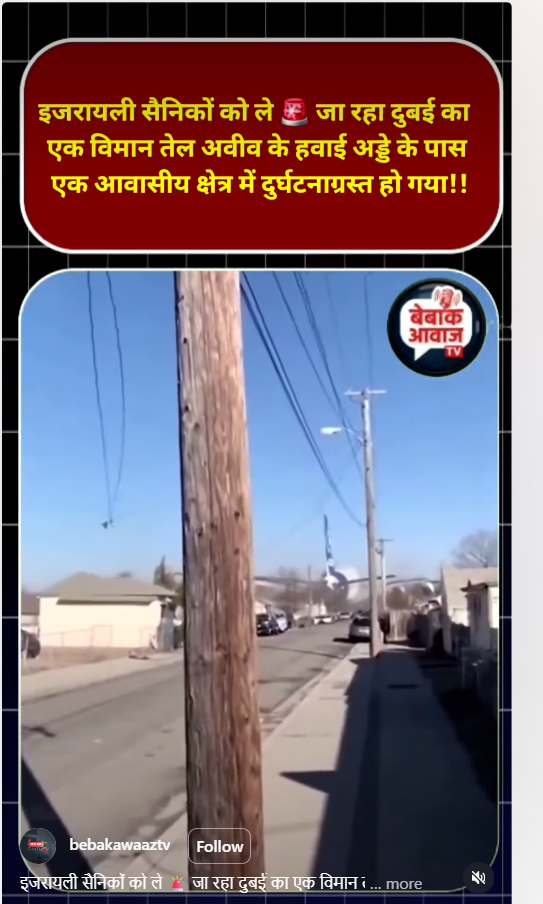
An Instagram user “bebakawaaztv” shared the video on April 7, 2026, claiming that a Dubai aircraft carrying Israeli soldiers crashed near Tel Aviv airport in a residential area, allegedly after being hit by debris from an Iranian hypersonic missile.
Fact Check
To verify the claim, we closely examined the viral video. Several visual inconsistencies indicated that it was not real. The aircraft appears to be flying unusually low over a residential area—something that is highly improbable under normal aviation conditions. Its landing gear seems to touch rooftops without causing any visible damage. Additionally, the wings of the aircraft pass through structures like poles without any collision impact, which is physically impossible. These anomalies strongly suggested that the video was artificially created.
We further analyzed the video using the AI detection tool HIVE Moderation, which indicated a 99% probability that the content is AI-generated.
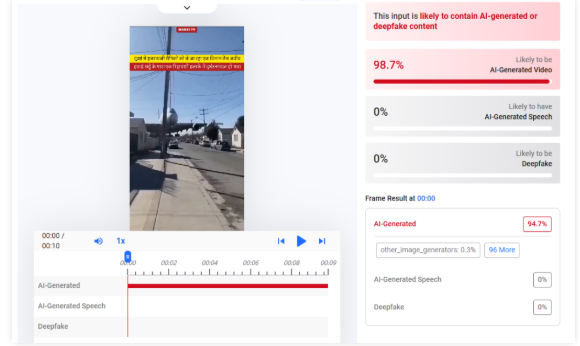
Another analysis using Sightengine also flagged the video as likely AI-generated.

Conclusion
The viral claim is false and misleading. There is no credible evidence or verified report confirming that any Dubai aircraft carrying Israeli soldiers crashed near Tel Aviv airport. No such incident has been reported by any reliable international or local media outlets. The video in question is digitally fabricated using AI technology, and the visual inconsistencies within the clip clearly indicate manipulation. Such content is often designed to exploit ongoing geopolitical tensions and spread misinformation at scale

Related Blogs

Executive Summary
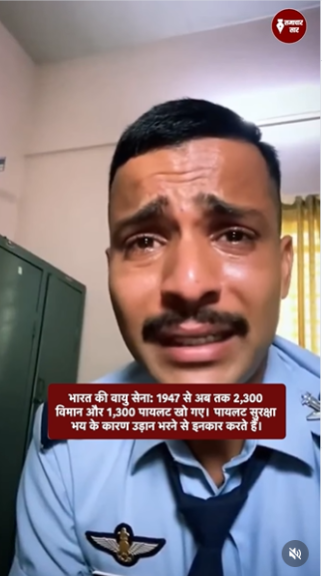
A video circulating widely on social media claims to show a pilot of the Indian Air Force (IAF) crying and expressing fear about flying fighter jets, allegedly citing poor maintenance and frequent crashes. The clip is being linked to the crash of an IAF Sukhoi-30 fighter jet in Assam on March 5, in which two pilots lost their lives. In the viral video, a man dressed like a pilot is seen speaking emotionally, saying that flying fighter jets has become frightening due to lack of maintenance and repeated accidents. Several users are sharing the clip claiming that the man in the video is an IAF pilot revealing the reality behind aircraft crashes. However, research by the CyberPeace found the claim to be false. The video does not depict a real pilot or an actual incident. Instead, it appears to be an AI-generated clip created and circulated with the intent to spread misinformation.
Claim:
An Instagram user, ‘samacharsaar0’, shared the viral video on March 10, 2026, with the English caption: “2300 aircraft crashes, 1300 pilots dead: A major challenge before the IAF.”
- Source: :https://www.instagram.com/reel/DVqa4lNiYJQ
- Archived link::https://perma.cc/EUZ8-DHE3
Fact Check:
The claim was also debunked by PIB Fact Check. While verifying the viral video, PIB clarified that the clip is artificially generated and not related to any real IAF personnel.
To further verify the authenticity of the video, we analyzed it using AI detection tools. The tool Hive Moderation indicated a 99.9% probability that the video was generated using artificial intelligence.
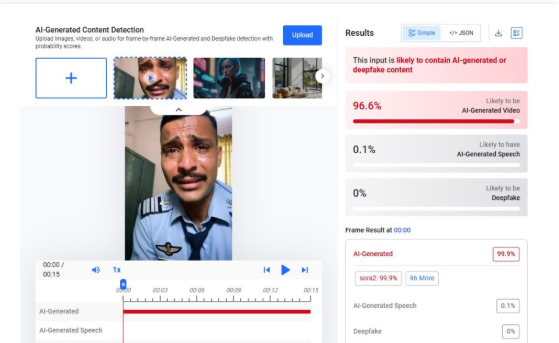
We also examined the clip using another AI detection platform, Undetectable. The analysis suggested an 82% likelihood that the video was created with AI tools. The tool also indicated the possibility that the footage may have been generated using the Sora AI video generation tool.

Conclusion
Our research concludes that the viral video of a crying “pilot” is not authentic. The clip has been created using artificial intelligence and is being misleadingly shared as a real Indian Air Force pilot speaking about aircraft crashes. The government has also denied the claim associated with the video.

Cyber, is the new weapon today! Cyber Violence is violence in cyber-space that has led to violation of cyber rights of individuals, especially those of children and women. Online violence and harassment have been overlooked laying more emphasis on offline or physical violence.
New Delhi [India], November 12 (ANI/NewsVoir): Cyber, is the new weapon today! Cyber Violence is violence in cyber-space that has led to violation of cyber rights of individuals, especially those of children and women. Online violence and harassment have been overlooked laying more emphasis on offline or physical violence. Cyber violence very often permanently, psychologically impacts the victims and their families. Various forms of threats ranging from morphing, stalking, solicitation of children for sexual purposes, online grooming, have grave consequences on the victims disturbing their mental well-being. Maintaining mental well-being in cyber space is a challenge we wish to promote and advocate for, in order to build responsible netizens.
Together, we stand against violation of cyber rights and strongly believe; it is critical to allow everyone to feel safe online. Netizen’s safety rights must be protected from all kinds of abuse and violence. Setting a mission of ‘Making India Cyber Safe for Children and Women’, Responsible Netism a social purpose organization in association with CyberPeace Foundation, an award-winning Cyber Security think tank working towards bringing CyberPeace in CyberSpace for more than two decades, host its 6th Annual National Conference on Cyber Psychology themed “India Fights Cyber Violence”, scheduled for Saturday, January 22, 2022. Ta advocate on the theme, the campaign #IndiaFightsCyberViolence was launched on November 11, 2021 by Vinay Sahasrabuddhe – President ICCR, Member of Parliament, Priyank Kanoongo – Chairperson, NCPCR and Rekha Sharma, Chairperson NCW at the ICCR Auditorium Delhi. The session was also attended by the CyberPeace Foundation team members.
Vinay Sahasrabuddhe has been a strong advocate of online safety of children, he shared his visionary words and focused on 3 R’s, Research, Reform and Reshape. He recommended extensive research was necessary to strongly voice concerns and remedies based on evidence-based research which would help us reform intervention strategies and the reshape the existing framework to best suit the needs to protect women and children in cyber space. The NCW Chairperson Rekha Sharma shared how critical it is to create awareness about online safety rights of women and reiterated the need for spreading awareness about online safety to reach the last mile in order to build collective action and bring change. She also mentioned the need to conducting nationwide trainings for the police personal to handle and report online distress.
Priyank Kanoongo, the Chairperson of NCPCR has been very proactively advocating for the cause of child online protection and has been instrumental in voicing critical in fiercely voicing his thoughts on protecting online safety rights of children across India. He shared the following thoughts at the launch. He said there is dire need to educate parents about online safety in order to let the information trickle down to their children. He said NCPCR does not hold any inhibitions in naming and shaming violators of child rights be it offline or online and will always raise a strong voice against platform ‘s inability to protect children in cyber space.
Vineet Kumar, Founder and Global President, CyberPeace Foundation, the partnering organization shared that this nationwide movement will build great momentum on the cause of online protection of children and women cross the country and urged organizations across India to pledge their support to the cause. The more people joining this movement would build collective pressure to formulate guidelines and policies the make cyber space safe for children and women. Sonali Patankar – Founder Responsible Netism shared the objective of the campaign was to let online safety reach the last mile and build on aggressive reporting of online content. The movement was an effort to make the campaign India Fights Cyber Violence to make India cyber safe for children.
She shared that the campaign launch would be followed by a nationwide research conducted to understand parents perspectives on cyber violence which would be handy in representing recommendations on women and child safety protocols through commoners. There would be a round table for organizations working with children chaired by Priyank Kanoongo on November 22 followed by a round table held for organizations working with Women chaired by Rekha Sharma Madam on December 22, 2021. The campaign would culminate in the Responsible Netism 6th National Cyber Psychology Conference scheduled for January 22, 2022 that would witness a compilation of the research and the work done throughout the campaign.
The launch was attended by Sujay Patki – Social Activist and Advisor Responsible Netism and Shilpa Chandolikar trustee Responsible Netism, Adv Khushbu Jain Advocate Supreme Court of India followed by the vote of thanks by Unmesh Joshi – Co-founder Responsible Netism. With the success of the launch and the support of NCPCR and NCW, we are sure to make this a nation-wide movement to protect cyber safety rights of netizens and strongly believe in collective action to make India Cyber Safe for Women and Children.
This story is provided by NewsVoir. ANI will not be responsible in any way for the content of this article. (ANI/NewsVoir)(This story has not been edited by Devdiscourse staff and is auto-generated from a syndicated feed.)

Executive Summary
A purported news clip circulating on social media claims that the Bharatiya Janata Party (BJP) purchased Bhupen Bora, a leader of the Indian National Congress, for ₹50 crore as part of a political deal in Assam. The viral clip further alleges that the transaction took place under the leadership of Assam Chief Minister Himanta Biswa Sarma and included an agreement to induct several Congress leaders into the BJP.
However, research by CyberPeace found the viral claim to be false and revealed that the original news video had been manipulated using AI and shared with misleading claims.
Claim
On February 18, 2026, a user shared the viral video on Facebook, claiming that the Assam BJP had bought a Congress leader who had lost the last three elections for ₹50 crore, and that the alleged deal led by Himanta Biswa Sarma had drawn public criticism.

Fact Check:
To verify the authenticity of the claim, we extracted key frames from the viral video and conducted a reverse image search using Google Lens. During the research, we found the original version of the video published on the website of Aaj Tak on February 16, 2026. In the original report, the anchor is only seen reporting on Bhupen Bora’s resignation from the party. The report does not mention any alleged financial transaction or political deal, contrary to the claims made in the viral clip.

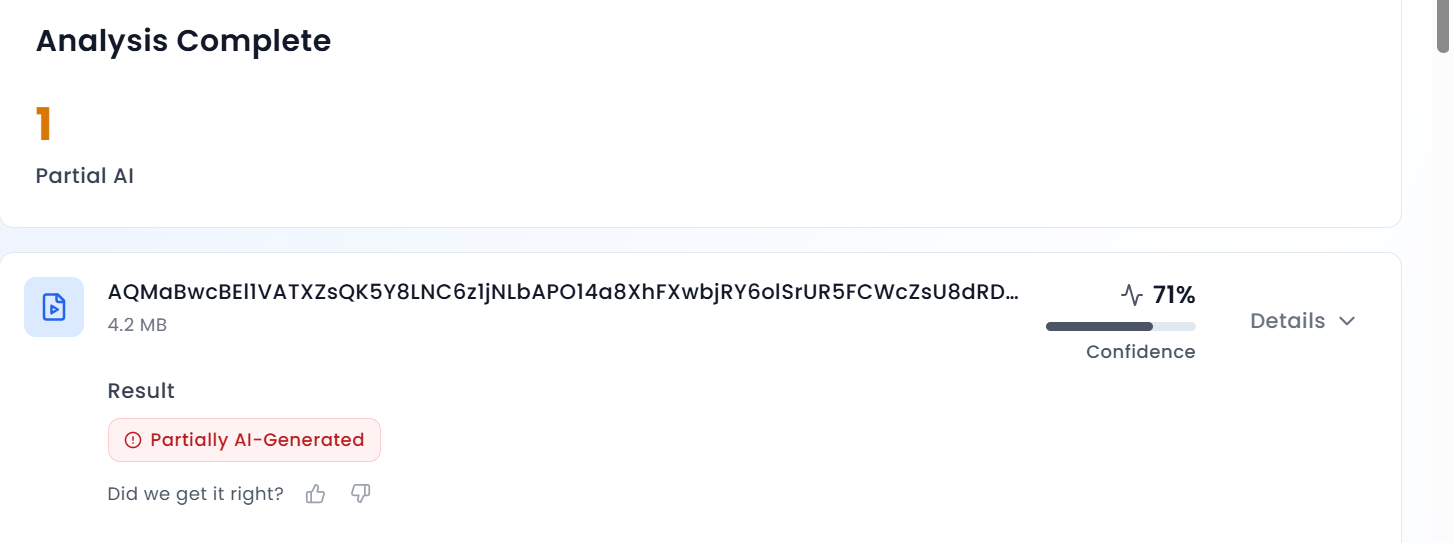
In the next stage of the research, the viral video was analysed using the AI detection tool AURGIN AI, which identified the video as AI-generated.
Conclusion
Our research found that users had manipulated the original news broadcast using AI and shared it with misleading claims. The viral clip does not show any real financial deal between Bhupen Bora and the Assam Chief Minister.
