
Privacy Under Scrutiny- What the WhatsApp Class Action Means for Data Protection and Trust
Introduction
In April 2026, a class action suit in a federal court in California rejuvenated one of the most basic assertions in digital communication: that private messages are private. The suit claims that Meta Platforms, its subsidiary WhatsApp, and third-party contractors such as Accenture could have accessed user messages even though it had long promised end-to-end encryption.
This case is not merely about a single company or a single platform. It poses more profound questions regarding the definition, communication and regulation of privacy in an age when digital infrastructure is becoming more and more incomprehensible or unprovable to regular users.
What the Lawsuit Actually Says
The suit was filed by plaintiffs Brian Y. Shirazi and Nida Samson, who alleged that WhatsApp, Meta and contractors had intercepted and shared private messages with third parties without their consent. The complaint states that the federal investigators were notified by the whistleblowers that employees of Meta and external contractors had access to the content of WhatsApp messages that were expected to be encrypted and inaccessible.
This directly puts into question the main privacy promise of WhatsApp. The platform has been promoting itself as an end-to-end encrypted service in which not even WhatsApp can read your messages. The case asserts that this assertion was deceptive in its application and that no one ever gave any consent prior to their messages being intercepted, stored, or read.
The plaintiffs are proposing to represent a nationwide class of users of WhatsApp who sent or received messages between April 5, 2016, and the current time and subclasses in California and Pennsylvania. The claims involve breach of contract, California laws on privacy and data violations, false advertising and the Pennsylvania Wiretapping and Electronic Surveillance Act.
It should be mentioned that they are allegations. Similar assertions have been refuted by Metacomet in the past, with the company asserting that its encryption frameworks ensure that the company cannot access the messages. The case is in progress, and no facts have been found.
The Grey Area No One Talks About
In order to see the significance of this lawsuit outside the court, it is useful to consider the way modern messaging platforms actually work. In principle, end-to-end encryption means that only the sender and receiver can decipher a message. Even the service provider should not be able to access the content.
However, there is a grey space that is seldom publicly discussed: content moderation. User reports, metadata analysis or restricted message review processes are common methods used by platforms to identify harmful content, like fraud, child exploitation, or spam. The complaint indicates that such moderation procedures might have opened avenues to the content of messages to human reviewers or automated systems more than users were made to think.
This is not the first time that privacy and safety are at odds. Many jurisdictions have also advocated access to encrypted communications through legal means in the name of national security or criminal investigations. What this suit does is put that tension into even more stark relief by asking whether platforms are really open with users about these trade-offs.
The Consent Problem
The emphasis on consent is one of the most significant implications of this case. The plaintiffs claim that the users were never warned that their messages would be accessed by the employees or third parties and were never provided with any meaningful option on the same.
This is where the case turns into a data governance issue, rather than a legal one. Most data protection models consider the legality of data processing to be based on whether the users know how their data is being processed or not. When the accusations are found to be true, then the matter is not technical. It would be a contractual and ethical failure, a disjuncture between what platforms promise and what they do.
The implications are huge to the billions of users who use WhatsApp to communicate, both personally and professionally, and even politically.
What This Means Going Forward
An effective attack on the encryption assertions of WhatsApp might have actual implications for the rest of the digital ecosystem. Users might start doubting that any platform can be really considered to guarantee privacy. The regulators can advocate more stringent disclosure policies and compulsory independent audits of encryption systems. Social networks might have to re-architect their moderation frameworks to make sure that safety features do not silently compromise privacy guarantees that they claim.
Meanwhile, there is a real policy dilemma in this case that cannot be disregarded. Complete privacy may preclude the capacity to identify abuse or hateful material. The manner in which that balance is achieved and, more to the point, the manner in which it is made transparent to users is an issue that has yet to be addressed by policymakers, civil society and the tech industry.
Other technical experts have also questioned the plausibility of the claims in the lawsuit at scale, noting that it would be an extraordinary undertaking to systematically bypass end-to-end encryption. This further supports the argument of independent verification mechanisms. The problem is that users should not be forced to decide what they should believe in more: corporate guarantees or legal charges. There must be rules that can be enforced which are above the two.
Conclusion: Beyond One Lawsuit
The WhatsApp class action is eventually concerning a structural issue within the digital economy. Users are expected to have faith in systems that they cannot observe, on the assertions that they cannot test themselves.
This case is a warning, regardless of whether the allegations are proved or not. Privacy cannot be based on marketing language. It needs legally binding norms, actual transparency in the treatment of data, and external control that will provide users with something more to hang on than a tagline.
References
- https://www.bitdefender.com/en-us/blog/hotforsecurity/lawsuit-claims-meta-can-access-whatsapp-messages-despite-end-to-end-encryption-2
- https://blog.cryptographyengineering.com/2026/02/02/whatsapp-encryption-a-lawsuit-and-a-lot-of-noise/
- https://www.bloomberg.com/news/articles/2026-01-25/lawsuit-claims-meta-can-see-whatsapp-chats-in-breach-of-privacy
- https://www.classaction.org/blog/despite-privacy-promises-meta-third-parties-read-and-store-whatsapp-messages-class-action-lawsuit-alleges

Related Blogs
Executive Summary
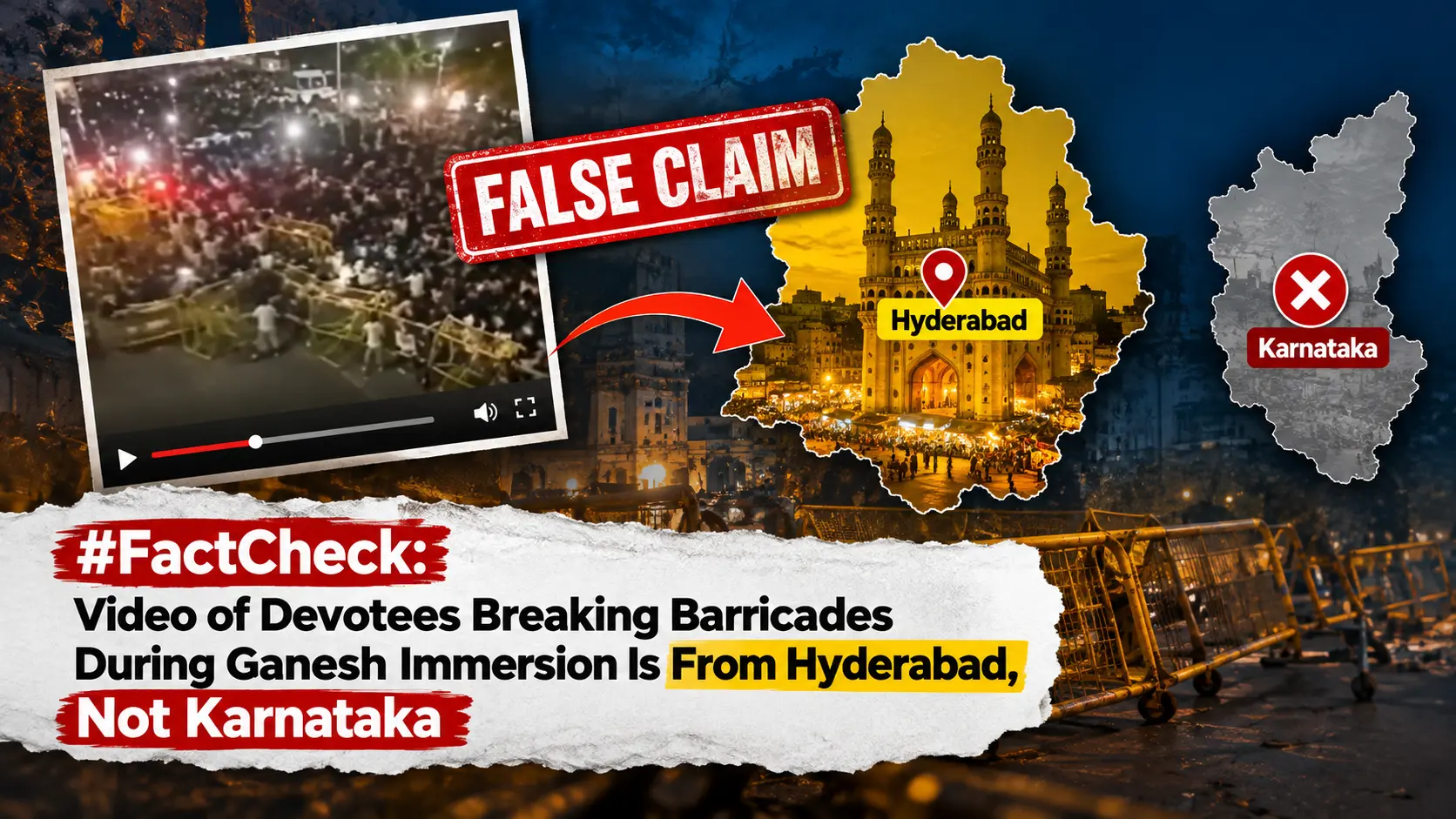
A video is being shared on social media showing several people breaking iron barricades installed along the banks of a water body. The video is being shared with the claim that people broke the barricades after the Karnataka government imposed a ban on idol immersion to prevent pollution in the river. CyberPeace Research found the viral claim to be misleading. Our Research revealed that the video is not from Karnataka but from Hyderabad, Telangana. The video shows members of The Bhagyanagar Ganesh Utsav Committee (BGUS) removing barricades installed at Tank Bund to prevent the immersion of Plaster of Paris (PoP) idols in the water body. The barricades had been installed following the High Court’s directions. Therefore, the claim linking the video to Karnataka is incorrect.
Claim:
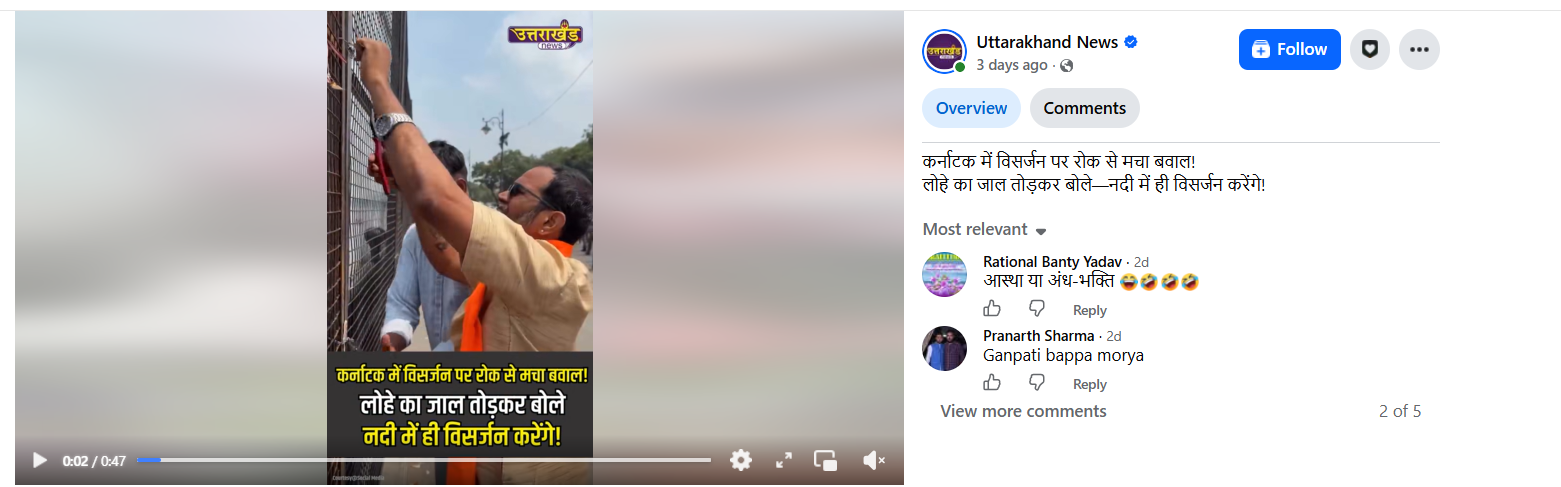
A Facebook user shared the video with the caption: “Chaos erupts in Karnataka over the ban on idol immersion! Breaking the iron barricades, they said — ‘We will immerse the idols in the river itself!’” The post link, archive link, and screenshot are provided below.
https://www.facebook.com/watch/?v=1523733916224661
https://ghostarchive.org/archive/SJgmD
Fact Check
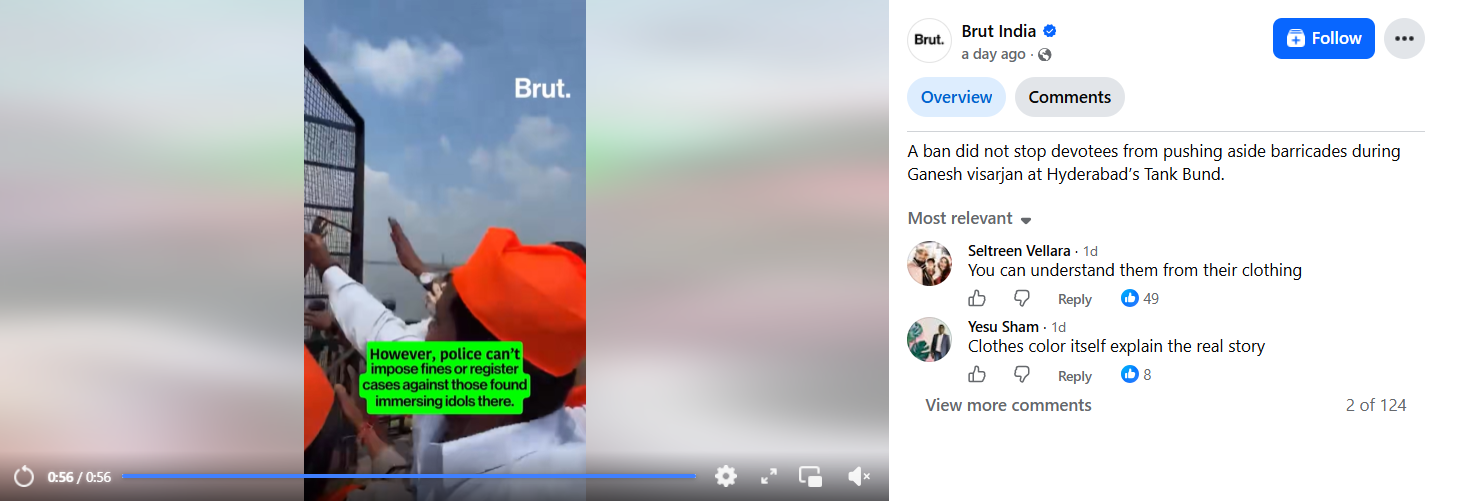
To verify the authenticity of the viral claim, we conducted a reverse image search of keyframes from the video. During the search, we found the same video on the Facebook page of Brut India. According to the post, the video is from Hyderabad. The caption states that despite the restrictions, devotees removed the barricades and made way during the Ganesh idol immersion at Hyderabad’s Tank Bund. The post link and screenshot are provided below.
https://www.facebook.com/watch/?v=2220012475615416
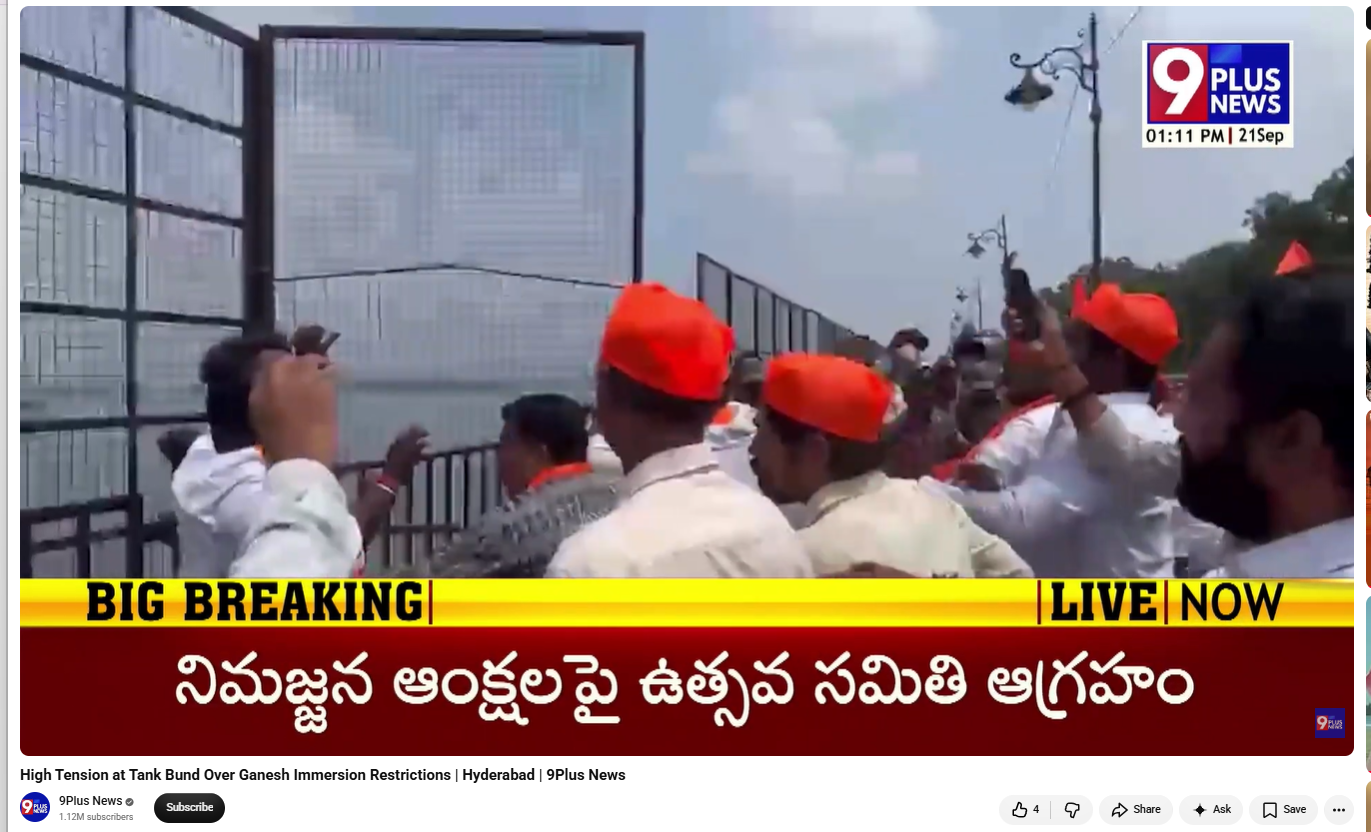
Taking the Research forward, we found the same video in a news report uploaded on the YouTube channel of ‘9Plus News’ on September 21, 2026. The report also includes the portion of the viral clip in which people can be seen breaking the barricades. According to the report, the incident took place in the Tank Bund area of Hyderabad. The post link and screenshot are provided below.
https://www.youtube.com/watch?v=l7GRELjqAwY
Conclusion
Our Research found that the viral video is not from Karnataka but from Hyderabad, Telangana. The video shows members of the Bhagyanagar Ganesh Utsav Committee (BGUS) removing barricades installed at Tank Bund to prevent the immersion of Plaster of Paris (PoP) idols in the water body. These barricades had been installed following the High Court’s directions. Therefore, the claim linking the video to Karnataka is false.
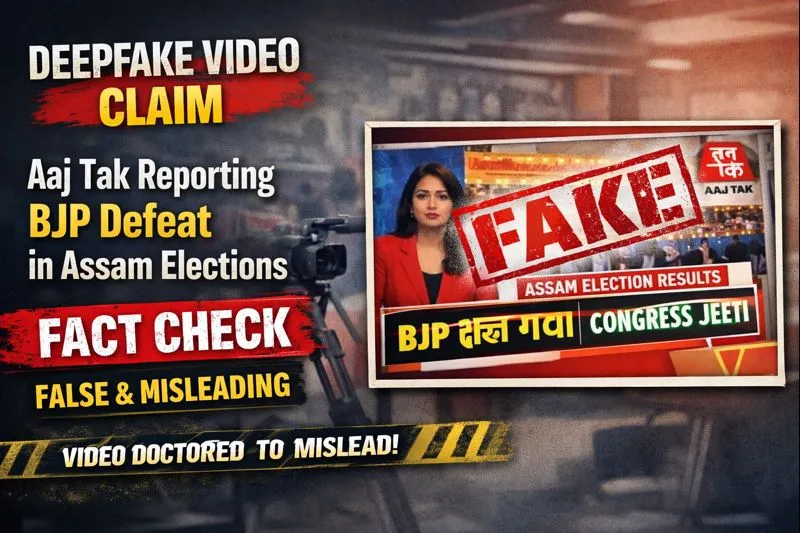
Assembly elections are due to be held in Assam later this year, with polling likely in April or May. Ahead of the elections, a video claiming to be an Aaj Tak news bulletin is being widely circulated on social media.
In the viral video, Aaj Tak anchor Rajiv Dhoundiyal is allegedly seen stating that a leaked intelligence report has issued a warning for the ruling Bharatiya Janata Party (BJP) in Assam. The clip claims that according to this purported report, the BJP may suffer significant losses in the upcoming Assembly elections. Several social media users sharing the video have also claimed that the alleged intelligence report signals the possible removal of Assam Chief Minister Himanta Biswa Sarma from office.
However, an investigation by the Cyber Peace Foundation found the viral claim to be false. Our probe clearly established that no leaked intelligence report related to the Assam Assembly elections exists.
Further, Aaj Tak has neither published nor broadcast any such report on its official television channel, website, or social media platforms. The investigation also revealed that the viral video itself is not authentic and has been created using deepfake technology.
Claim
On social media platform Facebook, a user shared the viral video claiming that the BJP has been pushed on the back foot following organisational changes in the Congress—appointing Priyanka Gandhi Vadra as chairperson of the election screening committee and Gaurav Gogoi as the Assam Pradesh Congress Committee president. The post further claims that an Intelligence Bureau report predicts that the current Assam government will not return to power.
(Link to the post, archive link, and screenshots are available.)
FactCheck:
To verify the claim, we first searched for reports related to any alleged leaked intelligence assessment concerning the Assam Assembly elections using relevant keywords. However, no credible or reliable reports supporting the claim were found. We then reviewed Aaj Tak’s official website, social media pages, and YouTube channel. Our examination confirmed that no such news bulletin has been published or broadcast by the network on any of its official platforms.
- https://www.facebook.com/aajtak/?locale=hi_IN
- https://www.instagram.com/aajtak/
- https://x.com/aajtak
- https://www.youtube.com/channel/UCt4t-jeY85JegMlZ-E5UWtA
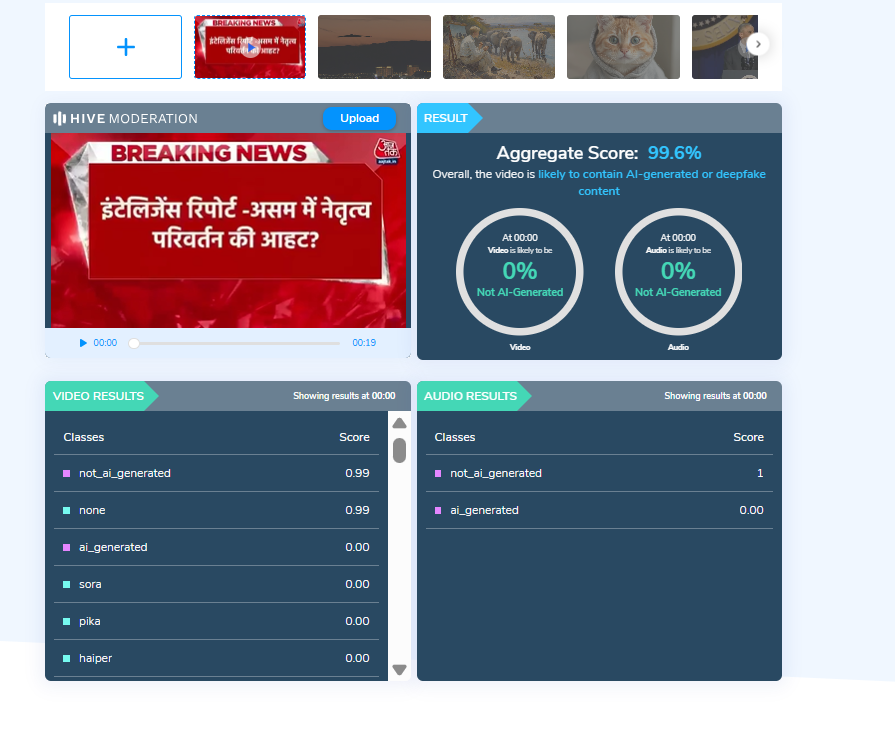
To further verify the authenticity of the video, its audio was scanned using the deepfake voice detection tool HIVE Moderation.
The analysis revealed that the voice heard in the video is 99 per cent AI-generated, clearly indicating that the audio is not genuine and has been artificially created using artificial intelligence.
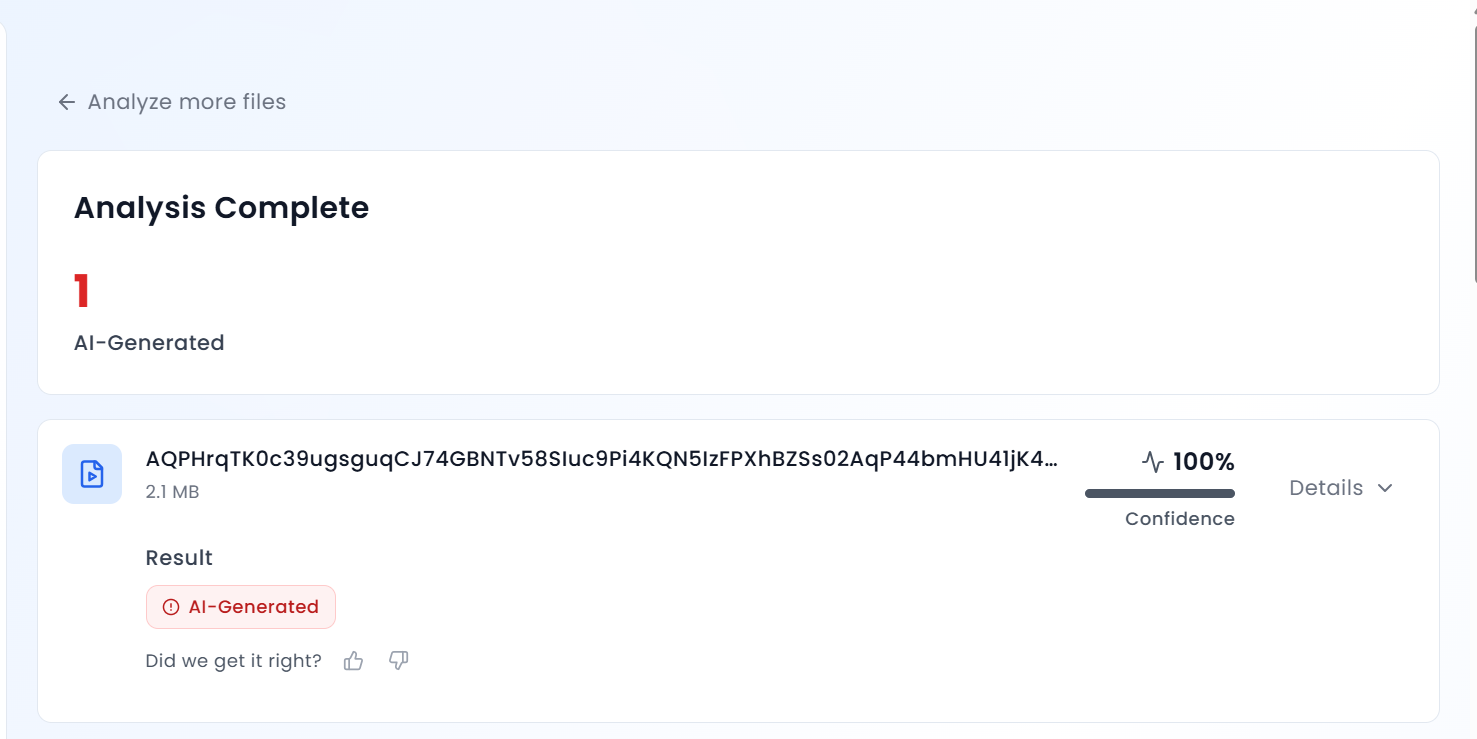
Additionally, the video was analysed using another AI detection tool, Aurigin AI, which also identified the viral clip as AI-generated.
Conclusion:
The investigation clearly establishes that there is no leaked intelligence report predicting BJP’s defeat in the Assam Assembly elections. Aaj Tak has not published or broadcast any such content on its official platforms. The video circulating on social media is not authentic and has been created using deepfake technology to mislead viewers.

Introduction
As digital platforms rapidly become repositories of information related to health, YouTube has emerged as a trusted source people look to for answers. To counter rampant health misinformation online, the platform launched YouTube Health, a program aiming to make “high-quality health information available to all” by collaborating with health experts and content creators. While this is an effort in the right direction, the program needs to be tailored to the specificities of the Indian context if it aims to transform healthcare communication in the long run.
The Indian Digital Health Context
India’s growing internet penetration and lack of accessible healthcare infrastructure, especially in rural areas, facilitates a reliance on digital platforms for health information. However, these, especially social media, are rife with misinformation. Supplemented by varying literacy levels, access disparities, and lack of digital awareness, health misinformation can lead to serious negative health outcomes. The report ‘Health Misinformation Vectors in India’ by DataLEADS suggests a growing reluctance surrounding conventional medicine, with people looking for affordable and accessible natural remedies instead. Social media helps facilitate this shift. However, media-sharing platforms such as WhatsApp, YouTube, and Facebook host a large chunk of health misinformation. The report identifies that cancer, reproductive health, vaccines, and lifestyle diseases are four key areas susceptible to misinformation in India.
YouTube’s Efforts in Promoting Credible Health Content
YouTube Health aims to provide evidence-based health information with “digestible, compelling, and emotionally supportive health videos,” from leading experts to everyone irrespective of who they are or where they live. So far, it executes this vision through:
- Content Curation: The platform has health source information panels and content shelves highlighting videos regarding 140+ medical conditions from authority sources like All India Institute of Medical Sciences (AIIMS), National Institute of Mental Health and Neurosciences (NIMHANS), Max Healthcare etc., whenever users search for health-related topics.
- Localization Strategies: The platform offers multilingual health content in regional languages such as Hindi, Tamil, Telugu, Marathi, Kannada, Malayalam, Punjabi, and Bengali, apart from English. This is to help health information reach viewers across most of the country.
- Verification of professionals: Healthcare professionals and organisations can apply to YouTube’s health feature for their videos to be authenticated as an authority health source on the platform and for their videos to show up on the ‘Health Sources’ shelf.
Challenges
- Limited Reach: India has a diverse linguistic ecosystem. While health information is made available in over 8 languages, the number is not enough to reach everyone in the country. Efforts to reach more people in vernacular languages need to be ramped up. Further, while there were around 50 billion views of health content on YouTube in 2023, it is difficult to measure the on-ground outcomes of those views.
- Lack of Digital Literacy: Misinformation on digital platforms cannot be entirely curtailed owing to the way algorithms are designed to enhance user engagement. However, uploading authoritative health information as a solution may not be enough, if users lack awareness about misinformation and the need to critically evaluate and trust only credible sources. In India, this critical awareness remains largely underdeveloped.
Conclusion
Considering that India has over 450 million users, by far the highest number of users in any country in the world, the platform has recognized that it can play a transformative role in the country’s digital health ecosystem. To accomplish its mission “to combat the societal threat of medical misinformation,” YouTube will have to continue to take several proactive measures. There is scope for strengthening collaborations with Indian public health agencies and trusted public figures, national and regional, to provide credible health information to all. The approach will have to be tailored to India’s vast linguistic diversity, by encouraging capacity-building for vernacular creators to produce credible content. Finally, multiple stakeholders will need to come together to promote digital literacy through education campaigns about identifying trustworthy sources.
Sources
- https://indianexpress.com/article/technology/tech-news-technology/youtube-health-dr-garth-graham-interview-9746673/
- https://economictimes.indiatimes.com/news/india/cancer-misinformation-extremely-prevalent-in-india-trust-in-science-medicine-crucial-report/articleshow/115931783.cms?from=mdr
- https://health.youtube/our-mission/
- https://health.youtube/features-application/
- https://backlinko.com/youtube-users
