
#FactCheck- Viral ABP News clip and image from 2013 falsely linked to recent events involving US Embassy security claim
Executive Summary
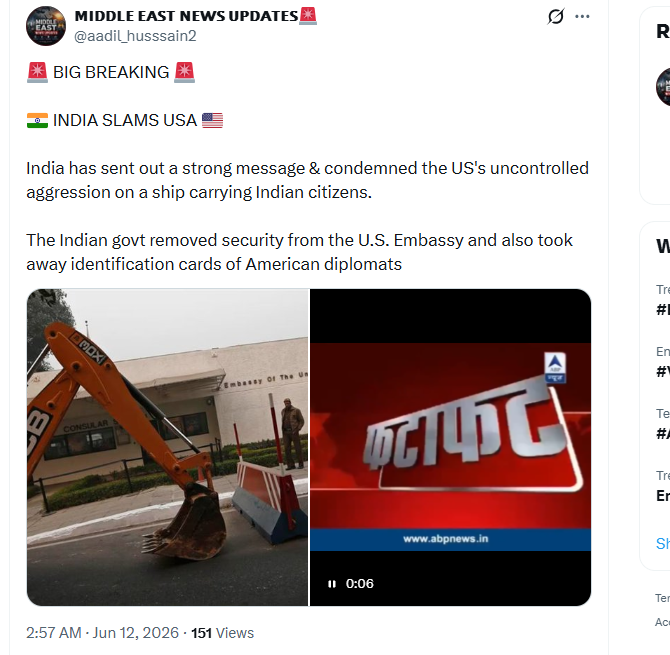
Amid ongoing tensions in West Asia and concerns over the safety of commercial vessels carrying Indian crew members, a purported ABP News video clip has been circulating on social media. The clip, along with an accompanying image, claims that in response to alleged US attacks on ships carrying Indian citizens, the Indian government removed security arrangements outside the US Embassy in New Delhi and withdrew identity cards issued to American diplomats. The viral post also includes an image showing a JCB machine near the US Embassy, which users are sharing as alleged evidence of recent government action against the United States CyberPeace Research Wing research found the claim to be misleading. The probe revealed that both the video clip and the image are not recent and are in fact related to events from 2013, during the diplomatic tensions following the arrest of Indian diplomat Devyani Khobragade.
Claim:
On X (formerly Twitter), a user shared the viral clip alleging that India strongly condemned the US over reported attacks on a vessel carrying Indian citizens and, in response, removed security from the US Embassy in New Delhi and revoked identity cards issued to American diplomats.
https://x.com/aadil_husssain2/status/2065184188157043053
https://ghostarchive.org/archive/A5Py5
Fact Check
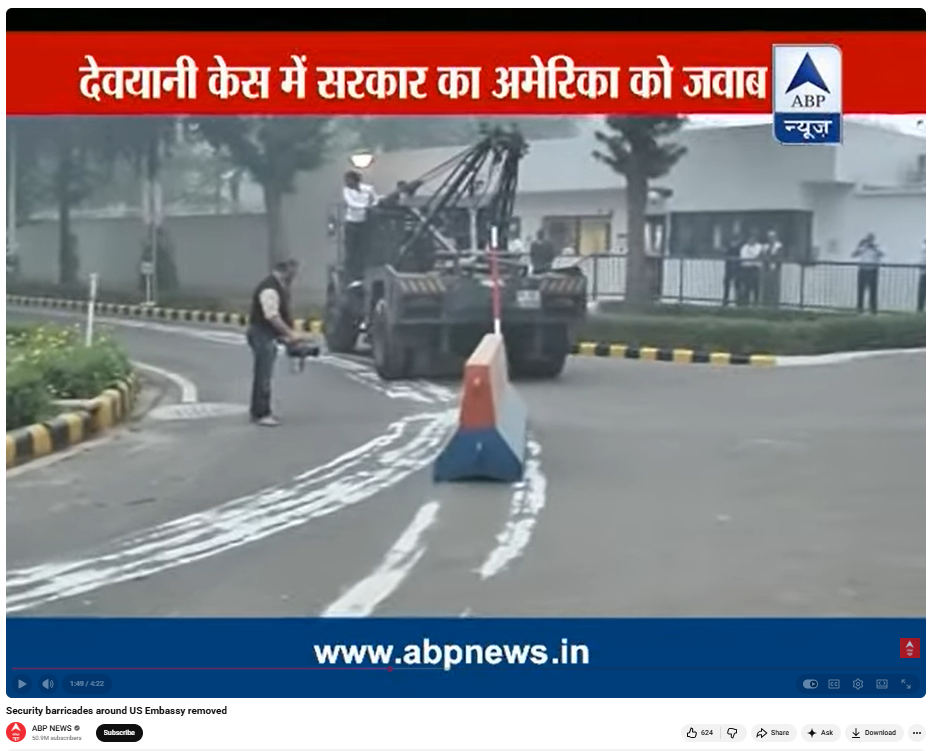
A keyword search related to the alleged removal of security outside the US Embassy did not yield any recent credible reports supporting the claim. We also observed that the ABP News logo visible in the viral clip is an older version that is no longer in use, raising further doubts about its authenticity and timeline. To verify the footage, we checked ABP News’ official YouTube channel and found a report dated December 17, 2013. The report stated that Delhi Police had removed security barricades outside the US Embassy in New Delhi following diplomatic tensions between India and the United States over the arrest and treatment of Indian diplomat Devyani Khobragade in New York. The visuals in the 2013 report closely match multiple segments seen in the viral clip. The footage originally aired as part of ABP News’ “Fatafat” bulletin.
https://www.youtube.com/watch?v=Qrm_UcL1zOk&t=139s
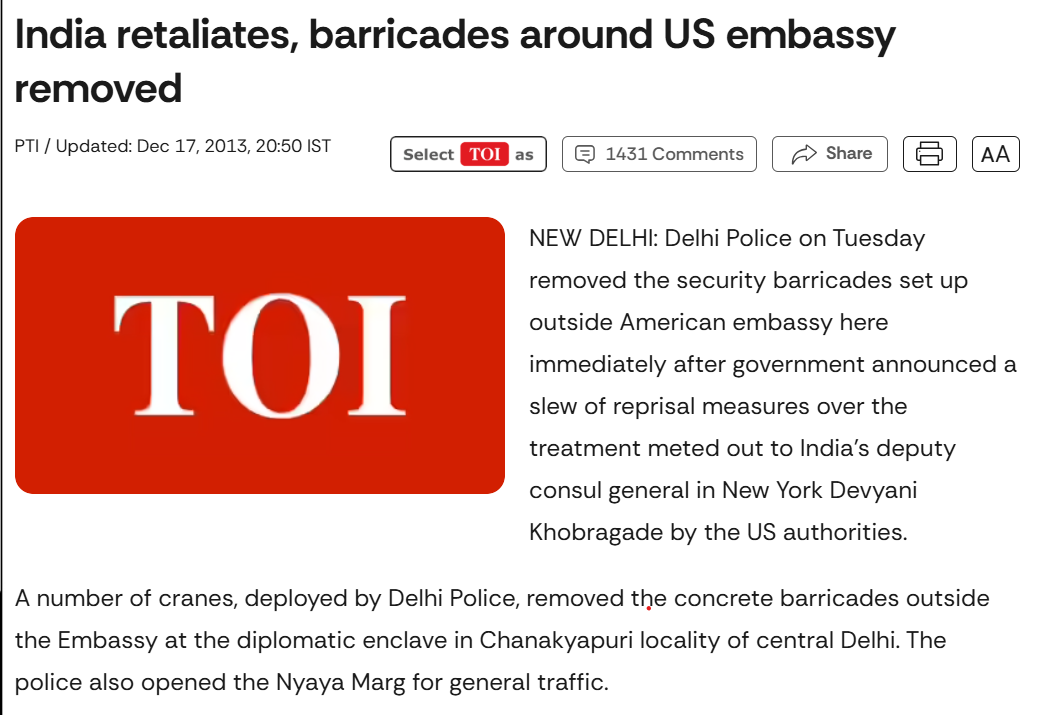
Further search also led to a PTI-reported article published by Times of India on December 17, 2013. According to the report, barricades outside the US Embassy were removed as part of India’s response to the Khobragade incident. The report also mentioned that India had sought the return of identity cards issued to American consular officials and rolled back certain diplomatic privileges.
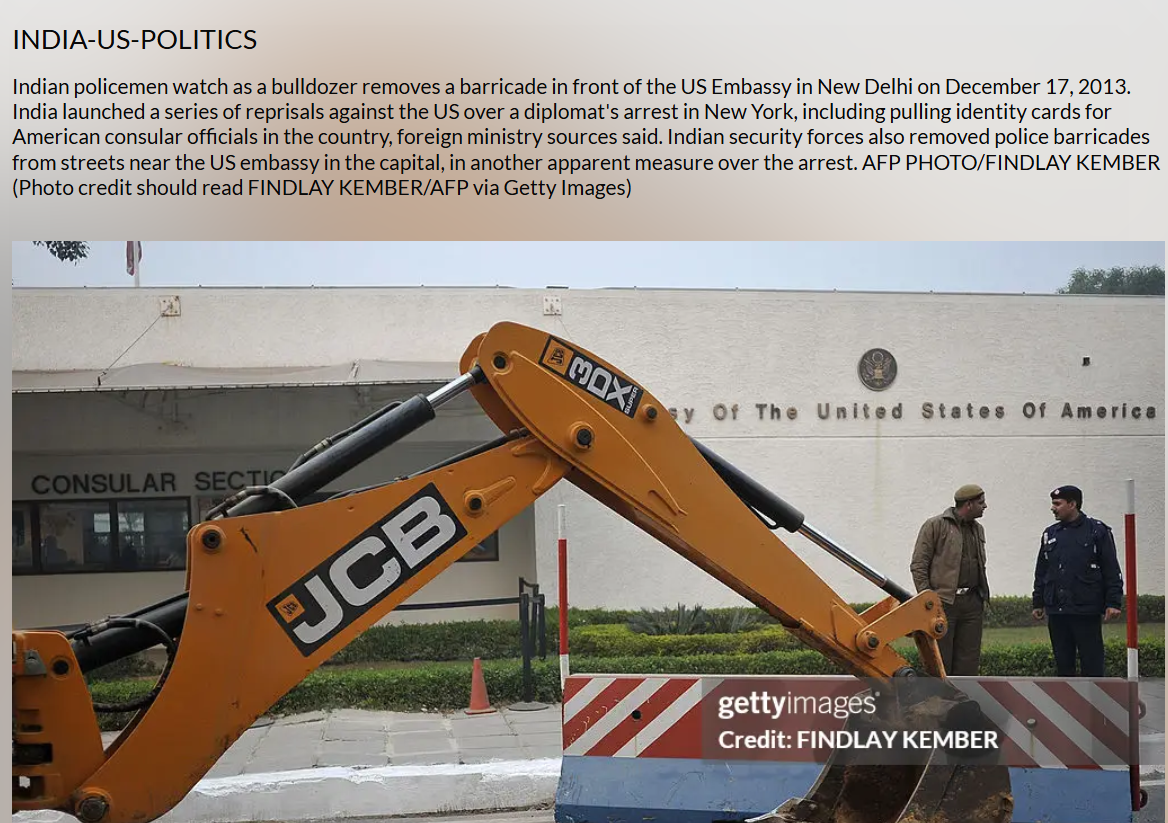
The image being shared alongside the claim, showing a JCB machine near the US Embassy, is also old. Getty Images carries photographs dated December 17, 2013 showing barricades being removed outside the US Embassy in New Delhi during the same diplomatic episode.
Conclusion:
The research clearly establishes that both the viral video clip and the accompanying image are not recent. These visuals are from 2013 and are linked to diplomatic developments following the Devyani Khobragade case. The claim linking them to recent events involving US Embassy security arrangements is misleading.

Related Blogs
Executive Summary
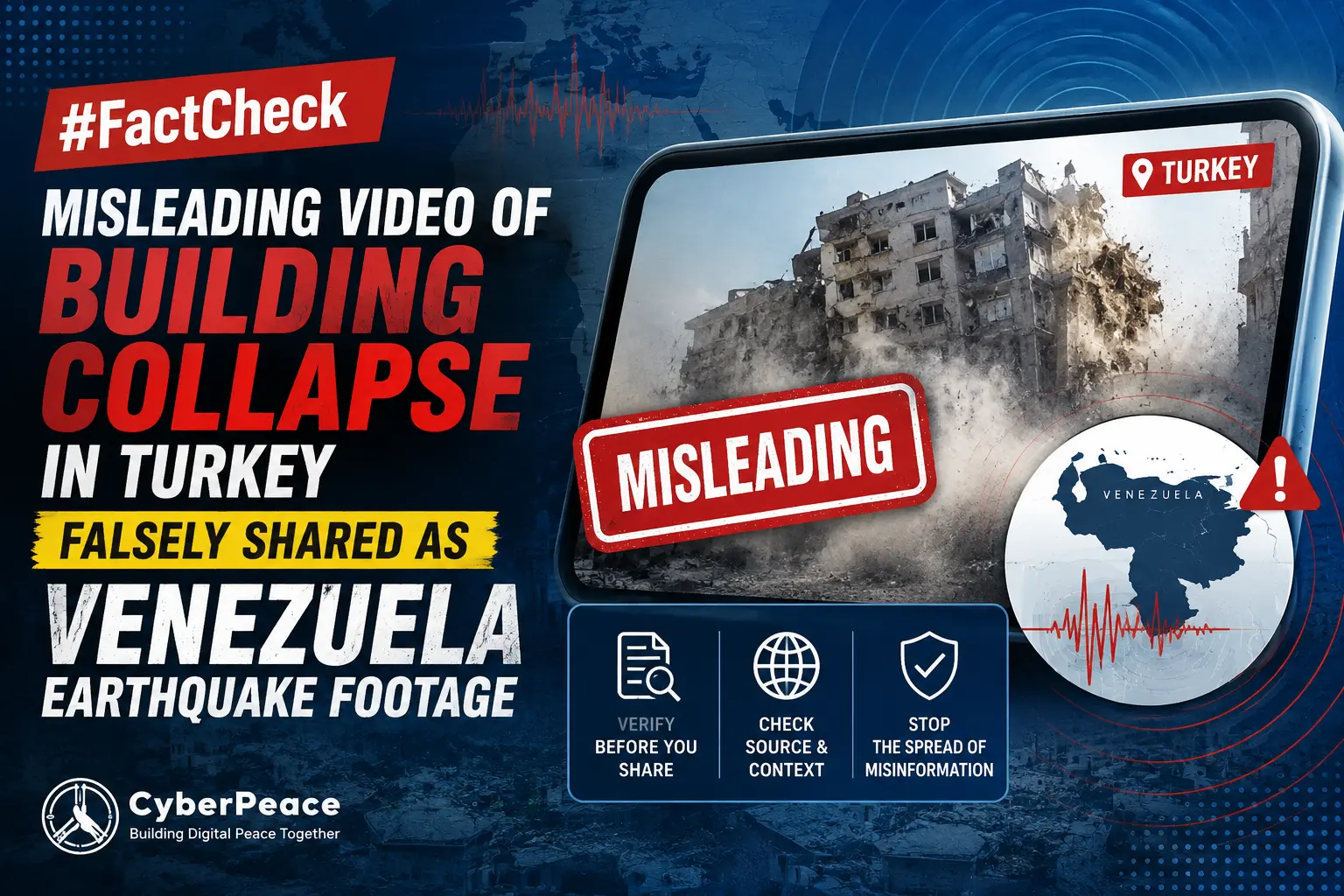
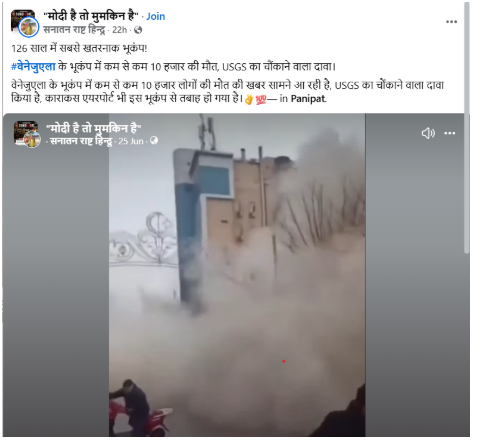
A video is being widely shared on social media, claiming it shows a terrifying scene from a recent earthquake in Venezuela. The 9-second clip shows a multi-storey building collapsing like a house of cards, while people nearby are seen running in panic as chaos unfolds. The video is being widely circulated by users as evidence of massive destruction caused by the alleged earthquake in Venezuela. CyberPeace Research Wing research found the claim to be misleading. The viral video has no connection to any recent earthquake in Venezuela. In fact, the footage is from a completely different event that took place nearly three years ago in Turkey. It is being falsely shared with a wrong context on social media.
Claim:
A Facebook user shared the viral video with the caption: “The most dangerous earthquake in 126 years! At least 10,000 deaths in Venezuela earthquake, shocking claim by USGS. Reports say massive destruction has occurred, Caracas airport has also been destroyed. Statement by Yogi Adityanath after Bharat Tiwari’s encounter.” The post link, archived link, and screenshots are provided below.
https://www.facebook.com/groups/2438255879794217/posts/4830038697282578/
FactCheck
To verify the claim, we performed a reverse image search of the video keyframes using Google Lens. During the search, we found the same video on WION’s Facebook page, where it was published on February 6, 2023. The original post link and screenshots are provided below. https://www.facebook.com/watch/?v=917786002738401
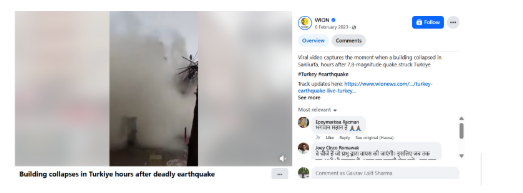
The original caption of the video clearly states that it shows a building collapse in Sanliurfa, Turkey, occurring hours after the 7.8-magnitude earthquake that struck the country. Based on clues from the Facebook post, we further searched using relevant keywords and found a report published by The Guardian on February 6, 2023, which also included the viral footage. https://www.theguardian.com/world/video/2023/feb/06/building-collapses-earthquake-aftershock-turkey-video
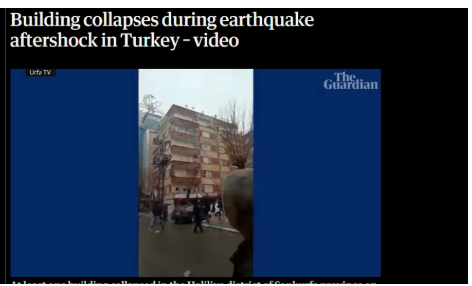
The report confirms that the video is from the aftermath of the devastating 2023 Turkey earthquake in Sanliurfa, not Venezuela.
Conclusion:
Our research confirms that the viral video has no connection to any recent earthquake in Venezuela. The footage is actually from the 2023 Turkey earthquake and is being falsely shared with a misleading context on social media.

Introduction
In today's era of digitalised community and connections, social media has become an integral part of our lives. A large number of teenagers are also active and have their accounts on social media. They use social media to connect with their friends and family. Social media offers ease to connect and communicate with larger communities and even showcase your creativity. On the other hand, it also poses some challenges or issues such as inappropriate content, online harassment, online stalking, misuse of personal information, abusive and dishearted content etc. There could be unindented consequences on teenagers' mental health by such threats or overuse of social media. The data shows some teens spend hours a day on social media hence it has a larger impact on them whether we notice it or not. Social media addiction and its negative repercussions such as overuse of social media by teens and online threats and vulnerabilities is a growing concern that needs to be taken seriously by social media platforms, regulatory policies and even user's responsibilities. Recently Colorado and California led a joint lawsuit filed by 33 states in the U.S. District Court for the Northern District of California against meta on the concern of child safety.
Meta and concern of child users safety
Recently Meta, the company that owns Facebook, Instagram, WhatsApp, and Messenger, has been sued by more than three dozen states for allegedly using features to hook children to its platforms. The lawsuit claims that Meta violated consumer protection laws and deceived users about the safety of its platforms. The states accuse Meta of designing manipulative features to induce young users' compulsive and extended use, pushing them into harmful content. However, Meta has responded by stating that it is working to provide a safer environment for teenagers and expressing disappointment in the lawsuit.
According to the complaint filed by the states, Meta “designed psychologically manipulative product features to induce young users’ compulsive and extended use" of platforms like Instagram. The states allege that Meta's algorithms were designed to push children and teenagers into rabbit holes of toxic and harmful content, with features like "infinite scroll" and persistent alerts used to hook young users. However, meta responded with disappointment with a lawsuit stating that meta working productively with companies across the industry to create clear, age-appropriate standards for the many apps.
Unplug for sometime
Overuse of social media is associated with increased mental health repercussions along with online threats and risks. Social media’s effect on teenagers is driven by factors such as inadequate sleep, exposure to cyberbullying and online threats and lack of physical activity. Its admitted that social media can help teens feel more connected to their friends and their support system and showcase their creativity to the online world. However, social media overuse by teens is often linked with underlying issues that require attention. To help teenagers, encourage them for responsible use and unplug from social media for some time, encourage them to get outside in nature, do physical activities, and express themselves creatively.
Understanding the threats & risks
- Psychological effects
- Addiction: Excessive use of social media will lead to procrastination and excessively using social media can lead to physical and psychological addiction because it triggers the brain's reward system.
- Mental Conditions Associated: Excessively using social media can be harmful for mental well-being which can also lead to depression and anxiety, self-consciousness and may also lead to social anxiety disorder.
- Eyes, Carpal tunnel syndrome: Excessive spending time on screen may lead to put a real strain on your eyes. Eye problems caused by computer/phone screen use fall under computer vision syndrome (CVS). Carpal tunnel syndrome is caused by pressure on the median nerve.
- Cyberbullying: Cyberbullying is one of the major concerns faced in online interactions on social media. Cyberbullying takes place using the internet or other digital communication technology to bully, harass, or intimidate others and it has become a major concern of online harassment on popular social media platforms. Cyberbullying may include spreading rumours or posting hurtful comments. Cyberbullying has emerged as a phenomenon that has a socio-psychological impact on the victims.
- Online grooming: Online grooming is defined as the tactics abusers deploy through the internet to sexually exploit children. The average time for a bad actor to lure children into his trap is 3 minutes, which is a very alarming number.
- Ransomware/Malware/Spyware: Cybercrooks impose threats such as ransomware, malware and spyware by deploying malicious links on social media. This poses serious cyber threats, and it causes consequences such as financial losses, data loss, and reputation damage. Ransomware is a type of malware which is designed to deny a user or organisation access to their files on the computer. On social media, cyber crooks post malicious links which contain malware, and spyware threats. Hence it is important to be cautious before clicking on any such suspicious link.
- Sextortion: Sextortion is a crime where the perpetrator threatens the victim and demands ransom or asks for sexual favours by threatening the victim to expose or reveal the victim’s sexual activity. It is a kind of sexual blackmail, it may take place on social media and youngsters are mostly targeted. The cyber crooks also misuse the advanced AI Deepfake technology which is capable of creating realistic images or videos which in actuality are created by machine algorithms. Deepfakes technology since easily accessible, is misused by fraudsters to commit various crimes including sextortion or deceiving and scamming people through fake images or videos which look realistic.
- Child sexual abuse material(CSAM): CSAM is inappropriate or illicit content which is prohibited by the laws and regulatory guidelines. Child while using the internet if encounters age-restricted or inappropriate content which may be harmful to them child. Through regulatory guidelines, internet service providers are refrained from hosting the CSAM content on the websites and blocking such inappropriate or CSAM content.
- In App purchases: The teen user also engages in-app purchases on social media or online gaming where they might fall into financial fraud or easy money scams. Where fraudster targets through offering exciting job offers such as part-time job, work-from-home job, small investments, liking content on social media, and earning money out of this. This has been prevalent on social media and fraudsters target innocent people ask for their personal and financial information, and commit financial fraud by scamming people on the pretext of offering exciting offers.
Safety tips:
To stay safe while using social media teens or users are encouraged to follow the best practices and stay aware of the online threats. Users must keep in regard to the best practices. Such as;
- Safe web browsing.
- Utilising privacy settings of your social media accounts.
- Using strong passwords and enabling two-factor authentication.
- Be careful about what you post or share.
- Becoming familiar with the privacy policy of the social media platforms.
- Being selective of adding unknown users to your social media network.
- Reporting any suspicious activity to the platform or relevant forum.
Conclusion:
Child safety is a major concern on social media platforms. Social media-related offences such as cyberstalking, hacking, online harassment and threats, sextortion, and financial fraud are seen as the most occurring cyber crimes on social media. The tech giants must ensure the safety of teen users on social media by implementing and adopting the best mechanisms on the platform. CyberPeace Foundation is working towards advocating for a Child-friendly SIM to protect from the illicit influence of the internet and Social Media.
References:
- https://www.scientificamerican.com/article/heres-why-states-are-suing-meta-for-hurting-teens-with-facebook-and-instagram/
- https://www.nytimes.com/2023/10/24/technology/states-lawsuit-children-instagram-facebook.html

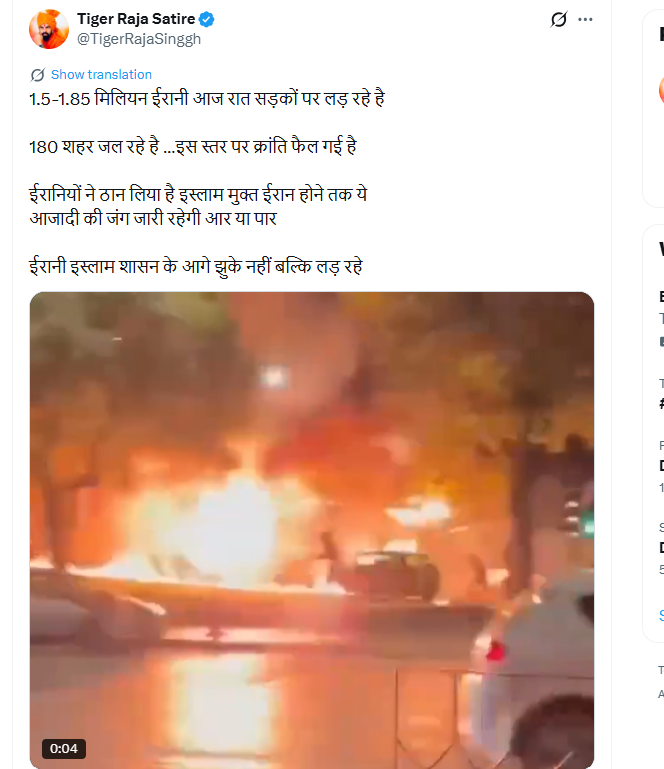
Amid reports of widespread protests in Iran over the past two weeks, a video showing protesters setting cars on fire is being widely shared on social media with claims that it depicts recent unrest in the country.
However, research by Cyber Peace Foundation has found the viral claim to be false. Our resarch shows that the video is not from Iran, but from violent protests that took place near the Turkish Consulate in Thessaloniki, Greece, on November 1, 2025.
Claim:
On January 11, 2026, users on social media platform X (formerly Twitter) shared the viral video claiming it showed massive anti-regime protests in Iran. One such post alleged:
“1.5–1.85 million Iranians are fighting on the streets tonight. 180 cities are burning… The revolution has spread. Iranians have decided to continue this fight for freedom until Iran becomes free from Islamic rule.”
The post’s link and archived version can be seen below: (Link and archive link)
Fact Check:
To verify the claim, we extracted keyframes from the viral video and conducted a Google Reverse Image Search. During this process, we found the same video uploaded on Instagram on November 2, 2025, well before the recent protests in Iran. (Link): https://www.instagram.com/reel/DQjRtCOjOPM/
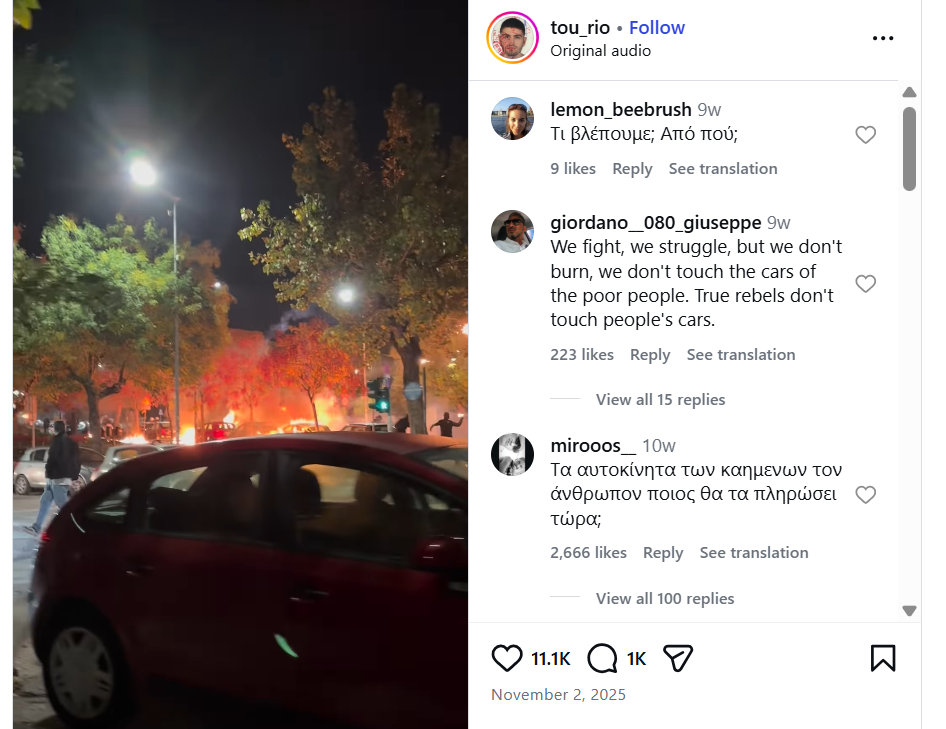
Further analysis revealed that the video was uploaded from a Greek Instagram account, indicating that the visuals are unrelated to Iran.
It is important to note that while protests in Iran have been ongoing for the past two weeks, the viral video has been circulating on the internet since early November 2025, establishing a clear timeline mismatch.
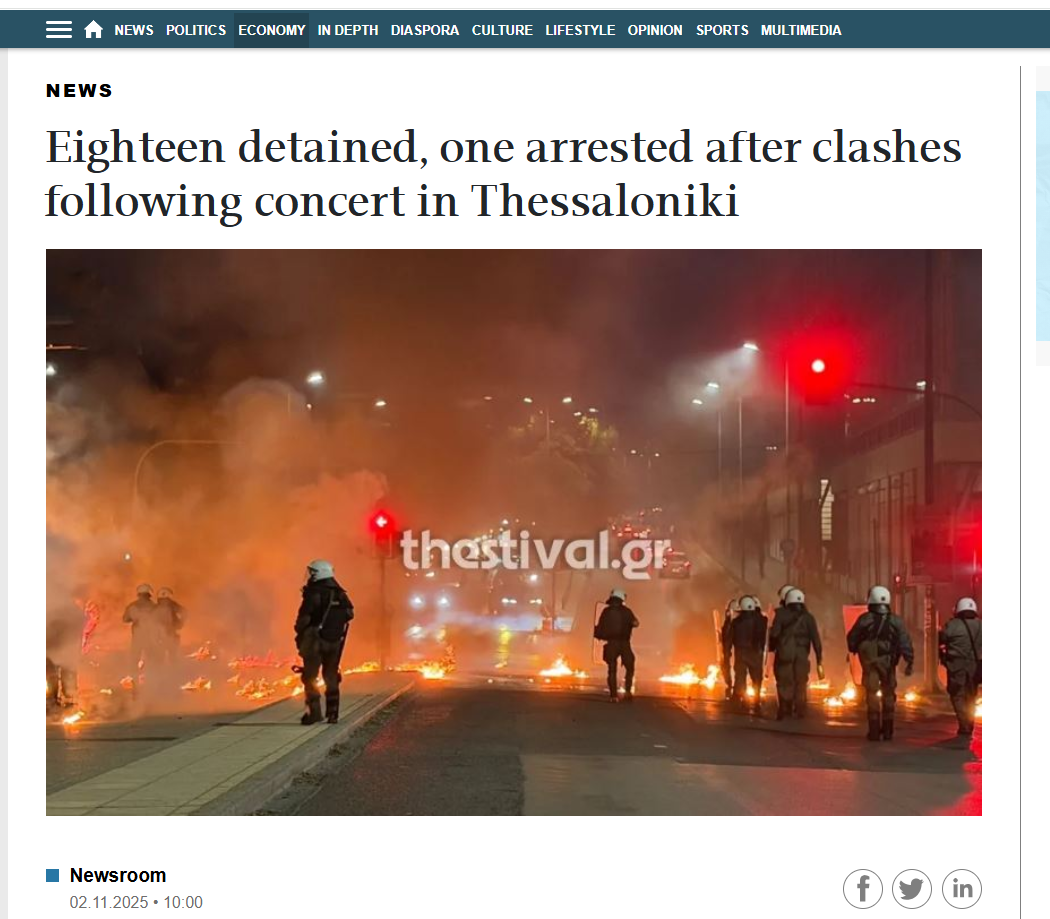
A keyword search led us to a report published on November 2, 2025, by Ekathimerini, a leading Greek media outlet. The report detailed violent clashes that erupted in Thessaloniki following a concert by Greek rapper Lex.
According to the report:
Police in Thessaloniki detained 18 people and arrested one individual on drug-related charges. The unrest began when a group attacked police forces stationed outside the Turkish Consulate. During the clashes, six cars were damaged, two of them completely burned, along with a garbage bin. ( report link and screenshot)
In the next stage of the investigation, we found similar visuals to the viral video on a YouTube channel named “Taifer”, where the footage was published on November 2, 2025. The link to the post and its screenshot can be seen below.
(YouTube link): https://www.youtube.com/watch?v=TejETjQRmTQ
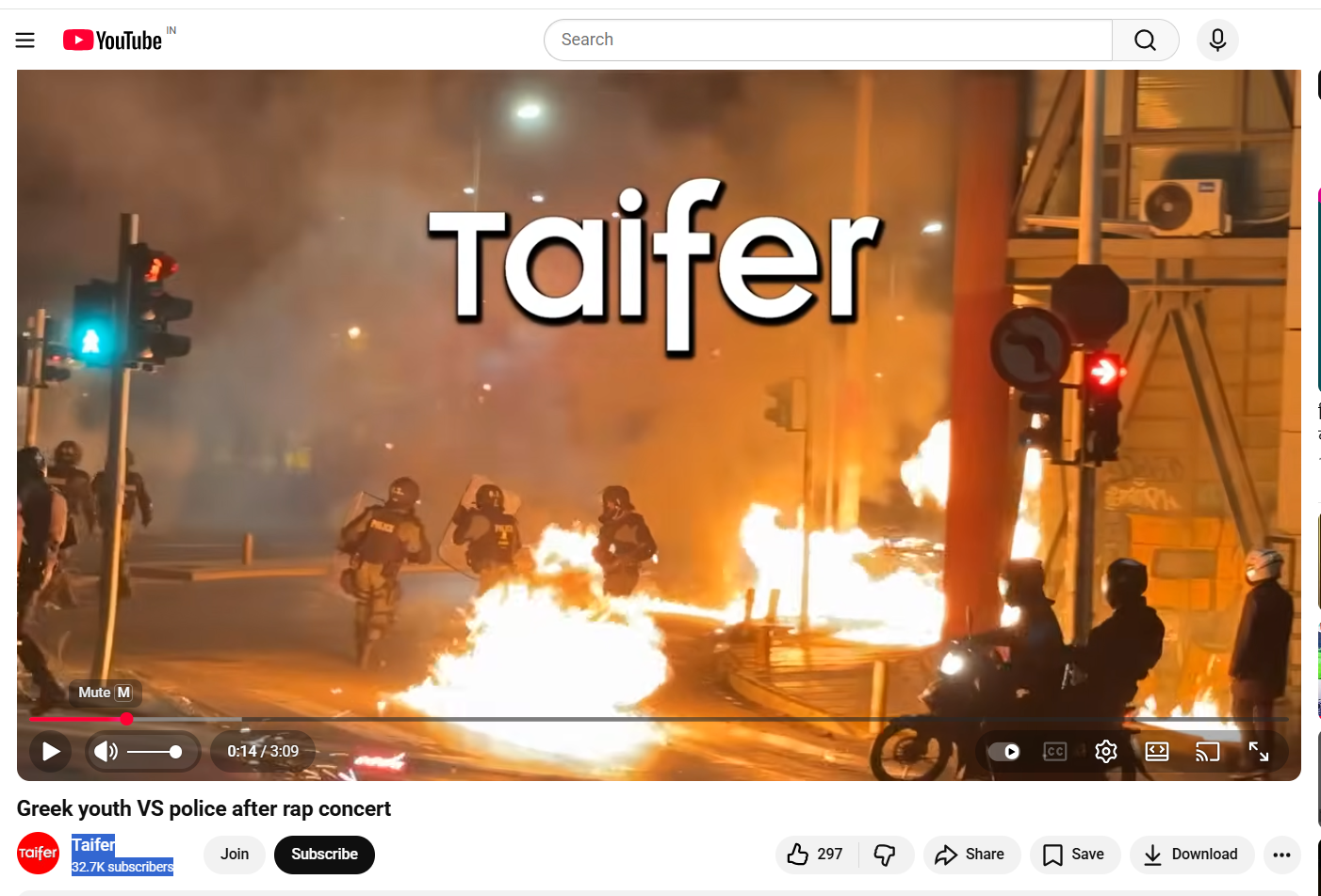
To strengthen our findings, we conducted a geolocation analysis of the video. By comparing road layouts, surrounding buildings, light poles, and other visual markers with online maps and images, we confirmed that the location shown in the video matches Agios Dimitriou Street in Thessaloniki, Greece.
(Location link)
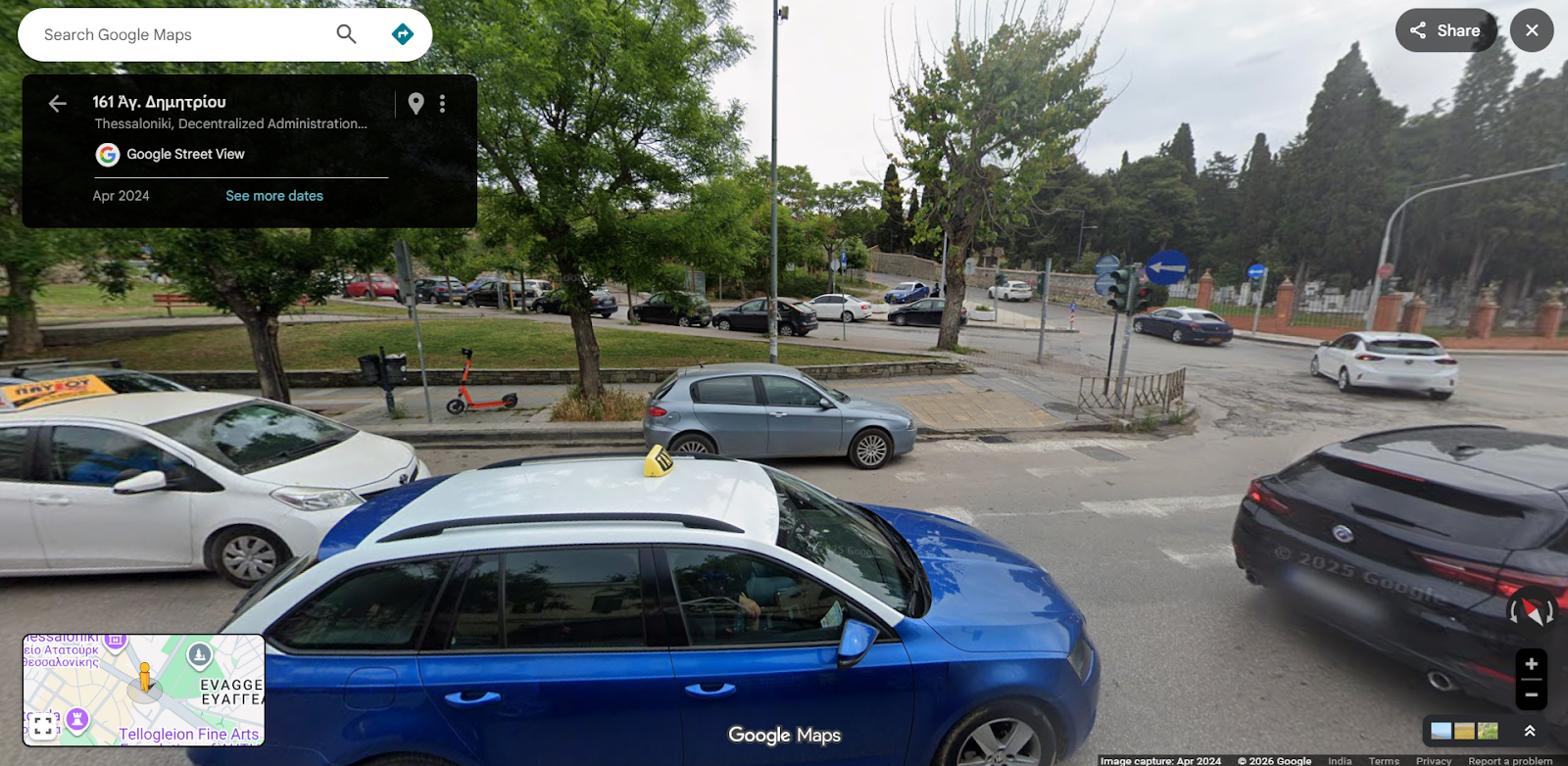
Our research clearly establishes that the viral video being shared as footage of recent protests in Iran is misleading. The video actually shows violent demonstrations near the Turkish Consulate in Thessaloniki, Greece, on November 1, 2025, and has no connection to the current situation in Iran.
