
#FactCheck- Grenade-Shaped Pen Shared as ‘Bomb’ Behind Explosions in Gujarat; Claim Is False
Executive Summary
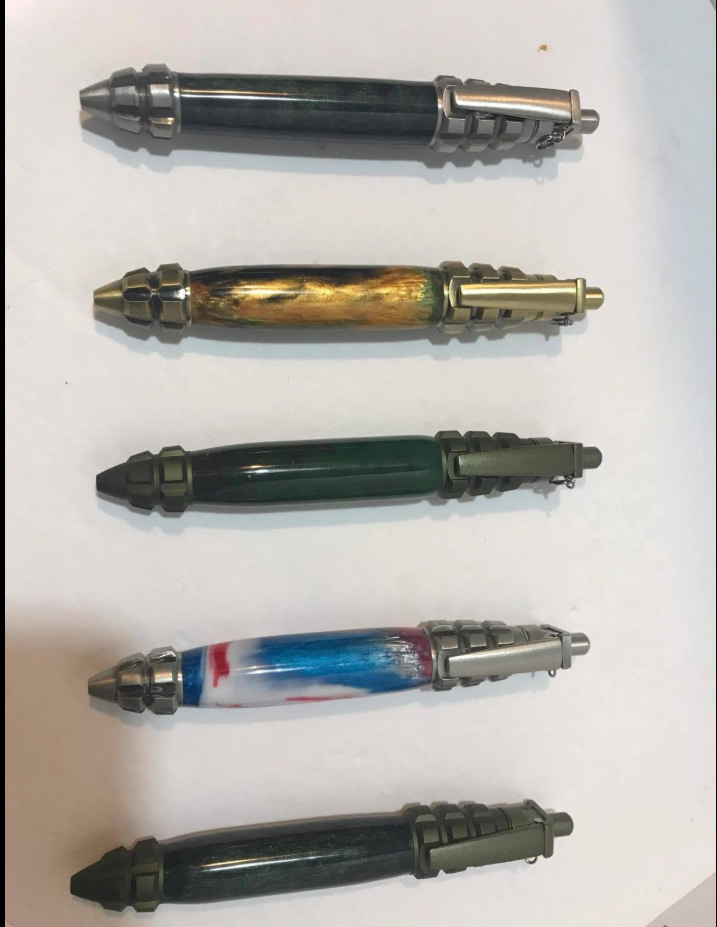
A picture of grenade-style pens is being circulated on social media with the claim that they are actually small bombs responsible for explosions in Gujarat. Users are being warned not to pick up any object resembling the pen, with posts alleging that similar devices are causing blasts in different parts of the state. CyberPeace Research Wing research found the claim to be completely false. The viral image shows a novelty military-style pen, not an explosive device. The same product is listed on the American e-commerce platform Etsy, where it is described as a military tank or grenade-style ink pen that uses refillable ink cartridges.
Claim
The viral image shows five grenade-shaped pens. It is being shared with a caption claiming: “Do not pick up anything that looks like this pen. If you find one lying somewhere, do not touch it. It is a small bomb, and incidents like this are happening wherever such pens are found in Gujarat.”The post also includes photographs of injured individuals to reinforce the claim.
https://www.facebook.com/groups/273456550609813/posts/1721798935775560/
Fact Check
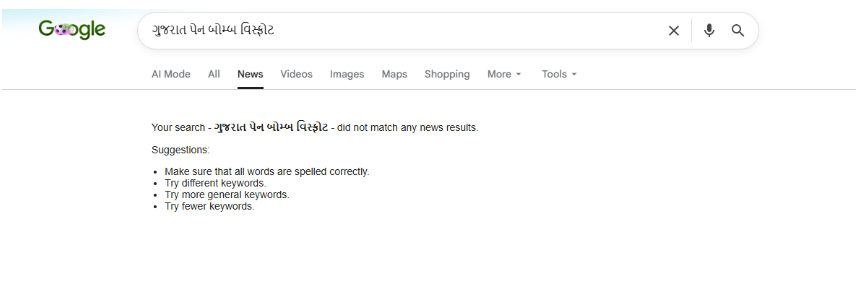
To verify the claim, we first searched for relevant news reports using English and Gujarati keywords. However, we found no credible media reports linking grenade-shaped pens to any explosions in Gujarat. During the search, we came across reports mentioning that certain Khalistani groups had allegedly sent emails threatening blasts in Ahmedabad and Gandhinagar. However, none of those reports mentioned grenade-style pens or any similar explosive devices.
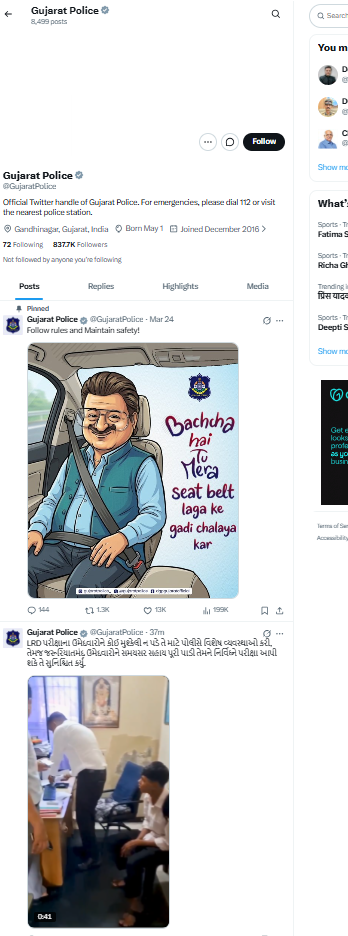
We also checked whether Gujarat Police had issued any warning, advisory, or public notice regarding such objects. However, no such advisory was found on any official Gujarat Police social media handle or public platform.
Next, we conducted a reverse image search of the viral photograph. The search led us to a listing on the American e-commerce website Etsy, where the product is described as a “Military Novelty Tank or Grenade Ink Pen.”
https://www.etsy.com/listing/889188479/military-novelty-tank-or-grenade-ink

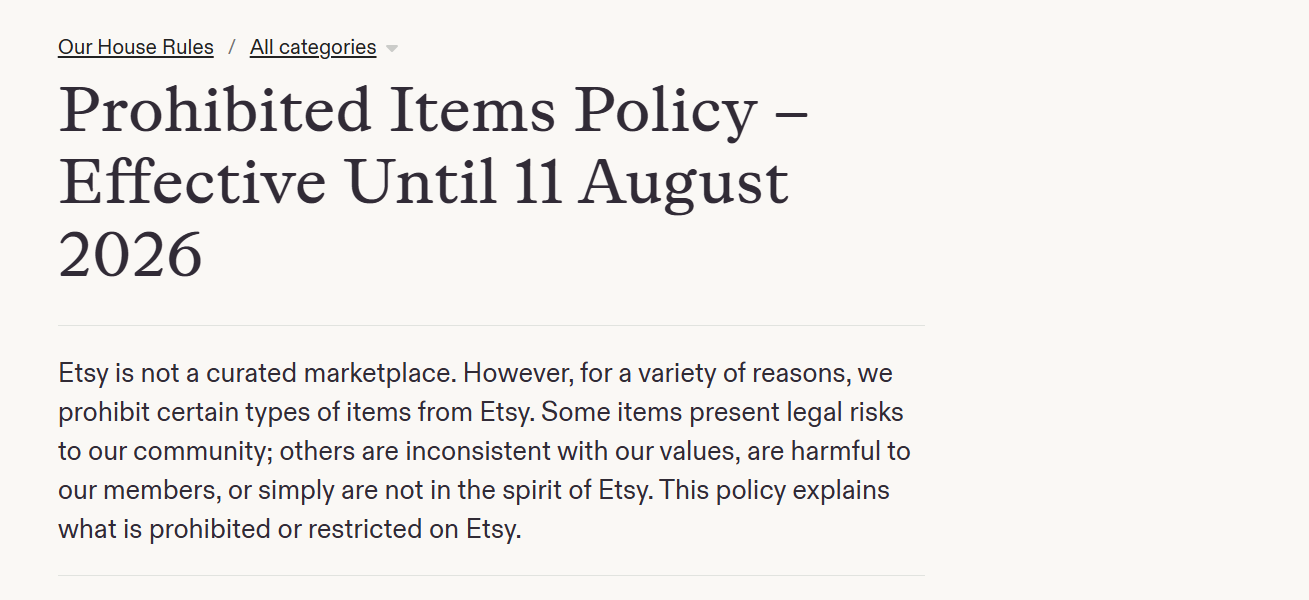
The product description indicates that it is a novelty writing instrument that uses refillable ink cartridges and is intended purely as a decorative or novelty item. We also reviewed Etsy’s prohibited items policy. According to the platform, weapons, explosives, and other dangerous items are not permitted to be sold on the website.
https://www.etsy.com/legal/prohibited/
Additionally, we attempted to contact Michael Dobbs, associated with the product listing, for clarification. This report will be updated if a response is received.
Conclusion
The evidence gathered during our research clearly shows that the claim is false. The viral image does not depict a bomb but a novelty grenade-style ink pen sold online. There is no evidence that such pens are causing explosions in Gujarat, and the claim being circulated on social media is entirely misleading.

Related Blogs

Executive Summary
Even after the conclusion of the Cockroach Janata Party (CJP) protest at Delhi’s Jantar Mantar, several misleading claims related to the demonstration continue to circulate on social media. During the protests, multiple AI-generated videos, deepfakes and fabricated narratives were circulated with the intention of misleading users. CyberPeace Research Wing’s Fact Check Team investigated several such viral claims and found that many of the videos were digitally manipulated or created using artificial intelligence (AI). The research revealed that fake audio, misleading captions and altered visuals were used to falsely attribute statements to public figures, including police officials, military officers and Union ministers. The following are four major false claims debunked by the CyberPeace Research Wing:
Claim 1: Delhi Police DCP Sumit Jha resigned from IPS in support of student protests
A video of Delhi Police DCP Sumit Jha was widely shared on social media with the claim that he resigned from the Indian Police Service (IPS) in support of the student movement at Jantar Mantar. In the viral video, DCP Sumit Jha is allegedly heard saying that he was resigning from his post with immediate effect and could not remain part of a system that forced him to spread false information against students. The video was shared with the claim that Delhi Police DCP Sumit Jha resigned from his position to support protesting students.
Claim
An Instagram user shared the viral video on July 28, 2026, claiming that Delhi Police DCP Sumit Jha had resigned from his post in support of protesting students.
https://www.instagram.com/reel/DbUr6CPoB13/

Fact Check
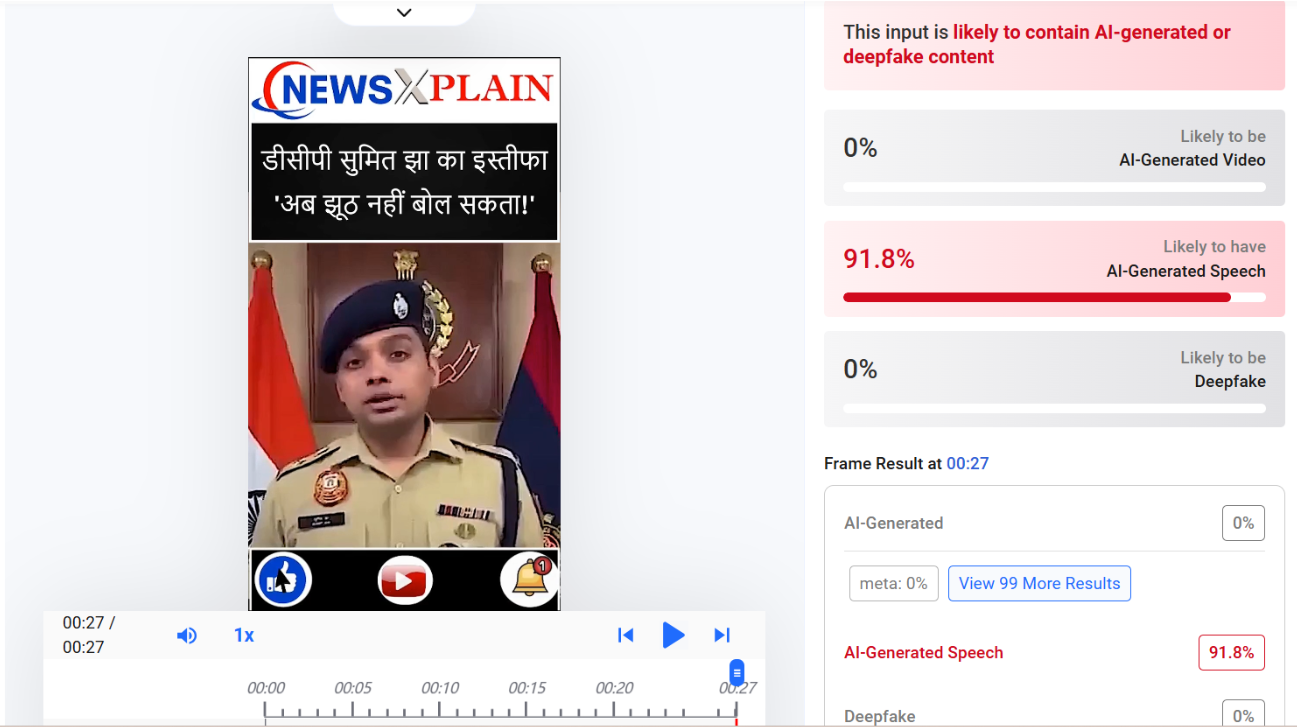
CyberPeace Research Wing’s research found the claim to be false. The research revealed that DCP Sumit Jha has not resigned from his position. The viral video was digitally manipulated by adding AI-generated audio to an original video shared by the Delhi Police on its official X account on July 23, 2026.
The video was further analysed using the AI detection tool HIVE Moderation. The tool’s analysis indicated that the audio used in the viral video had a 91.8 per cent probability of being AI-generated, confirming that the audio was artificially created and was not authentic.
Claim 2: CDS Raja Subramani confirmed that more than 30,000 soldiers resigned over Jantar Mantar protests
A video featuring Chief of Defence Staff (CDS) General Raja Subramani was widely circulated on social media with the false claim that he confirmed the resignation of more than 30,000 Indian Army personnel following the Jantar Mantar protest. The viral video claimed that soldiers had refused to serve the government after police action against protesting students.
Claim
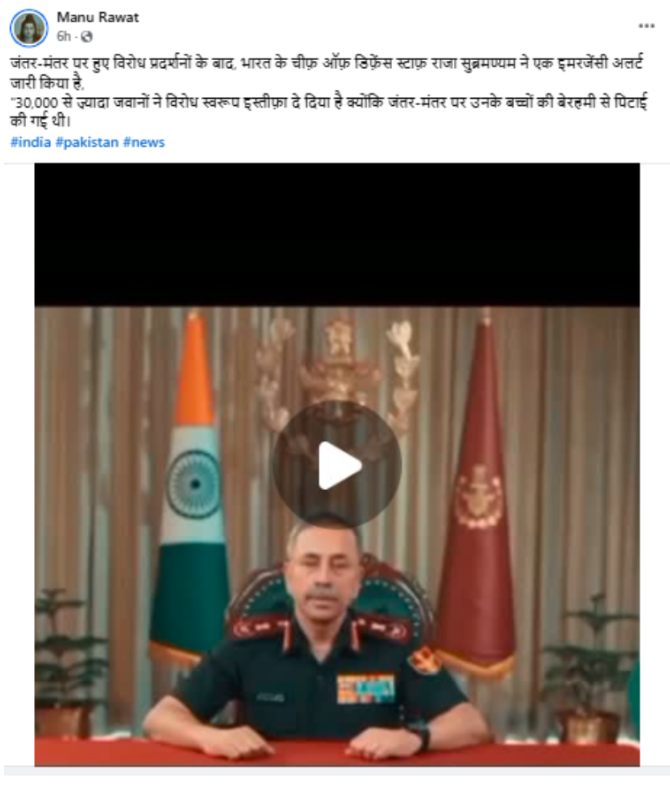
A Facebook user shared the video claiming: "After the protests at Jantar Mantar, India’s Chief of Defence Staff Raja Subramani has issued an emergency alert, saying that more than 30,000 soldiers have resigned in protest because their children were brutally beaten at Jantar Mantar."
Fact Check
CyberPeace Research Wing’s research found the claim to be false. The research revealed that the video featuring CDS Raja Subramani was digitally manipulated using AI-generated audio. The original video did not contain any statement related to soldiers resigning or the Jantar Mantar protest. Further research led us to the same video posted by the Instagram account myyouthindia, where CDS Raja Subramani can be seen extending his best wishes to teams participating in the 135th Indian Oil Durand Cup Football Tournament. https://www.instagram.com/reels/DbEGRGBsKv8/

The audio circulating with the viral video was falsely added to create a misleading narrative.
Claim 3: Defence Minister Rajnath Singh warned protesters of strict action
A video featuring Union Defence Minister Rajnath Singh was widely circulated on social media with the claim that he issued a strict warning against student protesters. In the viral clip, Singh was allegedly heard saying that the government would not tolerate “anarchy” and that strict action would be taken against those blocking roads, disturbing public order or damaging government property.
Claim
An X user (@ForumDefence) shared the video on July 22, 2026, claiming that Rajnath Singh had issued a warning regarding the ongoing student protest.

Fact Check
CyberPeace Research Wing’s research found the claim to be false.The original video available on Rajnath Singh’s official YouTube channel was digitally altered by adding AI-generated audio. The statement heard in the viral video was not made by the Defence Minister and was created using artificial intelligence. The viral video was also analysed using the AI detection tool HIVE Moderation. The analysis indicated that the speech used in the video had an 88.1 per cent probability of being AI-generated.

Claim 4: Piyush Goyal threatened to hang CJP supporters
A video of Union Minister Piyush Goyal was shared on social media with the false claim that he threatened protesters and called for two to three CJP supporters to be hanged to "teach the rest of them a lesson." In the AI-manipulated video, Goyal was allegedly heard saying: "To teach the CJP a lesson, we should hang two to three of its supporters so that they understand the real power of the government."
https://x.com/HinduReformer/status/2080367073117790288?s=20

Fact Check
CyberPeace Research Wing’s research found that the viral video was digitally manipulated using AI-generated audio. The original video, posted on the Press Trust of India’s official X account, showed Piyush Goyal discussing the government’s response to examination paper leaks and appealing for the issue to be resolved through dialogue. He made no remarks threatening protesters or calling for the execution of CJP supporters.
The audio and statements attributed to him in the viral video were fabricated using AI technology.

Conclusion
CyberPeace Research Wing’s research found that all four viral claims related to the CJP protest were false. The videos circulating on social media were either digitally manipulated or created using AI-generated audio to falsely attribute statements to public officials. The research highlights how AI-generated deepfakes and manipulated content are increasingly being used to spread misinformation during sensitive events.

Introduction
Misinformation in India has emerged as a significant societal challenge, wielding a potent influence on public perception, political discourse, and social dynamics. A potential number of first-time voters across India identified fake news as a real problem in the nation. With the widespread adoption of digital platforms, false narratives, manipulated content, and fake news have found fertile ground to spread unchecked information and news.
In the backdrop of India being the largest market of WhatsApp users, who forward more content on chats than anywhere else, the practice of fact-checking forwarded information continues to remain low. The heavy reliance on print media, television, unreliable news channels and primarily, social media platforms acts as a catalyst since studies reveal that most Indians trust any content forwarded by family and friends. It is noted that out of all risks, misinformation and disinformation ranked the highest in India, coming before infectious diseases, illicit economic activity, inequality and labour shortages. World Economic Forum analysts, in connection with their 2024 Global Risk Report, note that “misinformation and disinformation in electoral processes could seriously destabilise the real and perceived legitimacy of newly elected governments, risking political unrest, violence and terrorism and long-term erosion of democratic processes.”
The Supreme Court of India on Misinformation
The Supreme Court of India, through various judgements, has noted the impact of misinformation on democratic processes within the country, especially during elections and voting. In 1995, while adjudicating a matter pertaining to keeping the broadcasting media under the control of the public, it noted that democracy becomes a farce when the medium of information is monopolized either by partisan central authority or by private individuals or oligarchic organizations.
In 2003, the Court stated that “Right to participate by casting a vote at the time of election would be meaningless unless the voters are well informed about all sides of the issue in respect of which they are called upon to express their views by casting their votes. Disinformation, misinformation, non-information all equally create an uninformed citizenry which would finally make democracy a mobocracy and a farce.” It noted that elections would be a useless procedure if voters remained unaware of the antecedents of the candidates contesting elections. Thus, a necessary aspect of a voter’s duty to cast intelligent and rational votes is being well-informed. Such information forms one facet of the fundamental right under Article 19 (1)(a) pertaining to freedom of speech and expression. Quoting James Madison, it stated that a citizen’s right to know the true facts about their country’s administration is one of the pillars of a democratic State.
On a similar note, the Supreme Court, while discussing the disclosure of information by an election candidate, gave weightage to the High Court of Bombay‘s opinion on the matter, which opined that non-disclosure of information resulted in misinformation and disinformation, thereby influencing voters to take uninformed decisions. It stated that a voter had the elementary right to know the full particulars of a candidate who is to represent him in Parliament/Assemblies.
While misinformation was discussed primarily in relation to elections, the effects of misinformation in other sectors have also been discussed from time to time. In particular, The court highlighted the World Health Organisation’s observation in 2021 while discussing the spread of COVID-19, noting that the pandemic was not only an epidemic but also an “infodemic” due to the overabundance of information on the internet, which was riddled with misinformation and disinformation. While condemning governments’ direct or indirect threats of prosecution to citizens, it noted that various citizens who relied on the internet to provide help in securing medical facilities and oxygen tanks were being targeted by alleging that the information posted by them was false and was posted to create panic, defame the administration or damage national image. It instructed authorities to cease such threats and prevent clampdown on information sharing.
More recently, in Facebook v. Delhi Legislative Assembly [(2022) 3 SCC 529], the apex court, while upholding the summons issued to Facebook by the Delhi Legislative Assembly in the aftermath of the 2020 Delhi Riots, noted that while social media enables equal and open dialogue between citizens and policymakers, it is also a tool in the where extremist views are peddled into mainstream media, thereby spreading misinformation. It noted Facebook’s role in the Mynmar, where misinformation and posts that Facebook employees missed fueled offline violence. Since Facebook is one of the most popular social media applications, the platform itself acts as a power center by hosting various opinions and voices on its forum. This directly impacts the governance of States, and some form of liability must be attached to the platform. The Supreme Court objected to Facebook taking contrary stands in various jurisdictions; while in the US, it projected itself as a publisher, which enabled it to maintain control over the material disseminated from its platform, while in India, “it has chosen to identify itself purely as a social media platform, despite its similar functions and services in the two countries.”
Conclusion
The pervasive issue of misinformation in India is a multifaceted challenge with profound implications for democratic processes, public awareness, and social harmony. The alarming statistics of fake news recognition among first-time voters, coupled with a lack of awareness regarding fact-checking organizations, underscore the urgency of addressing this issue. The Supreme Court of India has consistently recognized the detrimental impact of misinformation, particularly in elections. The judiciary has stressed the pivotal role of an informed citizenry in upholding the essence of democracy. It has emphasized the right to access accurate information as a fundamental aspect of freedom of speech and expression. As India grapples with the challenges of misinformation, the intersection of technology, media literacy and legal frameworks will be crucial in mitigating the adverse effects and fostering a more resilient and informed society.
References
- https://thewire.in/media/survey-finds-false-information-risk-highest-in-india
- https://www.statista.com/topics/5846/fake-news-in-india/#topicOverview
- https://www.weforum.org/publications/global-risks-report-2024/digest/
- https://main.sci.gov.in/supremecourt/2020/20428/20428_2020_37_1501_28386_Judgement_08-Jul-2021.pdf
- Secretary, Ministry of Information & Broadcasting, Govt, of India and Others v. Cricket Association of Bengal and Another [(1995) 2 SCC 161]
- People’s Union for Civil Liberties (PUCL) v. Union of India [(2003) 4 SCC 399]
- Kisan Shankar Kathore v. Arun Dattatray Sawant and Others [(2014) 14 SCC 162]
- Distribution of Essential Supplies & Services During Pandemic, In re [(2021) 18 SCC 201]
- Facebook v. Delhi Legislative Assembly [(2022) 3 SCC 529]

Executive Summary
A video showing a massive gathering of people dressed in black is widely circulating on social media. The clip is being shared with the claim that it shows crowds mourning the funeral of Iran’s Supreme Leader Ayatollah Ali Khamenei following his alleged killing in February 2026 However, research by the CyberPeace found that the claim is misleading and the video is unrelated to Iran.
Claim:
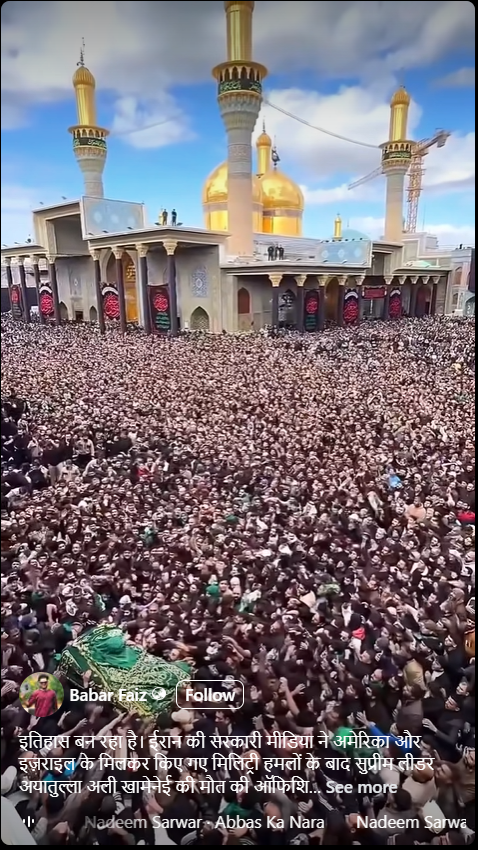
The viral video shows a large crowd gathered in a public square, with a mosque featuring a golden dome visible in the background. Social media posts claim that the footage captures mourners attending Ayatollah Khamenei’s funeral after his reported death in a joint US-Israel operation.
Fact Check:
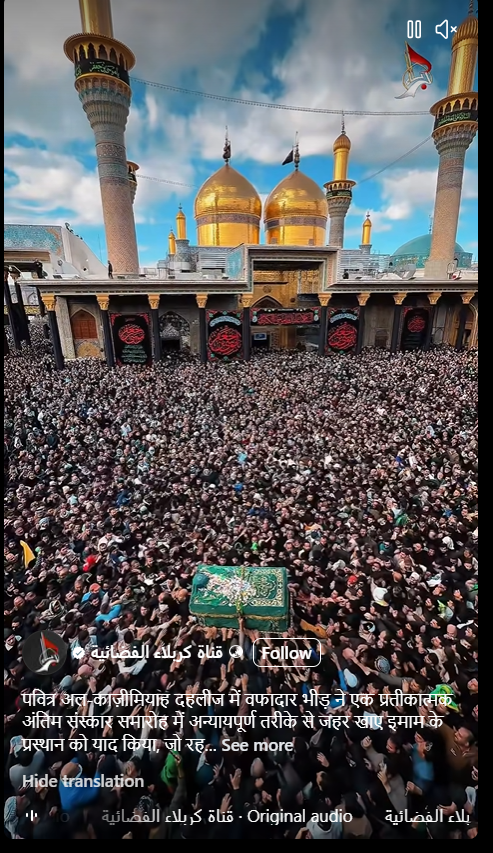
To verify the claim, we extracted keyframes from the video and conducted a reverse image search. This led us to a similar clip uploaded on January 15 by an Iraqi broadcaster, Karbala TV, on Facebook. In the footage, a large crowd can be seen carrying a symbolic coffin near a shrine with a golden dome—matching the visuals seen in the viral video. According to the Arabic caption, the video shows a “symbolic funeral” procession held at the Kazimayn Shrine in Baghdad, Iraq. The event is part of an annual religious observance commemorating Imam Musa al-Kazim, the seventh Imam in Shia Islam, who is believed to have died after being poisoned in the 8th century.
Every year, large numbers of Shia devotees gather at the shrine in Baghdad to pay their respects during this commemoration. The visuals seen in the viral clip are consistent with this annual gathering.
Conclusion:
The claim that the video shows crowds at Ayatollah Khamenei’s funeral is false. The footage is unrelated and actually depicts a religious gathering in Baghdad, Iraq, held as part of an annual Shia ritual.
