
#FactCheck -Truth Behind the Viral Snake Rain Video: AI-Generated, Not Real
Executive Summary
A shocking video claiming to show snakes raining down from the sky is going viral on social media. The clip shows what appear to be cobras and pythons falling in large numbers instead of rain, while people are seen running in panic through a marketplace. The video is being shared with the claim that it is the result of “tampering with nature” and that sudden snake rainfall occurred in an unidentified country. (Links and archived versions provided)
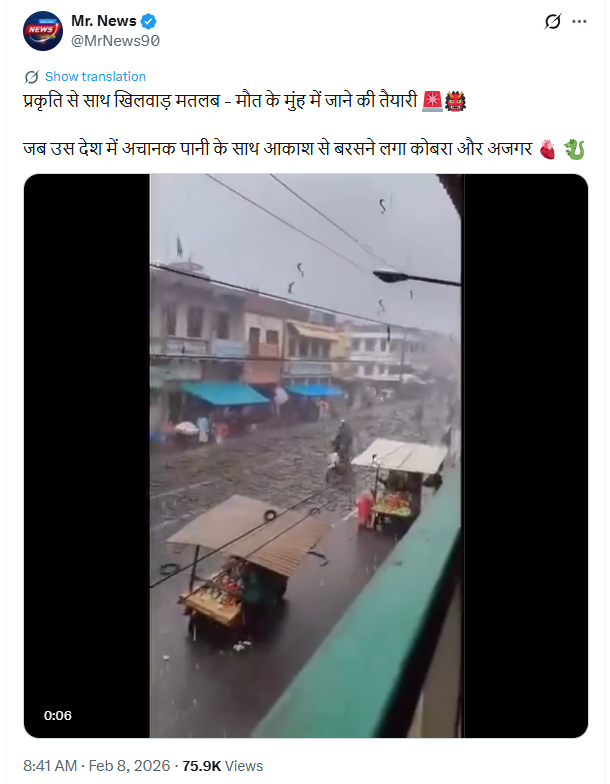
CyberPeace researched the viral claim and found it to be false. The video does not depict a real incident. Instead, it has been generated using artificial intelligence (AI).
Fact Check
To verify the authenticity of the video, we extracted keyframes and conducted a reverse image search using Google Lens. However, we did not find any credible media report linked to the viral footage. We also searched relevant keywords on Google but found no reliable national or international news coverage supporting the claim. If snakes had genuinely rained from the sky in any country, the incident would have received widespread media attention globally. A frame-by-frame analysis of the video revealed multiple inconsistencies and visual anomalies:
In the first two seconds, a massive snake appears to fall onto electric wires, yet its body passes unrealistically through the wires — something that is physically impossible. The snakes falling from the sky and crawling on the ground move in an unnatural manner. Instead of falling under gravity, they appear to float mid-air. Around the 9–10 second mark, a person lying on the ground has a visibly distorted hand structure, a common artifact seen in AI-generated videos.
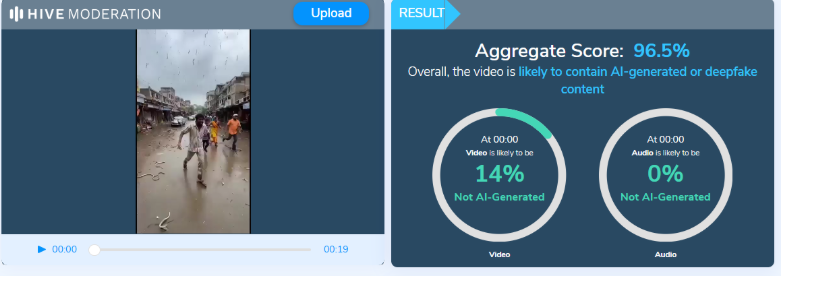
Such irregularities are typical indicators of AI-generated content. The viral video was further analyzed using the AI detection tool Hive Moderation, which indicated a 96.5% probability that the video was AI-generated.
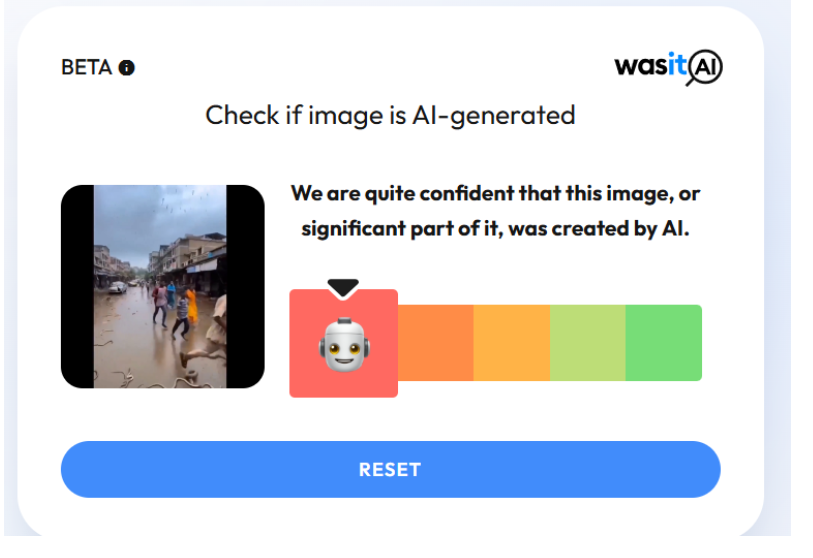
Additionally, image detection tool WasitAI also classified the visuals in the viral clip as highly likely to be AI-generated.
Conclusion
CyberPeace ’s research confirms that the viral video claiming to show snakes raining from the sky is not authentic. The footage has been created using artificial intelligence and does not depict a real event.

Related Blogs
Executive Summary
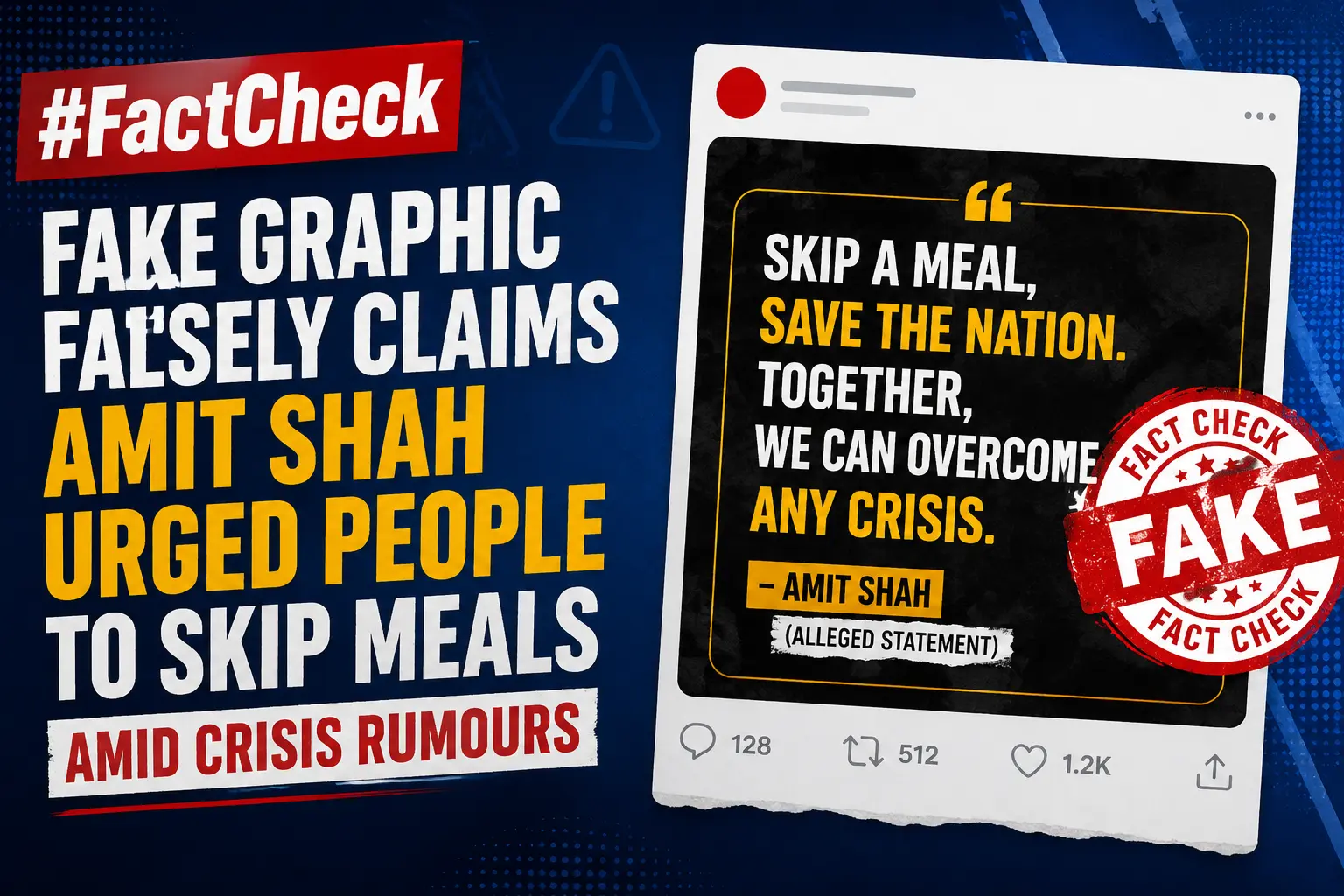
A graphic widely circulating on social media claims that Union Home Minister Amit Shah has warned, “A major crisis is coming; if possible, skip one meal a day.” The claim has been found to be false in a fact-check conducted by CyberPeace Research Wing. The research revealed that Amit Shah has not made any such statement.
Claim
A Facebook user shared the viral graphic on May 17, 2026, claiming that BJP leader and Home Minister Amit Shah issued a “warning” to the public, allegedly saying people should be prepared for a major crisis and consider skipping one meal a day. The post has been widely circulated on social media, drawing significant attention and discussion.
- https://www.facebook.com/photo.php?fbid=1509406197622070&set=pb.100056581115590.-2207520000&type=3
- https://archive.ph/Z9Tle

Factcheck
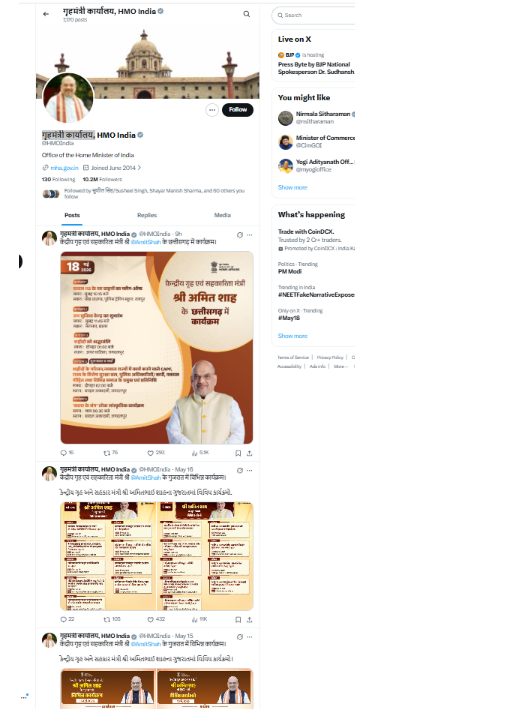
A keyword-based search on Google did not return any credible news reports supporting the claim. Further scrutiny of the official account of the Ministry of Home Affairs on X also found no mention or statement matching the viral claim.
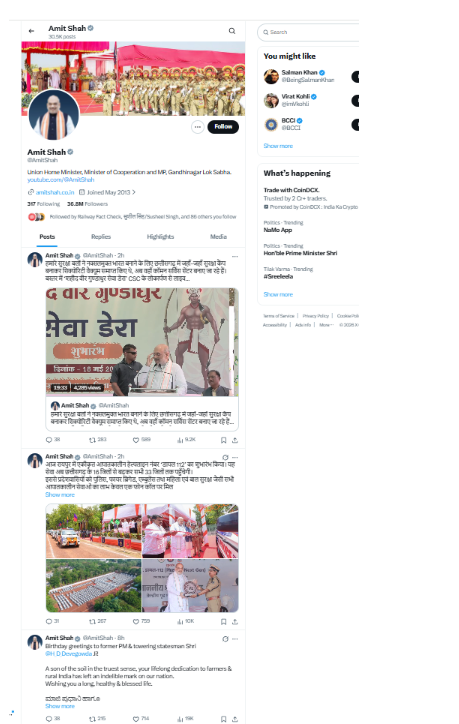
A separate review of the official X account of Home Minister Amit Shah also did not show any such statement or post confirming the viral claim.
Conclusion
The viral claim is false. Union Home Minister Amit Shah has not made any such statement.

Introduction
Emerging technologies in the digital era have made their inroads in manifold domains and locations, including the “Aviation industry”. A 2022 Cranfield University and Inmarsat report has made the point for digitalization powering a reviving age for the aviation industry. Several airport authorities are presently mobilizing power of emerging technologies such as Artificial Intelligence (AI) across the airport bedrock to provide travelers with a plain sailing and expeditious air travel experience.
The Perils of Juice-Jacking
Today, Universal Serial Bus (USB) charging ports are ubiquitous and a convenient way for travelers to keep their devices powered up. In their busy, mundane lives, people use the public charging facility while travelling. However, cybersecurity experts have warned that charging in public areas could wipe off data from an electronic device or install malware, and they have urged people to stay away from USB charging ports at airports and other public areas. This leads to the possibility that fraudsters may manipulate susceptible users via juice jacking.
Investigative journalist Brian Krebs in 2011 coined the term "Juice Jacking". It isa form of cyber attack where a public USB charging port is fiddled with and infected using hardware and software changes to pocket data or install malware on devices connected to it. The term “juice jacking” is a slang representation for electric power or energy, and “hijacking” indicates an unauthorized key toa device.
While the preliminary purpose of juice jacking is usually to pilfer sensitive information from corresponding devices, such as passwords and payment card details, attackers can exploit this stolen information to attain unauthorized to your financial accounts. If the adversary attacker installs malware in the electronic device during the juice jacking strategy, the attacker may further observe the individual's movements even after one has disconnected the device from the USB port. However, the hazards of Juice Jacking include malware infection, data heist, economic loss and damage to the reputation of an individual.
RedFlags from Agencies
In2023, the Federal Bureau of Investigation (FBI) forewarned travelers against using charging stations in public zones such as hotels, airports, and shopping malls due to malicious actors attempting to use the public USB to introduce monitoring software and malware into devices. The U.S. Federal Communications Commission (FCC) has also administered a new advisory regarding “juice jacking "and its possibility of launching a hushed cyber attack against a mobile gadget while one is charging the phone with a USB cord. Similarly, according to new research from International Business Machines (IBM) Security, many nation-state hackers are currently training their eyes on travelers.
RBI Advisory
Recently in 2024, The Reserve Bank of India (RBI) has likewise administered a warning statement to mobile phone users urging them against charging their devices using public ports. RBI has additionally accentuated the importance of safeguarding private and financial data while using mobile devices. Juice jacking is further cited as one of the scams in the RBI booklet on the modus operandi of financial fraudsters in the financial space.
Preventing juice jacking attacks
The routes to avoid Juice Jacking are to keep a tab on the USB devices, not use the public charging ports, update the phone software regularly, enable and utilize the software security measures of the device, use a USB pass-through device, a wall outlet, or a backup battery; never use unknown charging cables and use only the trusted security apps. It is further important to avoid using cables that are left behind by other travelers in any public space. Users can correspondingly turn off their devices before connecting to a wary charging port. Nevertheless, the absence of documented cases does not necessarily imply that users cannot be a target of such an attack and a warning is still recommended when securing personal gadgets with susceptible user data while using standard cables. Also, using a virtual private network (VPN) and assuring that devices have the updated security updates established can aid in mitigating the danger of cyber attacks. It is equally important to utilize the security features of your device, such as passcodes, fingerprints, or facial recognition, enabled to count as a supplementary layer of safeguard.
Conclusion
In the contemporary digital age, individuals, on the whole, need to be vigilant about “Cybersecurity hygiene” and avoid accessing susceptible data or conducting financial transactions on unsecured networks. Mobile phones or devices should run on the latest operating system, and antivirus software should be revamped to mitigate conceivable security susceptibilities.
References
- https://www.forbes.com/sites/suzannerowankelleher/2023/04/20/juice-jacking-malware-phone-airports-hotels/?sh=47adab7e82ed
- https://www.businessairportinternational.com/features/how-ai-is-improving-business-aviation-operations.html
- https://www.news18.com/business/juice-jacking-attack-scam-bank-frauds-india-8412037.html
- https://www.comparitech.com/blog/information-security/juice-jacking/
- https://blogs.blackberry.com/en/2023/04/juice-jacking-advisory
- https://www.thehindubusinessline.com/info-tech/juice-jacking-rbi-issues-warning-against-charging-mobile-phones-using-public-ports/article67895091.ece
- https://www.thehindu.com/sci-tech/technology/juice-jacking-how-hackers-target-smartphones-tethered-to-public-charging-points/article67026433.ece
- https://www.forbes.com/sites/suzannerowankelleher/2019/05/21/why-you-should-never-use-airport-usb-charging-stations/?sh=630f026a5955
- https://edition.cnn.com/2023/04/12/tech/fbi-public-charging-port-warning/index.html
- https://social-innovation.hitachi/en-in/knowledge-hub/hitachi-voice/digital-transformation/
- https://www.inmarsat.com/en/insights/aviation/2022/future-aviation-connectivity.html
.webp)
Introduction
The rise of misinformation, disinformation, and synthetic media content on the internet and social media platforms has raised serious concerns, emphasizing the need for responsible use of social media to maintain information accuracy and combat misinformation incidents. With online misinformation rampant all over the world, the World Economic Forum's 2024 Global Risk Report, notably ranks India amongst the highest in terms of risk of mis/disinformation.
The widespread online misinformation on social media platforms necessitates a joint effort between tech/social media platforms and the government to counter such incidents. The Indian government is actively seeking to collaborate with tech/social media platforms to foster a safe and trustworthy digital environment and to also ensure compliance with intermediary rules and regulations. The Ministry of Information and Broadcasting has used ‘extraordinary powers’ to block certain YouTube channels, X (Twitter) & Facebook accounts, allegedly used to spread harmful misinformation. The government has issued advisories regulating deepfake and misinformation, and social media platforms initiated efforts to implement algorithmic and technical improvements to counter misinformation and secure the information landscape.
Efforts by the Government and Social Media Platforms to Combat Misinformation
- Advisory regulating AI, deepfake and misinformation
The Ministry of Electronics and Information Technology (MeitY) issued a modified advisory on 15th March 2024, in suppression of the advisory issued on 1st March 2024. The latest advisory specifies that the platforms should inform all users about the consequences of dealing with unlawful information on platforms, including disabling access, removing non-compliant information, suspension or termination of access or usage rights of the user to their user account and imposing punishment under applicable law. The advisory necessitates identifying synthetically created content across various formats, and instructs platforms to employ labels, unique identifiers, or metadata to ensure transparency.
- Rules related to content regulation
The Information Technology (Intermediary Guidelines and Digital Media Ethics Code) Rules, 2021 (Updated as on 6.4.2023) have been enacted under the IT Act, 2000. These rules assign specific obligations on intermediaries as to what kind of information is to be hosted, displayed, uploaded, published, transmitted, stored or shared. The rules also specify provisions to establish a grievance redressal mechanism by platforms and remove unlawful content within stipulated time frames.
- Counteracting misinformation during Indian elections 2024
To counter misinformation during the Indian elections the government and social media platforms made their best efforts to ensure the electoral integrity was saved from any threat of mis/disinformation. The Election Commission of India (ECI) further launched the 'Myth vs Reality Register' to combat misinformation and to ensure the integrity of the electoral process during the general elections in 2024. The ECI collaborated with Google to empower the citizenry by making it easy to find critical voting information on Google Search and YouTube. In this way, Google has supported the 2024 Indian General Election by providing high-quality information to voters and helping people navigate AI-generated content. Google connected voters to helpful information through product features that show data from trusted institutions across its portfolio. YouTube showcased election information panels, featuring content from authoritative sources.
- YouTube and X (Twitter) new ‘Notes Feature’
- Notes Feature on YouTube: YouTube is testing an experimental feature that allows users to add notes to provide relevant, timely, and easy-to-understand context for videos. This initiative builds on previous products that display helpful information alongside videos, such as information panels and disclosure requirements when content is altered or synthetic. YouTube clarified that the pilot will be available on mobiles in the U.S. and in the English language, to start with. During this test phase, viewers, participants, and creators are invited to give feedback on the quality of the notes.
- Community Notes feature on X: Community Notes on X aims to enhance the understanding of potentially misleading posts by allowing users to add context to them. Contributors can leave notes on any post, and if enough people rate the note as helpful, it will be publicly displayed. The algorithm is open source and publicly available on GitHub, allowing anyone to audit, analyze, or suggest improvements. However, Community Notes do not represent X's viewpoint and cannot be edited or modified by their teams. A post with a Community Note will not be labelled, removed, or addressed by X unless it violates the X Rules, Terms of Service, or Privacy Policy. Failure to abide by these rules can result in removal from accessing Community Notes and/or other remediations. Users can report notes that do not comply with the rules by selecting the menu on a note and selecting ‘Report’ or using the provided form.
CyberPeace Policy Recommendations
Countering widespread online misinformation on social media platforms requires a multipronged approach that involves joint efforts from different stakeholders. Platforms should invest in state-of-the-art algorithms and technology to detect and flag suspected misleading information. They should also establish trustworthy fact-checking protocols and collaborate with expert fact-checking groups. Campaigns, seminars, and other educational materials must be encouraged by the government to increase public awareness and digital literacy about the mis/disinformation risks and impacts. Netizens should be empowered with the necessary skills and ability to discern fact and misleading information to successfully browse true information in the digital information age. The joint efforts by Government authorities, tech companies, and expert cyber security organisations are vital in promoting a secure and honest online information landscape and countering the spread of mis/disinformation. Platforms must encourage netizens/users to foster appropriate online conduct while using platforms and abiding by the terms & conditions and community guidelines of the platforms. Encouraging a culture of truth and integrity on the internet, honouring differing points of view, and confirming facts all help to create a more reliable and information-resilient environment.
References:
- https://www.meity.gov.in/writereaddata/files/Advisory%2015March%202024.pdf
- https://blog.google/intl/en-in/company-news/outreach-initiatives/supporting-the-2024-indian-general-election/
- https://blog.youtube/news-and-events/new-ways-to-offer-viewers-more-context/
- https://help.x.com/en/using-x/community-notes
