#FactCheck- Old Video from Pakistan’s Gwadar Falsely Shared as Iran’s Attack on US Military Base in Kuwait
Executive Summary
A video is being shared on social media with the claim that it shows Iran’s attack on a US military base located in Kuwait. It is being claimed that the video is from a recent attack carried out by Iran. CyberPeace Research Wing ’s research found the claim to be false. The research revealed that the video is actually from Panwan, a coastal town in southern Pakistan. The footage was published in connection with reports of a suicide attack carried out by a prominent militant organisation. The video has no connection with the alleged Iranian attack on a US military base in Kuwait.
Claim:
A Facebook post shared in the Sinhala language on July 25, 2026, claimed: “Iran targeted US-controlled Kuwaiti border checkpoints. The Abdali border checkpoint has been completely destroyed.” The post was shared along with a video of around one minute. In the video, a blue truck can be seen entering a secured compound. Within seconds, a massive explosion takes place, followed by a thick cloud of smoke rising into the sky. Text written in Sinhala on the video claimed: “Watch how Iran is attacking the US Abdali border crossing base located on the Kuwait border.”
https://www.facebook.com/reel/979364938493872
https://web.archive.org/web/20260730055635/https://www.facebook.com/reel/979364938493872

Factcheck
As part of the research, keyframes from the viral video were extracted and a reverse image search was conducted. During the search, we found a report published by India Today on July 4, 2026. According to the report, the footage actually shows a suicide attack carried out by the Pakistan-based Baloch Liberation Army (BLA) militant group.
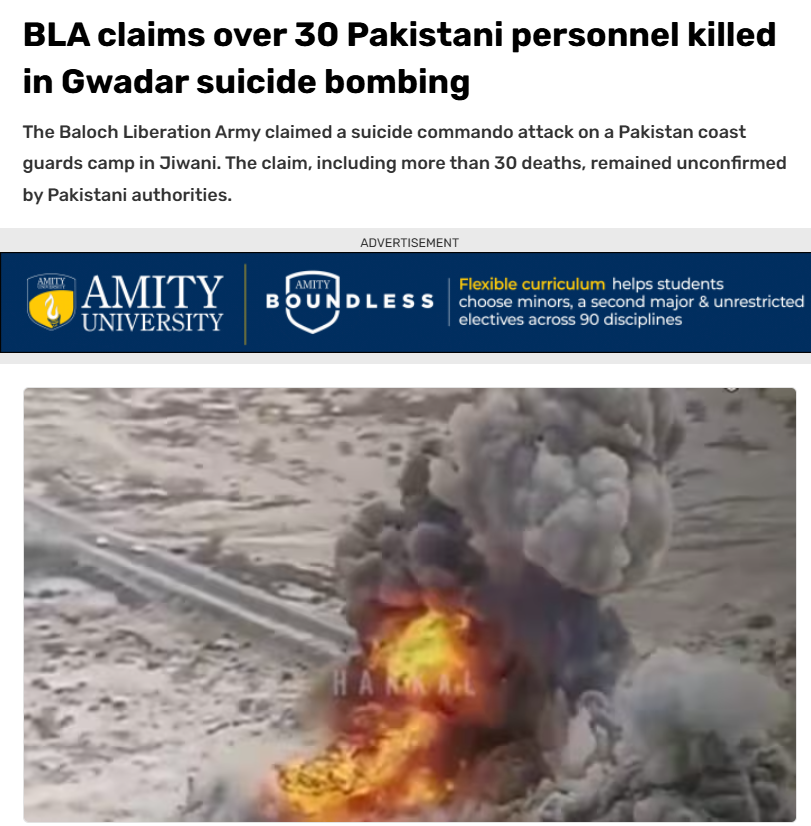
Further research led us to a report about a suicide bombing in Gwadar, Pakistan. According to the report, the BLA claimed responsibility for the attack and claimed that more than 30 security personnel were killed. Journalist Diksha Bisla also shared details about the incident.
https://www.facebook.com/watch/?v=1233630812123459

A search on Google Maps showed the Panwan area and a structure along Gwadar Road that resembles the location visible in the viral video.

Conclusion:
CyberPeace Research Wing ’s research found that the claim is false. The viral video is not related to any alleged Iranian attack on a US military base in Kuwait. The footage is from Panwan, a coastal town in southern Pakistan, and was circulated during reports of a suicide attack claimed by the Baloch Liberation Army (BLA).
Related Blogs

On the occasion of 20th edition of Safer Internet Day 2023, CyberPeace in collaboration with UNICEF, DELNET, NCERT, and The National Book Trust (NBT), India, took steps towards safer cyberspace by launching iSafe Multimedia Resources, CyberPeace TV, and CyberPeace Café in an event held today in Delhi.
CyberPeace also showcased its efforts, in partnership with UNICEF, to create a secure and peaceful online world through its Project iSafe, which aims to bridge the knowledge gap between emerging advancements in cybersecurity and first responders. Through Project iSafe, CyberPeace has successfully raised awareness among law enforcement agencies, education departments, and frontline workers across various fields. The event marked a significant milestone in the efforts of the foundation to create a secure and peaceful online environment for everyone.
Launching the Cyberpeace TV, café and isafe material , National Cybersecurity coordinator of Govt of India, Lt Gen Rajesh Pant interacts with the students by introducing them with the theme of this safer internet day. He launched the coword cyber challenge initiative by the countries. Content is most important in cyberspace. He also assured everyone that the government of India is taking a lot of steps at national level to make cyber space safer. He compliments CPF for their initiatives.
Ms. Zafrin Chaudhry, Chief of Communication, UNICEF addresses students with the facts that children make out 1 out of 3 in cyberspace, so they should have a safe cyberspace. They should be informed and equipped with all the information on how to deal with any kind of issues they face in cyberspace. They should share their experience with everyone to make others aware. UNICEF in partnership with CPF is extending help to children to equip them with the help and information.
Major Vineet Kumar, Founder and Global President of CPF welcomed all and introduced us about the launching of iSafe Multimedia Resources, CyberPeace TV, and CyberPeace Café . With this launch he threw some light on upcoming plans like launching a learning module of metaverse with AR and VR. He wants to make cyberspace safe even in tier 3 cities that’s why he established the first cybercafé in Ranchi.
As the internet plays a crucial role in our lives, CyberPeace has taken action to combat potential cyber threats. They introduced CyberPeace TV, the world’s first multilingual TV Channel on Jio TV focusing on Education and Entertainment, a comprehensive online platform that provides the latest in cybersecurity news, expert analysis, and a community for all stakeholders in the field. CyberPeace also launched its first CyberPeace Café for creators and innovators and released the iSafe Multimedia resource containing Flyers, Posters, E hand book and handbook on digital safety for children developed jointly by CyberPeace, UNICEF and NCERT for the public.
O.P. Singh, Former DGP, UP Police & CEO Kailash Satyarthi foundation, , started with the data of internet users in India. The Internet is used in day-to -day activities nowadays and primarily in social media. Students should have a channelized approach to cyberspace like fixed screen time, information to the right content, and usage of the internet. I really appreciate the initiates that CyberPeace is taking in this direction.
The celebration continued by iSafe Panel Discussion on “Creating Safer Cyberspace for Children.” The discussion was moderated by Dr. Sangeeta Kaul, Director of DELNET, and was attended by panellists Mr. Rakesh Maheshwari from MeitY(Ministry of electronics and information Technology, Govt. of India), Dr. Indu Kumar from CIET-NCERT, Ms. Bindu Sharma from ICMEC, and Major Vineet Kumar from CyberPeace.
The event was also graced by professional artists from the National School of Drama, who performed Nukkad Natak and Qawwali based on cyber security themes. Students from SRDAV school also entertained the audience with their performances. The attendees were also given a platform to share their experiences with online security issues, and ICT Awardees, Parents and iSafe Champions shared their insights with the guests. The event also had stalls by CyberPeace Corps, a Global volunteer initiative, and CIET-NCERT for students to explore and join the cause. The event’s highlight was the 360 Selfie Booth, where attendees lined up to have their turn.

Introduction
Imagine a scenario where a call is received by a senior citizen. The phone rings, he picks up. On the other side of the line is a polite and seemingly genuine bank official who informs him that his bank account has somehow been jeopardised and that he should quickly move his money to a safer escrow account right away. Or another situation where a police officer ends up threatening a senior citizen over a video call and places him under a digital arrest, pressuring him to pay up money in order to be set free.
This is not the storyline of a heist movie. This is the frightening new digital reality of millions of elderly people living all over the world.
Cybercrime against senior citizens has surged dramatically over the last few years. The year 2023 witnessed people (aged 60 and above), who submitted more than 101,000 complaints to the Federal Bureau of Investigation’s (FBI) Internet Crime Complaint Centre (IC3) in the United States. The total losses reached approximately 3.4 billion dollars, which reflected an increase of 11% in comparison to the previous year. Tech-support scams, investment frauds, government impersonation schemes, etc., have been some of the most recent and significant risks to the financial security of senior citizens.
This sharp increase in cyber fraud that has been targeting the seniors has shocked everyone, from the authorities to families. From phishing emails to fake customer care numbers to various digital payment scams, cyber criminals have deliberately been exploiting the senior population. They have repeatedly displayed the ability to wipe out a senior’s entire lifetime of savings in just a matter of minutes. The rise in cyber scams has been so alarming that even the Supreme Court of India expressed a deep concern over an estimated 3,000 crore rupees that was lost due to digital arrest scams.
Behind these statistics, there have been several individual cases that have revealed the true reality and the personal impact of such scams. The scale of this threat was clearly illustrated when, reportedly, an 86-year-old woman from Mumbai lost 20 crore rupees in a well-planned digital arrest scam in a timeline of 3-4 months between December 2024 and March 2025. In other real-life instances, in December 2025, multiple senior citizens from Hyderabad and Delhi were manipulated into transferring tens of lakhs under the false implication of undergoing a legal action.
This blog aims to focus specifically on the ways and means of:
- How cybercriminals operate against senior citizens,
- The most typical online scams that target seniors and
- How to quickly identify them.
Revealing the Insides of the Scammer’s Playbook: How They Operate, Trick and Steal
- Picking out the prey: Fraudsters use classified information from various leaked online databases, social media profiles, online images, phone directories and in some instances, even obituaries, to build comprehensive lists of potential and vulnerable senior citizen targets. It may be shocking to know that these scammers could already be aware of your age, bank, city and the details of your family members.
- Masquerading and trust theatrics: Scammers pose as authoritative figures such as bank officers, RBI (Reserve Bank of India) or tax officials, telecom staff, Microsoft or Apple tech support, CBI (Central Bureau of Investigation), ED (Enforcement Directorate) and even judges. They further support this spectacle by creating professional emails, logos, illegal websites and forged notices. Caller IDs can be spoofed and can even appear in the name of a trusted bank or a government helpline. In digital arrest scams, scammers may build a fake courtroom or police station to showcase their authority and authenticity over video calls.
- Tugging at emotions and pulling the strings of fear: Cyber fraudsters rarely rely on logic as the basis. Instead, they attack emotions. They may make statements such as: ‘your account is being used for money laundering, you may be arrested today’, thus creating feelings of fear and panic in the mind of the targeted individual. ‘You’ve won a lottery!’, another example that appeals to the emotions of greed and excitement, or ‘Grandma, I’ve been in an accident; please send money and don’t tell anyone’, a classic example that preys on the emotions of love, urgency and concern.
There are more such illustrations: ‘Once in a lifetime investment opportunity’, ‘verify your details in the next 10 minutes or else your account will be frozen, ‘your computer has been hacked; only our technical team can fix it’, and the list goes on.
- The final grab: Cash, Credentials and Control: After all that pretending and emotional manipulation, cyber criminals make their last and final move that essentially closes the deal. They may ask for OTPs (one-time passwords), internet banking credentials, or remote access via screen sharing mode. In other cases, they may pressurise their victims into making direct UPI (Unified Payments Interface) transfers, RTGS (Real-time Gross Settlement) / NEFT (National Electronic Funds Transfer) transfers and payment in the form of gift cards, vouchers or cryptocurrency. This marks the extraction phase. This is the moment where access and control is attained by the fraudster. After this, financial accounts, sensitive information, data, etc., can all be quickly drained, beyond any chance of recovery.
Unveiling the Cyber Scam Spectrum
Below are some of the most commonly deployed online scams that are targeted towards the senior citizens of the present day.
- Imposters in Power: Impersonation scams, on a global level, have proved to be one of the fastest-growing and costliest frauds that occur against seniors. The scammers feign and impersonate officials from banks, income tax departments or even big companies such as Amazon. They would generally warn you about a failed KYC (Know Your Customer) update, your account being blocked or a legal violation. The victim is basically caught off-guard and is forced to share crucial details such as login credentials and OTPs.
- The Digital Arrest Scam: From Call to Con: Lately, digital arrest has become one of the most terrifying scams that senior citizens have had to face. Seniors receive a voice call or a video call from someone who claims to be a police officer or a CBI/ED officer. Then, in a strict and authoritative tone, they make false claims about how the elderly’s Aadhaar, PAN (Permanent Account Number) or phone details have come under scrutiny for being linked to serious crimes such as drug trafficking, money laundering and terrorism. They threaten the elderly that they could be put under immediate arrest, their property could be seized, or they could be publicly humiliated. Once they have established fear, they then go on to show fake documents or court orders to corroborate their assertions.
Thereafter, the senior citizen is informed that he or she has been placed under a digital house arrest. They force the victim to stay on the video call, sometimes for hours and days, ask them to follow certain instructions and repeatedly warn them not to communicate with anyone else. Scammers further exploit the fear of being jailed or the fear of legal action, and gradually extract huge sums of money from the victim. In some cases, this scam can unfold and continue over an extended timeline spanning several months.
- Tech Support Hoax: When Help turns Hostile: As per the FBI and other multiple security analyses, tech support scams are the most commonly reported senior citizen-related frauds in the US.
A pop-up may appear on the elderly’s screen stating that: ‘your computer is infected, call this number now’. Or they might receive a call from a person posing as a tech support person from either Microsoft, Apple, a bank’s IT team or as an internet service provider. He then goes on to guide the elderly to install certain remote access software or to grant screen control access to fix the issue. Once they gain access, they pretend to find some serious infection in the user’s system or they talk about how the speed of the internet is slow and that it needs to be fixed. As a result, they quietly steal passwords, introduce malware into perfectly healthy systems, lock user access and demand ransom in return.
- Payment App Scams: Phishing, Deadly Links and OTP Snares: Phishing as a cyber scam tactic sits at the heart of many payment app scams that target senior citizens. It may begin with a harmless SMS, an email or a WhatsApp alert. These correspondences may look like they have been received from a trusted bank or a familiar online payment platform.
The messages are engineered in a way that aim at grabbing attention and trigger a feeling of panic and pressure. They push the elderly users who spring into action without any caution or thought. The victim may be urged to click a link, coupled with warnings of a blocked account, a failed transaction, a failed delivery or a KYC update. The message may also ask the user to ‘verify’ certain account details. They send urgent payment links that put pressure on the senior citizen to act immediately and transfer the said amount of money.
There are also instances where an SMS or WhatsApp link may claim to offer some kind of discount or reward only if the user enters his or her card details, UPI pin or OTP. This is an extremely dangerous scenario. If these details are given away, scammers acquire access to the user’s bank account.
- Family in Crisis: Staging Fake Emergencies: These cyber-enabled scams, also known as ‘grandparent scams’, specifically target senior citizens by impersonating their kin and creating a fake impression of them being in some kind of trouble. With the help of methods such as AI (Artificial Intelligence) voice cloning, fraudsters mimic the voice of a grandchild or a family member (which they originally obtain from social media posts or videos), making their deception tactics extremely believable. The caller may claim to be in an accident or could say they have been arrested or are stranded somewhere. They may plead with the senior citizen to make an immediate payment.
In order to avoid cross verification of their fraudulent claims, they may insist on maintaining secrecy and brainwash their victim to not inform other family members of their made-up dilemma.
- Fraudulent Friendships and Hijacked Hearts: For many senior citizens who live alone and in the absence of family and support systems, isolation becomes a vulnerability that is very hard to overcome. Fraudsters, who closely monitor such individuals, wait to seize any opportunity to use this weakness as a gateway to carry out their deceptive schemes.
‘Companionship scams’ and ‘romance scams’ are slowly turning into a serious problem among older adults. Cyber criminals befriend or connect with older adults on social networking, matrimonial and dating apps under false pretences. As time goes by, sometimes over weeks or months, these scammers work on building emotional intimacy and trust. Once this is accomplished, they then start making requests for money. These requests can be for (fake) medical emergencies, visas, travel tickets or business deals. Sadly, victims, who are already deeply invested emotionally, end up making these money transfers, sometimes losing their lifetime savings in the process.
In some cases, when things go too far, intimate photos or private conversations are later used by cyber fraudsters for sextortion. They threaten to leak these personal materials unless the victim pays money, further adding elements of fear and pressure to an already manipulative situation.
- Fraud in the name of Health and Benefits: For most senior citizens, their daily life depends on access to basic healthcare, uninterrupted pensions and government benefits. These systems are put in place to provide not just for the seniors’ financial stability, but also to ensure their peace of mind.
Conversely, fraudsters exploit this dependability. Fake medical offers, insurance plans, benefit claims and pension enhancement schemes, etc., are some of the methods that are being used to defraud the seniors. Scammers offer free medical equipment or health checkups in exchange for personal information related to banking and finances.
Another dangerous facet of these scams is ‘counterfeit medications’. These are sold under false claims and big promises and are advertised in a manner that tempts seniors to go for it. These fake medicines not only lead to loss of money but also gravely impact the elderly’s health.
Spot the Scam: Tips to Identify Early Warning Signs before the Scam Unfolds
Cyber criminals are clever, creative and notorious, but their tricks come with familiar warning signs. Timely recognition of these signs can save senior citizens from falling into the scammer’s trap. Some of the most common and apparent warning signs are discussed below:
- Don’t think fast, think twice! The urgency ploy: Cyber criminals thrive on creating a situation of panic and urgency. In instances where a senior citizen feels that he or she is being pushed towards rushed choices, it is better to take a step back to pause and think. Any unreasonable demand to act ‘immediately’ or within minutes, especially when it involves a transfer of money or confidential information, is very likely to be a scam. Not giving in to this hasty push can save the individual from getting tangled in the scammer’s web of lies.
- Scammer’s best friend: Secrecy and silence: First comes the urgency, and then comes the demand to stay silent. Scammers strategically cite and invent so-called ‘security reasons’ and instruct their elderly victims not to inform their bank, friends or family of their situation. This secrecy prevents verification and keeps the victim trapped. Recognising this forced isolation can stop a cybercrime before it escalates and gets out of hand.
- Red flag! When the deal sounds unreal: Scammers lure elderly victims with extraordinary offers and deals. Lottery wins, miracle investment returns, massive discounts or exclusive time-bound rewards are a few examples. These larger-than-life promises are designed in a manner that clouds an elderly person’s sound judgment. Therefore, if an offer feels too good to be true and unlike anything anyone’s ever heard before, then that’s the time to pause and take a step back. In almost all such cases, these unbelievable deals are simply a bait for a looming scam.
- Beware! They want your access codes: Senior citizens need to exercise extra caution when it comes to handing out their personal access codes. No legitimate bank, government office or reputable company will directly ask for OTPs, PINs or full passwords over calls or messaging apps. If someone asks for such details, it is an indication that a fraud may be imminent.
- Don’t pay just yet! Dubious payment gambits: If demands for payments are made in the form of gift cards, cryptocurrency or wire transfers to personal or unknown accounts, it is most definitely a scam. Scammers use these unconventional payment methods to avoid traceability. This strategy allows them to easily disappear with the victim’s funds, which in turn makes recovery of the stolen money nearly impossible.
- Threats and intimidation over a phone call: Hang up! It’s a scam: It is important to understand that legitimate police and court proceedings do not take place over calls or messaging apps. Genuine officials will never demand or negotiate fines, legal payments or bail online. If someone uses the intimidation ploy on a senior citizen and threatens him with legal trouble or police action unless some money is paid, then that’s a clear warning sign of a cyber scam.
Empowered, not Exploited: When Knowledge Becomes the Best Defence
Cyber scams targeting senior citizens are a deliberate and very well-orchestrated industry that thrives on uncertainty, ignorance and fear. The call of the moment is for the elderly and their families to turn awareness into armour. Knowledge about how scammers operate, how they steal, and the techniques they employ can prepare and empower our seniors to protect themselves in such critical situations. The early warning signs mentioned above are more than just mere cautions. They should be taken as ‘cues’ to ‘pause, reflect and re-check’. Being wary of unsolicited communication, safeguarding financial information, double-checking hurried correspondences, etc., can nip a scam in the bud before it plays out. Most importantly, digital safety for the senior citizens is a unified and collaborative responsibility that every responsible individual of the society needs to undertake.
References
- https://frontline.thehindu.com/social-issues/ai-deepfake-digital-arrest-scams-india-cybercrime/article70587955.ece
- https://www.ic3.gov/annualreport/reports/2023_ic3elderfraudreport.pdf
- https://www.thehindu.com/news/national/supreme-court-shocked-over-3000-crore-loss-in-digital-arrest-scams/article70235621.ece
- https://www.thehindu.com/news/cities/mumbai/elderly-woman-loses-20-crore-to-digital-arrest-fraud-3-held/article69353437.ece
- https://timesofindia.indiatimes.com/city/hyderabad/three-senior-citizens-duped-of-rs-1-7cr-in-digital-arrest-scam-spree/articleshow/125876194.cms
- https://www.aninews.in/news/national/general-news/82-year-old-senior-citizen-digitally-arrested-and-cheated-of-rs-116-crore-cyber-cell-arrests-three-key-members-of-syndicate20251213145528/
- https://crr.bc.edu/preventing-cyber-scams-that-target-seniors/
- https://dos.ny.gov/scams-targeting-older-adults
- https://indianexpress.com/article/cities/chandigarh/victims-in-8-of-top-10-digital-arrest-scams-in-chandigarh-are-senior-citizens-data-reveals-10444252/
- https://www.seniorliving.org/research/common-elderly-scams/
- https://www.ftc.gov/news-events/data-visualizations/data-spotlight/2025/08/false-alarm-real-scam-how-scammers-are-stealing-older-adults-life-savings
- https://www.psca.org/news/psca-news/2025/8/scams-against-seniors-increasing-dramatically-ftc-warns/
- https://www.pcmatic.com/blog/the-rising-threat-of-elder-fraud-insights-from-ic3s-2023-report/?srsltid=AfmBOorC069NIYFwFO0W56nPcg_K0Wfv_oq0V-MI7fImI5ityAUrQTO9
- https://www.quickheal.co.in/knowledge-centre/guarding-our-elders-a-comprehensive-report-on-the-elder-fraud-epidemic-in-india/?srsltid=AfmBOorviPvoRuecjsOtAfVxyQEJF2vyICnr15GqbDfP1m3UXAnXndMw
- https://www.ncoa.org/article/top-5-financial-scams-targeting-older-adults/
- https://www.uchealth.org/today/elder-fraud-is-rising-and-it-is-hurting-more-than-just-finances/
- https://centerlighthealthcare.org/protecting-yourself-online-recognizing-and-avoiding-online-scams/

Introduction
When Tamil Nadu Police arrested a man from Vellore in May 2026 on suspicion of being the point person helping Indian youth to be smuggled into cyber scam compounds in Cambodia, the papers led with the accused. They shouldn't have led with the accused but with the system. The arrest, one in a long string of them in Tamil Nadu, Madurai, and other states, is not simply another one-off policing victory. Rather, the arrest gives us an insight into a larger, darker world: an international criminal organisation that has successfully combined human trafficking and cybercrime, a new trend in criminality that specialists are calling 'cyber slavery.'
What Is Cyber Slavery?
“Cyber slavery” involves trafficking persons under the pretence of employment, forcing them into committing online fraud to serve criminal enterprises. Victims are not merely victims of the work they are forced to do; they are often turned into culprits as they become complicit in victimising others. Trafficked victims are compelled to participate in frauds targeted at unsuspecting victims all around the globe. These activities, organised into robust criminal schemes, involve victims of sex or labour trafficking who are forced into operating romance scams or the so-called "pig butchering" scams that defraud people of their investment in cryptocurrency, all in heavily secured complexes guarded with threats of violence and torture. The extent of the problem is enormous, with the UN Office of the High Commissioner for Human Rights estimating in a 2023 report that there are over 100,000 victims of cyber scam compounds in Cambodia and another 120,000 in Myanmar. Schemes throughout Southeast Asia were projected to commit as much as $39.9 billion in fraudulent schemes a year.
Why Southeast Asia? The Geography of Organised Crime
In order to answer why Cambodia, Myanmar, Laos, and the surrounding regions have developed into the cyber slavery hub of the world, we can draw together an array of structural reasons:
- Casino clampdown and crime diversification: Cambodia's ban on online gambling in 2019 broke down established casino-related criminal networks. This saw old casinos and Special Economic Zones turn into cyber scam compound operations.
- Corruption and state complicity: A pre-existing environment of corruption and involvement of politically linked figures permitted scamming networks to flourish, and the armed groups in the border areas of Myanmar are reportedly complicit in these operations through supplying land and protection for the networks to operate in.
- Poor governance in the border areas: The lack of state control in the frontier areas of Myanmar provided the criminal networks with a secure sanctuary in which they could operate with impunity and cross borders to escape crackdowns and move their operations.
- Post-pandemic growth: The economic stress associated with the COVID-19 pandemic led to an increase in the supply of vulnerable individuals available to fill the scam networks, as well as unprecedented profit margins on scams.
The Recruitment Pipeline: How Are Indian Youth Trapped?
The typical journey from an Indian town or village to a locked compound in Southeast Asia follows the same narrative:
- The bait: On platforms like Facebook, WhatsApp, and Telegram, gangs lure with posts of lucrative overseas employment for IT work, customer service, data entry, and digital marketing with attractive, albeit feasible, pay packages (Rs. 80,000 to Rs. 1.5 lakh per month) and destinations such as Thailand and Singapore added for a veneer of genuineness.
- The recruiters: Local agents who gain trust, arrange visas and flight tickets, and collect the application fees are key intermediaries. Cases registered in Vellore and Madurai hint at recruitment agents receiving a commission for each person successfully smuggled into a trap, linked to larger travel and immigration networks.
- The lie: Victims are assured that they will be working legitimately in Thailand, but on reaching the border and crossing over, they find themselves pushed into scam compounds in neighbouring countries and have their passports, mobile phones and devices confiscated, thus rendering any escape attempt futile.
- The trap: In the interim, fake interviews, false job promises and convincing flight tickets serve to maintain the facade until the victims are forced to participate in cyber-fraud schemes.
The Architecture of Coercion: Life Inside the Scam Compounds
It is in these compounds that the fates of the victims become known. Survivor accounts, investigations and UN human rights reports provide evidence of these circumstances. These compounds are often surrounded by barbed wire fences, monitored with cameras and heavily guarded. Once a potential victim is captured, they are stripped of their passports and any other electronic devices, preventing them from being able to contact the outside world or to escape. Workers are allocated stringent targets, ranging from the number of potential victims they must solicit for scams and the amount of money they must acquire through such scams. Failure to do so, or perceived disobedience, may lead to beatings, electroshock treatment, starvation and long periods in confinement. These beatings are supplemented with psychological torture, with scammers assuring their victims that they owe money for their journey, stay and training. This method of debt bondage keeps people at the compound even when the opportunity for escape is presented to them. The victims are then forced to take part in more complex online scams, which involve romance scams, fake investment scams, and impersonation scams using scripts and with supervision. In some cases, families will be encouraged to pay for their captive relatives' release by ransom, whereas those who refuse to comply or meet performance requirements may be sold and transferred to another compound as a piece of property within a transnational criminal network.
Cybercrime Is No Longer Just About Hacking
This emergency challenges the existing notion of cybercrime. The scam compound of Southeast Asia is not about a lonely hacker or a standalone breach; it is a form of organised cyber slavery in which trafficked individuals are made to commit financial fraud on an industrial level.
The probe of India's NIA found that recruitment is done in the Indian states of Bihar and Uttar Pradesh. Transport agents in Chennai and Madurai provide logistics, and Dubai and Bangkok act as transit points on the way to Cambodia, Laos, and Vietnam. It makes use of cryptocurrency wallets, shadow banking, and shell companies for the movement of funds across international borders. Companies such as the Huione Group has been accused of facilitating billions of dollars in financial transactions for scam infrastructure before receiving sanctions from the U.S.
To illustrate the threat landscape, the U.S. Treasury imposed sanctions on 19 entities spread across Myanmar and Cambodia and said that cyber scam operations looted $10 billion worth last year. Also, cryptocurrency transactions related to trafficking crimes jumped by 85% last year, which speaks to the expanding nature of the global criminal infrastructure.
India's Exposure: A National Vulnerability
The scale of exposure for India is large and expanding. The most likely victims are educated, and aspirational young men and women from Tier 2 and Tier 3 cities, seeking work abroad, which perfectly aligns with the primary target of such human trafficking networks.
Repeated incidents of people from Tamil Nadu falling victim to these networks have come to light. As far back as 2022, the chief minister wrote to the prime minister that close to 300 Indians, roughly 50 Tamils included, were being held in Myanmar. The Madurai-Cambodia case that came to light in 2026 revealed an entire network spanning Cambodia, Laos, and Vietnam, with authorities believing that thousands of Indians might have been trafficked there over the past three years. Such cases from Kerala, Karnataka, Andhra Pradesh, and some northern Indian states have been reported. Last year, India had to charter Air Force flights to rescue over 549 Indians from cyber scam centres along the Myanmar-Thailand border.
The Indian embassy in Phnom Penh assisted the Indian nationals along with the CBI, MEA, and NIA in the rescue of 67 Indians in September 2024; however, these operations are largely reactive in the face of the vast and evolving transboundary crisis.
Prevention
The best solution is awareness. The following are tangible signs that a job offer might be a lead to trafficking:
Red Flags within the job offer:
- Receiving unsolicited recruitment messages on WhatsApp, Telegram or Instagram from unknown numbers/contacts.
- Offer of unbelievably high salaries in undefined roles like ‘data entry,’ ‘online marketing’ or ‘customer service’ outside India.
- Request for upfront money to cover costs of visas, travel, accommodation, and training.
- Job offers to places in Thailand or Singapore involving complex transit routes through other countries.
- An interview process entirely through messaging apps, where the company has no real office address or registration number.
- Urgency and/or confidentiality required.
Verification:
- Check if the recruiter is registered on MEA's e-Migrate portal-this is a portal where MEA lists authorised overseas recruiters.
- Verify the authenticity of the company through its business registration with official registries in the foreign country.
- Contact the Indian Embassy/Consulate in that foreign country if something doesn't add up about the offer.
- Do not hand over your passport to your employer on arrival; it is standard practice for recruiters working as traffickers to confiscate it.
What to do if trapped:
- Contact the closest Indian embassy or consulate immediately.
- Call the MEA overseas helpline: 1800-11-3090.
- Lodge a report on the National Cybercrime Reporting Portal (cybercrime.gov.in).
Policy Imperatives
On their own, individual consciousness cannot undo such a massive criminal infrastructure. India has to enforce the Emigration Act rigorously, implement mandatory licensing of recruitment agents and create a specialised task force consisting of NIA, CBI, MEA and the states’ cybercrime units. Pre-departure orientations should also become mandatory for migrant workers who go to Southeast Asia. Globally, India needs to work more closely with Cambodia, Myanmar, Thailand and Laos via intel sharing protocols, victim repatriations and action against scam compounds. Financial probes must be on par with enforcement investigations to catch up with the perpetrators’ network, the cryptocurrency and hawala channels that facilitate money laundering and finance trafficking operations, as that would severely hit these networks.
Conclusion
This arrest of the recruiter in Vellore is just a small piece of a larger network. What we see in these instances is the marriage of cybercrime, trafficking, and financial fraud into a larger transnational ecosystem that systematically preys on the economic vulnerability of individuals. These young Indians are not simply falling for scams; they are being systematically targeted, recruited, trafficked, and forced into these criminal operations by a networked structure. The scam compounds in Cambodia and along the border of Myanmar and Thailand are only the end of a process that very likely starts with a convincing job offer on social media. Fighting cyber slavery will not be as simple as more arrests; we need education and international efforts, as well as policy responses that match the scope and scale of the problem.
References
- https://the420.in/78415-2vellore-man-cambodia-cyber-slavery-trafficking-case/
- https://the420.in/madhan-vadivel-cambodia-cyber-slavery-trafficking-racket-investigation/
- https://www.newsonair.gov.in/tamil-nadu-police-arrest-key-recruiter-in-cambodia-cyber-slavery-racket/
- https://kashmirdotcom.in/2026/05/16/cambodia-linked-human-trafficking-cyber-slavery-racket-nia-chargesheets-five-including-absconding-kingpin/
- https://www.aljazeera.com/news/2025/7/16/more-than-1000-arrested-in-cambodian-cyber-scam-raids
- https://www.pbs.org/newshour/world/why-southeast-asias-online-scam-industry-is-so-hard-to-shut-down
- https://www.cfr.org/articles/how-myanmar-became-global-center-cyber-scams
- https://www.amlrightsource.com/resources/scam-states-the-cybercrime-corruption-complex-in-southeast-asia-and-the-collapse-of-anti-money-laundering-enforcement
- https://newlinesinstitute.org/global-security-mil-priorities/cybercrimes-human-trafficking-and-cryptocurrency-in-southeast-asias-special-economic-zones/
- https://www.theweek.in/news/india/2026/03/21/lured-by-jobs-sold-into-slavery-indias-crackdown-on-cyber-trafficking-continues.html