
Italy’s Antitrust Action Against Meta: What the WhatsApp AI Chatbot Order Means for Competition Law
Introduction
Regulatory agencies throughout Europe have stepped up their monitoring of digital communication platforms because of the increased use of Artificial Intelligence in the digital domain. Messaging services have evolved into being more than just messaging systems, they now serve as a gateway for Artificial Intelligence services, Business Tools and Digital Marketplaces. In light of this evolution, the Competition Authority in Italy has taken action against Meta Platforms and ordered Meta to cease activities on WhatsApp that are deemed to restrict the ability of other companies to sell AI-based chatbots. This action highlights the concerns surrounding Gatekeeping Power, Market Foreclosure and Innovation Suppression. This proceeding will also raise questions regarding the application of Competition Law to the actions of Dominant Digital Platforms, where they leverage their own ecosystems to promote their own AI products to the detriment of competitors.
Background of the Case
In December 2025, Italy’s competition authority, the Autorità Garante della Concorrenza e del Mercato (AGCM), ordered Meta Platforms to suspend certain contractual terms governing WhatsApp. These terms allegedly prevented or restricted the operation of third-party AI chatbots on WhatsApp’s platform.
The decision was issued as an interim measure during an ongoing antitrust investigation. According to the AGCM, the disputed terms risked excluding competing AI chatbot providers from accessing a critical digital channel, thereby distorting competition and harming consumer choice.
Why WhatsApp Matters as a Digital Gateway
WhatsApp is situated uniquely within the European digital landscape. It has hundreds of millions of users throughout the entire European Union; therefore, it is an integral part of the communication infrastructure that supports communications between individual consumers and companies as well as between companies and their service providers. AI chatbot developers depend heavily upon WhatsApp as it provides the ability to connect directly with consumers in real-time, which is critical to their success as business offers.
According to the Italian regulator's opinion, a corporation that controls the ability to communicate via such a popular platform has a tremendous influence over innovation within that market as it essentially operates as a gatekeeper between the company creating an innovative service and the consumer using that service. If Meta is permitted to stop competing AI chatbot developers while providing more productive and useful offers than those offered by competing developers, it is likely that competing developers will be unable to market and distribute their innovative products at sufficient scale to remain competitive.
Alleged Abuse of Dominant Position
Under EU and national competition law, companies holding a dominant market position bear a special responsibility not to distort competition. The AGCM’s concern is that Meta may have abused WhatsApp’s dominance by:
- Restricting market access for rival AI chatbot providers
- Limiting technical development by preventing interoperability
- Strengthening Meta’s own AI ecosystem at the expense of competitors
Such conduct, if proven, could amount to an abuse under Article 102 of the Treaty on the Functioning of the European Union (TFEU). Importantly, the authority emphasised that even contractual terms—rather than explicit bans—can have exclusionary effects when imposed by a dominant platform.
Meta’s Response and Infrastructure Argument
Meta has openly condemned the Italian ruling as “fundamentally flawed,” arguing that third-party AI chatbots represent a major economic burden to the infrastructure and risk the performance, safety, and user enjoyment of WhatsApp.
Although the protection of infrastructure is a valid issue of concern, competition authorities commonly look at whether the justifications for such restrictions are appropriate and non-discriminatory. One of the principal legal issues is whether the restrictions imposed by Meta were applied in a uniform manner or whether they were selectively imposed in favour of Meta's AI services. If the restrictions are asymmetrical in application, they may be viewed as anti-competitive rather than as legitimate technical safeguards.
Link to the EU’s Digital Markets Framework
The Italian case fits into a wider EU context in relation to their efforts to regulate the actions of large technology companies with the use of prior (ex-ante) regulation as contained in the Digital Markets Act (DMA). The DMA has put in place obligations on a set of gatekeepers to make available to third parties on a non-discriminatory basis in order to maintain equitable access, interoperability and no discrimination against those parties.
While the Italian case has been brought pursuant to an Italian competition law, its philosophy is consistent with that of the DMA in that dominant digital platforms should not undertake actions that use their control over their core products and services to prevent other companies from being able to innovate. The trend with some EU national regulators is to be increasingly willing to take swift action through the application of interim measures rather than await many years for final decisions.
Implications for AI Developers and Platforms
The Italian order signifies to developers of AI-based chatbots that competitive access to AI technology via messaging services is an important factor for regulatory bodies. The order also serves as a warning to the large incumbent organisations that are establishing a foothold in the messaging services market to integrate AI into their already established platforms that they will not be protected from competition laws.
Additionally, the overall case showcases the growing consensus amongst regulatory agencies regarding the role of competition in the development of AI. If a handful of large companies are allowed to control both the infrastructure and the AI technology being operated on top of that infrastructure, the result will likely be the development of closed ecosystems that eliminate or greatly reduce the potential for technology diversity.
Conclusion
Italy's move against Meta highlights a significant intersection between competitive laws and artificial intelligence. The Italian antitrust authority has reinforced the principle that digital gatekeepers cannot use contractual methods to block off access to competition in targeting WhatsApp's restrictive terms. As AI becomes a larger part of our day to day digital services, regulatory bodies will likely continue to increase their scrutiny on platform behaviour. The result of this investigation will impact not just the Metaverse's AI strategy, but also create a baseline for future European regulators' methods of balancing innovation versus competition versus consumer choice in an increasingly AI-driven digital marketplace.
References
- https://www.reuters.com/sustainability/boards-policy-regulation/italy-watchdog-orders-meta-halt-whatsapp-terms-barring-rival-ai-chatbots-2025-12-24/
- https://techcrunch.com/2025/12/24/italy-tells-meta-to-suspend-its-policy-that-bans-rival-ai-chatbots-from-whatsapp/
- https://www.communicationstoday.co.in/italy-watchdog-orders-meta-to-halt-whatsapp-terms-barring-rival-ai-chatbots/
- https://www.techinasia.com/news/italy-watchdog-orders-meta-halt-whatsapp-terms-ai-bot

Related Blogs

Executive Summary
A video is being shared on social media with the claim that a Dalit woman was raped inside the Ram Temple in Ayodhya. In the video, two women can be seen crying, while some people around them appear to be consoling them. CyberPeace Research Wing’s research found the viral claim to be false. Our research found that the viral video has been created by combining two separate clips. In the first part of the video, a woman can be seen staging a protest at Buddha Park in Haldwani and raising issues related to her in-laws. The second part shows a girl expressing her anger. Our research found that this clip has been available on the internet since December 27, 2025. Neither of the two videos is related to the alleged rape of a Dalit woman inside the Ram Temple in Ayodhya.
Claim:
A Facebook user shared the viral video on September 21, 2026, with the caption, “Dalit woman raped inside the Ram Temple.”The post link, archive link and screenshot are provided below.
https://www.facebook.com/watch/?v=1420442086956519

Fact Check
To verify the authenticity of the viral image, we conducted a Google search using relevant keywords. However, we did not find any credible media report related to the viral image during the search. To verify the claim, we conducted a reverse image search of the keyframes from the video. During the search, we found the same video on the Facebook page of Punjab Kesari - Uttarakhand, where it was published on March 6, 2026. According to the post, the woman staged a protest at Buddha Park in Haldwani and raised issues related to her in-laws. The link and screenshot of the relevant post are provided below.
https://www.facebook.com/watch/?v=897776589732940

Meanwhile, we found the second part of the viral video on LinkedIn, where the video was published on December 27, 2025.

Our research makes it clear that two old and unrelated videos are being shared with a misleading claim linking them to the Ram Temple in Ayodhya. The videos have no connection with the alleged incident on the temple premises, and based on the available evidence, there is no confirmation of any such incident taking place at the Ram Temple. Our research found that the viral video was created by combining two separate clips. In the first part of the video, a woman can be seen staging a protest at Buddha Park in Haldwani and raising issues related to her in-laws. In the second part, a girl can be seen expressing her anger. Our research found that this clip has been available on the internet since December 27, 2025. Neither of the two videos is related to the alleged rape of a Dalit woman inside the Ram Temple in Ayodhya.
Executive Summary
A photo allegedly showing injuries to Seema Haider has been widely circulated on social media. Users are claiming that her husband Sachin Meena assaulted her. However, a fact-check by CyberPeace Research Wing has found the claim to be false. The research reveals that the viral image is AI-generated and is being shared with a misleading narrative.
Claim
On X (formerly Twitter), a user shared the image on May 14, 2026, claiming that Sachin Meena assaulted Seema Haider.

Fact Check
A keyword-based search on Google did not return any credible media reports supporting the viral claim.
A closer visual examination of the image raised suspicions of AI generation. The image was first analysed using the AI detection tool Hive Moderation, which indicated a 99% probability that the image is AI-generated.
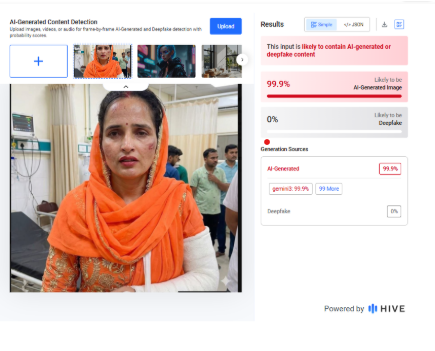
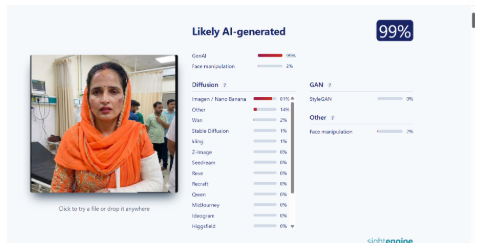
Further analysis using another AI detection tool, Sightengine, also produced similar results, confirming a 99% likelihood that the image was generated using AI tools.
Conclusion
The viral image is AI-generated and misleading. The claim that Sachin Meena assaulted Seema Haider is false and has no factual basis.

Introduction
Considering the development of technology, Voice cloning schemes are one such issue that has recently come to light. Scammers are moving forward with AI, and their methods and plans for deceiving and scamming people have also altered. Deepfake technology creates realistic imitations of a person’s voice that can be used to conduct fraud, dupe a person into giving up crucial information, or even impersonate a person for illegal purposes. We will look at the dangers and risks associated with AI voice cloning frauds, how scammers operate and how one might protect themselves from one.
What is Deepfake?
Artificial intelligence (AI), known as “deepfake,” can produce fake or altered audio, video, and film that pass for the real thing. The words “deep learning” and “fake” are combined to get the name “deep fake”. Deepfake technology creates content with a realistic appearance or sound by analysing and synthesising diverse volumes of data using machine learning algorithms. Con artists employ technology to portray someone doing something that has never been in audio or visual form. The best example is the American President, who used deep voice impersonation technology. Deep voice impersonation technology can be used maliciously, such as in deep voice fraud or disseminating false information. As a result, there is growing concerned about the potential influence of deep fake technology on society and the need for effective tools to detect and mitigate the hazards it may provide.
What exactly are deepfake voice scams?
Artificial intelligence (AI) is sometimes utilised in deepfake speech frauds to create synthetic audio recordings that seem like real people. Con artists can impersonate someone else over the phone and pressure their victims into providing personal information or paying money by using contemporary technology. A con artist may pose as a bank employee, a government official, or a friend or relative by utilising a deep false voice. It aims to earn the victim’s trust and raise the likelihood that they will fall for the hoax by conveying a false sense of familiarity and urgency. Deep fake speech frauds are increasing in frequency as deep fake technology becomes more widely available, more sophisticated, and harder to detect. In order to avoid becoming a victim of such fraud, it is necessary to be aware of the risks and take appropriate measures.
Why do cybercriminals use AI voice deep fake?
In order to mislead users into providing private information, money, or system access, cybercriminals utilise artificial intelligence (AI) speech-deep spoofing technology to claim to be people or entities. Using AI voice-deep fake technology, cybercriminals can create audio recordings that mimic real people or entities, such as CEOs, government officials, or bank employees, and use them to trick victims into taking activities that are advantageous to the criminals. This can involve asking victims for money, disclosing login credentials, or revealing sensitive information. In phishing assaults, where fraudsters create audio recordings that impersonate genuine messages from organisations or people that victims trust, deepfake AI voice technology can also be employed. These audio recordings can trick people into downloading malware, clicking on dangerous links, or giving out personal information. Additionally, false audio evidence can be produced using AI voice-deep fake technology to support false claims or accusations. This is particularly risky regarding legal processes because falsified audio evidence may lead to wrongful convictions or acquittals. Artificial intelligence voice deep fake technology gives con artists a potent tool for tricking and controlling victims. Every organisation and the general population must be informed of this technology’s risk and adopt the appropriate safety measures.
How to spot voice deepfake and avoid them?
Deep fake technology has made it simpler for con artists to edit audio recordings and create phoney voices that exactly mimic real people. As a result, a brand-new scam called the “deep fake voice scam” has surfaced. In order to trick the victim into handing over money or private information, the con artist assumes another person’s identity and uses a fake voice. What are some ways to protect oneself from deepfake voice scams? Here are some guidelines to help you spot them and keep away from them:
- Steer clear of telemarketing calls
- One of the most common tactics used by deep fake voice con artists, who pretend to be bank personnel or government officials, is making unsolicited phone calls.
- Listen closely to the voice
- Anyone who phones you pretending to be someone else should pay special attention to their voice. Are there any peculiar pauses or inflexions in their speech? Something that doesn’t seem right can be a deep voice fraud.
- Verify the caller’s identity
- It’s crucial to verify the caller’s identity in order to avoid falling for a deep false voice scam. You might ask for their name, job title, and employer when in doubt. You can then do some research to be sure they are who they say they are.
- Never divulge confidential information
- No matter who calls, never give out personal information like your Aadhar, bank account information, or passwords over the phone. Any legitimate companies or organisations will never request personal or financial information over the phone; if they do, it’s a warning sign that they’re a scammer.
- Report any suspicious activities
- Inform the appropriate authorities if you think you’ve fallen victim to a deep voice fraud. This may include your bank, credit card company, local police station, or the nearest cyber cell. By reporting the fraud, you could prevent others from being a victim.
Conclusion
In conclusion, the field of AI voice deep fake technology is fast expanding and has huge potential for beneficial and detrimental effects. While deep fake voice technology has the potential to be used for good, such as improving speech recognition systems or making voice assistants sound more realistic, it may also be used for evil, such as deep fake voice frauds and impersonation to fabricate stories. Users must be aware of the hazard and take the necessary precautions to protect themselves as AI voice deep fake technology develops, making it harder to detect and prevent deep fake schemes. Additionally, it is necessary to conduct ongoing research and develop efficient techniques to identify and control the risks related to this technology. We must deploy AI appropriately and ethically to ensure that AI voice-deep fake technology benefits society rather than harming or deceiving it.
