
#FactCheck: Old Nepal Gen-Z Protest Video Falsely Linked to ‘Hindu Nation’ Demonstrations
Executive Summary
A video showing protesters and smoke rising from an area is being widely shared on social media with the claim that it depicts violent protests in Nepal over demands to declare the country a Hindu nation. The CyberPeace Research Wing found that the claim is false. The viral video is actually from the Gen-Z protests in Nepal in September 2025 and is unrelated to the recent demands for a Hindu state.
Claim
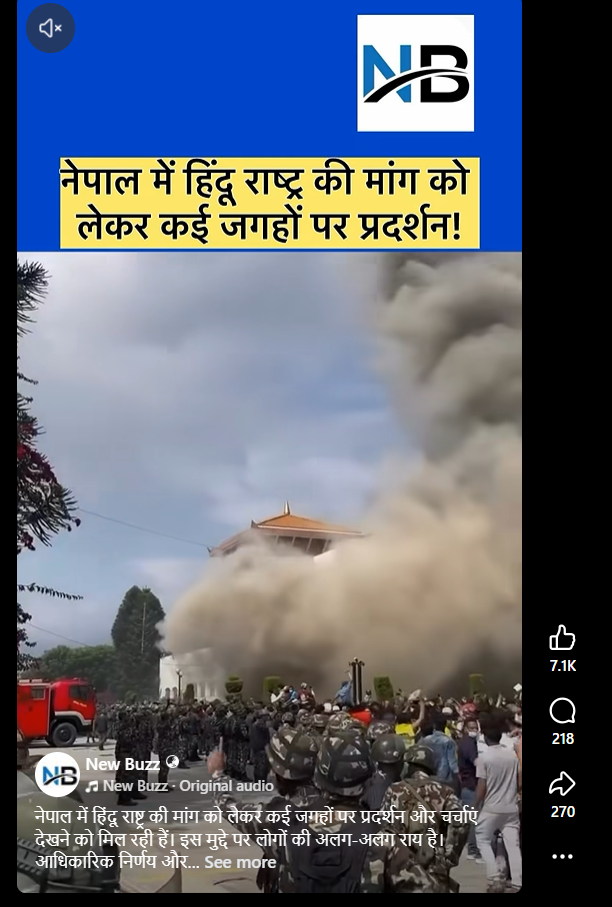
Following reports of communal violence in Nepal in July 2026, an organisation submitted a memorandum to Home Minister Soodan Gurung, calling for discussions on declaring Nepal a Hindu nation. Against this backdrop, a video showing protesters and smoke has gone viral on social media. A Facebook user, ‘New Buzz’, shared the video on August 5, 2026, with the caption:
"Protests and discussions are being seen in several places in Nepal over the demand for a Hindu nation. People have different views on this issue. One should reach a conclusion only on the basis of official decisions and credible information."
https://www.facebook.com/reel/27872198842449234
https://ghostarchive.org/archive/P89Qo
FactCheck:
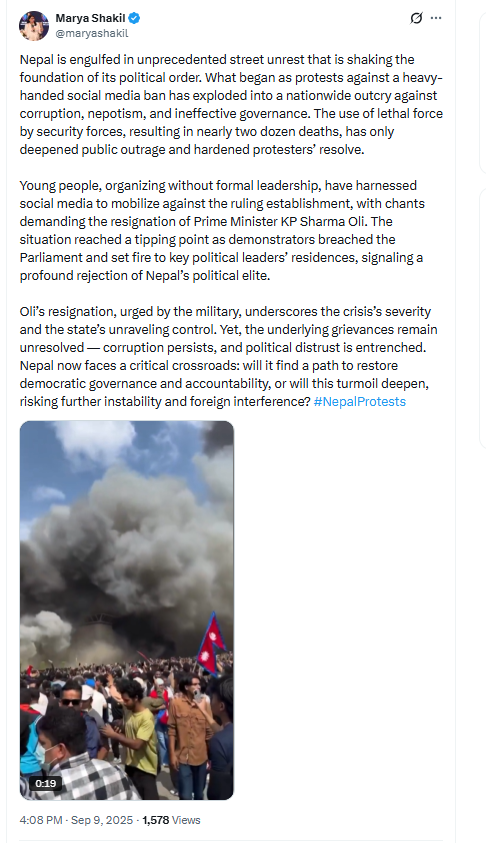
To verify the claim, we extracted keyframes from the viral video and conducted a reverse image search using Google Lens. The search led us to a post by India Today journalist Marya Shakil on X, dated September 9, 2025. She had shared the same video and identified it as footage from the Gen-Z protests in Nepal against corruption
https://x.com/maryashakil/status/1965364156992782723?s=20
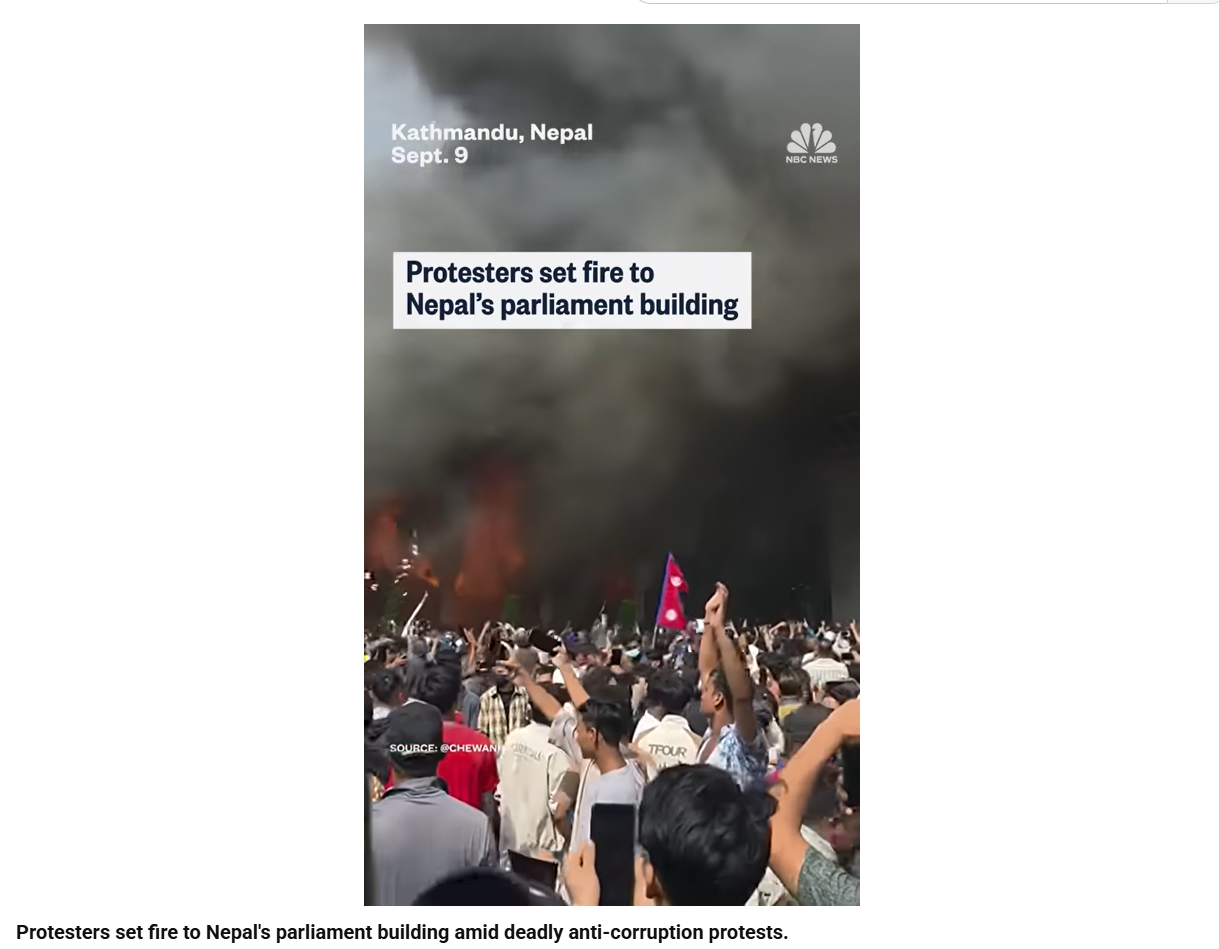
We also found a related news report on the NBC News YouTube channel, published on September 9, 2025. The video report also identified the footage as being from the protests in Nepal..
https://www.youtube.com/watch?v=PXnhHoH0XKE
Conclusion
The viral claim is false. The video being shared as footage of violent protests in Nepal over the demand for a Hindu nation actually dates back to the September 2025 Gen-Z protests against corruption. Although an organisation submitted a 13-point memorandum to Nepal's Home Minister following the July 2026 communal violence, including a demand for discussions on declaring Nepal a Hindu nation, the viral video is unrelated to that development.

Related Blogs

Introduction
MGM Resorts, which is an international company, has suffered an ongoing cyberattack which led to the shutdown of a number of its computer systems, including its website, in response to a cybersecurity issue. MGM Resorts International is in touch with external cybersecurity experts to resolve the issue since it has affected its entire Computer systems. MGM is a larger entity and operates thousands of hotel rooms across Las Vegas and the United States. MGM Resorts shared about the incident and posted that MGM recently identified a cybersecurity issue affecting some of the Company's systems. Promptly after detecting the issue, they quickly began an investigation with assistance from leading external cybersecurity experts. MGM has notified law enforcement and took prompt action to protect systems and data, including putting down certain systems. MGM further stated that the investigation is ongoing.
The issue
Basic operations such as the online reservation and booking system MGM have been affected and shut down due to the cybersecurity issue faced by a lot of visitors. Since earlier times, casino security has been the state of the art as they were very vulnerable to attacks by robbers and con artists. This is what we have also seen in a lot of movies. In today's time, con artists and robbers are now strengthened by cyber tactics. This is exactly what was seen in the case of the MGM attack.
MGM Resorts is home to best-in-class amenities and facilities for guests, but with the increase in tourist traction, the vulnerabilities and the scope of cyber attacks have also increased. This is also because of open wifis in the establishments and the transition of casinos to e-casinos, thus causing a major shift towards digital and technology-based intervention for better customer experience and streamlining a lot of operations.
How real is the threat?
As reported by MGM Resorts, the following systems were impacted in the cyber security attack:
- Slots Machines: The slot machines placed in the casino suddenly went offline and displayed an error message for the players. Some players who were already using the slot machines lost their bets and were unable to withdraw their winnings.
- Room Keys: Some of the guests reported that the room keys became unresponsive, and in some cases, the replacement keys were also inactive for some time, causing massive chaos at the reception.
- Booking Status: All the bookings in today's time are made online; this was one of the worst-hit segments of the cyber attacks. Most of the bookings made automatically were put on hold, and the confirmations could be made only from the hotel reception, thus causing massive cancelling of the bookings and both the hotel and customers losing out on money.
- MGM App: The official app of MGM Resorts was completely down, thus causing a situation of confusion and panic among the guests. The users also received notifications to speak to different customer care executives, but some of the numbers were unattentive and seemed to be operated by bad actors.
- Data breach: The main focus of the cyber attack was dedicated to committing a data breach. The attack led to the breach of personal data of most of the users registered on the app or on the system of MGM Resorts.
Conclusion
The cyber attack on the tourism industry is a major and growing concern for the industry and its customers. Seeing the volatility of the data and the regular inflow of personal information this makes the hotel's cyber security system a vulnerable choice for bad actors. The cyber attack was no less than a fire sale, where in all the segments of the services offered were impacted. Similar attacks were reported by MGM in 2019 and 2020, and subsequently, the safety measures were also deployed, but the bad actors have hit the resorts chain owners again, in such cases the most paramount defence is having a safe and regularly updated firewall, upskilling of staff for IT issues and attacks, active reporting and investigation mechanisms for assisting the LEAs. In the times of rising cyberattacks, one needs to be critical of their data management and digital footprints. The sooner we adopt safe, secure and resilient cyber hygiene practices, the safer our future will be.
References:
https://www.bleepingcomputer.com/news/security/mgm-resorts-shuts-down-it-systems-after-cyberattack/
https://www.cnbc.com/2023/09/12/mgm-resorts-cybersecurity-incident-forces-system-outage.html

Executive Summary
Amid rising tensions involving Iran, Israel and the United States following reports in early April 2026 that Iran had shot down an American fighter aircraft, a picture is going viral on social media claiming to show Iranian soldiers standing beside the wreckage of a destroyed helicopter while holding the Iranian flag. Research by CyberPeace Research Wing found that the viral claim is false. The image has been created using artificial intelligence and does not depict any real incident. The picture was generated using Google AI tools and is being misleadingly circulated online with different claims.
Claim
A Facebook page named “official salman 09” shared the image on May 1, 2026, along with a lengthy caption describing the scene as a symbol of Iran’s battlefield success. The post portrayed the image as evidence of a helicopter being brought down during ongoing tensions in the Middle East and suggested that the photo reflected strength, morale and victory in war.
- https://www.facebook.com/permalink.phpstory_fbid=pfbid02TAac6JwZha2UU4T8QiCGq4ENmsnNSwvigaz3vKxr9UWLbhghNsnMMpZdQ3dUuQ1rl&id=100092392280139
- https://archive.ph/

Fact Check
To verify the authenticity of the image, we first conducted a reverse image search using Google Lens. The image did not appear in any credible news reports or authentic media coverage. Instead, it was found circulating mainly on social media platforms, raising suspicion about its authenticity. We then analyzed the image using Google’s SynthID detector. The analysis confirmed the presence of a SynthID watermark with a “very high confidence” score, indicating that the image had been generated using Google AI tools. SynthID is Google’s watermarking technology used to identify AI-generated content created through its models.

Further verification using another AI-detection platform, Hive Moderation, also indicated a high probability that the image had been generated using AI. The tool identified Gemini as the likely source and assessed the image as overwhelmingly AI-generated.

Conclusion
Our research confirms that the viral image is AI-generated and unrelated to any real-world event. The picture showing soldiers holding the Iranian flag near helicopter wreckage was created using Google AI tools and is being falsely shared on social media to spread misleading claims.

Introduction
The year, 2022 has been a year of transition and change for the gaming industry. This year esports and gaming including the industry’s greater increased acceptance by the sports authorities and higher prize pools for top players, has been more commercial than ever, according to research by the year 2025 the industry will witness growth by 5 million dollars and around 420 million active gamers from India. Since, India is on the way to become world’s largest gaming market, with revenue earned in 2021 increasing by up to 28%, or 1.2 billion dollars, and predicted to reach 2 billion dollars by 2024 as a result of the COVID-19 expanding internet access throughout the country.
After a lengthy debate, the government has finally decided to bring online gaming under the purview of the law. The President of India has changed the rules governing e-sports and requested that the Sports Ministry and the Ministry of Electronics and Information Technology (MeitY) include e-sports in multi-sport competitions. India’s gaming sector has reached new heights this year, with the country winning its first bronze medal in the first esports event organized by this year’s Commonwealth Games, and this is only the beginning.
Indian government takes on E-sports
The Indian government has given esports a huge boost. It has been introduced into the traditional sports disciplines of the nation. Droupadi Murmu, the President of India, changed the regulations governing eSports using the authority “conferred by clause (3) of Article 77 of the Constitution,” and requested that “e-Sports be included as part of multi-sports events” from the Ministries of Electronics and Information Technology and Sports. Some crucial points will clarify the government’s position on e-sports.
- E-sports were added as a demonstration sport to the 2018 Asian Games in Jakarta, which meant that medals earned in the sport were not counted in the official total of medals.
- There is a greater desire for Esports to be integrated with school curricula.
- E-Sports (Electronic Sports) have been acknowledged by the Indian government as a component of multi-sport tournaments.

Why is e-sports important?
The Indian Esports Industry has worked hard to distinguish Esports from the broader category of “Gaming.” Esports is a competitive sport in which esports athletes compete in specific video game genres in a virtual, electronic environment using their physical and mental prowess, according to the industry.
According to studies, as individuals have gotten more screen aware and online gaming has become a part of their life, internet gaming not only improves fine motor skills but also sharpens the mind. The industry has the most users and stakeholders, and it has become critical to governing it; consequently, legislation is required to regulate it.
The online regulation bill 2022
The Online Gaming (Regulations) Bill, 2022, was recently filed in the Lok Sabha to create an effective regulatory mechanism for the online gaming business to prevent fraud and misuse of things related to or incidental to it. There are 20 sections spread throughout three chapters. It intends to establish an Online Gaming Commission, the authority, mandate, and jurisdiction of which will be specified by the Bill. An online gaming server will be licensed, relinquished, revoked, or suspended by the Commission’s key highlights of the bill to make it more clear
- The Bill establishes a regulating agency, the Online Gaming Commission (“OGC”), comprised of five members chosen by the Central Government, each with at least one specialist in the fields of law, cyber technology, and law enforcement experience.
- The OGC will be able to oversee the functions of online gaming websites, issue periodic or special reports on Online Gaming issues, recommend appropriate measures to control and curb illegal Online Gaming, grant, suspend, and revoke licenses for online gaming websites, and set fees for license applications and renewals.
- Without a website and a non-transferable and non-assignable license, the Bill proposes to make online gambling illegal. Anyone operating an online gaming server or website without a license risks up to three years in prison and a fine. The permission will be good for a six-year term.
- The license intended to be given under the Bill may be terminated or canceled if the licensee violates any of the license’s requirements or any of Bill’s provisions. However, the Bill does not apply to anybody providing backend services in India, including hosting and maintenance for any international gaming website situated outside of India.
- The bill also mentions the Foreign Direct Investment and Technology Collaboration in Online Gaming

Few misses in the bill that can be addressed to make it stronger and a better version
- The law does not address Know Your Customer (KYC) requirements, customer complaint procedures, advertising and marketing restrictions, user data protection, responsible gaming guidelines, and other concerns.
- In the bill, there is no clear distinction between money involved in the game. This is a matter of concern and needs to be addressed so the money laundering aspect can be determined.
- The distinction between “games of chance” and “games of skill” is not addressed in the Bill. Furthermore, the Bill does not specify whether its prohibitions apply only to for-real-money games or to free games.
Conclusion
Despite the bill’s flaws, it has offered optimism to the burgeoning gaming sector, which desperately needs a robust regulatory and legal framework free of ambiguity, allowing players to play safely, and encouraging entrepreneurs to enter the field with safety and security. An improved regulatory framework will increase job prospects while also assisting the government. A transparent framework will also aid in the protection of the rights of actors and stakeholders.
