
#FactCheck- Old Earthquake Images Falsely Linked to April 2026 Indonesia Quake
Executive Summary
Images showing collapsed buildings are being widely shared on social media following a powerful earthquake in Indonesia, with users claiming they depict the aftermath of the recent 7.4-magnitude quake. However, research by the CyberPeace Research Wing found the claim to be misleading. The viral images are not from the recent earthquake but from past tremors, and were published by major international news agencies in 2018, 2021 and 2022.
- https://perma.cc/6BTK-2V6T
- https://www.facebook.com/reel/1272067278357847%20no%20other%20snapshots%20from%20this%20url

Fact Check
The posts surfaced after a 7.4-magnitude earthquake struck off the coast of Kota Ternate in eastern Indonesia in the early hours of April 2, 2026, killing one person after a building collapse, as reported by international media.

To verify the authenticity of the images, we conducted reverse image and keyword searches on Google. The first image was found to be part of a wider photograph published by The Associated Press on January 15, 2021.

The third image was traced to Getty Images, which published it on October 2, 2018. According to its description, the image shows rubble and debris around a mosque in Palu, Central Sulawesi, following a 7.5-magnitude earthquake.

These findings confirm that the viral images are unrelated to the recent earthquake and have been taken from older incidents.
Conclusion
The viral claim is misleading. The images circulating online do not show the aftermath of the April 2026 earthquake in Indonesia. Instead, they are old visuals from previous earthquakes, reused with a false and misleading context.

Related Blogs

Executive Summary
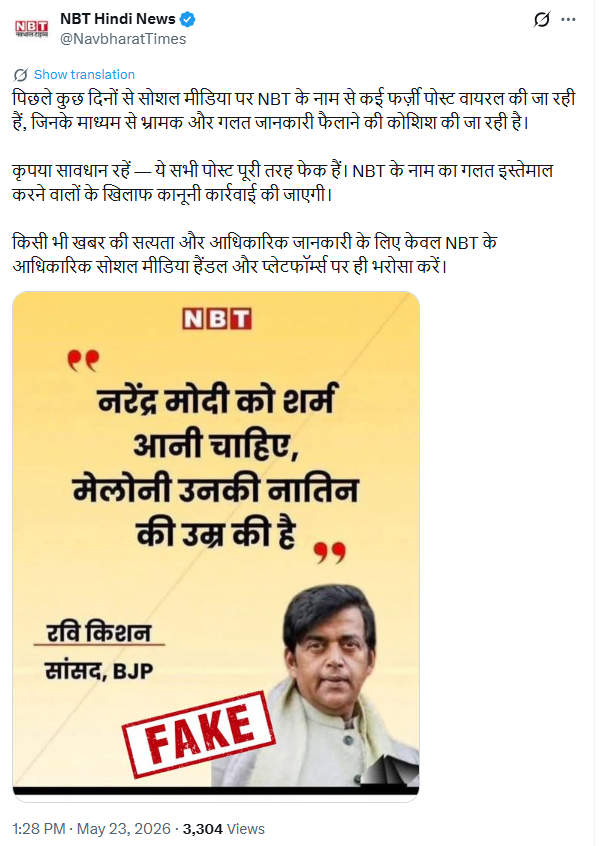
A social media post featuring a graphic attributed to Navbharat Times and BJP MP Ravi Kishan is being widely circulated. The post falsely claims that Ravi Kishan made a controversial statement saying, “Narendra Modi should be ashamed, Meloni is of his granddaughter’s age.” CyberPeace Research Wing investigation found that the claim is false. In the original Navbharat Times postcard, Ravi Kishan is seen saying that people should stop criticising the Prime Minister, otherwise they may have to face consequences.
Claim
An X (formerly Twitter) user named “Prem Jai Moolnivasi Paswan” shared the viral post and alleged that Ravi Kishan made objectionable remarks targeting Prime Minister Narendra Modi.
- https://www.facebook.com/premjaymulnivasi.paswan/posts/pfbid02Drv387K2ugesnP9vvbJXgqU7yTZkrUhVAB5y9euzHuxpigWa8uDEnu3E2T6oox8Wl?rdid=4VbtbVi1G8bgo12d
- https://archive.ph/NHBXP
Fact Check
During the investigation, we searched for the alleged statement using relevant keywords but found no credible reports or evidence supporting the claim. We then examined Navbharat Times’ official social media handles. A similar-looking but authentic postcard was found on the official Facebook page of Navbharat Times (Uttar Pradesh) dated May 18, 2026.
The original post quoted Ravi Kishan differently, stating that criticism of the Prime Minister should be avoided, or else consequences may follow. Nowhere in the authentic post is the viral controversial remark mentioned.

Further investigation revealed that Navbharat Times itself issued a clarification on its official X handle, stating that the viral post is fake and that legal action would be taken against misuse of its name.
Conclusion
The viral claim is false. The authentic Navbharat Times postcard shows Ravi Kishan saying that criticism of the Prime Minister should be stopped, or there would be consequences. The viral graphic has been altered to spread misinformation.

Executive Summary
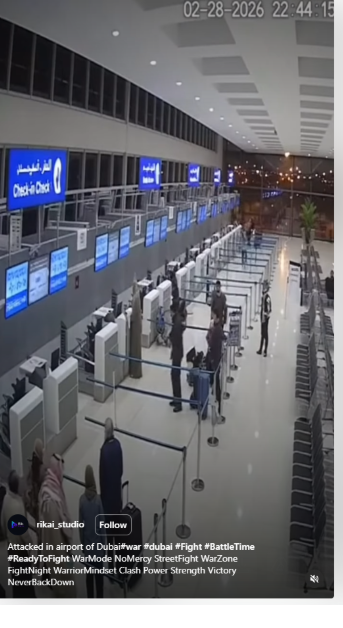
Amid rising tensions in the Middle East following attacks on Iran by the United States and Israel, a video is being shared on social media claiming that it shows a recent attack at Dubai International Airport. Research by the CyberPeace found the viral claim to be false. Our research revealed that the viral video is not real but has been created using artificial intelligence technology.
Claim:
An Instagram user shared the viral video on March 1, 2026, claiming it shows an attack at Dubai Airport. The link to the post, the archive link, and a screenshot are provided below.
Fact Check:
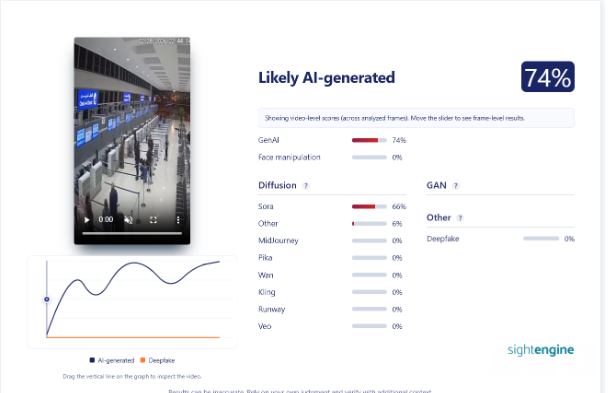
To verify the viral claim, we searched Google using relevant keywords. However, we did not find any credible media report confirming the claim.On closely examining the viral video, we noticed several unusual visuals and technical inconsistencies, raising suspicion that it might be AI-generated. To verify this, we scanned the video using the AI detection tool Sightengine. According to the results, around 74 percent of the video shows the likelihood of being AI-generated.
Conclusion:
Our research found that the viral video is not real but has been created using artificial intelligence technology.
Introduction
With the modernization of automobiles, so have the methods employed by criminals who seek to commit thefts. The old method of smashing a car window or bypassing an engine lock is no longer prevalent. Modern car thieves employ cloning techniques for keys and digital signals, and sophisticated methods to commit crimes without any traces left behind. In an era where intelligence is crucial, the forensic examination of car keys has become an indispensable tool for investigations, providing clues buried within ordinary car keys.
The Need for Car Key Forensics Today
Daily, thousands of cars worth millions are being hacked or stolen around the globe. The shocking thing is that most of these hacks do not have any sign of breakage or forced entry. It is because the thieves use vulnerabilities in the wireless key systems to unlock the vehicles without leaving any trace behind. Therefore, car-key forensics has now become more important than ever before.
Forensic Value of Smart Key
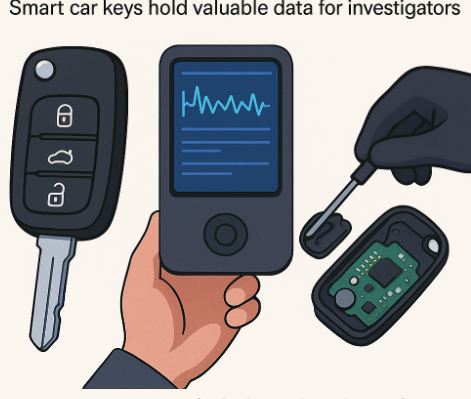
The smart key is not just comprised of locking and unlocking features for vehicles. Actually, it operates as a miniature computer within the key itself. Information such as pairing records, frequency of use, or the last instance that the key was used to unlock something could be contained in smart keys, thus offering evidence of any criminal activity conducted using these items.
Patterns of Vehicle Theft
Through the examination of the chip in a key, one will be able to establish whether the key was legally programmed or had been tampered with by some other means. Such forensics become more important when trying to detect and monitor any car theft rings, which employ cloning machines or software.
Confirming Ownership and Authenticity
In cases involving insurance claims or fraud, smart key data can help confirm whether the person making a claim actually owned or used the car during the incident. It’s digital proof that goes beyond what paperwork or statements can show.
Strengthening Legal Cases
When brought to court, data doesn’t lie. A properly handled forensic examination of a car key can provide hard evidence — the kind that holds up under questioning and supports or disproves claims with complete accuracy. In many cases, this small device becomes the most reliable witness in the investigation.
A Real-Life Example
Consider the following scenario: An expensive SUV is stolen from a parking lot secured with security surveillance. No one is captured on camera and there is no sign of forced entry. After days of investigation, the police end up arresting a suspect with a smart key.
During forensic analysis of the smart key, it is revealed that:
- The transponder has an ID number which can be matched against the immobilizer installed in the vehicle.
- The rolling code counter has been incremented in such a way that the date corresponds with the report of theft of the vehicle.
- The extracted information helps match the pair timestamp of the key with the particular make and model of the vehicle.
All this from a single piece of evidence – the smart key.
Inside a Smart Key: Where the Data Lives
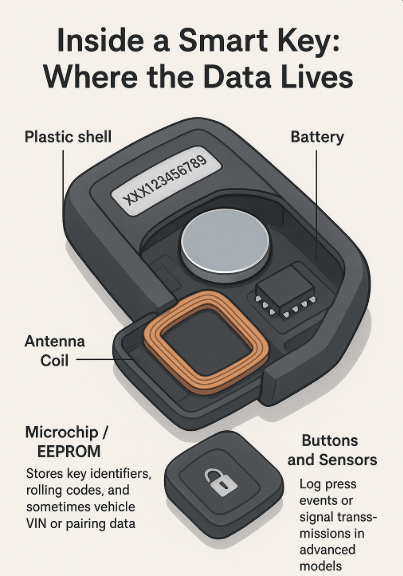
An average smart key is not only a remote but also a multi-level set of data carriers:
- Plastic Shell– could include serial numbers and information on the manufacture.
- Battery – helps calculate the time of using the key or detect any modifications.
- Antenna Coil – sends encrypted information to the immobilizer of a car. Draw the picture of this element.
- Microchip / EEPROM – holds key identification code, rolling code, VIN number, and/or other information of the vehicle.
- Buttons / sensors – could record any pressing or transmission actions in some cases.
All the little devices above, once properly studied via forensics software, provide valuable information.
How the Investigator Uncovers the Truth
In relation to investigating the true story about a vehicle, it is no different than handling other forms of digital evidence, as forensic analysts treat the car key in the same way. It is nothing more than an encrypted device in your hands, and using special techniques, they are able to reveal the information contained within the device.
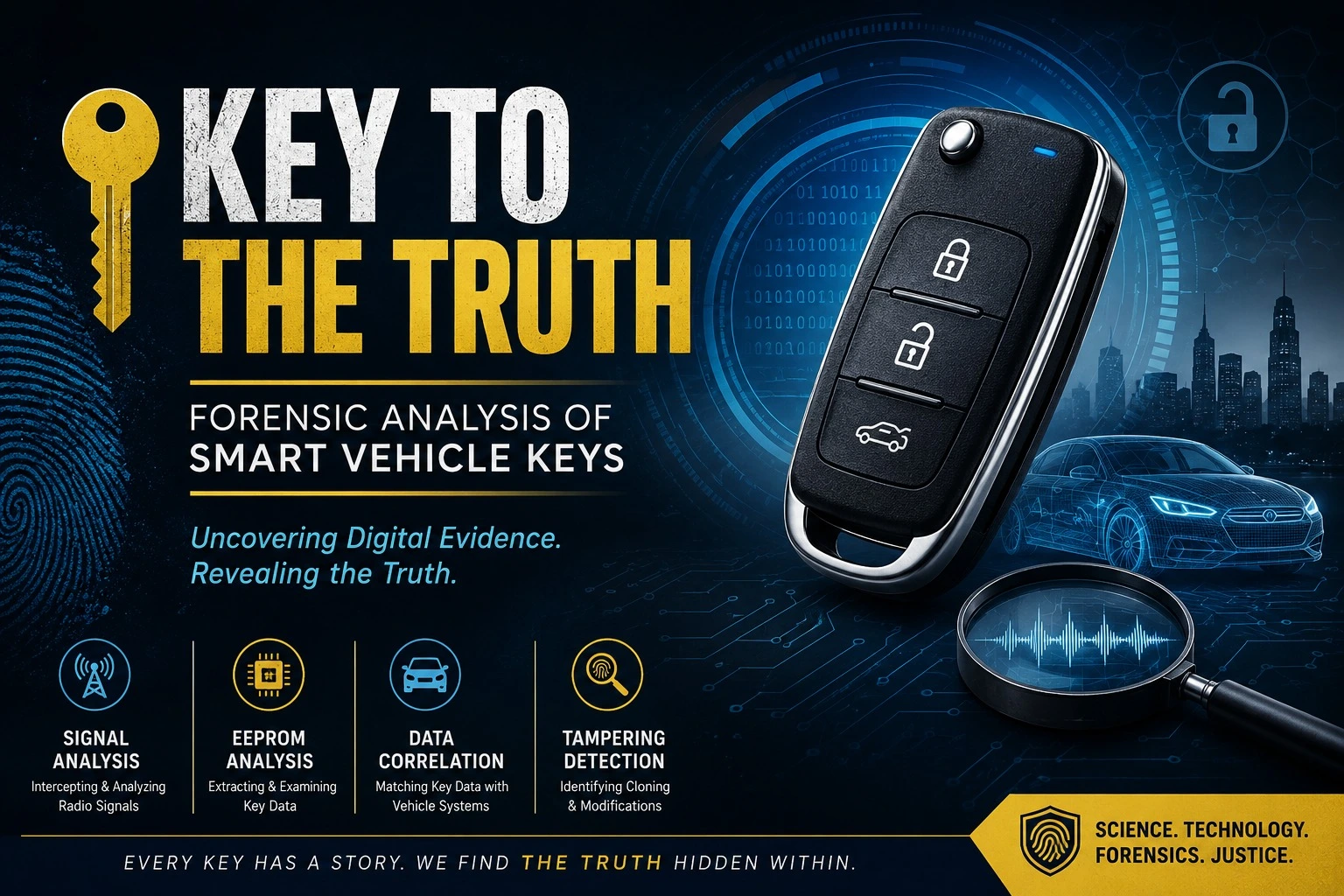
Some of the methods used by modern forensic laboratories include:
1. Intercepting Radio Signals
Any intelligent key transmits radio signals to communicate with a car. Specialists employ advanced antennas and radio frequency (RF) analysers to catch and analyse them. This way, it is possible to understand the interaction between the key and the car – how often was it used, what kind of authentication procedure takes place, and if the signal matches the car’s one or has been forged somehow.
2. Checking Out the Key’s Brain (Analysis of EEPROM)
There is always a special chip on the key that is responsible for its activity. The chip contains an important memory module (EEPROM – Electrically Erasable Programmable Read-Only Memory), which holds various data, including key IDs and rolling codes. It can be carefully retrieved via advanced tools. Thus, it is possible to determine whether somebody tried to tamper with the key.
3. The Correlation between the Key and Car’s Information
The information stored inside the key will not be used separately since investigators will correlate the key's data with that of the vehicle itself (ECU and immobilizer). If the two kinds of information coincide, the investigation may conclude that the key belongs to the vehicle. Otherwise, this may mean either cloning or tampering.
4. Identifying the Tampering and Cloning Evidence
As was mentioned above, thieves sometimes resort to using unlawful programming devices for duplicating smart car keys. In order to detect possible cloning, experts examine the key using various diagnostic devices to find out whether the keys were modified by changing the encryption code, frequencies, and hardware itself.
At the end of the process, some kind of miracle occurs because of the following: all actions committed with this particular key become documented, recorded inside the device itself. Even if someone tries to hide anything or remove any information concerning this particular incident, there will always remain some data.
Car Key Forensics in the Future
The evolution of cars to connect with other devices and adopt self-driving technologies requires new investigative methods to be used for vehicle-related crimes. Advanced car keys or smartphone apps that replace physical keys will likely incorporate biometric authentication, cloud integration, or blockchain records of key activity in the near future.
Such improvements will pose several threats and offer many benefits:
- Artificial intelligence tools can determine if the car key is cloned based on its behaviour pattern.
- Blockchain validation ensures all key-related activities are recorded and cannot be altered.
- Cyber-forensic protocols will become increasingly necessary for investigating criminal activity related to vehicles.
Car key forensics technology will not only allow solving crimes but may become instrumental in crime prevention.
Conclusion
A car key in this era is more than just an unlocking mechanism; it is a miniature data storage facility, which can yield information about the user, intentions, and access rights. The more cars become technologically advanced, the more the examination of smart keys becomes necessary as part of correlating physical evidence with digital investigation. It clearly indicates how small objects such as keys can play pivotal roles in cracking cases.
