
#FactCheck -AI-Generated Video Falsely Claims Indian Soldiers Failed Motorcycle Stunts During Republic Day Parade
Executive Summary
As India concluded its 77th Republic Day celebrations on January 26, 2026, with grandeur and patriotic enthusiasm along the iconic Kartavya Path, a video began circulating on social media claiming to show Indian security personnel failing to perform motorcycle stunts during the ceremonial parade. The short clip allegedly depicts soldiers attempting high-risk, synchronised motorcycle manoeuvres, only to lose balance and fall off their bikes. The visuals were widely shared online with mocking captions, suggesting incompetence during a nationally televised event. However, an research by the CyberPeace found that the video is not authentic and was digitally generated using artificial intelligence.
Claim
A Pakistan-based X user, Sadaf Baloch (@sadafzbaloch), shared the video on January 27, claiming it showed Indian security personnel failing to execute motorcycle stunts during the Republic Day parade held on January 26, 2026. While sharing the clip, the user wrote:“Every time the Indian Army tries a tactical stunt, it looks less like combat training and more like a low-budget circus trailer filmed in one take.”The post was widely circulated with similar narratives questioning the professionalism of Indian forces.
Here is the link and archive link to the post, along with a screenshot.

To verify the authenticity of the viral video, the Desk conducted a detailed frame-by-frame analysis. During the examination, a watermark linked to ‘Sora’—an AI text-to-video generation model was detected at the 00:05 timestamp. The presence of this watermark strongly indicated that the video was artificially generated and not recorded during a real-world event.

Fact Check:
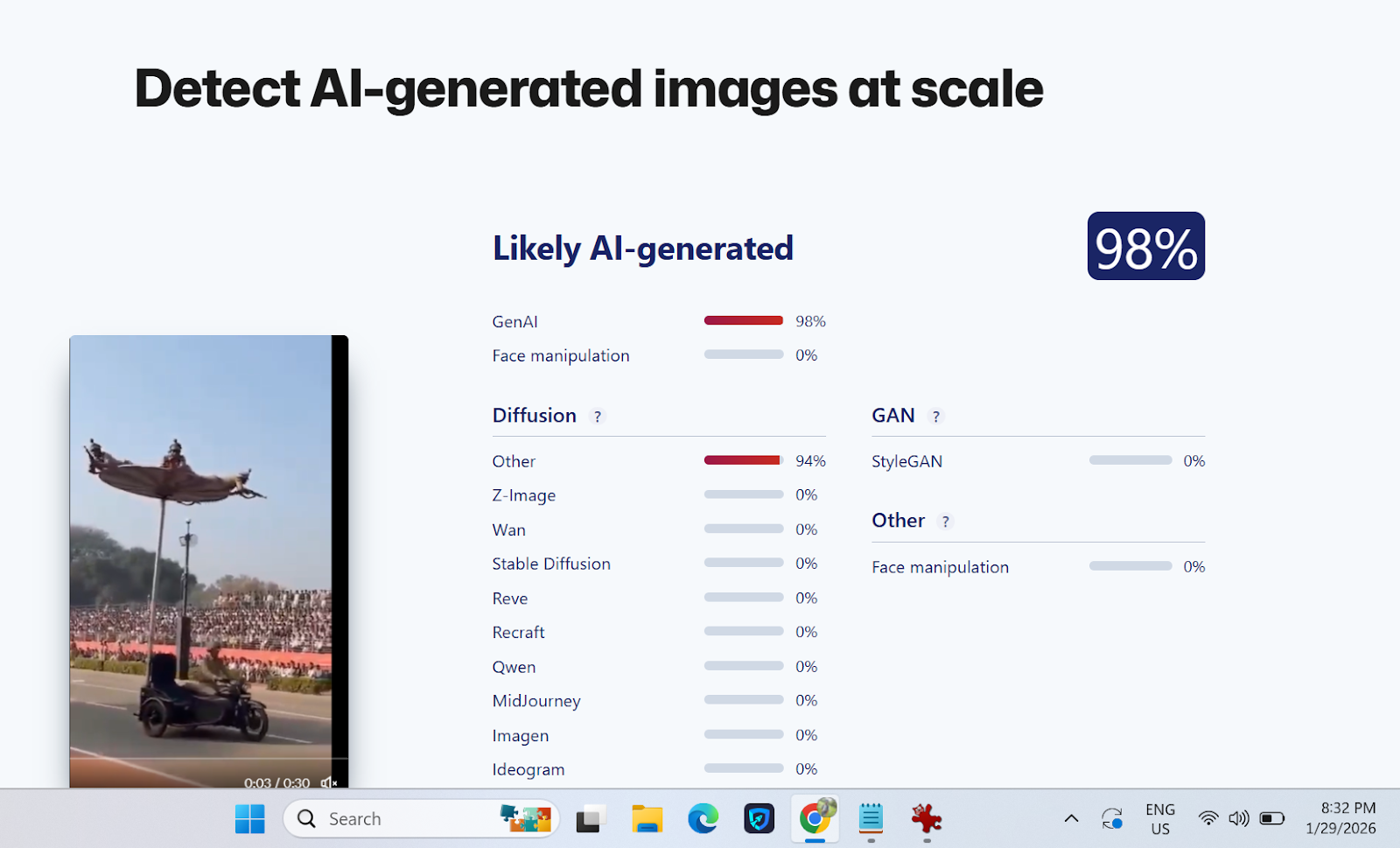
Further visual scrutiny revealed several inconsistencies commonly associated with AI-generated content. The background appeared unnatural and lacked realistic depth, while the movements and reactions of the security personnel looked mechanically exaggerated and inconsistent with real physics. Facial expressions and body motions during the alleged falls also appeared unrealistic. To strengthen the verification, the Desk analysed the clip using Sightengine, an AI-detection tool. The results showed a 98 per cent probability that the video contained AI-generated or deepfake elements.
Below is a screenshot of the result.
As part of the research , the Desk also conducted a customised keyword search and reviewed official coverage of the Republic Day parade. A full-length video broadcast by DD News on its official YouTube channel was examined. The footage showed joint CRPF and SSB motorcycle teams performing traditional daredevil stunts without any mishap. No incident resembling the viral claim was found in the official broadcast or in any credible media reports.
Here is the video link and a screenshot.

Conclusion
The CyberPeace research confirms that the viral video purportedly showing Indian security personnel failing to perform motorcycle stunts during the 77th Republic Day parade is AI-generated. The clip has been falsely circulated online as genuine content with the intent to mislead viewers and spread misinformation.

Related Blogs
"India’s digital public infrastructure promises inclusion and efficiency. But when essential services depend on handing over data, children become legible to the state long before anyone listens to them."
India’s digital transformation deserves much of the praise it gets. Digital Public Infrastructure (DPI) has taken public services to people at a scale few countries have managed. Still, one question gets less attention than it should: what happens when the state’s wish for a neatly administered citizen starts to override the rights of a child?
Aditi Pillai takes this up in From Principle(al) to Practice: The Child as a Datafied Digital Citizen in India’s Digital Public Infrastructure. She doesn’t argue against digital infrastructure. Her point is that its claim to serve the public can’t be separated from the power it holds over the people enrolled in it. The most obvious example is children. When they are persons with rights today, they run the risk of being reduced to administrative categories, data points and future projections. A child’s citizenship is suspended until adulthood. These days, identity, privacy and agency are important but digital governance frequently views childhood as something that needs to be tracked, controlled and maximised.
Protection without participation
Pillai’s sharpest idea is what she calls “double paternalism.” She uses 49-story completion responses from parents who completed brief hypothetical situations regarding enrolling a child in a computerised system, as well as expert interviews. Her focus is on how parental and institutional power reinforce one another and prevent kids from making decisions about their own online life.
Consider the Automated Permanent Academic Account Registry (APAAR), which provides a permanent academic identification for every student. Consolidating records may well help administrators. The harder questions are whether enrolment is truly voluntary, whether refusing carries a penalty, and whether a family can question how data is collected and linked without risking the child’s schooling.
The answers weren’t encouraging. Many parents either accepted enrolment despite their reservations or viewed it as a requirement that wasn’t worth challenging. Out of the 48, only four exhibited aggressive resistance and just one admitted that the adolescent in the scenario might have a voice. It is not appropriate to interpret this little qualitative study as a statistical representation of Indian parents. Nevertheless, it implies that there was never a choice and that obedience may be mistaken for informed agreement.
That is the double edge. The state compels, or strongly nudges, parents to enrol their children. Parents then decide on the child’s behalf without involving them. Both layers claim to protect the child’s interests, and the child’s own voice is missing from both.
When convenience becomes compulsion
It is easy to treat digital systems as neutral tools. They aren’t. Every system embodies decisions about what is collected, which records are linked, who can see them, and what happens to someone who can’t or won’t comply.
Pillai points to what can follow when educational records are tied to identity systems. Persistent data trails can expose children to long-term profiling. Rigid identification rules can shut out those whose lives don’t fit the institutional template: children without reliable documents, those who have left abusive homes, those who can’t provide valid biometrics.
There is an irony here. A system built to make citizens more visible to the state can make its most vulnerable citizens less visible as people. When a child can’t meet the system’s requirements, the result is often exclusion, not accommodation.
All of this does not imply that India should abandon digital infrastructure.The true debate is whether people’s freedom of choice, privacy and equitable access should be sacrificed for efficiency. A system can’t call itself inclusive if participation is compulsory in practice and the exceptions are badly designed.
Parents can’t carry this alone
Pillai also names “potentiality risk,” the worry that data gathered in childhood will quietly shape future opportunities, reputation or identity. A school record can outlast the circumstances that produced it. A bad year, once logged, may follow a student if institutions come to read them through a permanent digital profile.
Parents are left in an impossible spot. They are expected to guard their children against risks they may not fully understand and have little power to control. Responsibility slides from the institutions that build and run these systems to the families who must live with them. That is a weak form of accountability. Parental consent can’t justify every kind of data processing involving a child, and parents shouldn’t have to bargain one by one with schools or authorities when the alternative is losing an essential service.
The Digital Personal Data Protection Act, 2023, treats children as a distinct category of data principals and requires verifiable parental consent, subject to its provisions and rules. That is a start. The deeper question remains: does a child-focused data regime only regulate what adults decide about children, or does it also leave room for children’s own evolving views and abilities? Protection without participation can turn into control by another name.
From data subjects to digital citizens
Pillai’s strategy is built on two interconnected concepts: a rights-based perspective of data justice rooted in the UN Convention on the Rights of the Child (UNCRC) and participatory digital citizenship.
In actuality, this entails consulting kids before systems are developed rather than after. Parents need clear information and practical options to raise concerns about enrolment. Accessible grievance procedures, real alternatives when necessary and safeguards against exclusion are all necessary for institutions. Collection and linking of data should be proportionate to a legitimate purpose with clear accountability for how it is used later. Above all, the child’s best interests should be a standard that actually governs decisions, not a phrase invoked to excuse administrative convenience.
India’s digital ambitions and children’s rights don’t have to collide. A public system is best judged by how it treats the people least able to challenge it. The real test of a digital state is not how many people it can enrol or connect, but whether they keep their dignity and agency once inside. Children should not end up as records to be maintained or risks to be managed. They are citizens now, and their rights matter now.
References
- Aditi Pillai, ‘From Principle(al) to Practice: The Child as a Datafied Digital Citizen in India’s Digital Public Infrastructure’ (2026) 22(2) Indian Journal of Law and Technology, Article 3. DOI: 10.55496/NFYV5618.
- Digital Personal Data Protection Act 2023, s 9.
- United Nations Convention on the Rights of the Child (adopted 20 November 1989, entered into force 2 September 1990) 1577 UNTS 3.
- Government of India, ‘G20 New Delhi Leaders’ Declaration’ (2023).

Introduction
Sexual Offences against children have recently come under scrutiny after the decision of the Madras High Court which has ruled that watching and downloading child sexual porn is an inchoate crime. In response, the Supreme Court, on 23 September 2024, ruled that Section 15 of the POCSO and Section 67B of the IT Act penalise any form of use of child pornography, including storing and watching such pornographic content. Along with this, the Supreme Court has further recommended replacing the term “Child Pornography” which it said acts as a misnomer and does not capture the full extent of the crime, with a more inclusive term “Child Sexual Exploitative and Abuse Material” (CESAM). This term would more accurately reflect the reality that these images and videos are not merely pornographic but are records of incidents, where a child has either been sexually exploited and abused or where any abuse of children has been portrayed through any self-generated visual depiction.
Intermediaries cannot claim exemption from Liability U/S 79
Previously, intermediaries claimed safe harbour by only complying with the requirements stipulated under the MOU. As per the decision of the SC, now, an intermediary cannot claim exemption from the liability under Section 79 of the IT Act for any third-party information, data, or communication link made available or hosted by it unless due diligence is conducted by it and compliance is made of these provisions of the POCSO Act. This is as per the provisions of Sections 19 and 20 of the POCSO read with Rule 11 of the POCSO Rules which have a mandatory nature.
The due diligence under section 79 of the IT Act includes the removal of child pornographic content and immediate reporting of such content to the concerned police units in the manner specified under the POCSO Act and the Rules. In this way, the Supreme Court has broadened the Interpretation and scope of the ‘Due Diligence’ obligation under section 79 of the IT Act. It was also stated that is to be duly noted that merely because an intermediary complies with the IT Act, will not absolve it of any liability under the POCSO. This is unless it duly complies with the requirements and procedure set out under it, particularly Section 20 of the POCSO Act and Rule 11 of the POCSO Rules.
Bar on Judicial Use of the term ‘Child Porn’
Supreme Court found that the term child pornography can be trivialised as pornography is often seen as a consensual act between adults. Supreme Court emphasised using the term Child Sexual Exploitative and Abuse Material (CESAM) as it would emphasise the exploitation of children highlight the criminality of the act and shift the focus to a more robust framework to counter these crimes. The Supreme Court also stated that the Union of India should consider amending the POCSO Act to replace the "child pornography" term with "child sexual exploitative and abuse material" (CSEAM). This would reflect more accurately on the reality of such offences. Supreme Court also directed that the term "child pornography" shall not be used in any judicial order or judgment, and instead, the term "CSEAM" should be endorsed.
Curbing CSEAM Content on Social Media Platforms
Social Media Intermediaries and Expert Organisations play an important role in curbing CESAM content. Per the directions of the Apex Court, a need to impart positive age-appropriate sex education to prevent youth from engaging in harmful sexual behaviours, including the distribution, and viewing of CSEAM is important and all stakeholders must engage in proactive measures to counter these offences which are under the umbrella of CSEAM. This should entail promoting age-appropriated and lawful content on social media platforms and social media platforms to ensure compliance with applicable provisions.
Conclusion
In light of the Supreme Court’s landmark ruling, it is imperative to acknowledge the pressing necessity of establishing a safer online environment that shields children from exploitation. The shift towards using "Child Sexual Exploitative and Abuse Material" (CSEAM) emphasizes the severity of the crime and the need for a vigilant response. The social media intermediaries must respect their commitment to report and remove exploitive content and must ensure compliance with POCSO and IT regulations. Furthermore, comprehensive, age-appropriate sex education can also be used as a preventive measure, educating young people about the moral and legal ramifications of sexual offences, encouraging respect and awareness and ensuring safer cyberspace.
References
- https://www.scconline.com/blog/post/2024/09/23/storing-watching-child-pornography-crime-supreme-court-pocso-it-act/#:~:text=Supreme%20Court%3A%20The%20bench%20of,watching%20of%20such%20pornographic%20content
- https://timesofindia.indiatimes.com/india/supreme-court-viewing-child-porn-is-offence-under-pocso-it-acts/articleshow/113613572.cms
- https://bwlegalworld.com/article/dont-use-term-child-pornography-says-sc-urges-parliament-to-amend-pocso-act-534053
- https://indianexpress.com/article/india/child-pornography-law-pocso-it-supreme-court-9583376/

Introduction
The enactment of the Online Gaming (Promotion and Regulation) Act, 2025 has a significant impact, resulting in considerable changes to the structure of the Indian gaming industry. The ban on Real-Money Games (RMG), including fantasy sports, rummy, and poker, aims to curb addiction, illegal betting and most importantly, financial exploitation.
However, this decision sent ripples throughout the industry, resulting in players, companies and their investors re-strategising their plans to move forward. This approach, however, is a sharp contrast to how other nations, including the UK, Singapore and others, regulate online gaming. This, as a result, has also raised doubts about the ban and calls into question whether this is the right move.
Industry in Flux - The resultant Fallout
- MPL’s Layoffs: The Mobile Premiere League has so far laid off nearly 60 per cent of its workforce, with the CEO of the company openly admitting that the company is no longer able to make money in India.
- Dream11’s Lost Revenue: Having seen a position of being a market leader, the company has now witnessed its 95 per cent revenue wiped out, resulting in raised alarms among investors.
- A23’s Legal Move: The company chose to move the Karnataka High Court under the argument that the ban also ends up unfairly criminalising skill-based games that were earlier classified differently from gambling by the courts.
The new face of eSports: With RMGs outlawed, the focus is now on esports, including casual mobile gaming, console/PC gaming, and creating new opportunities and also leaving a void for RMG revenue companies.
Regulations Around the World - & India
India has adopted a prohibition model, whereas many other countries have developed regulatory frameworks that allow sectoral expansion under monitoring.
United Kingdom:
- Online gaming is regulated by the UK Gambling Commission.
- RMGs are legal but subject to strict licensing, age verification and advertising rules.
- Self-exclusion schemes are a must, offered by operators along with tools to prevent gambling addictions.
United States
- State-driven regulations that vary from state to state.
- States including Nevada and New Jersey allow casinos both online and offline, while other states prohibit them completely.
- Regulation for skill-based fantasy games is fragmented but generally legal.
China
- Great focus on controlling and restricting gaming addictions among minors.
- Time limits are enforced for players under 18 (usually as little as 3 hours per week).
- Gambling has been deemed illegal; however, esports and casual gaming operate within China’s regulated gaming ecosystem, subject to certain compliance.
Singapore
- The Remote Gambling Act regulates chance-based games, while other eSports and skill-based games operate out of its jurisdiction and are regulated separately.
- Online gambling isn't completely banned, but is operated under restrictions.
- Only Licensed operators under strict controls are allowed by the government to operate to avoid and prevent black-market alternatives.
Australia
- Regulates under the Interactive Gambling Act.
- Sports betting and certain licensed operators are allowed, while most of the other online gambling services are prohibited.
- Restrictions on advertising and real-time interventions allow emphasis on harm minimisation.
India’s Approach - Comparison
The Online Gaming (Promotion and Regulation) Act, 2025 introduces a prohibition model for real money games. This differs from jurisdictions such as the UK and US, which have implemented regulatory frameworks to oversee the sector. In India, earlier legal interpretations distinguished between games of skill and games of chance. The new legislation provides a single treatment for both categories, which marks a departure from previous judicial pronouncements.
Conclusion
At present, India’s gaming sector is navigating layoffs, court cases, and a pivot towards esports post the RMG ban. Keeping in mind that the intent of said ban is the protection of citizens, the industry also argues that regulation, instead of prohibition, offers a sustainable approach to the issues. On the other hand, on the global scale, most nations prefer controlled and licensed models that ensure consumer safety and work on preserving both jobs and revenues. However, India’s step is diverging from such a model. The lack of safeguards and engagement in the real money gaming industry led to a prohibition model, underscoring that in sensitive digital sectors, early regulatory alignment is essential.
References
- India online gaming ban: Global rules & regulation bill 2025
- Level up or game over? Decoding India’s gaming industry post RMG ban
- MPL lays off 350 employees after GST rules, RMG crackdown
- India’s Dream11 hit by online gaming ban, revenue slumps
- Online gaming ban: A23 moves Karnataka HC against government decision
- UK Gambling Commission – Licensing and Regulations
- Fantasy Sports & Gambling Law – State by State
- China’s gaming restrictions for minors
- Singapore Remote Gambling Act – Ministry of Home Affairs
- Australian Communications and Media Authority – Interactive Gambling Act
