
#FactCheck- Old Dubai Flood Videos Falsely Shared as Recent Storm Footage
Executive Summary
Amid reports of heavy rainfall and flooding in several cities of the United Arab Emirates, a video is being widely circulated on social media claiming to show recent scenes from Dubai. The clip allegedly depicts severe waterlogging at Dubai Airport and inside shopping malls, with users linking it to a “recent storm.”According to research by CyberPeace, the viral footage is not recent. The video is actually a compilation of three different clips stitched together and dates back to 2024, when Dubai experienced unprecedented flooding following heavy rains.
Claim
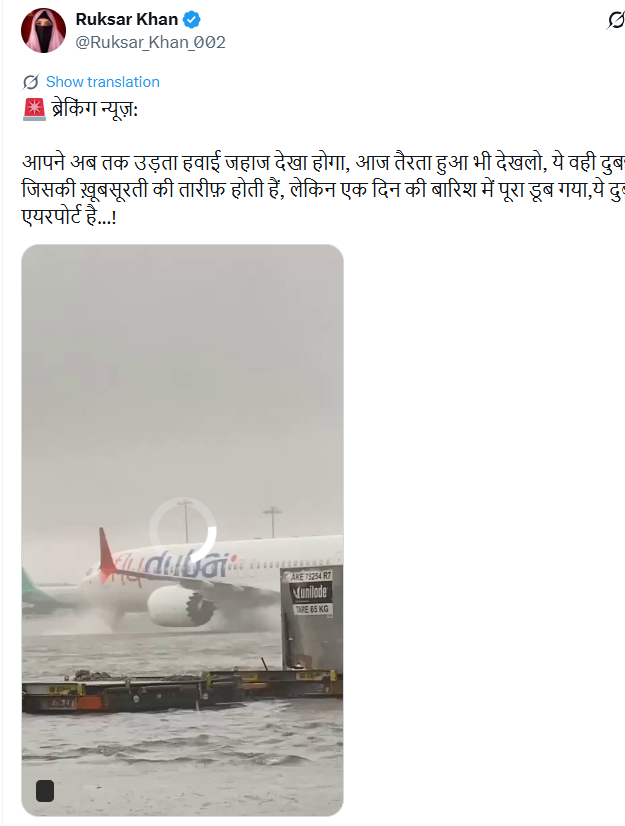
The misleading post was shared by an X (formerly Twitter) user named ‘Ruksar Khan’ on March 28, 2026, with a caption suggesting that Dubai had been submerged after just one day of rain. The post attempted to sensationalize the situation by portraying the visuals as current.
Fact Check:
To verify the claim, keyframes from the viral video were extracted using the InVid tool and analyzed through reverse image search. One of the clips was traced to a Facebook post by “9 News,” uploaded on April 17, 2024. The video showed waterlogged runways at Dubai International Airport following intense rainfall and flooding.

Further verification led to a report published by Hindustan Times on April 17, 2024, which featured similar visuals and confirmed that the footage was from the floods that hit Dubai in 2024.

Conclusion:
The viral claim suggesting that the video shows recent flooding in Dubai is false. The footage is nearly two years old and originates from the 2024 floods in Dubai. It is now being reshared with misleading claims to create confusion around current weather events.

Related Blogs

The digital ecosystem of India has experienced rapid growth, which has created numerous opportunities for economic development, better governance and increased social connections. The increasing use of digital technology has resulted in a higher incidence of cyber-enabled crimes, which include online fraud and cyber harassment, child exploitation and the spread of misinformation. The Government of India has established multiple initiatives to enhance a complete and unified framework that will help in combatting cybercrime more effectively. The latest updates presented to Parliament demonstrate how different institutional frameworks and legal provisions, capacity building efforts, and public awareness programs work together to handle new cyber threats.
A Coordinated Institutional Framework
The Indian system for investigating and prosecuting cybercrimes assigns responsibility to States and Union Territories, which operate their own Law Enforcement Agencies. The central government established the Indian Cyber Crime Coordination Centre (I4C) to support these operations through its Ministry of Home Affairs.
The I4C functions as a central hub that allows various stakeholders in cybercrime prevention and investigation to share intelligence and build their operational capacities. The initiative establishes a cybersecurity system that will improve its organisational structure through better central and state agency collaboration.
The National Cyber Crime Reporting Portal (NCCRP) serves as a primary project of this framework by providing online cyber incident reporting for citizens. The portal enables users to register complaints more efficiently while enhancing access to crime reporting, which particularly benefits victims of crimes against women and children. The system offers special channels which allow users to report Child Sexual Exploitative and Abuse Material (CSEAM) and rape-related materials while providing options for anonymous reporting and case tracking. After a complaint is lodged, the appropriate state authorities initiate the process to investigate the matter and proceed with legal procedures.
Capacity Building and Cyber Forensics
The response to cybercrime requires both expert investigators and advanced forensic technology systems. The Cyber Crime Prevention against Women and Children (CCPWC) Scheme, which provides financial backing and technical training to states and union territories, was instituted by the Ministry of Home Affairs to address this requirement.
The scheme has authorised the release of ₹132.93 crore for developing cyber forensic facilities and investigative technologies. The funding has supported the establishment of cyber forensic-cum-training laboratories across multiple states and union territories. The total number of operational laboratories has reached 33 at this time.
The organisation has prioritised its training initiatives together with its infrastructure development projects. More than 24,600 law enforcement personnel, prosecutors, and judicial officers have received training on cybercrime investigation, digital evidence handling, and forensic analysis. The capacity-building initiatives were designed to provide investigators and judicial authorities with essential skills needed to handle advanced cyber incidents.
International Cooperation for Child Protection
International cooperation is essential for addressing online child exploitation because these crimes utilise digital networks that connect multiple countries. The National Crime Records Bureau (NCRB) established a partnership with the National Centre for Missing and Exploited Children (NCMEC) of the United States in 2019 through a Memorandum of Understanding, which aims to enhance regional collaboration in this field.
The partnership enables the sharing of tipline reports about online child exploitation, which Indian authorities use for their investigative work. Under the Information Technology Act provisions, NCRB has received official powers to issue removal notices to intermediaries because they oversee child sexual abuse material and other dangerous content.
Promoting Online Safety Awareness
Cybercrime prevention requires two essential elements, which are public knowledge and digital expertise. The National Commission for Protection of Child Rights (NCPCR) has developed several resources to educate children, parents, teachers, and school administrators about online safety. The guidelines include Being Safe Online, together with school safety manuals that protect against cyberbullying and the 2024 updates, which provide new recommendations for cyberbullying prevention. The commission has established multiple conferences and training sessions throughout various states to educate both educators and school administrators about child protection regulations and school security measures, and cyber protection standards.
The digital responsibility programs educate communities about proper online conduct and teach them how to recognise and handle cybersecurity threats.
Legal Framework for Digital Safety
The Information Technology Act of 2000, together with the Information Technology Intermediary Guidelines and Digital Media Ethics Code Rules of 2021, (Updated as of 2026) serve as the core legal foundation through which India combats cybercrime. The laws establish penalties for online distribution of obscene and sexually explicit material while requiring digital intermediaries to block access to illegal content.
The Bharatiya Nyaya Sanhita 2023 contains additional legal provisions that deal with two types of offences that involve disseminating obscene material and spreading dangerous misinformation.
The regulatory framework requires intermediaries to eliminate illegal content within specified timeframes, while they must prevent their platforms from being used to conduct dangerous or unlawful activities.
Conclusion
India establishes its cybercrime response strategy through a multi-layered method that uses different institutional systems, technological systems, legal systems, and public education programs. Cyber threats develop through technological progress, yet authorities must establish effective cybersecurity, which depends on their ability to investigate, their systems for reporting incidents, and their dedication to maintaining proper online conduct.
India needs continuous cooperation among government bodies, police forces, technology companies, and community organisations to maintain secure and strong digital networks that provide equal access to all citizens.
References
- https://www.pib.gov.in/PressReleasePage.aspx?PRID=2238260®=3&lang=2
- https://www.policyedge.in/p/rajya-sabha-strengthening-indias-coordinated-response-to-cyber-crimes
Executive Summary
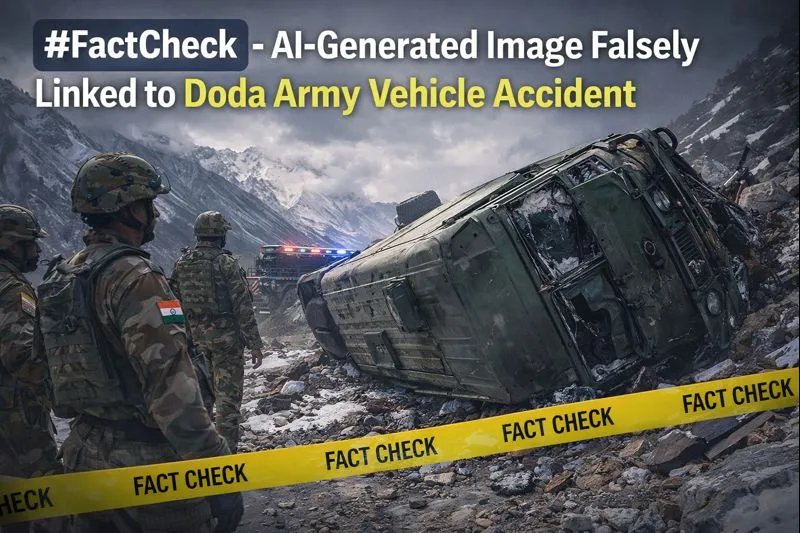
On January 22, an Indian Army vehicle met with an accident in Jammu and Kashmir’s Doda district, resulting in the death of 10 soldiers, while several others were injured. In connection with this tragic incident, a photograph is now going viral on social media. The viral image shows an Army vehicle that appears to have fallen into a deep gorge, with several soldiers visible around the site. Users sharing the image are claiming that it depicts the actual scene of the Doda accident.
However, an research by the CyberPeacehas found that the viral image is not genuine. The photograph has been generated using Artificial Intelligence (AI) and does not represent the real accident. Hence, the viral post is misleading.
Claim
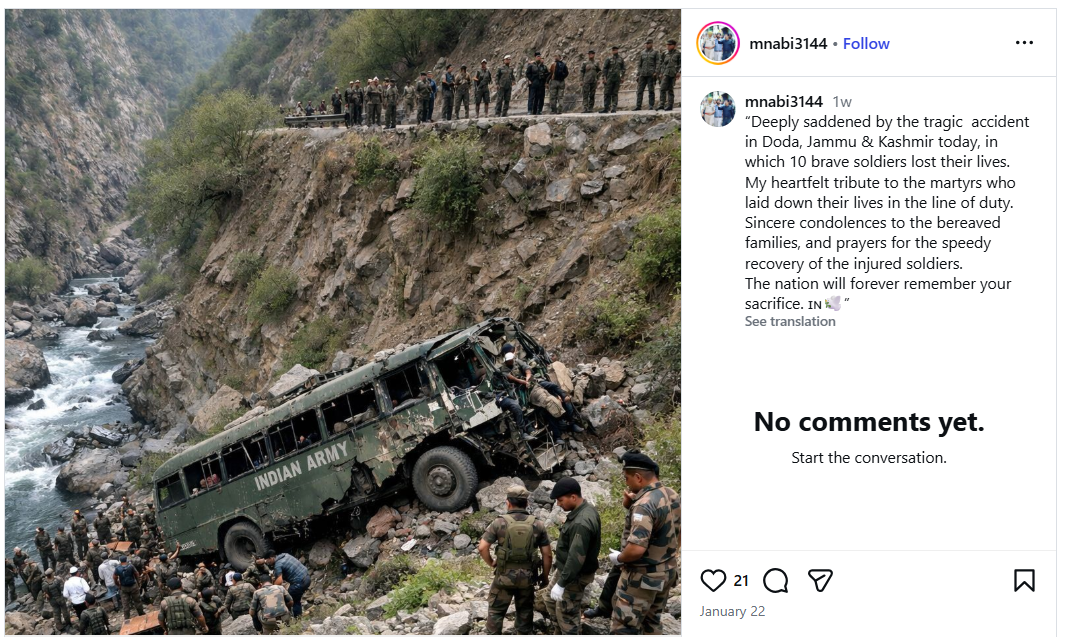
An Instagram user shared the viral image on January 22, 2026, writing:“Deeply saddened by the tragic accident in Doda, Jammu & Kashmir today, in which 10 brave soldiers lost their lives. My heartfelt tribute to the martyrs who laid down their lives in the line of duty.Sincere condolences to the bereaved families, and prayers for the speedy recovery of the injured soldiers.The nation will forever remember your sacrifice.”
The link and screenshot of the post can be seen below.
- https://www.instagram.com/p/DT0UBIRk_3k/
- https://archive.ph/submit/?url=https%3A%2F%2Fwww.instagram.com%2Fp%2FDT0UBIRk_3k%2F+
Fact Check:
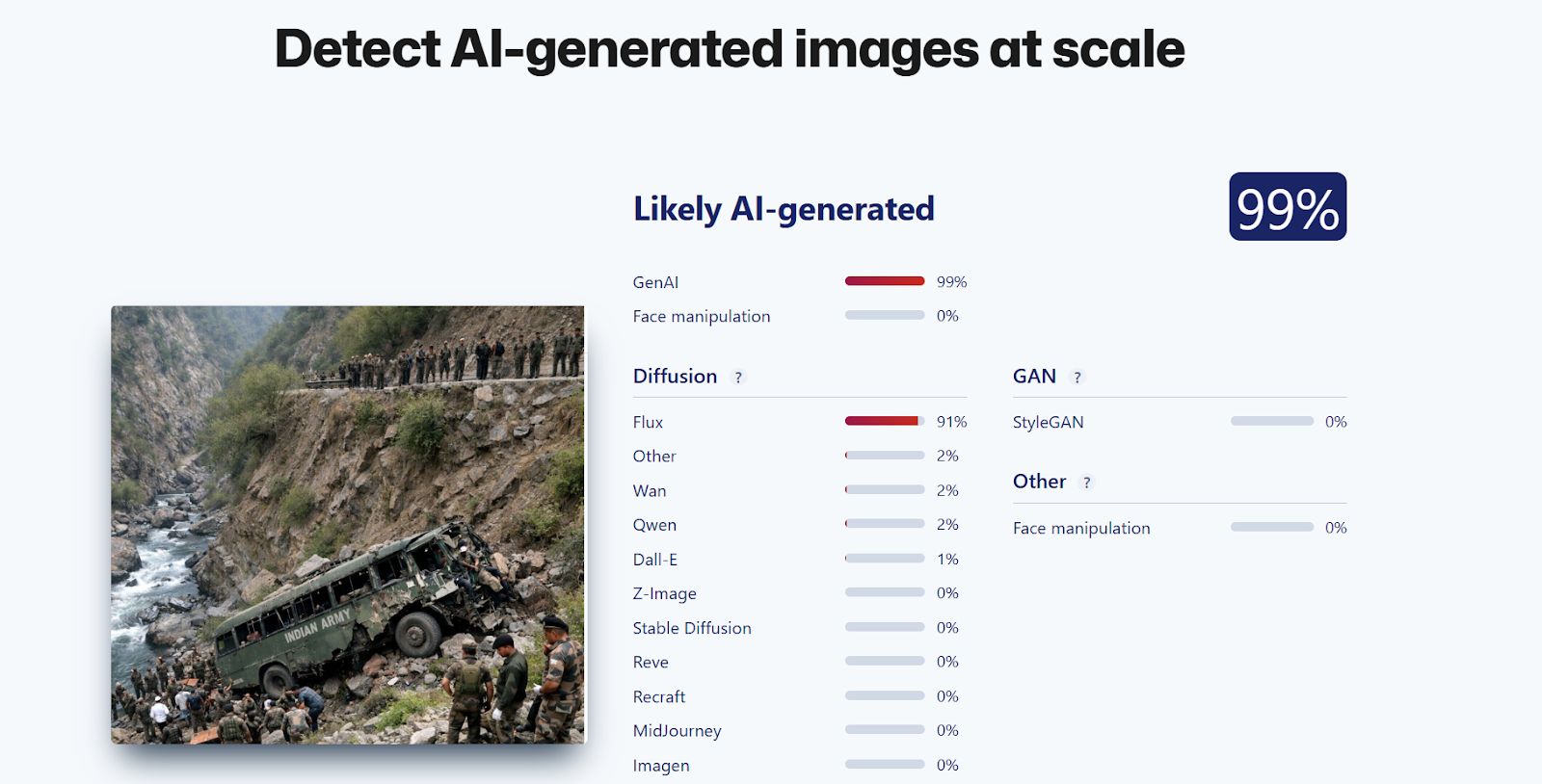
To verify the claim, we first closely examined the viral image. Several visual inconsistencies were observed. The structure of the soldier visible inside the damaged vehicle appears distorted, and the hands and limbs of people involved in the rescue operation look unnatural. These anomalies raised suspicion that the image might be AI-generated. Based on this, we ran the image through the AI detection tool Hive Moderation, which indicated that the image is over 99.9% likely to be AI-generated.

Another AI image detection tool, Sightengine, also flagged the image as 99% AI-generated.
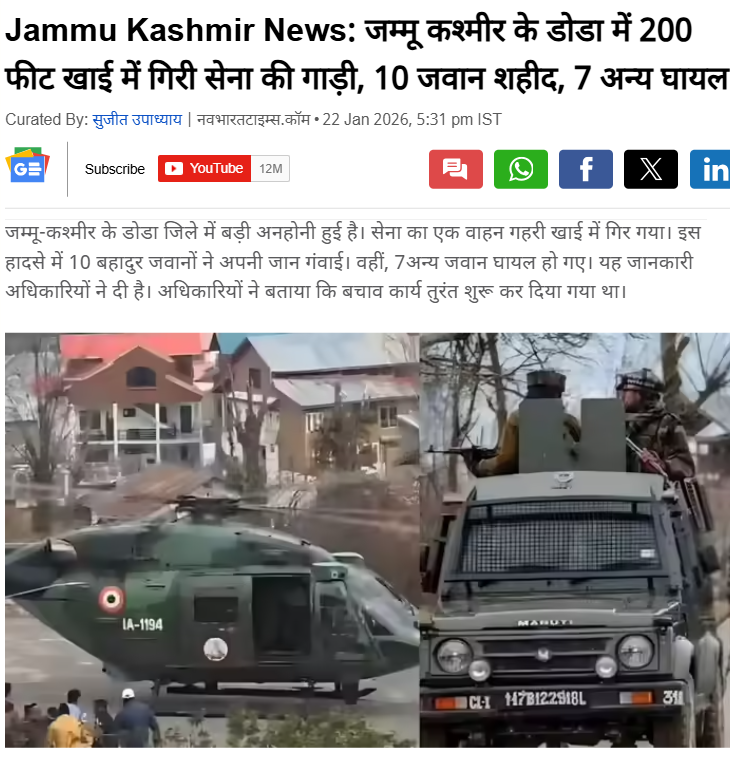
During further research , we found a report published by Navbharat Times on January 22, 2026, which confirmed that an Indian Army vehicle had indeed fallen into a deep gorge in Doda district. According to officials, 10 soldiers were killed and 7 others were injured, and rescue operations were immediately launched.
However, it is important to note that the image circulating on social media is not an actual photograph from the incident.
Conclusion
CyberPeace research confirms that the viral image linked to the Doda Army vehicle accident has been created using Artificial Intelligence. It is not a real photograph from the incident, and therefore, the viral post is misleading.

Executive Summary
A video featuring the newly appointed Chief of Army Staff (COAS), General Dhiraj Seth, is going viral on social media. The video claims that he made controversial remarks regarding Operation Sindoor and alleged that the previous military leadership hid the bodies of Indian soldiers martyred during the operation. It further claims that Defence Minister Rajnath Singh and Prime Minister Narendra Modi were also kept unaware of the matter. CyberPeace Research Wing research found the claim to be misleading. The research revealed that the viral video was digitally manipulated using artificial intelligence (AI), and the voice heard in the video is not authentic.
Claim
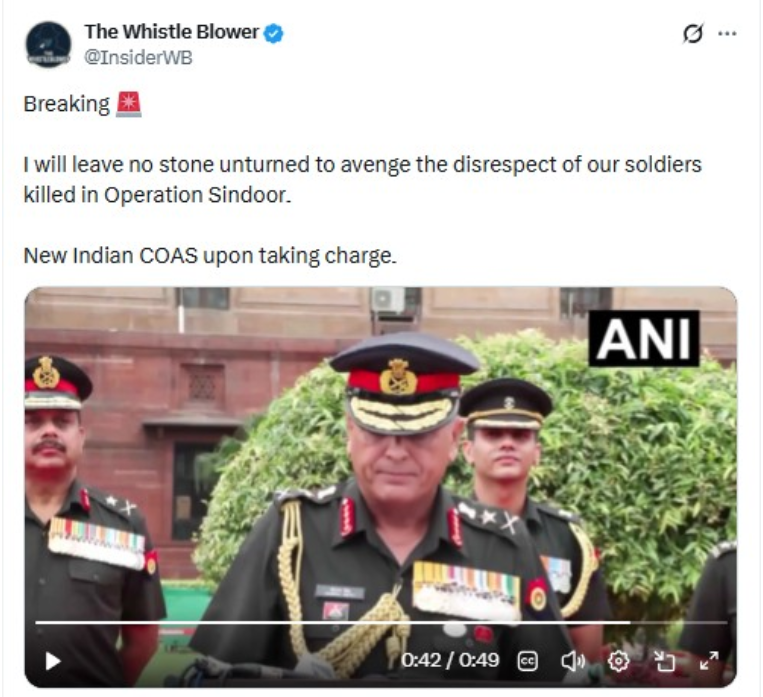
A viral video shared on social media platform X claims that newly appointed Chief of Army Staff (COAS) General Dhiraj Seth said that the bodies of Indian soldiers martyred during Operation Sindoor were hidden and that Defence Minister Rajnath Singh and Prime Minister Narendra Modi were not informed about it. https://archive.ph/oaOgB , https://x.com/InsiderWB/status/2072434480543899826
Fact Check
To verify the viral claim, we searched the internet using relevant keywords including “General Dhiraj Seth statement on Operation Sindoor”, “Operation Sindoor martyrs”, and “dead bodies hidden.” However, we did not find any credible media report stating that Army Chief General Dhiraj Seth made the remarks attributed to him in the viral video. We also checked the official social media handles of the Indian Army, but found no official statement or information supporting the viral claim. During the research, several keyframes from the viral video were extracted and analysed through reverse image search. The search led us to an ANI report published on July 1, 2026, whose watermark is also visible in the viral video. The original footage shows General Dhiraj Seth addressing the public after assuming charge as the Chief of Army Staff. We carefully reviewed General Dhiraj Seth’s entire address but found no mention of hiding the bodies of martyred soldiers or any statement related to the viral claim. The same address was also shared on the official platform of the Indian Army. The video review confirmed that it does not contain any such remarks.
https://www.facebook.com/reel/1592505052458589

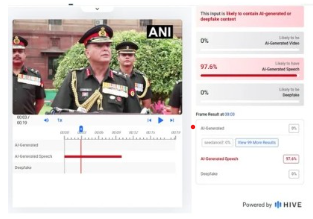
During the analysis, it was also observed that the name tag on General Dhiraj Seth’s uniform appears distorted in several frames. Such inconsistencies are commonly seen in AI-generated or digitally manipulated videos. To verify the authenticity of the video, we analysed it using multiple AI detection tools. The results from all the tools were consistent. Hive Moderation’s analysis indicated a high probability that the viral media contains AI-generated or deepfake content.
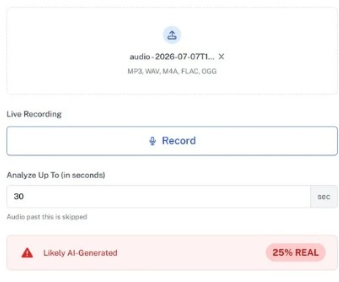
Undetectable AI’s analysis also concluded that the voice heard in the viral video was likely generated using artificial intelligence (AI).
Conclusion
Our research found that the viral video is not authentic. There is no evidence that Chief of Army Staff General Dhiraj Seth ever accused the previous military leadership of concealing the bodies of soldiers martyred during Operation Sindoor. The video has been digitally manipulated, and the claim being circulated on social media is misleading.
