
#FactCheck - Viral Video Showing Man Frying Bhature on His Stomach Is AI-Generated
A video circulating on social media shows a man allegedly rolling out bhature on his stomach and then frying them in a pan. The clip is being shared with a communal narrative, with users making derogatory remarks while falsely linking the act to a particular community.
CyberPeace Foundation’s research found the viral claim to be false. Our probe confirms that the video is not real but has been created using artificial intelligence (AI) tools and is being shared online with a misleading and communal angle.
Claim
On January 5, 2025, several users shared the viral video on social media platform X (formerly Twitter). One such post carried a communal caption suggesting that the person shown in the video does not belong to a particular community and making offensive remarks about hygiene and food practices..
- The post link and archived version can be viewed here: https://x.com/RightsForMuslim/status/2008035811804291381
- Archive Link: https://archive.ph/lKnX5

Fact Check:
Upon closely examining the viral video, several visual inconsistencies and unnatural movements were observed, raising suspicion about its authenticity. These anomalies are commonly associated with AI-generated or digitally manipulated content.
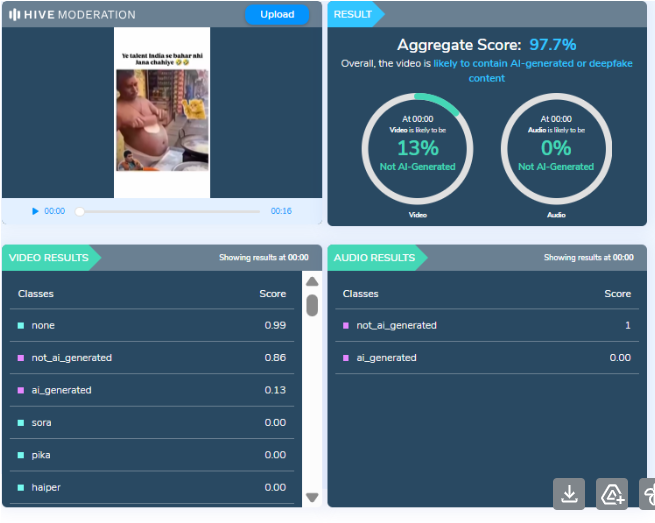
To verify this, the video was analysed using the AI detection tool HIVE Moderation. According to the tool’s results, the video was found to be 97 percent AI-generated, strongly indicating that it was not recorded in real life but synthetically created.
Conclusion
CyberPeace Foundation’s research clearly establishes that the viral video is AI-generated and does not depict a real incident. The clip is being deliberately shared with a false and communal narrative to mislead users and spread misinformation on social media. Users are advised to exercise caution and verify content before sharing such sensational and divisive material online.

Related Blogs
The Expanding Governance Challenge of Artificial Intelligence
Artificial intelligence (AI) systems are increasingly embedded in economic and social infrastructure. They are being adopted in financial services, healthcare diagnostics, hiring systems, and public administration. But while these systems improve efficiency and decision-making, they also introduce new forms of technological risk.
Unlike conventional software, AI systems learn patterns from data and continue to evolve as they run. This poses governance issues since risks can arise throughout the AI life cycle, whether at the coding level or in their implementation.
The latest regulatory frameworks, such as the European Union’s AI Act (EU AI Act) and the UNESCO Recommendation on the Ethics of Artificial Intelligence, note that responsible AI governance depends on the realisation of where risks emerge across the development process.
This article maps the AI system lifecycle, identifies the risks that emerge at each stage and evaluates the policy tools used to mitigate them using the lifecycle framework developed by the Organisation of Economic Co-operation and Development (OECD).
The Lifecycle of an AI System
AI systems are developed through a structured process that includes problem definition, dataset collection and preparation, model development, testing and validation, deployment, and monitoring.
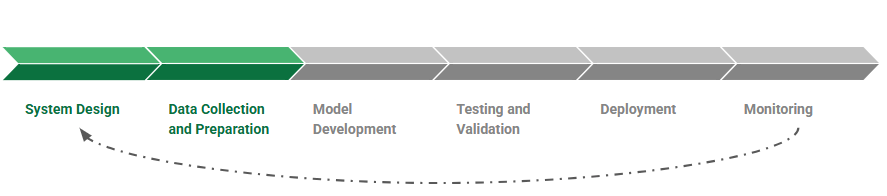
The OECD conceptualises this development process as the AI system lifecycle. Each stage entails various technical and administrative procedures, since choices made during these stages will dictate the goals and limits of an AI system. Further, the quality and representativeness of training sets will have a strong effect on the behaviour of models after implementation.
Since this is an iterative and not a linear procedure, risks can be introduced at each stage of the AI lifecycle. New data can be retrained into different models, and systems are regularly updated once they have been deployed, to address performance degradation, model errors, or unintended outputs. This iterative process means governance must address risks across the entire lifecycle, not just at deployment.
Where AI Risks Emerge
AI risks usually emerge earlier in the development process, especially in the phases when system objectives are formulated and training data are chosen. The EU AI Act and the UNESCO Recommendation on the Ethics of AI outline the following risks: bias and discrimination, privacy and data security violations, the absence of transparency in automated decision-making, and risks to fundamental rights.
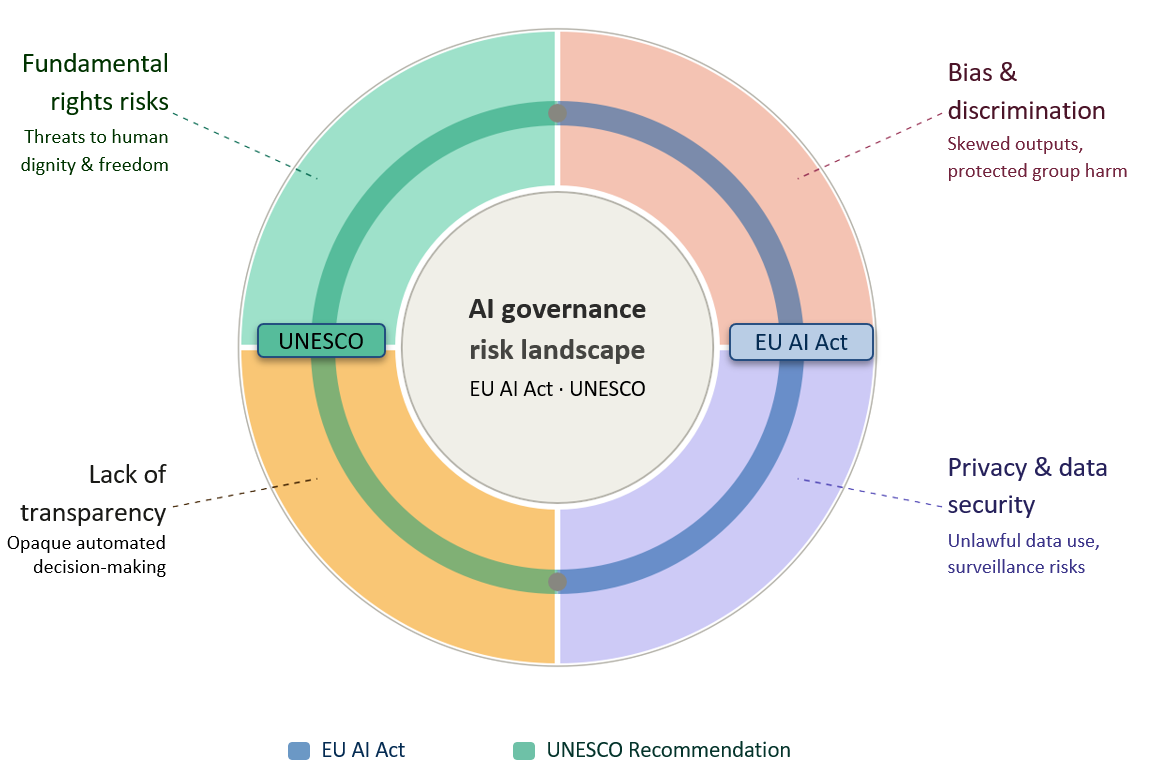
AI Governance Risk Landscape: Core Risk Categories Under International Frameworks
Risk categories jointly identified by the EU AI Act and UNESCO Recommendation on the Ethics of Artificial Intelligence
Outlining the risks throughout the AI lifecycle helps understand the areas where governance interventions are most necessary. For example, discriminatory outcomes often result from biased or unrepresentative training data, while safety failures are typically linked to inadequate testing before deployment. Risks such as misinformation arise post the development process, when generative AI systems are deployed at scale on digital platforms.
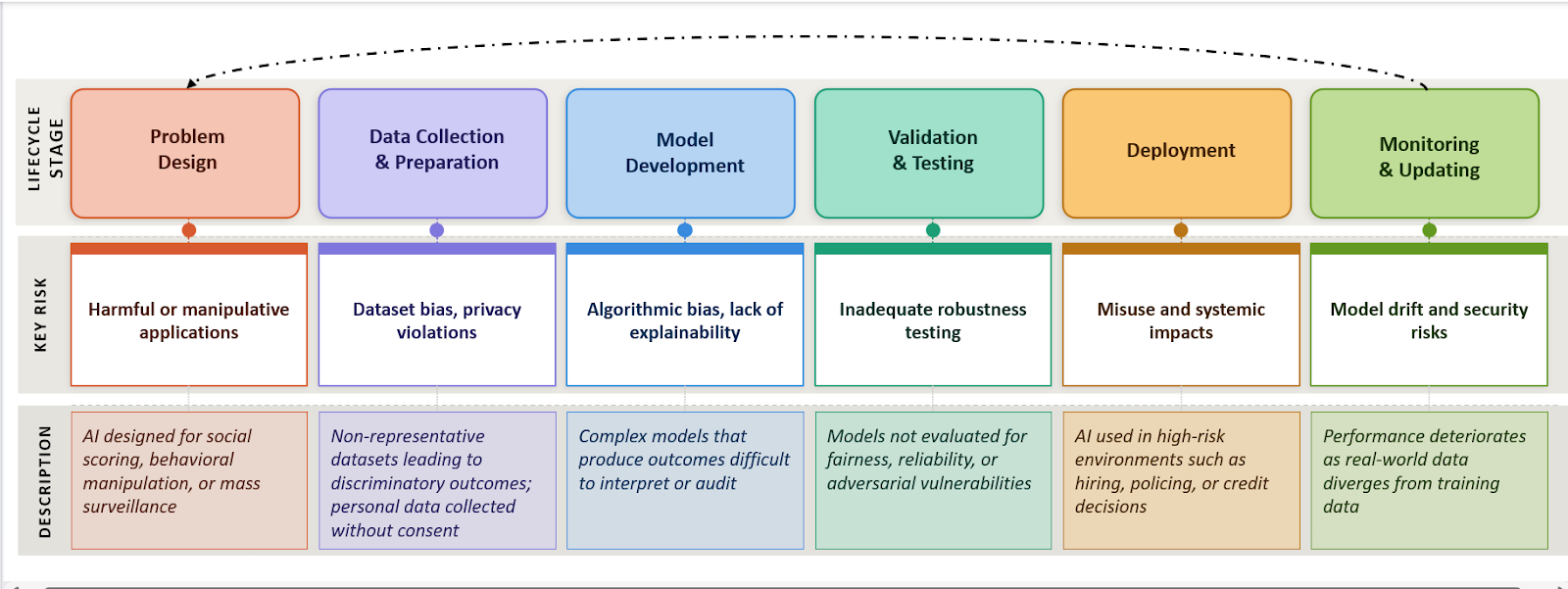
AI System Lifecycle: Key Risks at Each Stage
Risks identified per the EU AI Act and UNESCO Recommendation on the Ethics of AI
Understanding where risks emerge across the lifecycle explains why governance frameworks classify AI systems by risk and apply oversight at multiple stages.
Policy Tools for Mitigating AI Risks
Governments and international organisations have developed regulatory tools to help mitigate AI risks in the lifecycle. These tools are meant to make sure that AI technologies are identified as up to standard in safety, accountability and fairness prior to and after deployment.
For example, the OECD AI Policy Observatory recommends that governments adopt policy instruments such as risk evaluations, algorithmic auditing necessities, regulatory sandboxes, and transparency necessities of AI systems. The European Union’s Artificial Intelligence Act (AI Act) is one of the most comprehensive systems of governance that introduces a risk-oriented regulation strategy. It mandates adherence to requirements concerning data governance, documentation, human oversight, and robustness, and cybersecurity. Such requirements bring regulatory checkpoints to the lifecycle of AI systems.
Mapping these policy tools across the lifecycle illustrates how governance mechanisms can intervene at different stages of AI development.
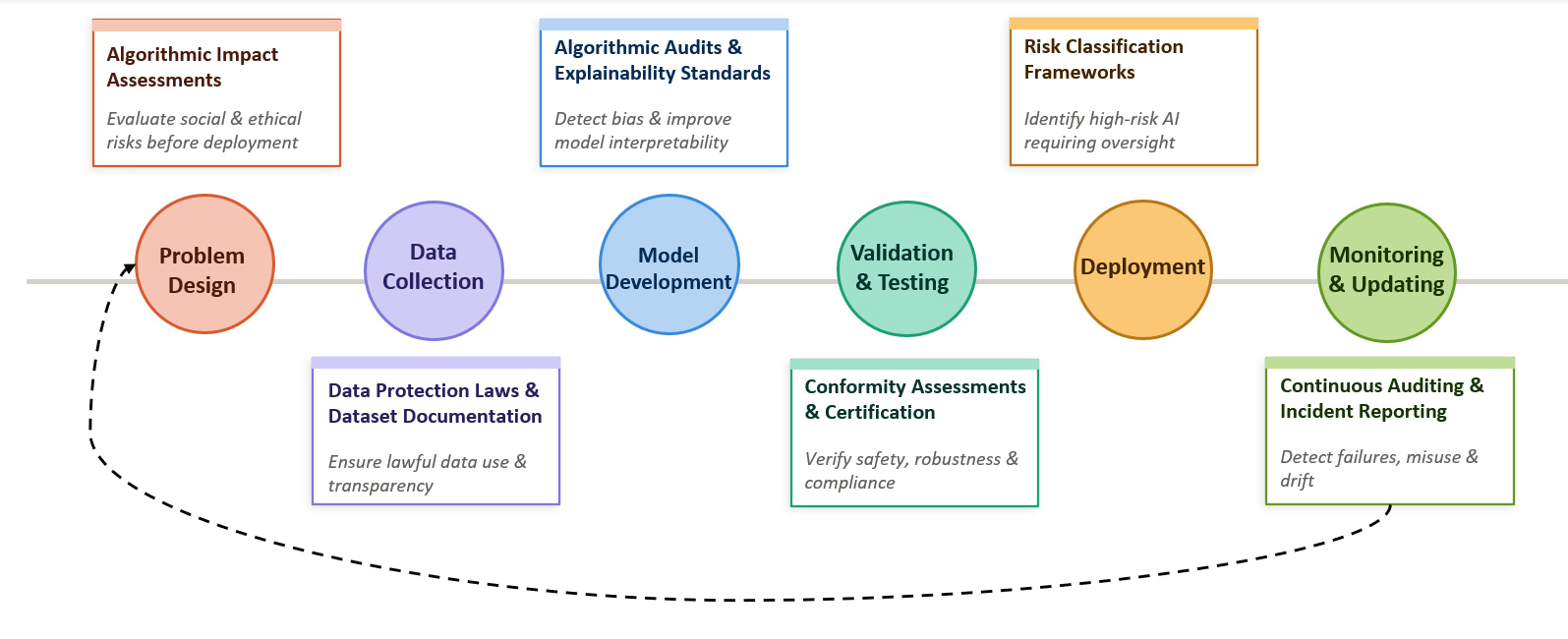
Governance Overlay: Policy Interventions Across the AI Lifecycle
Regulatory tools mapped at each stage of AI development per the EU AI Act and UNESCO Recommendation on the Ethics of AI
Several policy tools are directed at the risks that occur in the pre-developmental stages. In one example, algorithmic impact assessment has been applied in various jurisdictions to measure the possible consequences of automated decision systems on society before implementation. On the same note, the requirements of dataset documentation, including dataset transparency requirements and model cards, are aimed at enhancing accountability during the training and development stages of the AI systems. Therefore, lifecycle-based policy design allows regulators to intervene before harmful outcomes occur, rather than responding only after AI systems have caused damage in real-world environments.
The Policy Gap in AI Governance
The misalignment between risks and governance tools across the AI lifecycle indicates a critical structural gap in existing regulations. Numerous governance processes become activated after AI systems are classified as “high risk” or after they are implemented in the real world. But the most serious sources of damage have their roots in earlier stages of the development procedure.
An example is that prejudiced or unbalanced training data is almost inevitably a source of discriminative results in automated decision systems. When these types of models are applied in areas like staffing, credit rating, or in providing services to the public, such biases can quickly spread to large populations and undermine democratic rights. In the same way, the lack of transparency in model design might result in the fact that the regulator or individuals are affected by the decision-making process. This reflects a broader timing gap in AI governance, where risks originate during design and development, but regulatory intervention typically occurs only after deployment.
Analysis
1. Key risks originate before deployment: As depicted in the lifecycle mapping, the data collection and model development phase presents several significant governance risks as opposed to the deployment phase. Structural issues can be entrenched within AI systems even before they are deployed in practice due to bias in data sets, incomplete reporting of training sets, and obscured network designs.
2. Data governance is a primary point of vulnerability: Most of the instances of algorithmic discrimination listed above are associated with training material that is not representative of some population groups or is historical. Since machine learning models are optimisations of patterns that exist in datasets, these biases can be carried through the whole lifecycle and reproduced after deployment.
3. Regulatory approaches remain mismatched across jurisdictions: Different countries adopt varying approaches to AI governance, ranging from risk-based frameworks such as the EU AI Act to more sector-specific or voluntary guidelines in other regions. This divergence creates inconsistencies in safety, accountability, and enforcement standards, allowing risks to persist across borders and potentially undermining the protection of users in globally deployed AI systems.
4. Governance interventions remain uneven across the lifecycle: Whereas the various regulatory instruments aim at deployment and monitoring, fewer instruments systematically tackle the risks that are posed by the previous design and development phases.
Recommendations
1. Introduce mandatory lifecycle risk assessments: The regulatory systems need to demand systemic risk evaluation at the beginning of AI development, especially at the problem design and dataset selection phases. This would assist in detecting possible harmful applications in advance, before systems are constructed and installed.
2. Strengthen dataset governance standards: Training datasets must be supplemented with documentation as to their provenance, composition and limitations. Standardised documentation frameworks of data sets can assist in the discovery by regulators and auditors of the potential sources of bias or privacy threats.
3. Expand independent algorithmic auditing: AI systems can be assessed by regular third-party audits based on fairness, strength, and security weaknesses. The auditing mechanisms especially apply to high-risk systems employed in employment, finance or the public services.
4. Integrate continuous monitoring requirements: AI systems may be monitored regularly after implementation to identify model drift, unforeseen consequences, or abuse. Reporting systems can facilitate the process where the regulators can see the emerging risks and modify the governance systems.
Conclusion - The Need for Global AI Governance
Despite growing regulatory attention, global air governance remains fragmented. Different jurisdictions adopt varying approaches to risk classification, oversight, and enforcement, leading to inconsistencies in safety and accountability standards. Given that AI systems are often developed, deployed, and used across borders, this lack of coordination allows risks to persist beyond national regulatory frameworks.
Addressing these challenges requires a shift towards greater international cooperation and lifecycle-based governance. Developing shared standards, improving cross-border regulatory alignment, and embedding oversight across all stages of AI development will be essential to ensuring that AI systems are safe, transparent, and accountable in a globally interconnected environment.
References
- OECD AI lifecycle
- OECD AI system lifecycle description
- OECD AI governance lifecycle framework
- EU AI Act overview
- EU AI Act risk categories
- UNESCO Recommendation on the Ethics of AI
- AI governance lifecycle analysis
- OECD AI policy tools database

Executive Summary
A video allegedly showing India’s Defence Secretary Rajesh Kumar Singh making remarks about Pakistan’s cyber capabilities is being widely shared on social media. The clip claims that Singh admitted Pakistan had “jammed Indian systems” on May 10 and described Pakistan’s cyber and electronic warfare capabilities as a major challenge for India. Research by CyberPeace Research Wing found that the viral clip is an AI-generated deepfake being circulated to spread misinformation. Rajesh Kumar Singh never made any such statement.
Claim
An X user shared the viral video claiming that India’s Defence Secretary had acknowledged Pakistan’s technological superiority. The post alleged that Singh admitted Pakistan successfully jammed Indian systems and claimed that India was lagging behind in cyber and electronic warfare technology.

Fact Check
To verify the claim, we searched relevant keywords on Google but found no credible media reports carrying such a statement from the Defence Secretary. We then extracted keyframes from the viral clip and conducted a reverse image search. During the research, we found the original video uploaded on the YouTube channel of ANI on April 30, 2026.

A review of the full video confirmed that Rajesh Kumar Singh never made the remarks heard in the viral clip. The original footage had been manipulated and altered using AI-generated audio techniques.
Conclusion
Our research confirms that the viral video is fake and AI-manipulated. The statement attributed to India’s Defence Secretary Rajesh Kumar Singh is fabricated, and the deepfake clip is being shared with misleading claims to spread disinformation.

Executive Summary
Last September, protests were held in Ladakh over several demands, including full statehood, extension of Sixth Schedule protections, separate Lok Sabha seats for Leh and Kargil, and reservation in jobs. During that period, some demonstrations turned violent. Since then, talks between stakeholders and the government have continued regarding these demands. Amid this backdrop, Pakistani propaganda handles on social media are sharing a video of a protest and claiming that violent demonstrations have erupted in Ladakh following the arrest of education reformer Sonam Wangchuk. CyberPeace Research Wing research found the claim to be misleading. The claim regarding Sonam Wangchuk’s arrest is false, while the viral video is actually from protests that took place in September last year.
Claim:
Sharing the video, a user wrote: “Massive protests in Ladakh. Violent demonstrations have erupted after reports of the arrest of Ladakh’s revolutionary leader Sonam Wangchuk. The people of Ladakh seek justice and freedom from the Indian Army, which is attacking civilians.”
https://x.com/ZardSi/status/2064204063248695393?s=20

Fact Check:
Our research found the claim to be misleading. The viral video is from protests held in September last year, and the claim that Sonam Wangchuk has been arrested is also false. We first converted the video into keyframes and conducted a reverse image search using Google Lens. This led us to several videos and news reports covering the same incident. The viral footage was found in a news report uploaded on September 24, 2025, by Asianet News English on YouTube.
https://www.youtube.com/@asianetnewsenglish
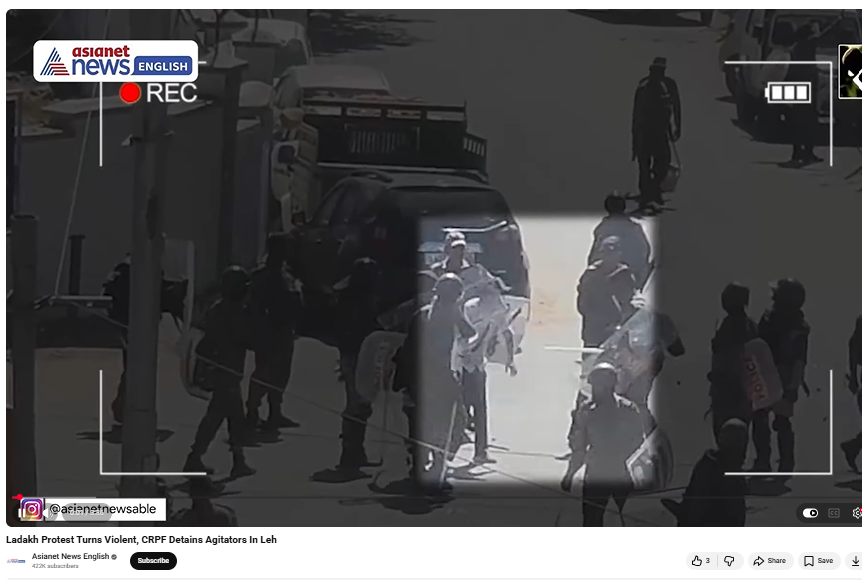
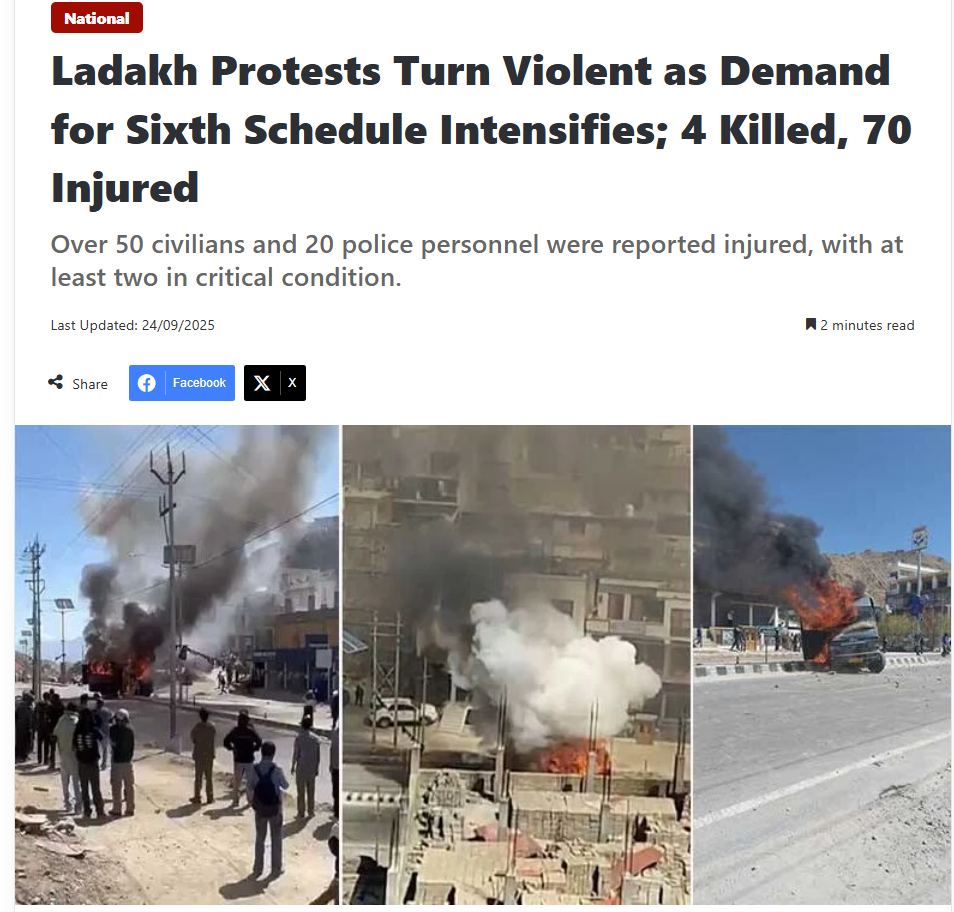
According to the information provided with the video, large-scale protests took place in Leh in support of demands for Sixth Schedule status and full statehood for Ladakh. The movement turned violent following clashes with police, and protesters allegedly set fire to a BJP office in Leh. CRPF personnel and local police later detained several protesters, bringing the situation under control. We also found a report published by Arunachal24, which stated that at least four people were killed and more than 70 injured in violent clashes between protesters demanding statehood and constitutional safeguards for Ladakh and security forces. The report further mentioned that protesters set fire to a local BJP office and a CRPF vehicle, following which authorities imposed a strict curfew across Leh.
Our team also found that the claim about Sonam Wangchuk’s arrest is entirely false. Wangchuk remains active on social media and had posted an update on June 10, indicating that he had not been detained.

Conclusion:
The fact-check clearly shows that the viral claim is misleading. There is no evidence that Sonam Wangchuk has been arrested. The viral video is not recent and actually shows protests that took place in Ladakh in September 2025.
