
#FactCheck : AI Video Falsely Shows Iran Destroying Israeli Military Base
Executive Summary
Amid the ongoing conflict involving the US-Israel and Iran in West Asia, a video showing destroyed aircraft at an airport is going viral on social media. The clip is being shared with the claim that it shows an Israeli military base destroyed in an Iranian attack. However, an research by the CyberPeacen found that the viral video is not real but AI-generated.
Claim:
An Instagram user “sakirali8064” shared the video on March 22, 2026, claiming that Iran had demonstrated its military strength by deploying advanced missiles capable of long-range precision strikes.The video also carries a “Breaking News” overlay stating:“Iran attack Israel military base… the entire base destroyed.
Post link and archive link:

Fact Check:
To verify the claim, we extracted keyframes from the viral clip and conducted a reverse image search using Google Lens. We found a longer version of the same video posted on March 5, 2026, by a Facebook user named “With INC,” where it was also falsely linked to an Iranian attack on Israel’s Ben Gurion Airport.

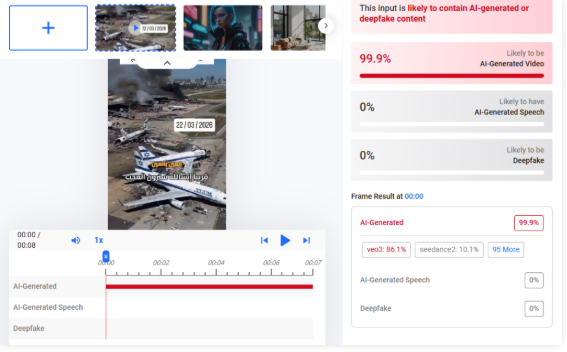
Upon closely examining the video, we observed inconsistencies such as fire changing positions unnaturally, which raised suspicion of AI manipulation. We then analyzed the video using Hive Moderation, which indicated a probability of over 99% that the content is AI-generated.
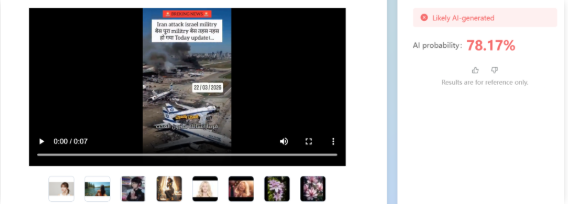
Additionally, analysis using Tencent’s “Zhuque AI” detection tool suggested more than 78% likelihood of the video being AI-generated.
Conclusion:
The viral video claiming that an Iranian attack destroyed an Israeli military base is AI-generated and misleading. While Iran has claimed to have targeted Israel’s Ben Gurion International Airport using drones, the viral footage does not depict a real event.

Related Blogs
.webp)
Executive Summary
Amid heightened tensions following Israel and US actions against Iran, a video is being widely shared on social media. The footage shows thick black smoke rising into the sky from a location, suggesting a major explosion or attack. However, research conducted by the CyberPeace found the viral claim to be misleading. Our research revealed that the video is not recent and has no connection to the current Israel-Iran tensions. In fact, the footage is nearly a year old and shows a fire at a casino in Mexico, now being shared out of context.
Claim
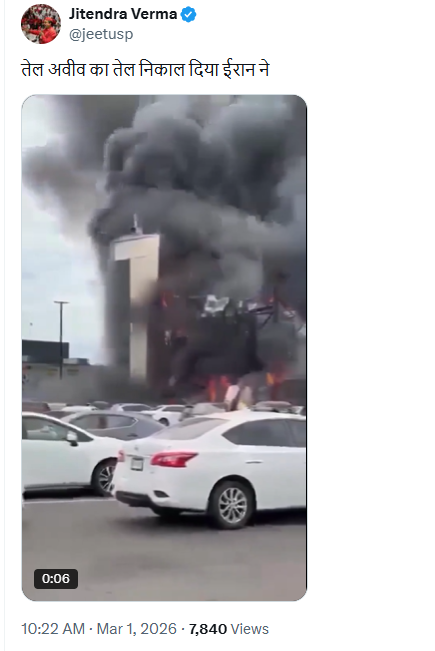
Users circulating the video claim that it shows an attack on Tel Aviv, Israel. On March 1, 2026, a user on X shared the clip with the caption, “Iran has drained the oil out of Tel Aviv,” implying a devastating retaliatory strike. (Post and archive links provided above.)
Fact Check:
To verify the authenticity of the video, we extracted key frames and performed a reverse image search using Google Lens. During the search, we found the same visuals in a Spanish media report published on January 16, 2025. This confirmed that the video predates the ongoing geopolitical developments.
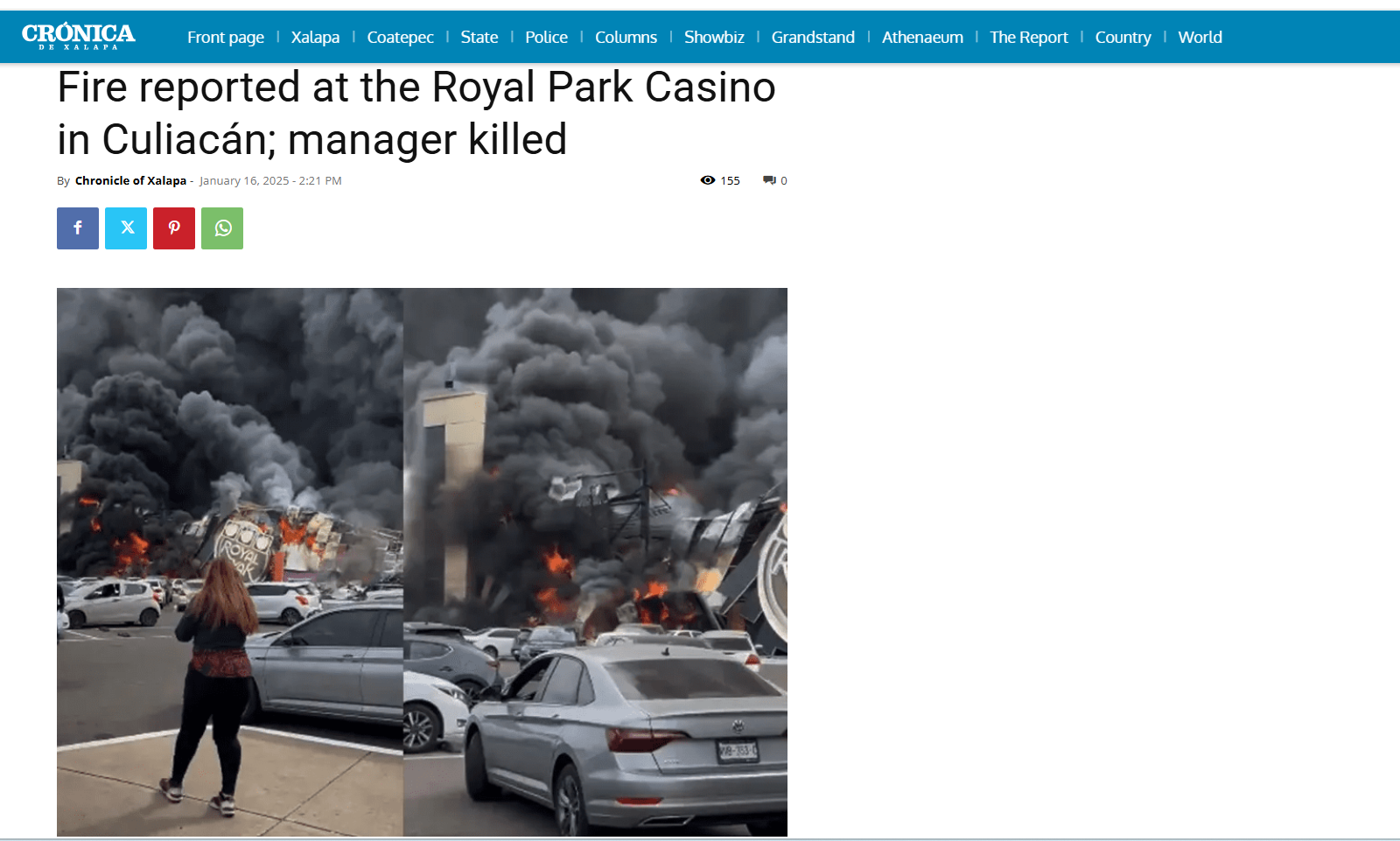
According to the report, the footage shows a fire at the Royal Park Casino located inside the Cinépolis plaza in Culiacán, Mexico. Local outlet Meganoticias Culiacán reported on X that the casino was “completely burned down.” The structure reportedly collapsed following the blaze, and emergency responders confirmed that several people were injured. Further keyword searches led us to the same footage on the official YouTube channel of Milenio, uploaded on January 17, 2025. The report clearly states that the fire occurred at the Royal Yacht Casino in Mexico and is unrelated to any recent military developments.

Conclusion
Evidence gathered during our research clearly establishes that the viral video is not related to any missile attack by Iran on Israel. The claim is false. The footage is from a fire incident at a casino in Mexico and is being misleadingly shared in the context of current international tensions, potentially creating unnecessary panic and confusion.

Executive Summary:
In recent times an image showing the President of AIMIM, Asaduddin Owaisi holding a portrait of Hindu deity Lord Rama, has gone viral on different social media platforms. After conducting a reverse image search, CyberPeace Research Team then found that the picture was fake. The screenshot of the Facebook post made by Asaduddin Owaisi in 2018 reveals him holding Ambedkar’s picture. But the photo which has been morphed shows Asaduddin Owaisi holding a picture of Lord Rama with a distorted message gives totally different connotations in the political realm because in the 2024 Lok Sabha elections, Asaduddin Owaisi is a candidate from Hyderabad. This means there is a need to ensure that before sharing any information one must check it is original in order to eliminate fake news.

Claims:
AIMIM Party leader Asaduddin Owaisi standing with the painting of Hindu god Rama and the caption that reads his interest towards Hindu religion.


Fact Check:
In order to investigate the posts, we ran a reverse search of the image. We identified a photo that was shared on the official Facebook wall of the AIMIM President Asaduddin Owaisi on 7th April 2018.

Comparing the two photos we found that the painting Asaduddin Owaisi is holding is of B.R Ambedkar whereas the viral image is of Lord Rama, and the original photo was posted in the year 2018.

Hence, it was concluded that the viral image was digitally modified to spread false propaganda.
Conclusion:
The photograph of AIMIM President Asaduddin Owaisi holding up one painting of Lord Rama is fake as it has been morphed. The photo that Asaduddin Owaisi uploaded on a Facebook page on 7 Apr 2018 depicted him holding a picture of Bhimrao Ramji Ambedkar. This photograph was digitally altered and the false captions were written to give an altogether different message of Asaduddin Owaisi. It has even highlighted the necessity of fighting fake news that has spread widely through social media platforms especially during the political realm.
- Claim: AIMIM President Asaduddin Owaisi was holding a painting of the Hindu god Lord Rama in his hand.
- Claimed on: X (Formerly known as Twitter)
- Fact Check: Fake & Misleading
%20(1).jpg)
Introduction
Artificial Intelligence (AI) driven autonomous weapons are reshaping military strategy, acting as force multipliers that can independently assess threats, adapt to dynamic combat environments, and execute missions with minimal human intervention, pushing the boundaries of modern warfare tactics. AI has become a critical component of modern technology-driven warfare and has simultaneously impacted many spheres in a technology-driven world. Nations often prioritise defence for significant investments, supporting its growth and modernisation. AI has become a prime area of investment and development for technological superiority in defence forces. India’s focus on defence modernisation is evident through initiatives like the Defence AI Council and the Task Force on Strategic Implementation of AI for National Security.
The main requirement that Autonomous Weapons Systems (AWS) require is the “autonomy” to perform their functions when direction or input from a human actor is absent. AI is not a prerequisite for the functioning of AWSs, but, when incorporated, AI could further enable such systems. While militaries seek to apply increasingly sophisticated AI and automation to weapons technologies, several questions arise. Ethical concerns have been raised for AWS as the more prominent issue by many states, international organisations, civil society groups and even many distinguished figures.
Ethical Concerns Surrounding Autonomous Weapons
The delegation of life-and-death decisions to machines is the ethical dilemma that surrounds AWS. A major concern is the lack of human oversight, raising questions about accountability. What if AWS malfunctions or violates international laws, potentially committing war crimes? This ambiguity fuels debate over the dangers of entrusting lethal force to non-human actors. Additionally, AWS poses humanitarian risks, particularly to civilians, as flawed algorithms could make disastrous decisions. The dehumanisation of warfare and the violation of human dignity are critical concerns when AWS is in question, as targets become reduced to mere data points. The impact on operators’ moral judgment and empathy is also troubling, alongside the risk of algorithmic bias leading to unjust or disproportionate targeting. These ethical challenges are deeply concerning.
Balancing Ethical Considerations and Innovations
It is immaterial how advanced a computer becomes in simulating human emotions like compassion, empathy, altruism, or other emotions as the machine will only be imitating them, not experiencing them as a human would. A potential solution to this ethical predicament is using a 'human-in-the-loop' or 'human-on-the-loop' semi-autonomous system. This would act as a compromise between autonomy and accountability.
A “human-on-the-loop” system is designed to provide human operators with the ability to intervene and terminate engagements before unacceptable levels of damage occur. For example, defensive weapon systems could autonomously select and engage targets based on their programming, during which a human operator retains full supervision and can override the system within a limited period if necessary.
In contrast, a ‘human-in-the-loop” system is intended to engage individual targets or specific target groups pre-selected by a human operator. Examples would include homing munitions that, once launched to a particular target location, search for and attack preprogrammed categories of targets within the area.
International Debate and Regulatory Frameworks
The regulation of autonomous weapons that employ AI, in particular, is a pressing global issue due to the ethical, legal, and security concerns it contains. There are many ongoing efforts at the international level which are in discussion to regulate such weapons. One such example is the initiative under the United Nations Convention on CertainConventional Weapons (CCW), where member states, India being an active participant, debate the limits of AI in warfare. However, existing international laws, such as the Geneva Conventions, offer legal protection by prohibiting indiscriminate attacks and mandating the distinction between combatants and civilians. The key challenge lies in achieving global consensus, as different nations have varied interests and levels of technological advancement. Some countries advocate for a preemptive ban on fully autonomous weapons, while others prioritise military innovation. The complexity of defining human control and accountability further complicates efforts to establish binding regulations, making global cooperation both essential and challenging.
The Future of AI in Defence and the Need for Stronger Regulations
The evolution of autonomous weapons poses complex ethical and security challenges. As AI-driven systems become more advanced, a growing risk of its misuse in warfare is also advancing, where lethal decisions could be made without human oversight. Proactive regulation is crucial to prevent unethical use of AI, such as indiscriminate attacks or violations of international law. Setting clear boundaries on autonomous weapons now can help avoid future humanitarian crises. India’s defence policy already recognises the importance of regulating the use of AI and AWS, as evidenced by the formation of bodies like the Defence AI Project Agency (DAIPA) for enabling AI-based processes in defence Organisations. Global cooperation is essential for creating robust regulations that balance technological innovation with ethical considerations. Such collaboration would ensure that autonomous weapons are used responsibly, protecting civilians and combatants, while encouraging innovation within a framework prioritising human dignity and international security.
Conclusion
AWS and AI in warfare present significant ethical, legal, and security challenges. While these technologies promise enhanced military capabilities, they raise concerns about accountability, human oversight, and humanitarian risks. Balancing innovation with ethical responsibility is crucial, and semi-autonomous systems offer a potential compromise. India’s efforts to regulate AI in defence highlight the importance of proactive governance. Global cooperation is essential in establishing robust regulations that ensure AWS is used responsibly, prioritising human dignity and adherence to international law, while fostering technological advancement.
References
● https://indianexpress.com/article/explained/reaim-summit-ai-war-weapons-9556525/
