
#FactCheck -AI-Manipulated Clip Misrepresents PM Modi’s Remarks on Iran-Israel Conflict
Executive Summary
Amid the ongoing conflict between the US-Israel and Iran, a video of Indian Prime Minister Narendra Modi is being widely circulated on social media. In the clip, he is allegedly heard supporting Israel and calling Iran a “terrorist state.” The video also appears to show him speaking about the idea of “Akhand Bharat.” Many users are sharing this video as genuine. However, a detailed research by the CyberPeacefound that the claim is false. The viral video is a deepfake created using AI technology.
Claim:
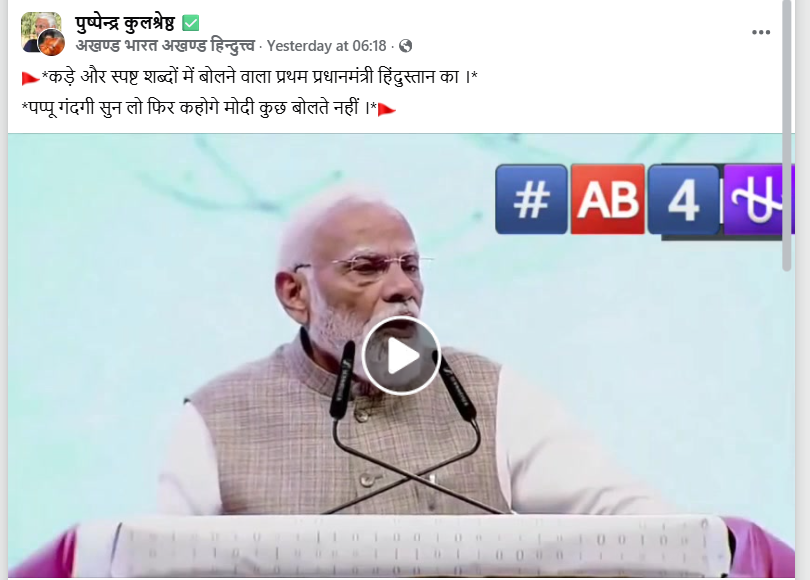
A Facebook page named “Pushpendra Kulshreshtha” shared the video on March 23, 2026, with a caption suggesting that PM Modi made strong remarks in support of Israel and against Iran.
Fact Check:
To verify the claim, we first conducted a keyword search to find any credible reports or official statements where PM Modi made such remarks. However, no reliable news reports or authentic videos supporting the claim were found. We then extracted keyframes from the viral video and performed a reverse image search using Google Lens. This led us to the original video posted on the X (formerly Twitter) handle of ANI on March 12, 2026.
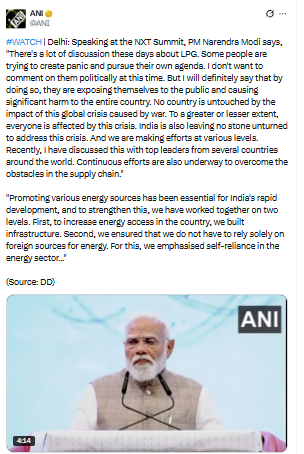
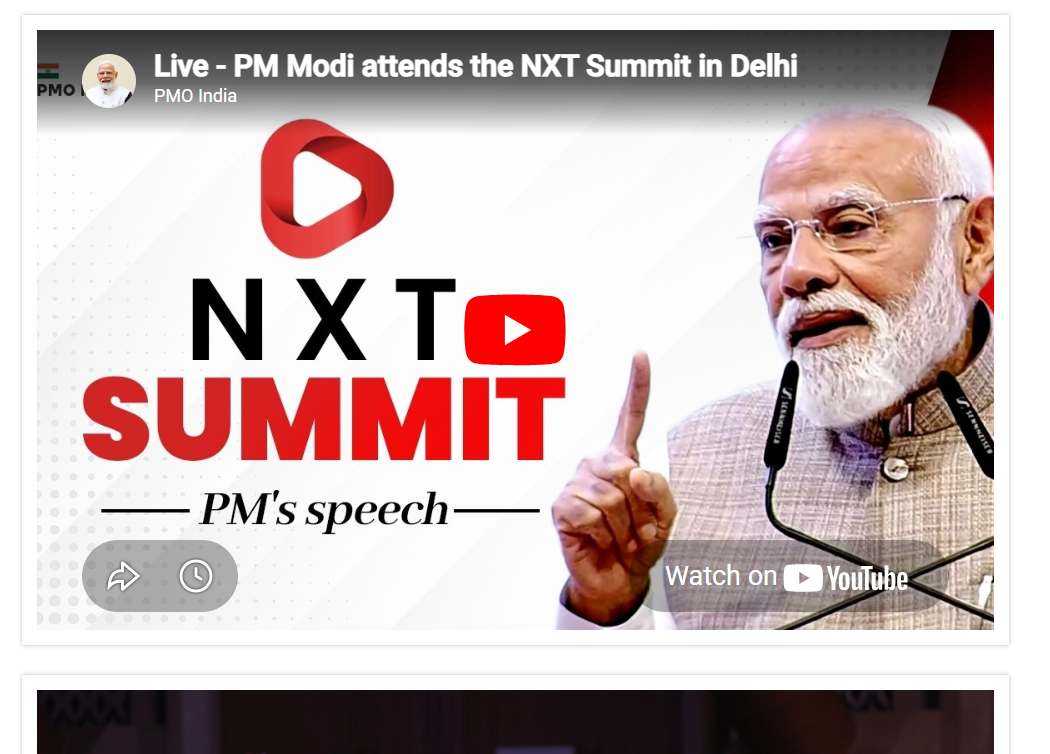
The visuals, including PM Modi’s attire and the stage setup, matched the viral clip—indicating that the fake video was created using this original footage. However, in the authentic video, PM Modi did not make any statements about Iran, Israel, or “Akhand Bharat” as seen in the viral version. In the original footage, PM Modi is seen addressing the NXT Summit in Delhi, where he spoke about the global energy crisis arising from ongoing conflicts and highlighted the expansion of LPG and PNG facilities in India. Additionally, a customised keyword search led us to a press release issued by the Prime Minister's Office regarding his address at the summit. The statement heard in the viral clip was not found there either.
Conclusion:
The viral video of PM Modi is a deepfake. He did not make any statement calling Iran a “terrorist state” or expressing support for Israel in the manner shown. The original video is from a summit held in Delhi and has been manipulated using AI to spread misleading claims.

Related Blogs
Executive Summary
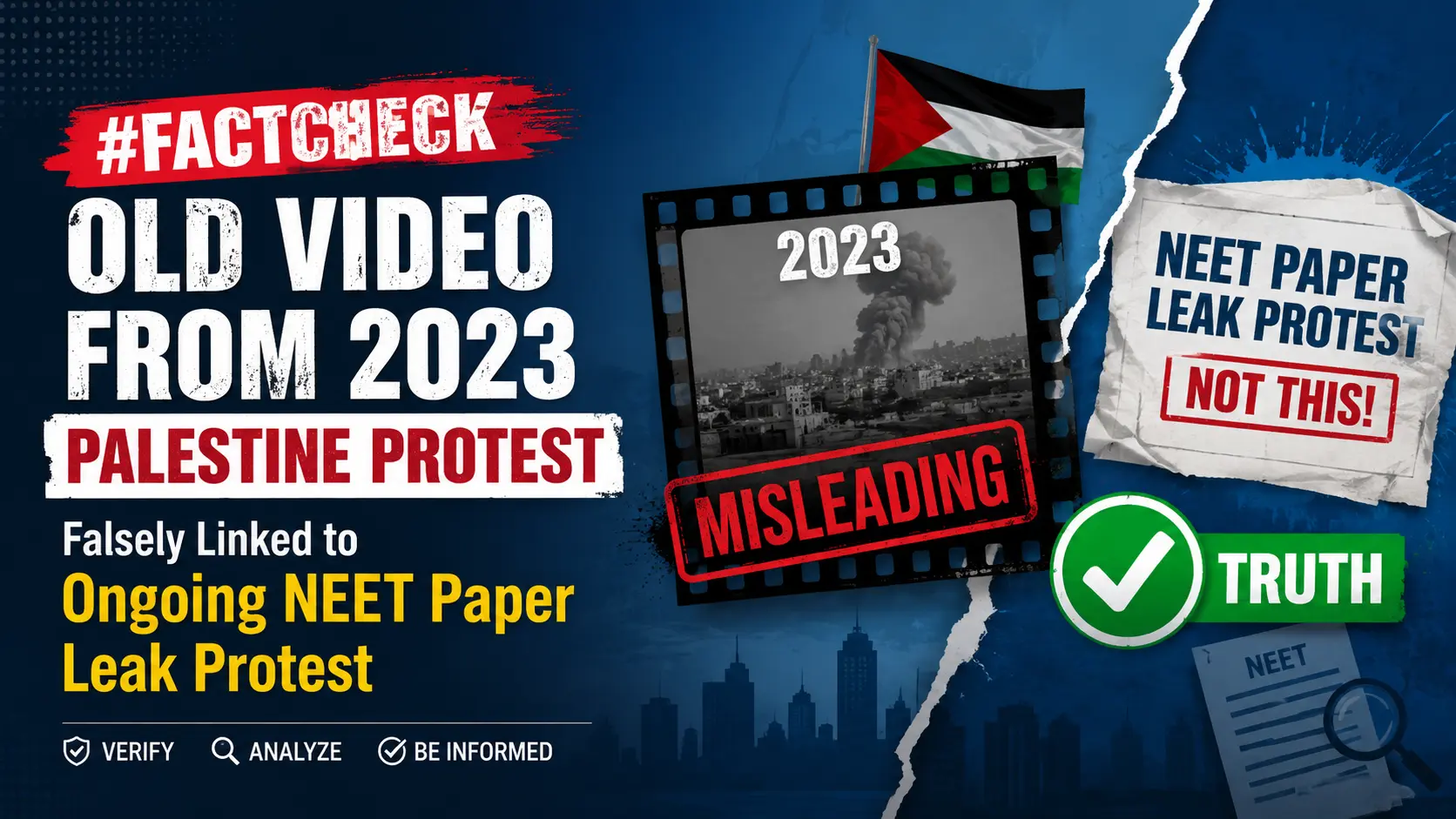
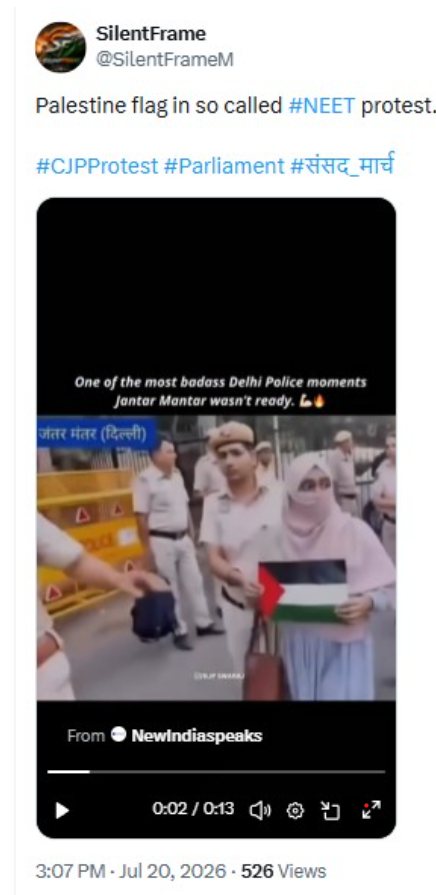
A video showing police personnel allegedly snatching and tearing a Palestine flag from a woman protester is being widely shared on social media. Users are claiming that the video was recorded during the ongoing CJP-led protest at Jantar Mantar demanding the resignation of the Union Education Minister over the NEET paper leak. CyberPeace Research Wing ’s research found that the viral claim is misleading. The video is not related to the ongoing CJP-led protest at Jantar Mantar over the NEET paper leak. The footage dates back to 2023 and is being falsely linked to a recent protest.
Claim:
A social media user shared the viral video claiming that a woman protester arrived at the NEET paper leak protest carrying a Palestine flag.
https://x.com/SilentFrameM/status/2079138742795939907
Fact Check:
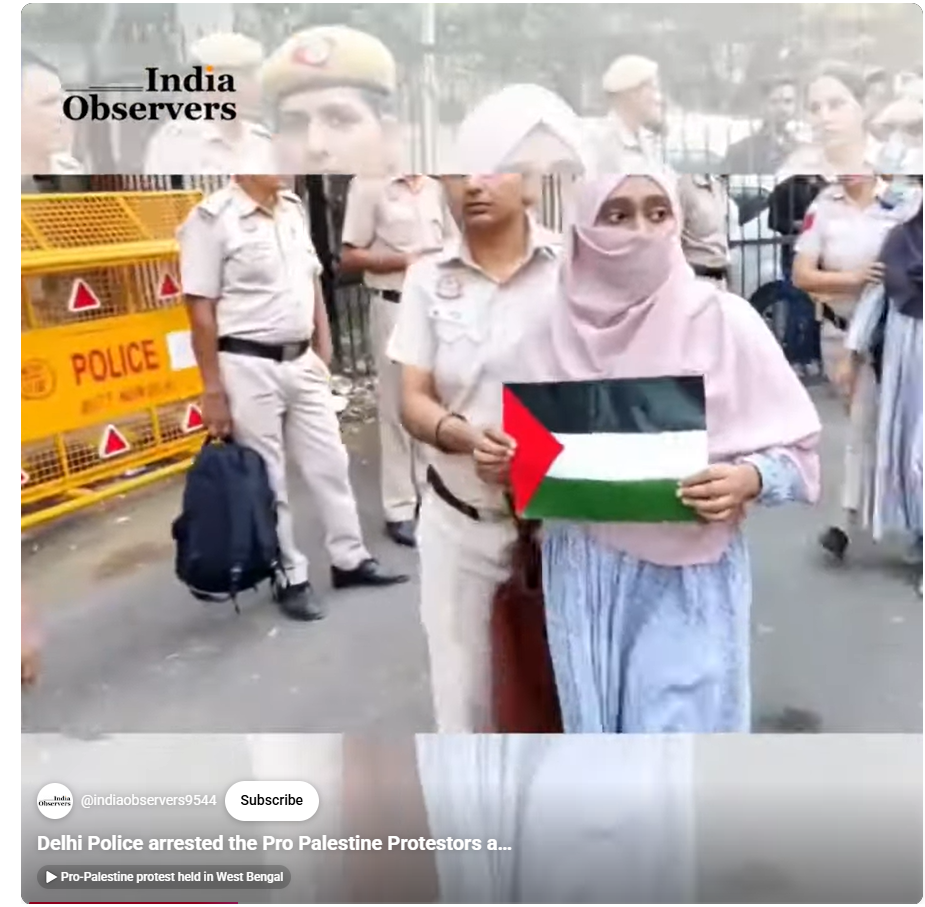
A reverse image search of keyframes from the viral video led us to a YouTube video uploaded by Indian Observer on October 30, 2023, featuring the same visuals. The video description identified the footage as being from a pro-Palestine demonstration held at Jantar Mantar in solidarity with Palestinians.
https://www.youtube.com/shorts/_JhJyZ-Djyw
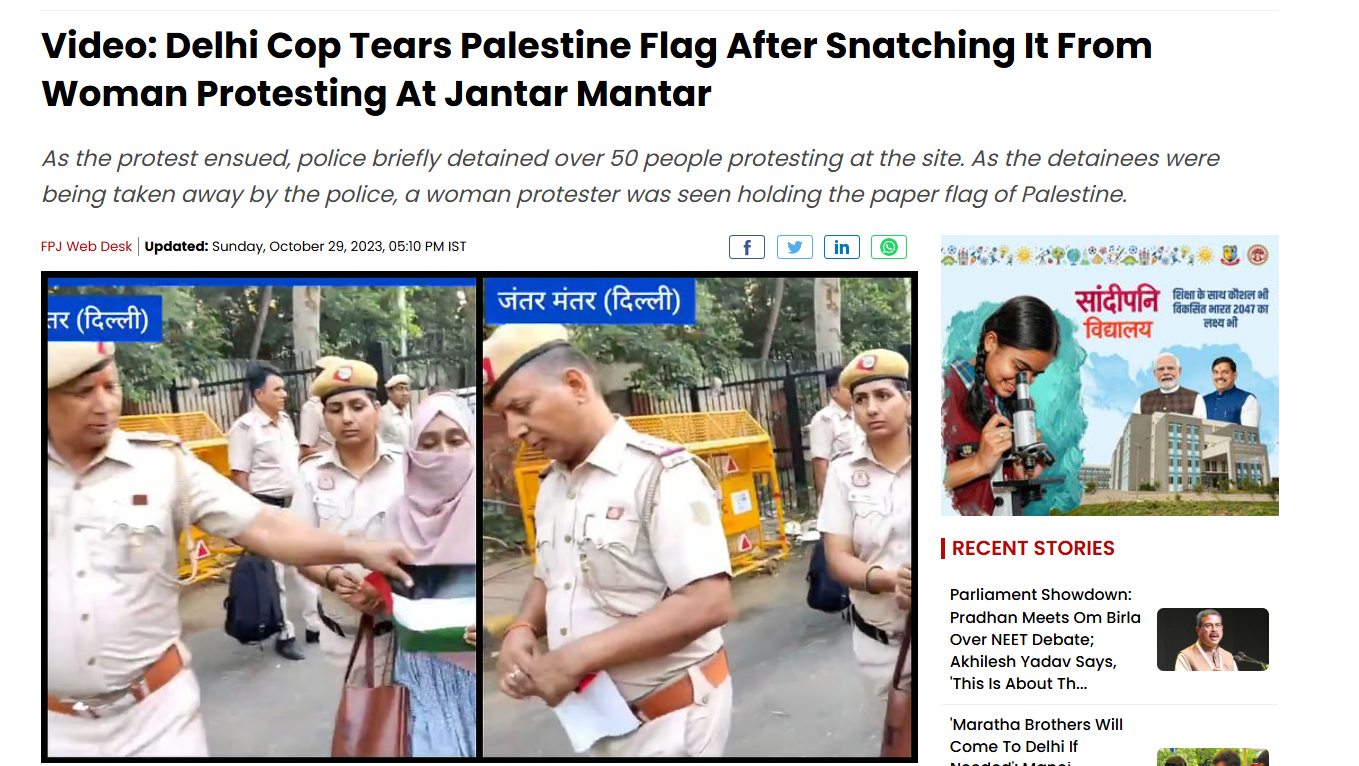
We also found an October 2023 report by Free Press Journal carrying the same visuals. According to the report, several students and civil society members had gathered at Jantar Mantar to protest Israel’s military actions in the Gaza Strip and express solidarity with Palestine. During the protest, Delhi Police briefly detained more than 50 demonstrators. As the detainees were being escorted away, a woman carrying a paper Palestine flag was seen confronting police personnel, who allegedly snatched and tore the flag.
Conclusion:
CyberPeace Research Wing ’s fact check found the viral claim to be misleading. The video is not from the ongoing CJP-led NEET paper leak protest at Jantar Mantar. The footage is from a pro-Palestine demonstration held in October 2023 and has been falsely shared as a recent video from the ongoing protests.

Introduction
Beginning with the premise that the advent of the internet has woven a rich but daunting digital web, intertwining the very fabric of technology with the variegated hues of human interaction, the EU has stepped in as the custodian of this ever-evolving tableau. It is within this sprawling network—a veritable digital Minotaur's labyrinth—that the European Union has launched a vigilant quest, seeking not merely to chart its enigmatic corridors but to instil a sense of order in its inherent chaos.
The Digital Services Act (DSA) is the EU's latest testament to this determined pilgrimage, a voyage to assert dominion over the nebulous realms of cyberspace. In its latest sagacious move, the EU has levelled its regulatory lance at the behemoths of digital indulgence—Pornhub, XVideos, and Stripchat—monarchs in the realm of adult entertainment, each commanding millions of devoted followers.
Applicability of DSA
Graced with the moniker of Very Large Online Platforms (VLOPs), these titans of titillation are now facing the complex weave of duties delineated by the DSA, a legislative leviathan whose coils envelop the shadowy expanses of the internet with an aim to safeguard its citizens from the snares and pitfalls ensconced within. Like a vigilant Minotaur, the European Commission, the EU's executive arm, stands steadfast, enforcing compliance with an unwavering gaze.
The DSA is more than a mere compilation of edicts; it encapsulates a deeper, more profound ethos—a clarion call announcing that the wild frontiers of the digital domain shall be tamed, transforming into enclaves where the sanctity of individual dignity and rights is zealously championed. The three corporations, singled out as the pioneers to be ensnared by the DSA's intricate net, are now beckoned to embark on an odyssey of transformation, realigning their operations with the EU's noble envisioning of a safeguarded internet ecosystem.
The Paradigm Shift
In a resolute succession, following its first decree addressing 19 Very Large Online Platforms and Search Engines, the Commission has now ensconced the trinity of adult content purveyors within the DSA's embrace. The act demands that these platforms establish intuitive user mechanisms for reporting illicit content, prioritize communications from entities bestowed with the 'trusted flaggers' title, and elucidate to users the rationale behind actions taken to restrict or remove content. Paramount to the DSA's ethos, they are also tasked with constructing internal mechanisms to address complaints, forthwith apprising law enforcement of content hinting at criminal infractions, and revising their operational underpinnings to ensure the confidentiality, integrity, and security of minors.
But the aspirations of the DSA stretch farther, encompassing a realm where platforms are agents against deception and manipulation of users, categorically eschewing targeted advertisement that exploits sensitive profiling data or is aimed at impressionable minors. The platforms must operate with an air of diligence and equitable objectivity, deftly applying their terms of use, and are compelled to reveal their content moderation practices through annual declarations of transparency.
The DSA bestows upon the designated VLOPs an even more intensive catalogue of obligations. Within a scant four months of their designation, Pornhub, XVideos, and Stripchat are mandated to implement measures that both empower and shield their users—especially the most vulnerable, minors—from harms that traverse their digital portals. Augmented content moderation measures are requisite, with critical risk analyses and mitigation strategies directed at halting the spread of unlawful content, such as child exploitation material or the non-consensual circulation of intimate imagery, as well as curbing the proliferation and repercussions of deepfake-generated pornography.
The New Rules
The DSA enshrines the preeminence of protecting minors, with a staunch requirement for VLOPs to contrive their services so as to anticipate and enfeeble any potential threats to the welfare of young internet navigators. They must enact operational measures to deter access to pornographic content by minors, including the utilization of robust age verification systems. The themes of transparency and accountability are amplified under the DSA's auspices, with VLOPs subject to external audits of their risk assessments and adherence to stipulations, the obligation to maintain accessible advertising repositories, and the provision of data access to rigorously vetted researchers.
Coordinated by the Commission in concert with the Member States' Digital Services Coordinators, vigilant supervision will be maintained to ensure the scrupulous compliance of Pornhub, Stripchat, and XVideos with the DSA's stringent directives. The Commission's services are poised to engage with the newly designated platforms diligently, affirming that initiatives aimed at shielding minors from pernicious content, as well as curbing the distribution of illegal content, are effectively addressed.
The EU's monumental crusade, distilled into the DSA, symbolises a pledge—a testament to its steadfast resolve to shepherd cyberspace, ensuring the Minotaur of regulation keeps the bedlam at a manageable compass and the sacrosanctity of the digital realm inviolate for all who meander through its infinite expanses. As we cast our gazes toward February 17, 2024—the cusp of the DSA's comprehensive application—it is palpable that this legislative milestone is not simply a set of guidelines; it stands as a bold, unflinching manifesto. It beckons the advent of a novel digital age, where every online platform, barring small and micro-enterprises, will be enshrined in the lofty ideals imparted by the DSA.
Conclusion
As we teeter on the edge of this nascent digital horizon, it becomes unequivocally clear: the European Union's Digital Services Act is more than a mundane policy—it is a pledge, a resolute statement of purpose, asserting that amid the vast, interwoven tapestry of the internet, each user's safety, dignity, and freedoms are enshrined and hold the intrinsic significance meriting the force of the EU's legislative guard. Although the labyrinth of the digital domain may be convoluted with complexity, guided by the DSA's insightful thread, the march toward a more secure, conscientious online sphere forges on—resolute, unerring, one deliberate stride at a time.
References
https://ec.europa.eu/commission/presscorner/detail/en/ip_23_6763https://www.breakingnews.ie/world/three-of-the-biggest-porn-sites-must-verify-ages-under-eus-new-digital-law-1566874.html
Executive Summary
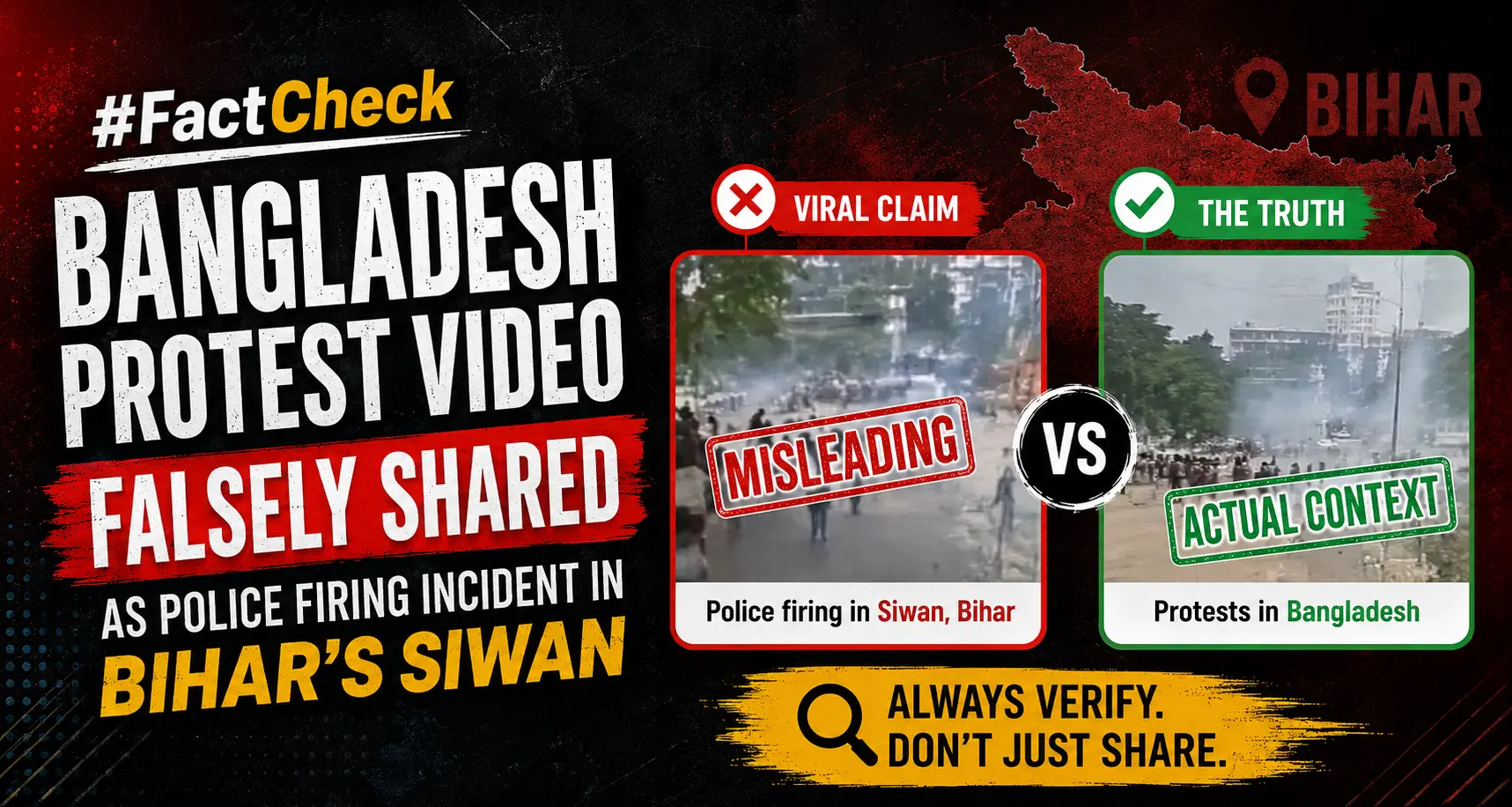
A video is being widely shared on social media with the claim that a youth was killed in police firing in Bihar’s Siwan. The viral 1-minute-22-second video shows a young man standing with a stick in his hand. Moments later, gunfire is heard, after which he appears to be injured and collapses. His associates are then seen carrying him away from the spot. CyberPeace Research Wing’s research found that the claim is false. The research revealed that the viral video is not from Bihar’s Siwan but dates back to the student protests in Bangladesh in July 2024.
Claim:
The video was shared on X with a caption claiming that it shows a police firing incident in Bihar’s Siwan, where a student was allegedly killed after police opened fire with AK-47 rifles.
The caption stated, “This video is going viral on social media. It is being claimed that this video is from Siwan, Bihar, where police fired AK-47s at students. During the firing, a youth was hit by two bullets and died.”
https://x.com/Deshmukh_0/status/2082053481993740701

Fact Check:
To verify the authenticity of the viral claim, we extracted keyframes from the video and conducted a reverse image search. During the research, we found a longer version of the same video uploaded on the YouTube channel of a Bangladeshi news portal on July 16, 2024.
According to the video description, the footage shows the death of student Abu Sayed during protests in Rangpur, Bangladesh, on July 16, 2024.
https://www.youtube.com/watch?v=iuf7H0MNIaI

Further research led us to a report published by bdnews24, which also carried visuals matching those seen in the viral video. The report stated that on July 16, 2024, Abu Sayed, an English Department student at Begum Rokeya University in Rangpur, Bangladesh, died after being shot during the protests.
https://bdnews24.com/bangladesh/87ef7e69c496#google_vignette

Conclusion:
The evidence gathered during the research confirms that the viral video claiming to show a youth being killed in police firing in Bihar’s Siwan is misleading. The video is actually from Bangladesh and shows the death of student Abu Sayed during the July 2024 protests in Rangpur. The old footage is being shared with a false claim linking it to a recent incident in Bihar.
