
#FactCheck -Bangladesh protest video falsely shared as police firing incident in Bihar’s Siwan
Executive Summary
A video is being widely shared on social media with the claim that a youth was killed in police firing in Bihar’s Siwan. The viral 1-minute-22-second video shows a young man standing with a stick in his hand. Moments later, gunfire is heard, after which he appears to be injured and collapses. His associates are then seen carrying him away from the spot. CyberPeace Research Wing’s research found that the claim is false. The research revealed that the viral video is not from Bihar’s Siwan but dates back to the student protests in Bangladesh in July 2024.
Claim:
The video was shared on X with a caption claiming that it shows a police firing incident in Bihar’s Siwan, where a student was allegedly killed after police opened fire with AK-47 rifles.
The caption stated, “This video is going viral on social media. It is being claimed that this video is from Siwan, Bihar, where police fired AK-47s at students. During the firing, a youth was hit by two bullets and died.”
https://x.com/Deshmukh_0/status/2082053481993740701

Fact Check:
To verify the authenticity of the viral claim, we extracted keyframes from the video and conducted a reverse image search. During the research, we found a longer version of the same video uploaded on the YouTube channel of a Bangladeshi news portal on July 16, 2024.
According to the video description, the footage shows the death of student Abu Sayed during protests in Rangpur, Bangladesh, on July 16, 2024.
https://www.youtube.com/watch?v=iuf7H0MNIaI

Further research led us to a report published by bdnews24, which also carried visuals matching those seen in the viral video. The report stated that on July 16, 2024, Abu Sayed, an English Department student at Begum Rokeya University in Rangpur, Bangladesh, died after being shot during the protests.
https://bdnews24.com/bangladesh/87ef7e69c496#google_vignette

Conclusion:
The evidence gathered during the research confirms that the viral video claiming to show a youth being killed in police firing in Bihar’s Siwan is misleading. The video is actually from Bangladesh and shows the death of student Abu Sayed during the July 2024 protests in Rangpur. The old footage is being shared with a false claim linking it to a recent incident in Bihar.

Related Blogs

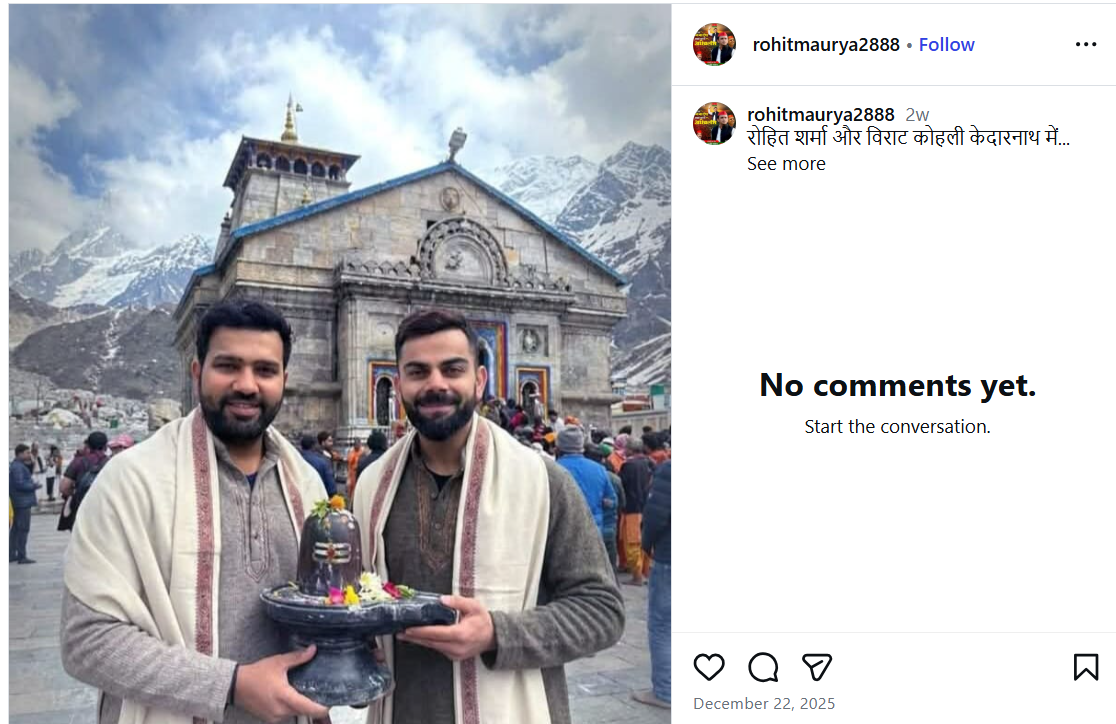
A photo featuring Indian cricketers Virat Kohli and Rohit Sharma is being widely shared on social media. In the image, both players are seen holding a Shivling, with the Kedarnath temple visible in the background. Users sharing the image claim that Virat Kohli and Rohit Sharma recently visited Kedarnath.
However, CyberPeace Foundation’s investigation found the claim to be false. Our verification established that the viral image is not real but has been created using Artificial Intelligence (AI) and is being circulated with a misleading narrative.
The Claim
An Instagram user shared the viral image on December 22, 2025, with the caption stating that Rohit Sharma and Virat Kohli are in Kedarnath. The post has since been widely reshared by other users, who assumed the image to be authentic. Link, archive link, screenshot:
Fact Check
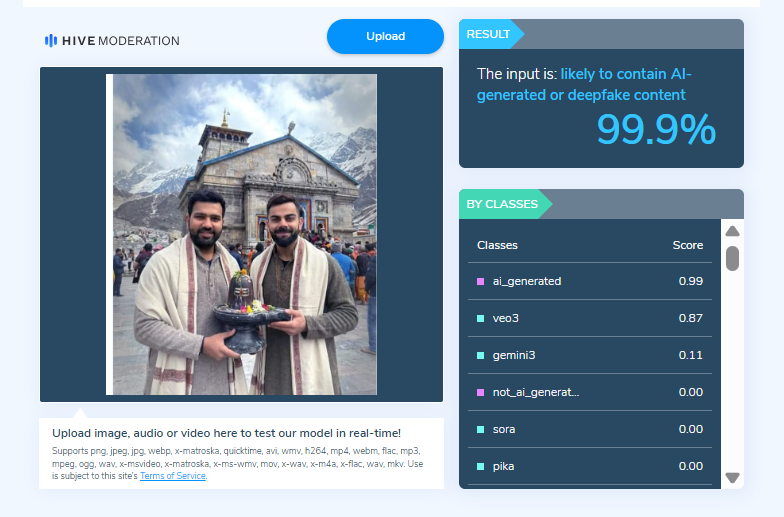
On closely examining the viral image, the Desk noticed visual inconsistencies suggesting that it may be AI-generated. To verify this, the image was scanned using the AI detection tool HIVE Moderation. According to the results, the image was found to be 99 per cent AI-generated.
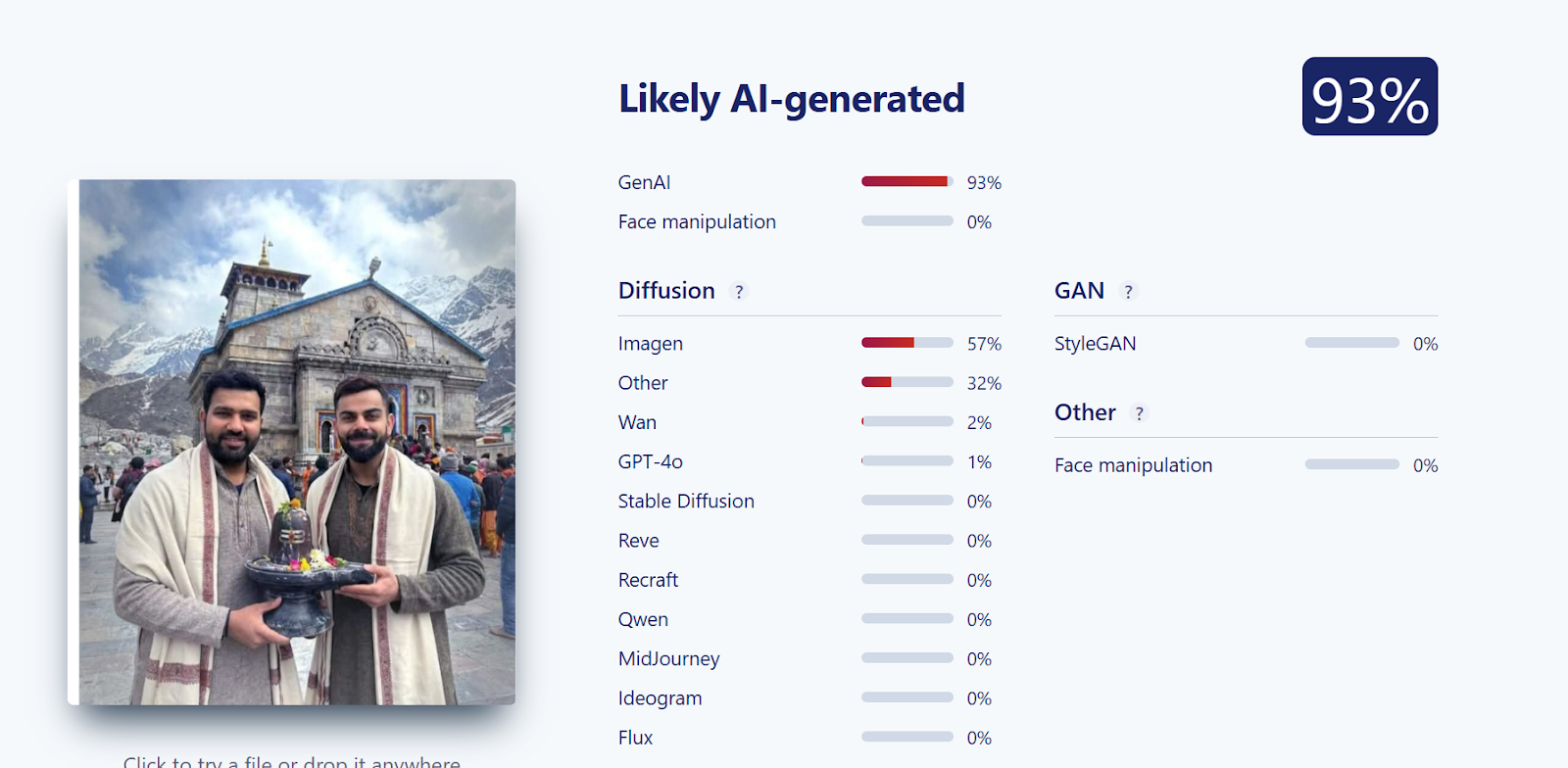
Further verification was conducted using another AI detection tool, Sightengine. The analysis revealed that the image was 93 per cent likely to be AI-generated, reinforcing the findings from the previous tool.
Conclusion
CyberPeace Foundation’s research confirms that the viral image claiming Virat Kohli and Rohit Sharma visited Kedarnath is fabricated. The image has been generated using AI technology and is being falsely shared on social media as a real photograph.

Introduction
The Ministry of Electronics and Information Technology (MeitY) recently issued the “Email Policy of Government of India, 2024.” It is an updated email policy for central government employees, requiring the exclusive use of official government emails managed by the National Informatics Centre (NIC) for public duties. The policy replaces 2015 guidelines and prohibits government employees, contractors, and consultants from using their official email addresses on social media or other websites unless authorised for official functions. The policy aims to reinforce cybersecurity measures and protocols, maintain secure communications, and ensure compliance across departments. It is not legally binding, but its gazette notification ensures compliance and maintains cyber resilience in communications. The updated policy is also aligned with the newly enacted Digital Personal Data Protection Act, 2023.
Brief Highlights of Email Policy of Government of India, 2024
- The Email Policy of the Government of India, 2024 is divided into three parts namely, Part I: Introduction, Part II: Terms of Use, Part III: Functions, duties and Responsibilities, and with an annexe attached to it defining the meaning of certain organisation types in relation to this policy.
- The policy direct to not use NICeMail address for registering on any social media or other websites or mobile applications, save for the performance of official duties or with due authorisation from the authority competent.
- Under this new policy, “core use organisations” (central government departments and other government-controlled entities that do not provide goods or services on commercial terms) and its users shall use only NICeMail for official purposes.
- However, where the Core Use Organisation has an office or establishment outside India, to ensure availability of local communication channels under exigent circumstances may use alternative email services hosted outside India with all due approval.
- Core Use Organisations, including those dealing with national security, have their own independent email servers and can continue operating their independent email servers provided the servers are hosted in India. They should also consider migrating their email services to NICeMail Services for security and uniform policy enforcement.
- The policy also requires departments that currently use @gov.in or @nic.in to instead migrate to @departmentname.gov.in mail domains so that information sanctity and integrity can be maintained when officials are transferred from one department/ministry to another, and so that the ministry/department doesn’t lose access to the official communication. For this, the department or ministry in question must register the domain name with NIC. For instance, MeitY has registered the mail domain @meity.gov.in. The policy gives government departments six months time period complete this migration.
- The policy also makes distinction between (1) Organisation-linked email addresses and (2) Service-linked email addresses. The policy in respect of “organisation-linked email addresses” is laid down in paragraphs 5.3.2(a) and 5.4 to 5.6.3. And the policy in respect of “service-linked email addresses” is laid down in paragraphs 5.3.2(b) and 5.7 to 5.7.2 under the official document of said policy.
- Further, the new policy includes specific directives on separating the email addresses of regular government employees from those of contractors or consultants to improve operational clarity.
CyberPeace Policy Outlook
The revised Email Policy of the Government of India reflects the government’s proactive response to countering the evolving cybersecurity challenges and aims to maintain cyber resilience across the government department’s email communications. The policy represents a significant step towards securing inter government and intra-government communications. We as a cybersecurity expert organisation emphasise the importance of protecting sensitive data against cyber threats, particularly in a world increasingly targeted by sophisticated phishing and malware attacks, and we advocate for safe and secure online communication and information exchange. Email communications hold sensitive information and therefore require robust policies and mechanisms in place to safeguard the communications and ensure that sensitive data is shielded through regulated and secure email usage with technical capabilities for safe use. The proactive step taken by MeitY is commendable and aligned with securing governmental communication channels.
References:
- https://www.meity.gov.in/writereaddata/files/Email-policy-30-10-2024.pdf-(Official document for Email Policy of Government of India, 2024.
- https://www.hindustantimes.com/india-news/dont-use-govt-email-ids-for-social-media-central-govt-policy-for-employees-101730312997936.html#:~:text=Government%20employees%20must%20not%20use,email%20policy%20issued%20on%20Wednesday
- https://bwpeople.in/article/new-email-policy-issued-for-central-govt-employees-to-strengthen-cybersecurity-measures-537805
- https://www.thehindu.com/news/national/centre-notifies-email-policy-for-ministries-central-departments/article68815537.ece

Executive Summary:
A viral video circulating on social media that appears to be deliberately misleading and manipulative is shown to have been done by comedian Samay Raina casually making a lighthearted joke about actress Rekha in the presence of host Amitabh Bachchan which left him visibly unsettled while shooting for an episode of Kaun Banega Crorepati (KBC) Influencer Special. The joke pointed to the gossip and rumors of unspoken tensions between the two Bollywood Legends. Our research has ruled out that the video is artificially manipulated and reflects a non genuine content. However, the specific joke in the video does not appear in the original KBC episode. This incident highlights the growing misuse of AI technology in creating and spreading misinformation, emphasizing the need for increased public vigilance and awareness in verifying online information.

Claim:
The claim in the video suggests that during a recent "Influencer Special" episode of KBC, Samay Raina humorously asked Amitabh Bachchan, "What do you and a circle have in common?" and then delivered the punchline, "Neither of you and circle have Rekha (line)," playing on the Hindi word "rekha," which means 'line'.ervicing routes between Amritsar, Chandigarh, Delhi, and Jaipur. This assertion is accompanied by images of a futuristic aircraft, implying that such technology is currently being used to transport commercial passengers.

Fact Check:
To check the genuineness of the claim, the whole Influencer Special episode of Kaun Banega Crorepati (KBC) which can also be found on the Sony Set India YouTube channel was carefully reviewed. Our analysis proved that no part of the episode had comedian Samay Raina cracking a joke on actress Rekha. The technical analysis using Hive moderator further found that the viral clip is AI-made.

Conclusion:
A viral video on the Internet that shows Samay Raina making a joke about Rekha during KBC was released and completely AI-generated and false. This poses a serious threat to manipulation online and that makes it all the more important to place a fact-check for any news from credible sources before putting it out. Promoting media literacy is going to be key to combating misinformation at this time, with the danger of misuse of AI-generated content.
- Claim: Fake AI Video: Samay Raina’s Rekha Joke Goes Viral
- Claimed On: X (Formally known as Twitter)
- Fact Check: False and Misleading
