
#FactCheck- AI-Generated Image Falsely Shows SRH Team Seeking Blessings
Executive Summary
A post is rapidly going viral on social media claiming to show Sunrisers Hyderabad (SRH) captain Ishan Kishan, CEO Kavya Maran, and the team seeking blessings in front of a portrait of Jesus Christ at the Rajiv Gandhi International Cricket Stadium before a match. The image is being shared as a genuine pre-match moment. However, research by the CyberPeace found that the viral image is not real but generated using artificial intelligence (AI). There are no credible media reports or official updates from Sunrisers Hyderabad confirming any such pre-match activity. Further analysis using multiple AI detection tools also indicated that the image is likely synthetic. Therefore, the claim made in the viral post is false.
Claim
A Facebook user shared the image with the caption:“Preparation starts from within. Before taking the field at the Rajiv Gandhi Stadium, Ishan Kishan, Abhishek Sharma, and the SRH squad seek blessings. With Kavya Maran and the team united in faith, the Orange Army is ready for battle!”
- https://archive.ph/wip/dtbZ0
- https://www.facebook.com/13CricketNews/posts/preparation-starts-from-within-before-taking-the-field-at-the-rajiv-gandhi-stadi/1790225659038036/

Fact Check
A close inspection of the viral image revealed several inconsistencies. A cooler box in the image bears a sticker of Mumbai Indians, even though Mumbai Indians and Sunrisers Hyderabad had not played each other in IPL 2026 at the time implied by the claim. Their scheduled match is set for April 29, 2026, at Wankhede Stadium, not at the Hyderabad venue shown in the image.
- https://www.iplt20.com/teams/sunrisers-hyderabad/schedule
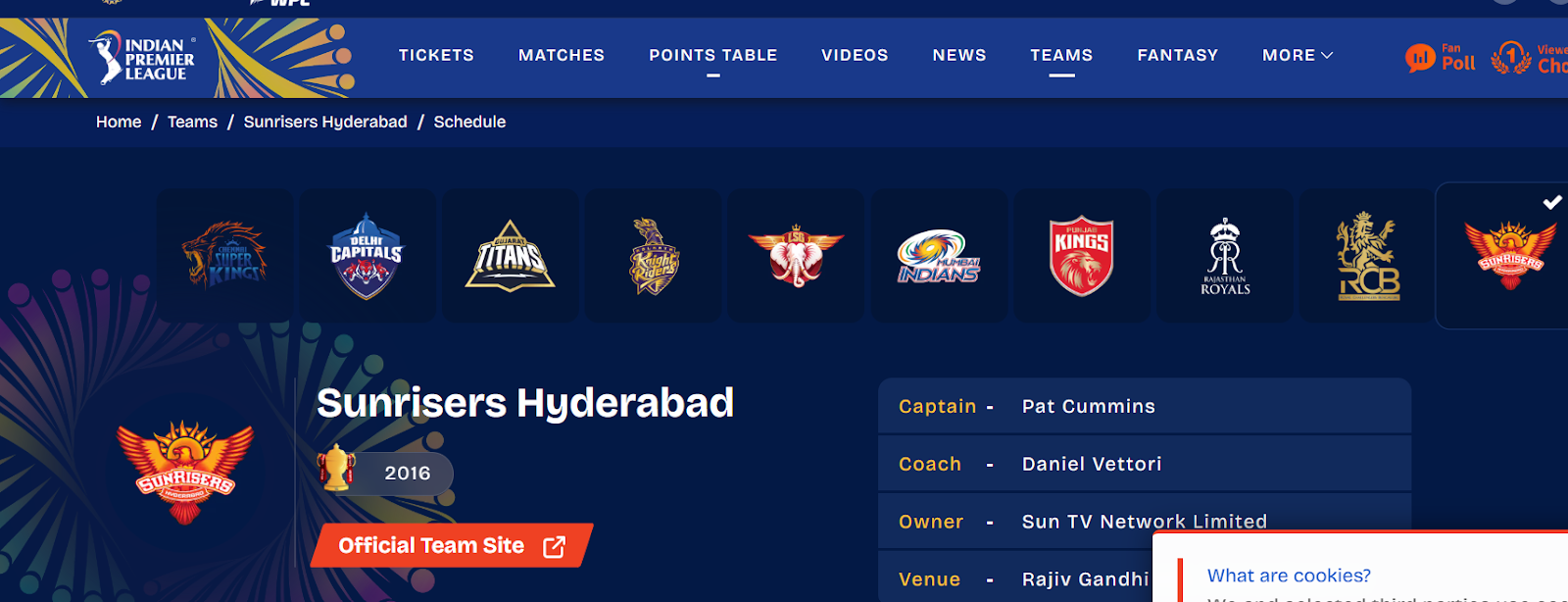
Additionally, the image incorrectly displays Dream11 as the title sponsor for SRH, whereas Shree Cement is the official title sponsor for the IPL 2026 season.

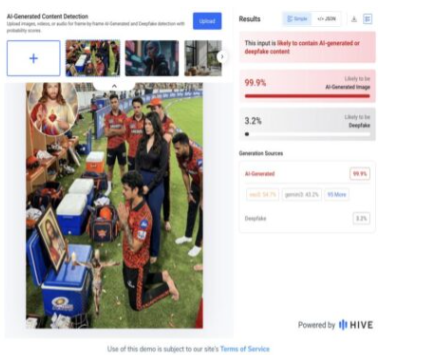
To further verify authenticity, the image was analysed using AI detection tools. Hive Moderation assigned it a 99.9% probability of being AI-generated, strongly indicating that it is not genuine.
Conclusion
The viral claim is false. The image showing Sunrisers Hyderabad players and their CEO praying before a match is AI-generated and does not depict a real event. It has been circulated with a misleading narrative and lacks any factual basis.

Related Blogs

Executive Summary:
A video is widely circulating on social media in which Israel’s Prime Minister Benjamin Netanyahu appears to praise India’s Prime Minister Narendra Modi. The viral clip is being shared with the claim that during a speech delivered on February 25, 2026, Netanyahu announced a special aid package for Afghanistan at the request of PM Modi. However, research by CyberPeace found the claim to be false. The research revealed that the circulating video was generated using artificial intelligence. The probe also confirmed that Netanyahu did not make any announcement related to Afghanistan or the Taliban during the speech.
Claim
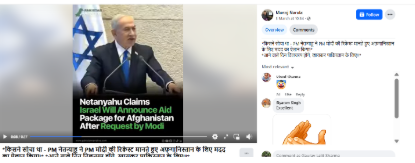
On March 1, 2026, a social media user shared the viral video on Facebook claiming that Netanyahu praised PM Modi and announced a special assistance package for Afghanistan following India’s request. The links to the post and its archive are provided below, along with a screenshot.
Fact Check:
To verify the claim, we first searched Google using relevant keywords. However, we did not find any credible media reports supporting the claim that Israel had announced such an aid package for Afghanistan. Next, we extracted key frames from the viral video and performed a reverse image search using Google Lens. During this process, we found the original video on the YouTube channel of VERTEX, which had been uploaded on February 25, 2026.
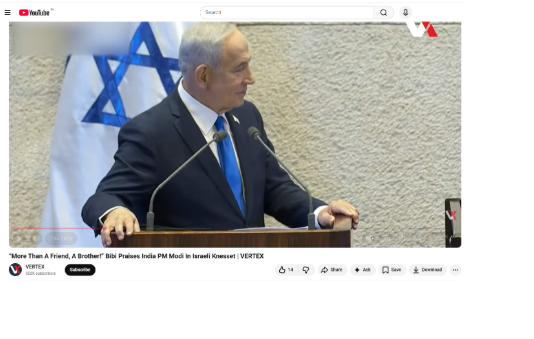
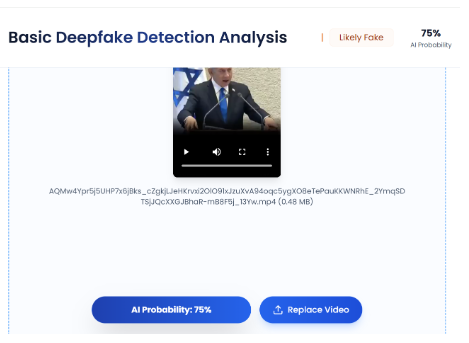
A detailed review of the original video revealed that the viral clip circulating on social media is not part of the original footage. This indicates that the circulating clip has been manipulated and shared with a misleading claim. In the original video, Netanyahu was addressing a special parliamentary session in Jerusalem, where he spoke about the growing trade, strategic cooperation, and strengthening diplomatic relations between India and Israel. He described the partnership between the two democracies as a significant and historic milestone in bilateral relations. Upon carefully listening to the viral clip, we noticed irregularities in the voice and tone, which raised suspicions that it might be AI-generated. We then analyzed the video using the AI detection tool TruthScan. The results indicated that the viral video has approximately a 75% probability of being AI-generated.
Conclusion
Our research found that the viral video was created using artificial intelligence. Moreover, Israel’s Prime Minister Benjamin Netanyahu did not make any announcement regarding Afghanistan or the Taliban during the speech being referenced. The claim circulating on social media is therefore false.
Executive Summary
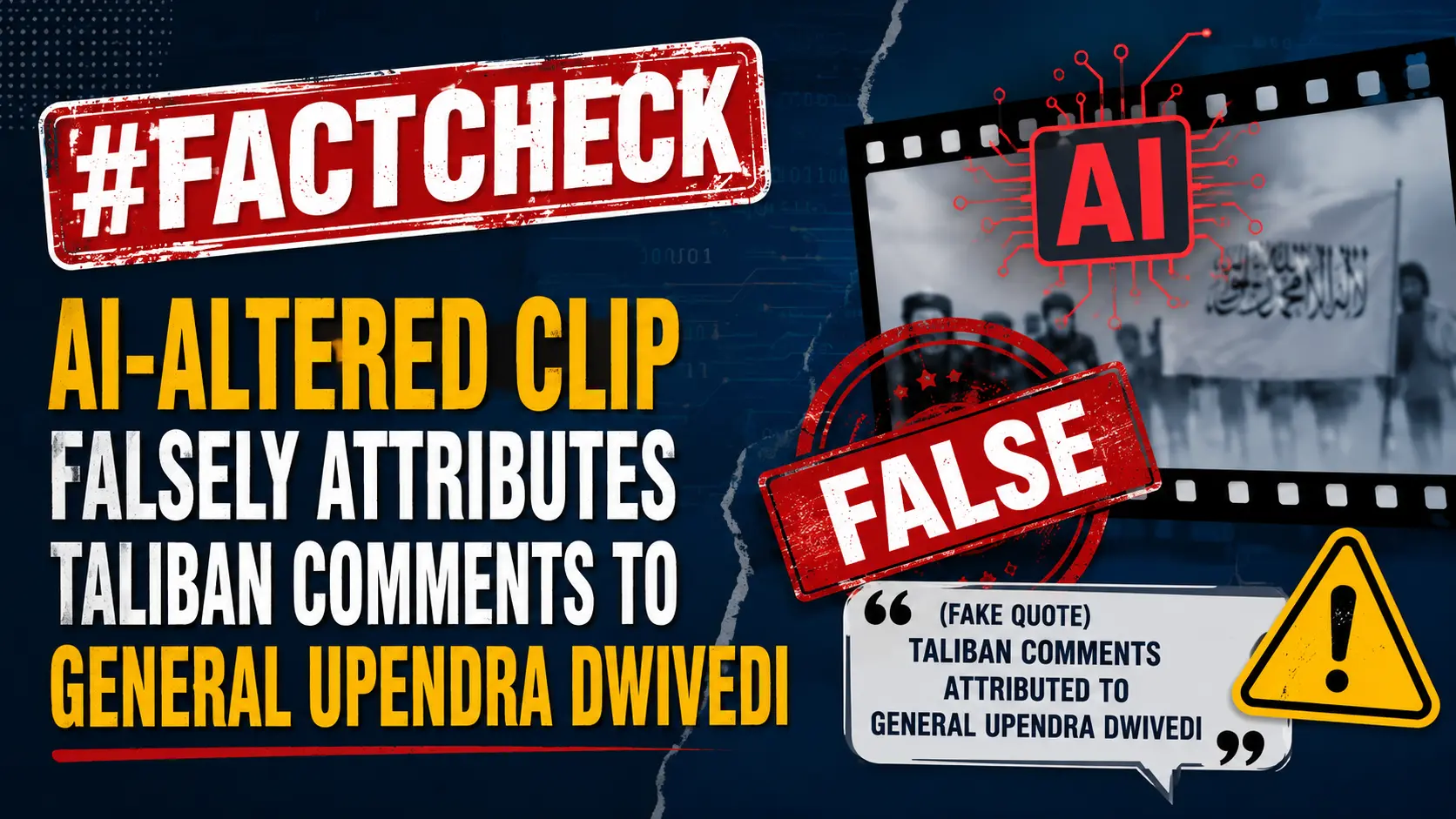
A video clip of Indian Army Chief Upendra Dwivedi is being widely shared across social media platforms with the claim that he criticised the Indian government's policy towards Taliban-ruled Afghanistan. In the viral clip, the Army Chief is allegedly heard saying that India is doing nothing except sending money to the Taliban government due to the Centre’s failed policies.
However, CyberPeace Research Wing research found the claim to be false. The viral video is a deepfake. In the original footage, General Upendra Dwivedi was speaking about Operation Sindoor and the preparedness of the Indian Armed Forces for a possible “Operation Sindoor 2.0.” He made no remarks regarding the Taliban or the government’s Afghanistan policy.
Claim
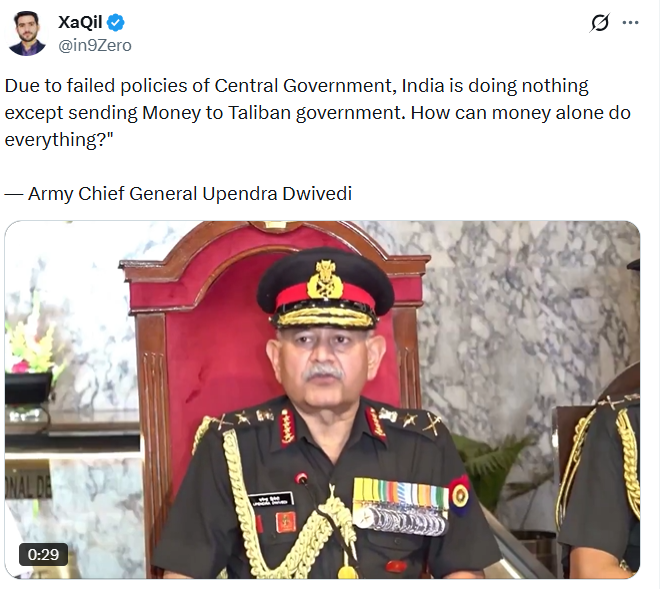
An X user named “XaQil” shared the viral video on May 31, 2026, with the caption:“Due to failed policies of the Central Government, India is doing nothing except sending Money to Taliban government. How can money alone do everything?” — Army Chief General Upendra Dwivedi.
Fact Check
In the viral video, General Dwivedi is purportedly heard making remarks about India’s Afghanistan policy, the Taliban, Pakistan, Iran, and India’s diplomatic position. To verify the claim, we searched for the original source of the video. A reverse image search of key frames led us to the authentic footage posted by news agency ANI on its official X account on May 30, 2026.
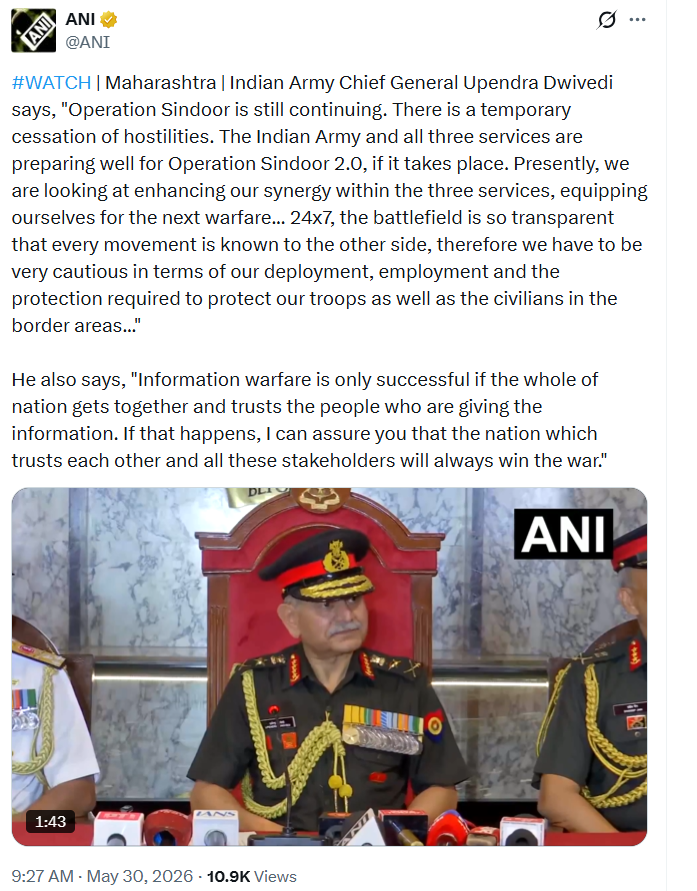
In the original video, General Dwivedi was responding to a question about Operation Sindoor. He stated that the operation was still ongoing, hostilities had only paused temporarily, and that the Indian Armed Forces were fully prepared if “Operation Sindoor 2.0” became necessary.
He also spoke about enhancing coordination among the three services and maintaining operational readiness.”
No part of his statement mentioned the Taliban, Afghanistan, Pakistan, Iran, or criticism of the Central Government.
Further corroboration came from media reports covering the same event. According to a report published by Navbharat Times on May 30, 2026, General Dwivedi made the remarks during the passing-out parade of the 150th course of the National Defence Academy (NDA), where he attended as the chief guest. He reiterated that the armed forces were fully prepared for “Operation Sindoor 2.0” if required.
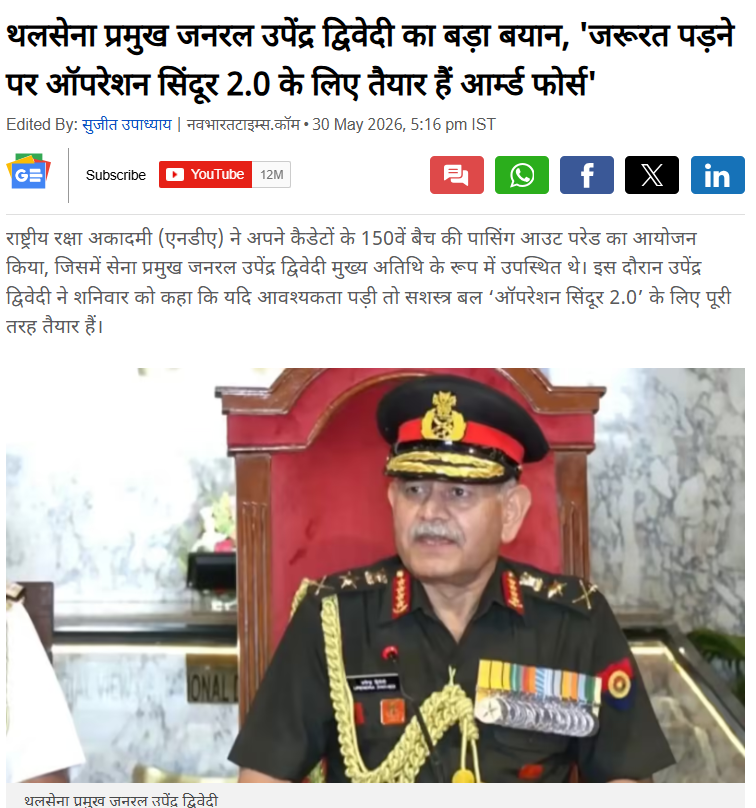
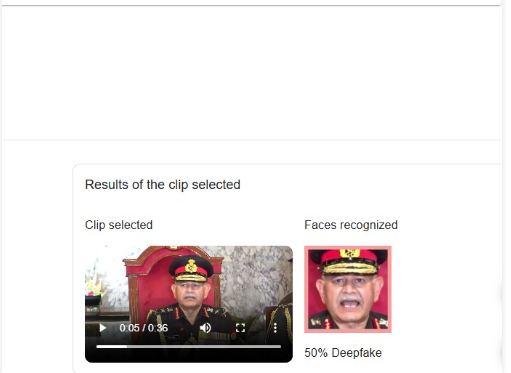
Since the content of the viral clip did not match the original statement, we examined it using InVID’s MeVer Deepfake Detector. The tool flagged signs of AI manipulation and indicated that the video had likely been altered.
Conclusion
Cyber Peace Foundation found that the viral video purportedly showing Army Chief General Upendra Dwivedi criticising the Indian government’s policy towards the Taliban is a deepfake. The Army Chief made no such remarks. The original video was recorded during an NDA event, where he spoke about Operation Sindoor and the preparedness of the Indian Armed Forces for a possible future operation. The viral clip has been manipulated using AI to spread a false narrative.

The rapid innovation of technology and its resultant proliferation in India has integrated businesses that market technology-based products with commerce. Consumer habits have now shifted from traditional to technology-based products, with many consumers opting for smart devices, online transactions and online services. This migration has increased potential data breaches, product defects, misleading advertisements and unfair trade practices.
The need to regulate technology-based commercial industry is seen in the backdrop of various threats that technologies pose, particularly to data. Most devices track consumer behaviour without the authorisation of the consumer. Additionally, products are often defunct or complex to use and the configuration process may prove to be lengthy with a vague warranty.
It is noted that consumers also face difficulties in the technology service sector, even while attempting to purchase a product. These include vendor lock-ins (whereby a consumer finds it difficult to migrate from one vendor to another), dark patterns (deceptive strategies and design practices that mislead users and violate consumer rights), ethical concerns etc.
Against this backdrop, consumer laws are now playing catch up to adequately cater to new consumer rights that come with technology. Consumer laws now have to evolve to become complimentary with other laws and legislation that govern and safeguard individual rights. This includes emphasising compliance with data privacy regulations, creating rules for ancillary activities such as advertising standards and setting guidelines for both product and product seller/manufacturer.
The Legal Framework in India
Currently, Consumer Laws in India while not tech-targeted, are somewhat adequate; The Consumer Protection Act 2019 (“Act”) protects the rights of consumers in India. It places liability on manufacturers, sellers and service providers for any harm caused to a consumer by faulty/defective products. As a result, manufacturers and sellers of ‘Internet & technology-based products’ are brought under the ambit of this Act. The Consumer Protection Act 2019 may also be viewed in light of the Digital Personal Data Protection Act 2023, which mandates the security of the digital personal data of an individual. Envisioned provisions such as those pertaining to mandatory consent, purpose limitation, data minimization, mandatory security measures by organisations, data localisation, accountability and compliance by the DPDP Act can be applied to information generated by and for consumers.
Multiple regulatory authorities and departments have also tasked themselves to issue guidelines that imbibe the principle of caveat venditor. To this effect, the Networks & Technologies (NT) wing of the Department of Telecommunications (DoT) on 2 March 2023, issued the Advisory Guidelines to M2M/IoT stakeholders for securing consumer IoT (“Guidelines”) aiming for M2M/IoT (i.e. Machine to Machine/Internet of things) compliance with the safety and security standards and guidelines in order to protect the users and the networks that connect these devices. The comprehensive Guidelines suggest the removal of universal default passwords and usernames such as “admin” that come preprogrammed with new devices and mandate the password reset process to be done after user authentication. Web services associated with the product are required to use Multi-Factor Authentication and duty is cast on them to not expose any unnecessary user information prior to authentication. Further, M2M/IoT stakeholders are required to provide a public point of contact for reporting vulnerability and security issues. Such stakeholders must also ensure that the software components are updateable in a secure and timely manner. An end-of-life policy is to be published for end-point devices which states the assured duration for which a device will receive software updates.
The involvement of regulatory authorities depends on the nature of technology products; a single product or technical consumer threat may see multiple guidelines. The Advertising Standards Council of India (ASCI) notes that cryptocurrency and related products were considered as the most violative category to commit fraud. In an attempt to protect consumer safety, it introduced guidelines to regulate advertising and promotion of virtual digital assets (VDA) exchange and trading platforms and associated services as a necessary interim measure in February 2022. It mandates that all VDA ads must carry the stipulated disclaimer “Crypto products and NFTs are unregulated and can be highly risky. There may be no regulatory recourse for any loss from such transactions.” must be made in a prominent and unmissable manner.
Further, authorities such as Securities and Exchange Board of India (SEBI) and the Reserve Bank of India (RBI) also issue cautionary notes to consumers and investors against crypto trading and ancillary activities. Even bodies like Bureau of Indian Standards (BIS) act as a complimenting authority, since product quality, including electronic products, is emphasised by mandating compliance to prescribed standards.
It is worth noting that ASCI has proactively responded to new-age technology-induced threats to consumers by attempting to tackle “dark patterns” through its existing Code on Misleading Ads (“Code”), since it is applicable across media to include online advertising on websites and social media handles. It was noted by ASCI that 29% of advertisements were disguised ads by influencers, which is a form of dark pattern. Although the existing Code addressed some issues, a need was felt to encompass other dark patterns.
Perhaps in response, the Central Consumer Protection Authority in November 2023 released guidelines addressing “dark patterns” under the Consumer Protection Act 2019 (“Guidelines”). The Guidelines define dark patterns as deceptive strategies and design practices that mislead users and violate consumer rights. These may include creating false urgency, scarcity or popularity of a product, basket sneaking (whereby additional services are added automatically on purchase of a product or service), confirm shaming (it refers to statements such as “I will stay unsecured” when opting out of travel insurance on booking of transportation tickets), etc. The Guidelines also cater to several data privacy considerations; for example, they stipulate a bar on encouraging consumers from divulging more personal information while making purchases due to difficult language and complex settings of their privacy policies, thereby ensuring compliance of technology product sellers and e-commerce platforms/vendors with data privacy laws in India. It is to be noted that the Guidelines are applicable on all platforms that systematically offer goods and services in India, advertisers and sellers.
Conclusion
Consumer laws for technology-based products in India play a pivotal role in safeguarding the rights and interests of individuals in an era marked by rapid technological advancements. These legislative frameworks, spanning facets such as data protection, electronic transactions, and product liability, assume a pivotal role in establishing a regulatory equilibrium that addresses the nuanced challenges of the digital age. The dynamic evolution of the digital landscape necessitates an adaptive legal infrastructure that ensures ongoing consumer safeguarding amidst technological innovations. As the digital landscape evolves, it is imperative for regulatory frameworks to adapt, ensuring that consumers are protected from potential risks associated with emerging technologies. Striking a balance between innovation and consumer safety requires ongoing collaboration between policymakers, businesses, and consumers. By staying attuned to the evolving needs of the digital age, Indian consumer laws can provide a robust foundation for security and equitable relationships between consumers and technology-based products.
References:
- https://dot.gov.in/circulars/advisory-guidelines-m2miot-stakeholders-securing-consumer-iot
- https://www.mondaq.com/india/advertising-marketing--branding/1169236/asci-releases-guidelines-to-govern-ads-for-cryptocurrency
- https://www.ascionline.in/the-asci-code/#:~:text=Chapter%20I%20(4)%20of%20the,nor%20deceived%20by%20means%20of
- https://www.ascionline.in/wp-content/uploads/2022/11/dark-patterns.pdf
