
#FactCheck - AI-Generated Video of Peacock ‘Rescue’ Falsely Shared as Real
Executive Summary:
A video showing a peacock allegedly trapped in ice has been going viral on social media. In the clip, the peacock appears to be frozen in a snow-covered area. Moments later, a man is seen approaching with a hammer and breaking the ice to rescue the bird. Social media users are sharing the video as a real-life incident, praising the peacock’s resilience and describing the scene as inspiring. However, CyberPeace research found the viral claim to be misleading. Our research revealed that the video was created using Artificial Intelligence (AI) and is being falsely circulated as a real incident.
Claim:
Facebook user ‘Ras Bihari Pathak’ shared the viral video on January 25, 2026, with the caption: “This peacock is not standing on ice, but on courage. It reminds us that no matter how harsh the circumstances are, hope always returns in colours.” The archived version of the post can be accessed here.

Fact Check:
To verify the claim, we first conducted a keyword search on Google to check whether any such real incident involving a peacock trapped in ice had been reported. However, no credible or verified media reports were found. Next, we closely examined the viral video. Upon observation, the peacock’s movements and reactions appeared unnatural and artificial. The motion lacked realistic physical behaviour, raising suspicion that the video might have been digitally generated. To confirm this, we analysed the clip using the AI video detection tool Hive Moderation, which indicated a 99 per cent or higher likelihood that the video was AI-generated.

Conclusion:
CyberPeace research confirms that the viral video showing a peacock allegedly trapped in ice is not real. The clip has been created using Artificial Intelligence and is being shared on social media with a false and misleading claim.

Related Blogs

Executive Summary
A video has recently gone viral on social media, with claims that it shows Iranian air defence systems intercepting attacks by US fighter jets. The video is being widely shared across various social media platforms, linking it to the ongoing military tensions between Iran and the United States. CyberPeace’s research found the viral claim to be misleading. The research revealed that the video is old and has no connection with the ongoing war between Iran and the US or any recent military action.
Claim:
A video shared on the social media platform X claims that Iranian air defence systems are responding to an attack by US aircraft.
https://x.com/tvir_X/status/2095185048567968013?s=20

Factcheck
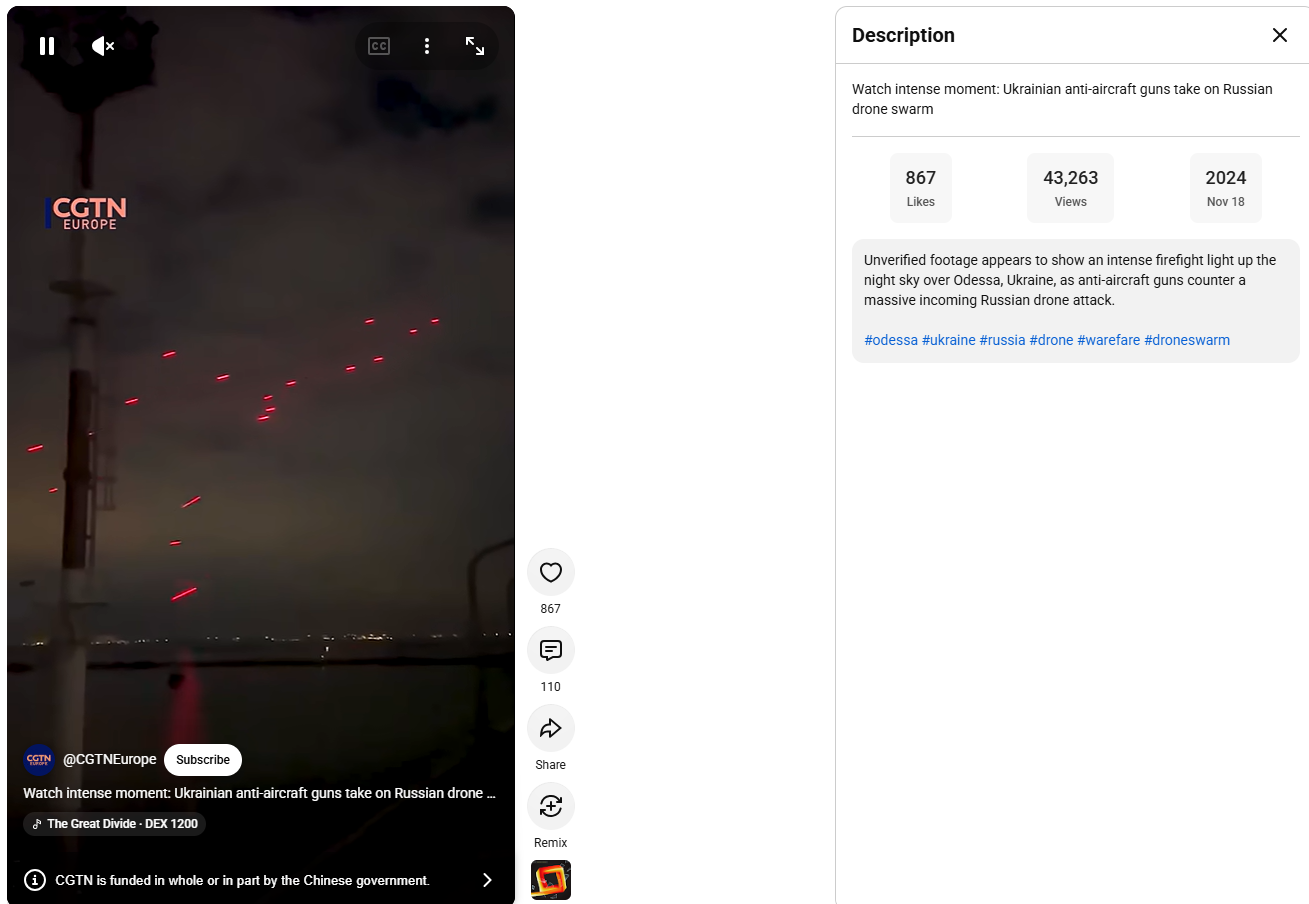
As part of our research, we conducted a reverse image search of the keyframes from the viral video. During the search, we found the same video on The Sun’s YouTube channel, where it was published on November 16, 2024. According to the video’s description, the incident took place in Odesa, Ukraine, where Ukrainian air defence systems engaged in a heavy confrontation with Russian drones. The descr
https://www.youtube.com/watch?v=TxECQr27wng

As part of our research, we found the video on the CGTN Europe YouTube channel, where it was published on November 18, 2024.The unverified footage appears to show heavy gunfire lighting up the night sky over Odesa, Ukraine. It is claimed that anti-aircraft guns were fired in response to a Russian drone attack.
https://www.youtube.com/shorts/Hq5P-UoPNHc
Conclusion:
The evidence gathered during our research makes it clear that the video circulating on social media is not related to the ongoing military tensions or any recent military action between Iran and the United States. A reverse image search revealed that the same video was published in November 2024. According to the video’s description, it shows Ukrainian air defence systems responding to a Russian drone attack in Odesa, Ukraine. Therefore, the claim that the viral video shows Iranian air defence systems intercepting attacks by US fighter jets is misleading.
Introduction
Parliament is about to begin its Monsoon Session from July 20, 2026 to August 13, 2026, and the mood in Delhi already feels charged. Ahead of the opening bell, the government has flagged five new bills for introduction, alongside a couple of pending pieces of legislation it may take up for passage. Predictably, the political oxygen in the run-up has gone almost entirely to what isn't on that list — reports this week noted the conspicuous absence of the long-anticipated Delimitation Bill and a Constitutional amendment for women's reservation in the Lok Sabha, a gap that has already drawn sharp reactions from Congress leaders. What is on the list has generated its own share of noise: a Foreign Contribution (Regulation) Amendment Bill that NGOs are watching warily, a Prevention of Insults to National Honour (Amendment) Bill tied to safeguards for the National Flag and Anthem, and a Supreme Court (Number of Judges) Amendment Bill proposing to raise the Court's sanctioned strength from 33 to 37. Every one of these will command its share of prime-time debate. But tucked quietly among the five is a bill that, headline for headline, may end up mattering more to the everyday Indian economy than all the others combined: the Micro, Small and Medium Enterprises Development (Amendment) Bill, 2026.
MSMEs play a foundational role in India’s economic engine, powering employment, entrepreneurship and growth across the country. That makes this Bill one worth watching closely, because even seemingly technical changes to the MSME framework could have very real consequences for millions of businesses and the people whose livelihoods depend on them.
What the Bill Actually Does
The MSME sector hasn't seen a structural legal update since the original MSMED Act of 2006 nearly two decades in an economy that looks nothing like it did back then. The new amendment is designed to close that gap. According to the government's own description of the bill, it aims to align the 2006 law with the sector's changed realities, improve ease of doing business, and shift toward what officials are calling "trust-based" regulation rather than a purely compliance-driven approach.
Three provisions stand out.
- First, it strengthens the mechanism for resolving delayed payments to micro and small enterprises, arguably the single biggest complaint MSME owners have voiced for years.
- Second, it creates a pathway to enforce arbitral awards specifically for micro and small units, giving smaller suppliers real teeth when a dispute is decided in their favor.
- Third, it gives states more flexibility in deciding the composition of Micro and Small Enterprises Facilitation Councils (MSEFCs) , the bodies that adjudicate payment disputes which should allow more councils to be formed and cut down on case backlogs.
The Delayed Payment Crisis, in Numbers
To understand why this matters, look at the scale of the problem the bill is trying to fix. The MSME Ministry's Samadhaan portal, which lets small enterprises file delayed-payment complaints online, had received close to 2.57 lakh applications as of June 2026, involving claimed dues of roughly ₹55,244 crore. Of these, only about 58,000 cases had actually been resolved by facilitation councils. That's a resolution rate that leaves the vast majority of small businesses waiting often for money already owed to them for goods or services delivered.
The government did tighten the screws somewhat in 2024 through Section 43B(h) of the Income Tax Act, which denies large buyers a tax deduction if they don't pay MSME suppliers within the 15-to-45-day window mandated by law. Enforcement, however, has remained patchy, and industry bodies like Assocham have continued to flag delayed payments including from PSUs and government departments as a core source of financial stress for small firms, with high interest charges on overdue statutory dues compounding the problem.
Why This Is Bigger Than One Bill
A regulation targeting the payments practices of India's micro, small, and medium-sized enterprises is more than just paperwork and procedural wrangling; the stakes for the Indian economy and society are enormous. According to the 2025-26 Economic Survey, MSMEs now contribute about 31.1% of India’s GDP, 35.4% of its manufacturing output, and 48.58% of its exports, while employing 33 to 39 crore people and providing India’s second largest source of employment after agriculture. The official Udyam database of MSMEs crossed the 8.7 crore mark by June 2026, underscoring a clear trend towards the sector’s formalisation in the last few years. Access to finance is the second pillar of MSME empowerment. The Credit Guarantee Fund Trust for Micro and Small Enterprises has authorised several lakh crores in guarantees, and most recently, the government increased its loan guarantee cover ceiling from Rs 5 crore to Rs 10 crore to facilitate more collateral-free loans to businesses. However, the actual credit gap remains estimated in the tens of lakh crores, with the biggest gaps faced by women-led and medium enterprises. While the MSME Bill doesn’t directly address access to finance, improved and quicker payment settlement mechanisms are expected to relieve some working-capital stress and dissuade small firms from falling into expensive informal credit markets. The MSME Bill also adds to a wave of recent measures to de-regulate smaller enterprises, such as the Jan Vishwas (Amendment of Provisions) Bill that was passed earlier in 2026. That Bill modified or deleted criminal offences with a more lenient civil equivalent across numerous central acts, a change industry lobby FISME called a significant move towards ease of doing business.
The Data Protection Clock Is Already Ticking - The Gap Payment Reform Won't Close
It's also worth noting that India's Digital Personal Data Protection (DPDP) Act, 2023 is now in force, with rules notified in November 2025 and full compliance — including breach notification, security safeguards. With nearly half of Indian small businesses already reporting cyber incidents each year, MSMEs have a narrowing runway to build the security practices this regime will expect of them. Given that scale of exposure, there's a real case for the MSME Amendment Bill, or a companion policy, to go further — mandating baseline cyber-hygiene standards for Udyam-registered firms or tying credit-guarantee schemes to demonstrated security practices. Payment reform alone protects an MSME's right to be paid; it does little to protect what happens to that money, or that data, once it arrives.Payment reform alone protects an MSME's right to be paid; it does little to protect what happens to that money, or that data, once it arrives. CyberPeace calls on relevant agencies to issue clearer advisories and introduce additional, cost-friendly cybersecurity safeguards tailored to MSMEs' limited budgets and IT capacity.
What to Watch For
Whether the MSME Bill gets the attention it deserves during this session is an open question. With the Opposition expected to spend political capital on delimitation, the Vande Mataram bill, unemployment, inflation, and the NEET paper-leak controversy, a technical amendment to an enterprise development law is unlikely to dominate floor debate even though it may end up affecting more households than any single headline bill this session.
Conclusion
For India's roughly 7-8 crore MSMEs, most of them family-run and thinly capitalised, the details that get finalised in the coming weeks how MSEFCs are reconstituted, how arbitral awards get enforced, how "trust-based" regulation is actually defined will matter far more than who wins the argument over delimitation. It's worth watching this one closely, even if the cameras are pointed elsewhere.
Sources
- https://www.business-standard.com/india-news/vande-mataram-bill-among-five-new-legislations-listed-for-monsoon-session-126071601319_1.html
- https://www.prokerala.com/news/articles/a1780267.html

Introduction
As the calendar pages turn inexorably towards 2024, a question looms large on the horizon of our collective consciousness: Are we cyber-resilient? This is not a rhetorical flourish but a pragmatic inquiry, as the digital landscape we navigate is fraught with cyberattacks and disruptions that threaten to capsize our virtual vessels.
What, then, is Cyber Resilience? It is the capacity to prepare for, respond to, and recover from these cyber squalls. Picture, if you will, a venerable oak amid a howling gale. The roots, those unseen sinews, delve deep into the earth, anchoring the tree – this is preparation. The robust trunk and flexible branches, swaying yet unbroken, embody response. And the new growth that follows the storm's rage is recovery. Cyber resilience is the digital echo of this natural strength and flexibility.
The Need for Resilience
Why, you might ask, is Cyber Resilience of such paramount importance as we approach 2024? The answer lies in the stark reality of our times:
- A staggering half of businesses have been breached by cyberattacks in the past three years.
- The financial haemorrhage from these incursions is projected to exceed a mind-numbing $10 trillion by the end of 2024.
- The relentless march of technology has not only brought innovation but also escalated the arms race against cyber threats.
- Cyber resilience transcends mere cybersecurity; it is a holistic approach that weaves recovery and continuity into the fabric of digital defenses.
- The adaptability of organisations, often through measures such as remote working protocols, is a testament to the evolving strategies of cyber resilience.
- The advent of AI and Machine Learning heralds a new era of automated cyber defense, necessitating an integrated framework that marries security with continuity protocols.
- Societal awareness, particularly of social engineering tactics, and maintaining public relations during crises are now recognised as critical elements of resilience strategies.
- Cyber threats have evolved in sophistication, paralleling the intense competition to develop new AI-driven solutions.
- As we gaze towards the future, cyber resilience is expected to be a prominent trend in both business and consumer technology sectors throughout 2024.
The Virtues
The benefits of cyber resilience for organisations are manifold, offering a bulwark against the digital onslaught:
- A reduction in the risk of data breaches, safeguarding sensitive information and customer data.
- Business continuity, ensuring operations persist with minimal disruption.
- Protection of reputation, as companies that demonstrate effective cyber resilience engender trust.
- Compliance with data protection and privacy regulations, thus avoiding fines and legal entanglements.
- Financial stability, as the costs associated with breaches can be mitigated or even prevented.
- Enhanced customer trust, as clients feel more secure with companies that take cybersecurity seriously.
- A competitive advantage in a market rife with cyber threats.
- Innovation and agility, as cyber-resilient companies can pivot and adapt without fear of digital disruptions.
- Employee confidence, leading to improved morale and productivity.
- Long-term savings by sidestepping the expenses of frequent or major cyber incidents.
As the year wanes, it is a propitious moment to evaluate your organisation's cyber resilience. In this edition, we will guide you through the labyrinth of cyber investment buy-in, tailored discussions with stakeholders, and the quintessential security tools for your 2024 cybersecurity strategy.
How to be more Resilient
Cyber resilience is more than a shield; it is the preparedness to withstand and recover from a cyber onslaught. Let us explore the key steps to fortify your digital defenses:
- Know your risks: Map the terrain where you are most vulnerable, identify the treasures that could be plundered, and fortify accordingly.
- Get the technology right: Invest in solutions that not only detect threats with alacrity but also facilitate rapid recovery, all the while staying one step ahead of the cyber brigands.
- Involve your people: Embed cybersecurity awareness into the fabric of every role. Train your crew in the art of recognising and repelling digital dangers.
- Test your strategies: Regularly simulate incidents to stress-test your policies and procedures, honing your ability to contain and neutralise threats.
- Plan for the worst: Develop a playbook so that everyone knows their part in the grand scheme of damage control and communication in the event of a breach.
- Continually review: The digital seas are ever-changing; adjust your sails accordingly. Cyber resilience is not a one-time endeavour but a perpetual commitment.
Conclusion
As we stand on the precipice of 2024, let us not be daunted by the digital storms that rage on the horizon. Instead, let us embrace the imperative of cyber resilience, for it is our steadfast companion in navigating the treacherous waters of the cyber world. Civil Society Organizations such as ‘CyberPeace Foundation’ playing a crucial role in promoting cyber resilience by bridging the gap between the public and cybersecurity complexities, conducting awareness campaigns, and advocating for robust policies to safeguard collective digital interests. Their active role is imperative in fostering a culture of cyber hygiene and vigilance.
References
- https://www.loginradius.com/blog/identity/cybersecurity-trends-2024/
- https://ciso.economictimes.indiatimes.com/news/ciso-strategies/cisos-guide-to-2024-top-10-cybersecurity-trends/106293196
