
#FactCheck -AI-Generated Image Falsely Shows Amit Shah and Jay Shah Travelling in Charter Plane Amid Austerity Appeal
Executive Summary
Prime Minister Narendra Modi recently appealed to citizens to reduce the consumption of gold and edible oil for a year. He also urged people to conserve petrol, diesel, and cooking gas amid the crisis arising from the ongoing tensions in West Asia involving the United States, Israel, and Iran. Amid this backdrop, a purported image of Union Home Minister Amit Shah and his son Jay Shah, who currently serves as Chairman of the International Cricket Council, has gone viral on social media. The image shows them seated inside a chartered aircraft along with two other individuals. Several social media users shared the picture as genuine while targeting the central government and Amit Shah.
However, CyberPeace Research Wing reseach found that the viral image is fake and was generated using Artificial Intelligence (AI).
Claim
An Instagram user named “Om Prakash Shukla” shared the viral image on May 24, 2026, with the caption:“People are sacrificing their desires for the nation, while they are enjoying luxury.”
https://www.instagram.com/p/DYuFqnmCh7T

Fact Check
To verify the authenticity of the viral image, we conducted a Google Lens search. However, the image was not found on any credible news platform, which raised suspicion about its authenticity. We also performed keyword-based searches related to the image using Google Search, but found no authentic reports or media coverage associated with the picture.
Further reseach involved analysing the image using AI detection tools. We first examined the picture using the “Sight Engine” AI detection tool, which indicated a 99 percent probability that the image was AI-generated.

We also tested the image using another AI detection platform called “TruthScan.” This tool likewise suggested, with around 97 percent probability, that the image had been created using artificial intelligence

Conclusion
The reseach found that the viral image featuring Union Home Minister Amit Shah and ICC Chairman Jay Shah inside a chartered aircraft is AI-generated. The image was digitally created using AI tools, and the viral claim associated with it is false.

Related Blogs
.webp)
Introduction
As per the National Crime Records Bureau (NCRB) ‘Cyber Crime In India Report 2022’, A total of 65,893 cases were registered under Cyber Crimes, showing an increase of 24.4% in registration in comparison to 52,974 cases registered in 2021. The crime rate increased from 3.9 in 2021 to 4.8 in 2022. During 2022, 64.8% of cyber-crime cases registered were for the motive of fraud (42,710 out of 65,893 cases), followed by Extortion with 5.5% (3,648 cases) and Sexual Exploitation with 5.2% (3,434 cases). The statistics released by NCRB show the increased rate of cyber crimes in the country, which poses a significant question of safety in the online world. The rise in cybercrime indicates a rise in emerging criminal groups with malicious intentions, creating new cybercrime hotspots in the country where these groups target and commit cyber crimes despite limited resources.
Cyber Crime Hotspots
Police have recently arrested several cyber criminals in a specific region, indicating that certain areas have become hotspots for cybercrime. Mewat region is one such hotspot indicating a growing trend of cybercrime operating from this area. The Mewat gang's modus operandi is quite different; Cybercriminals in Mewat scam mobile owners just using smartphones and SIM cards without kingpins and targeting mobile owners. The scammers also lure people through online marketplaces such as OLX, in which they pretend to sell possessions and then either physically lure victims to pick-up locations or scam them virtually.
A study conducted by Future Crime Research Foundation and IIT Kanpur in 2023 has revealed that Jamatara city, once considered the cyber crime capital of India, is no longer the epicentre. The study found that 35 hotspots in India are actively involved in cybercrime activities. The top 10 cybercrime hotspots in India collectively account for 80% of cybercrime-related cases in India. These districts are strategically located near India's capital or closer to the National Capital Region (NCR). These districts are strategically placed with multiple borders, making them easy targets for criminals.
Online financial fraud and social media-related crimes are the most common in India. Cybercriminals exploit data as a gold mine, using it to commit crimes. For instance, they can obtain banking and insurance data, use simple AI tools to cheat victims, and they can easily impersonate identities to lure innocent people. In cybercrime hotspots, sextortion is a modern way for cybercriminals to record and demand money. Loan app fraud, OLX fraud, and job fraud also originate from these specific regions.
Recommendations
To counter the challenges posed by emerging cybercrime hubs, the following recommendations are to be considered:
- Advanced threat Intelligence: The digital landscape is evolving, and the threat landscape is becoming more complex. AI's role in cybersecurity is becoming increasingly critical, both positively and negatively, as it helps in understanding and addressing advanced threats. AI is capable of proactive threat hunting, real-time anomaly detection, and swift incident response.
- Enhancing capabilities of Law Enforcement Agencies: Law enforcement agencies must be sensitised to advanced tools or techniques to investigate cyber crime cases effectively. The development and implementation of advanced forensic tools and technologies need to be utilised or implemented to keep up with the evolving tactics of cybercrime perpetrators.
- Continuous Monitoring: Continuous cybersecurity monitoring is crucial for detecting anomalies and preventing cyber-attacks. It involves analysing systems and data to establish baseline security, identify deviations, and investigate potential threats. Cybersecurity experts use data observability tools, artificial intelligence, and machine learning to detect unexpected dataset changes.
- Cyber Security Awareness: Public awareness needs to be higher. Cybercrime prevention and cybersecurity is a shared responsibility of all of us by being aware of the threats and following the best practices. The frequent interaction between law enforcement and the public is necessary to raise awareness about safeguarding personal and financial information. Effective campaigns on cyber security are necessary to educate netizens.
Safety Tips for Netizens
Install up-to-date security software and firewalls on devices, use strong passwords for accounts, and regularly update software and applications. Be cautious when clicking on links or downloading files from unknown sources, and be cautious of your personal information.
Conclusion
The rise of Cyber Crime Hotspots in specific regions or districts has significantly exacerbated the issue of increasing cybercrime rates. In order to combat cybercrime more effectively, it is necessary for law enforcement agencies to strengthen their coordination between different states and to adapt advanced technology methods to counter cybercrime threats effectively. Moreover, educating netizens about cyber crime threats and providing best practices is an effective method to counter these threats, considered the first line of defense against cybercrime.
References
- https://ncrb.gov.in/uploads/nationalcrimerecordsbureau/custom/1701607577CrimeinIndia2022Book1.pdf
- https://economictimes.indiatimes.com/tech/technology/no-kingpins-just-a-smartphone-and-sim-card-how-cybercriminals-in-mewat-scam-mobile-owners/articleshow/98062889.cms?from=mdr
- https://www.futurecrime.org/fcrf-cyber-crime-survey-2023
- https://timesofindia.indiatimes.com/city/mumbai/jamtara-loses-crown-as-new-remote-districts-rewrite-indias-cybercrime-map/articleshow/104475868.cms?from=mdr
- https://government.economictimes.indiatimes.com/news/secure-india/80-of-cyber-crimes-from-10-new-districts-iit-report/103921338
- https://www.dw.com/en/how-mewat-became-indias-new-hub-for-cyber-criminals/video-68674527
- https://www.indiatoday.in/from-india-today-magazine/story/into-cybercrime-hotspot-india-mewat-rajasthan-haryana-uttar-pradesh-2381545-2023-05-19
- https://frontline.thehindu.com/the-nation/spotlight-how-nuh-district-in-haryana-became-a-breeding-ground-for-cybercriminals/article67098193.ece
- https://www.opindia.com/2024/04/nuh-mewat-cyber-crime-haryana-police-crackdown/#google_vignette

Executive Summary
A video is being shared on social media showing several people attempting to rescue a young man trapped under a pile of soil and debris. The video is being shared as footage of the recent floods in Nepal. A research done by the Research Wing of the CyberPeace found the viral claim to be misleading. The research revealed that the video dates back to March 2026 and has no connection with the floods in Nepal. The video is actually from an incident in Prayagraj, Uttar Pradesh, and is being falsely shared as recent footage of the devastation caused by the floods in Nepal.
Claim:
On Facebook, a user shared the viral video with the caption: “These scenes are horrifying. The floods in Nepal have claimed countless lives, but there are also people who are still fighting for their lives even 24 hours after the floodwaters have receded. Seeing this person sends chills down the spine.” The archived post link and screenshot are provided below.
https://www.facebook.com/reel/1104511315422755

FactCheck
To verify the authenticity of the viral claim, we first extracted keyframes from the video and conducted a reverse image search using Google Lens. During the search, we found the same video uploaded on the YouTube account ‘Prayagraj Live 24’ on March 24, 2026.
According to the video description, the footage shows the relief and rescue operation carried out following an accident at a cold storage facility in Phaphamau, Prayagraj. The report link and screenshot are provided below.
https://www.youtube.com/shorts/D6ADJzxZUGQ

Based on the clue obtained from YouTube, we conducted a Google search using relevant keywords. During the search, we found a report published on the Dainik Bhaskar website on March 24, 2026, which featured the same visuals seen in the viral video. The report link and screenshot are provided below.

According to a report by Dainik Bhaskar, a major accident occurred at Adarsh Cold Storage in the Phaphamau police station area of Prayagraj on March 23, 2026. At around 1:30 pm, an ammonia gas chamber used for cooling at the cold storage exploded, causing the building’s walls and roof to collapse. Several workers were trapped under the debris in the accident.
Conclusion
Our research found that the viral video dates back to March 2026 and has no connection with the floods in Nepal. The video is actually from an incident in Prayagraj, Uttar Pradesh, and is being falsely shared on social media as recent footage of the devastation caused by the floods in Nepal.

A video circulating widely on social media claims to show snowfall near Ambience Mall in Gurugram, Haryana. The clip is being shared alongside assertions that Gurugram witnessed snowfall for the first time in its history amid a severe cold wave in January 2026. However, an research by Cyber Peace Foundation has found the claim to be misleading. Our verification reveals that the viral video is not recent and has been available online since March 2023.
The Claim
On 14 January 2026, a Facebook user shared the video with the caption,“Something truly unbelievable happened today — Gurgaon witnessed snowfall for the first time in its history!”Through this post, the user implied that the visuals showed snowfall near Ambience Mall during the ongoing cold wave.link and screeshot
- https://www.instagram.com/reel/DTfS9X9DyBo/?utm_source=ig_embed&ig_rid=239ddaf7-ec53-4b1d-8f3b-a5e39540b3ee
- https://archive.ph/JVjHf

Fact Check:
To verify the claim, we conducted a detailed search using relevant keywords but found no credible media reports or official statements to support it. Although Gurugram’s temperature dropped to 0.6 degrees Celsius amid an IMD-issued cold wave warning, there is no evidence to suggest that the city experienced snowfall or hail. As of January 16, 2026, weather records and official sources confirm that no such weather event occurred in Gurugram.
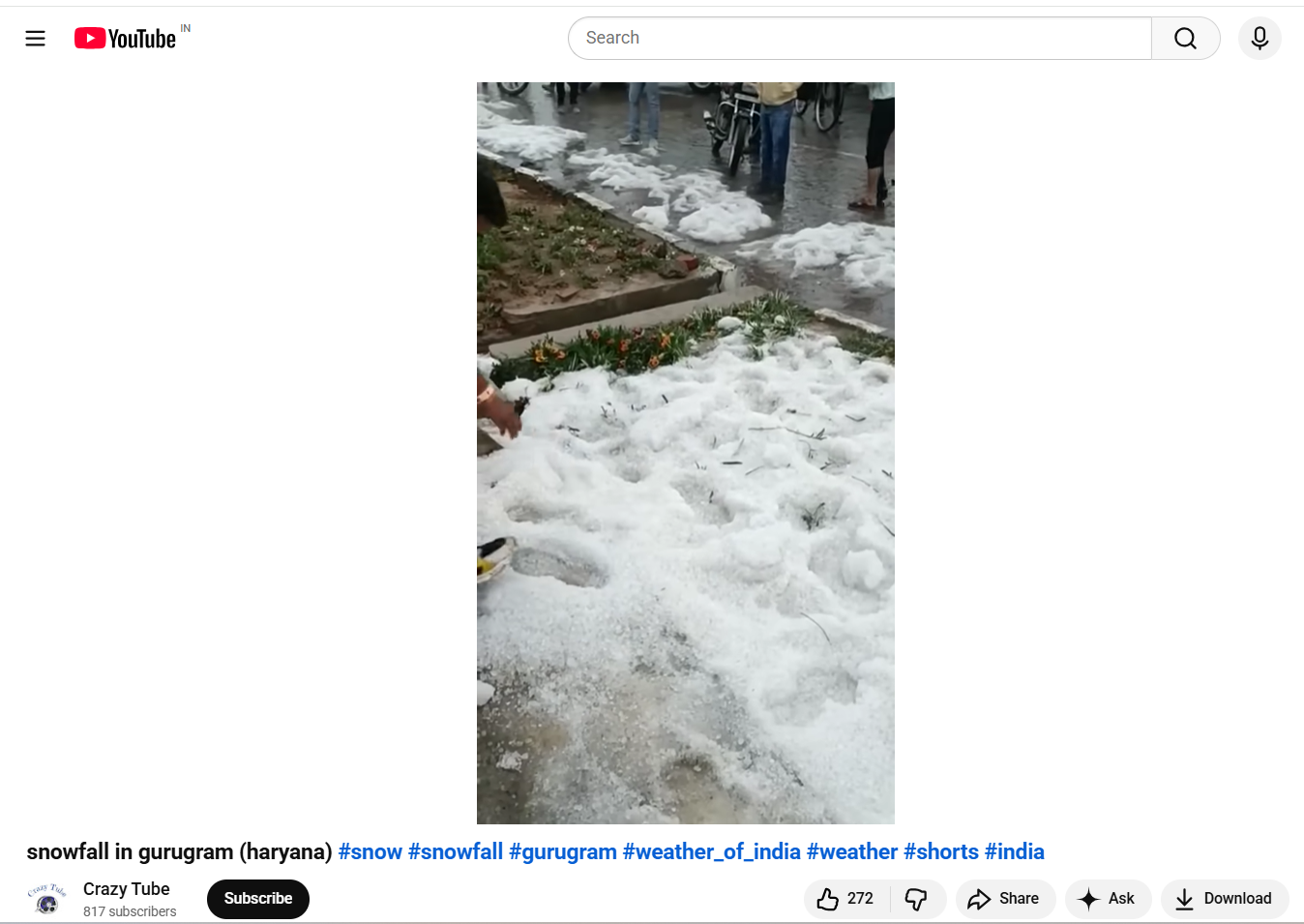
A reverse image search of keyframes extracted from the viral clip traced the same footage to a video uploaded on the YouTube channel Crazy Tube on March 21, 2023. This establishes that the video has been in circulation for nearly three years. In the original upload, the person filming clearly mentions that the visuals were recorded near a toll plaza, further indicating that the clip is unrelated to the recent weather conditions in Gurugram. Link and Screen Shot
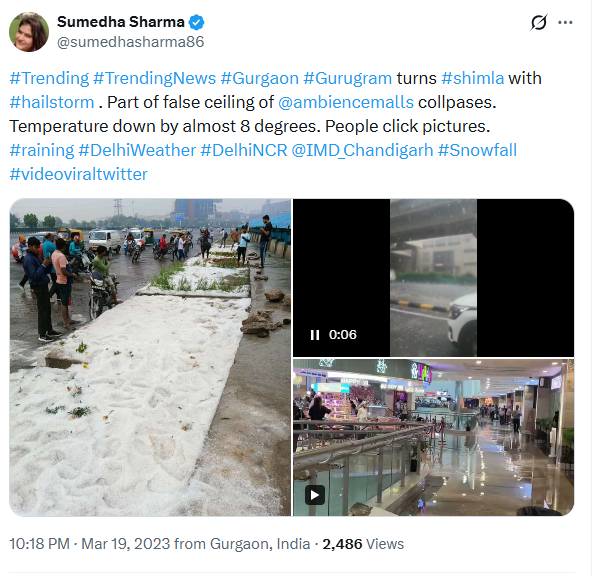
We also came across an X (formerly Twitter) post from March 19, 2023, which featured images similar to those seen in the viral video. The post described the visuals as being from a hailstorm in Gurugram, indicating that the content predates the current weather conditions and is unrelated to the recent cold wave.
Conclusion:
The video is old and predates January 2026, and has been on the internet at least since March 2023. While Gurugram recorded a low of 0.6 degrees Celsius amid an IMD cold wave warning, the city did not experience snowfall or hail as of 16 January 2026. News reports from March 2023 confirm heavy rain and hail in Delhi and adjoining areas, including parts of Gurugram, but there is no evidence of snowfall in January 2026. Hence, the claim made in the post is MISLEADING.
