
#FactCheck- Pakistan Video Falsely Shared as Attack on Army in West Bengal
Executive Summary:
Assembly elections are underway in several Indian states, including West Bengal, Assam, Kerala, Tamil Nadu, and Puducherry. While voting has already taken place in Assam, Kerala, and Puducherry, polling is still pending in West Bengal. In view of the elections, central security forces have been deployed across West Bengal. Amid this, a video showing a group of people pelting stones at a security vehicle is being widely shared on social media. Some users claim that the incident took place in West Bengal and allege that Muslims attacked an army vehicle. However, research by CyberPeace found the claim to be false. The viral video is from Pakistan and has no connection to West Bengal.
Claim
A social media user shared the video on April 5, 2026, claiming that an army vehicle was attacked in West Bengal.
Post links:

Fact Check
To verify the claim, we extracted keyframes from the viral video and conducted a reverse image search using Google Lens. This led us to a video posted on a Facebook page on October 13, 2025. The caption of that post indicated that the video was from Lahore, showing clashes between members of Tehreek-e-Labbaik and the police.

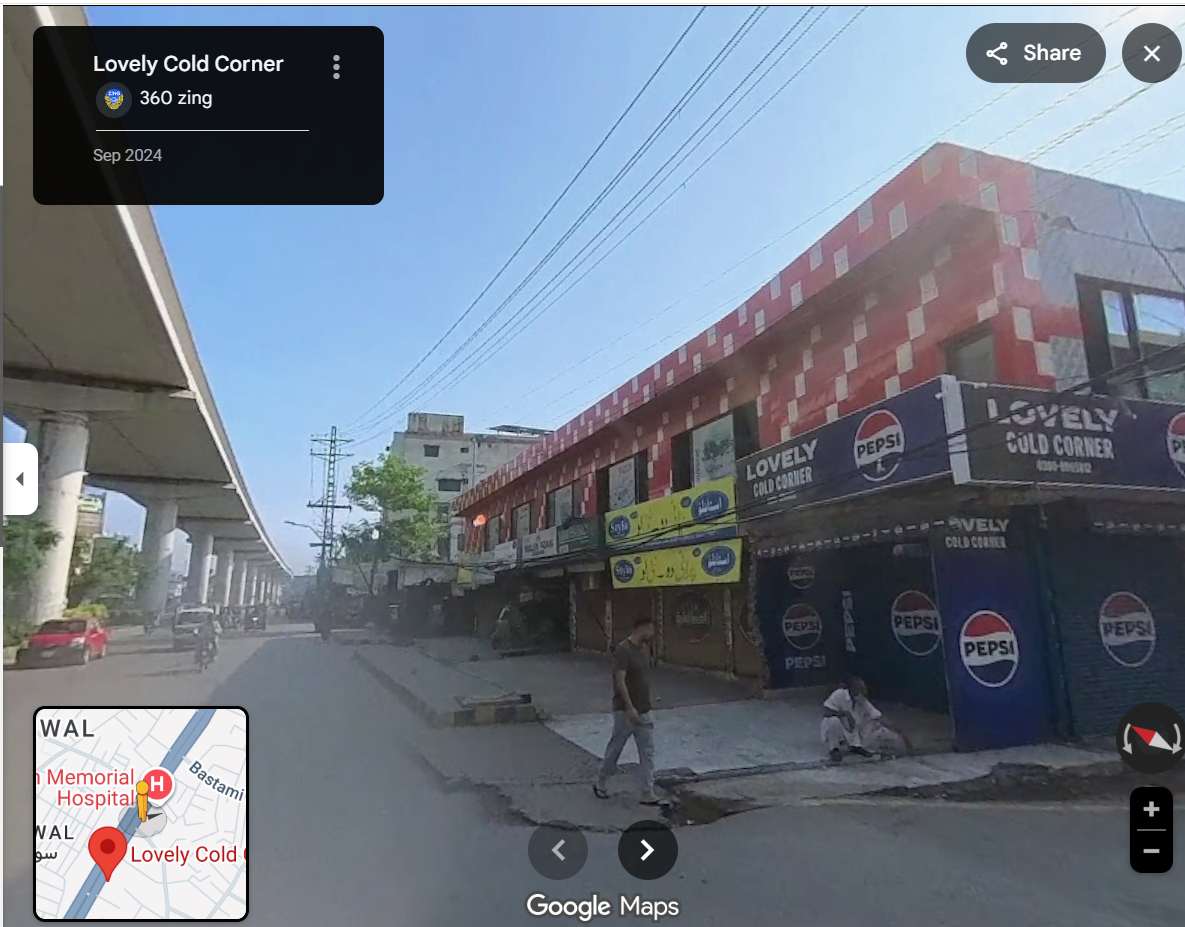
Further clues in the video also pointed to Pakistan. A shop sign reading “Lovely Drink Corner” is visible in the footage. A Google search confirmed that this establishment is located in Lahore, Pakistan.
Conclusion
The viral claim is misleading. Although central forces have been deployed in West Bengal for the ongoing elections, the video showing stone-pelting on a security vehicle is not from the state. It is an old video from Lahore, Pakistan, and is being falsely shared with a communal angle to mislead users.

Related Blogs
Executive Summery
A video is being widely shared on social media claiming that a man seen working at a brick kiln is an Australian citizen named “Anderson.” The claim states that he lost his passport and all his belongings after a theft in Agra, following which he was forced to work at a brick kiln for survival. Social media users are circulating the video as a shameful incident and are also appealing for the return of his stolen passport and belongings so that he can safely return to his country. CyberPeace Research Wing research found that the viral story is completely false and fabricated. For verification, we first conducted a keyword-based search on Google, but did not find any credible news report or media coverage supporting such an incident. Had this event been true, it would have certainly been reported by mainstream media outlets.
Claim
Facebook user ‘Yadav Roshni’ posted a video on June 23, 2026 (archive link) along with a caption claiming that an Australian tourist named “Anderson” visited Agra (Uttar Pradesh) to explore India’s culture and heritage, but was allegedly robbed during his visit. The post claims that thieves stole his passport, money, and all his belongings, leaving him helpless in a foreign country It further alleges that after losing everything, the tourist was forced to work as a labourer at a brick kiln to survive. The post describes the incident as shameful and appeals to users to widely share the video so that it reaches authorities, and requests that whoever stole his belongings return them so that he can safely return to his home country.
https://www.facebook.com/reel/1001213176107998 , https://perma.cc/MB8S-ZD24?type=standard

Fact Check
We then extracted keyframes from the viral video and performed a Google Lens search. This led us to an Instagram video posted by user sahildeshwal7500 on June 25, 2026. In this video, the person seen in the viral clip is identified as a resident of Katha village in Baghpat, Uttar Pradesh, named Sahil Deshwal. He himself clarifies in the video that the viral claim is false and that his footage was misused and shared with a fake narrative.
https://www.instagram.com/reels/DaAEB7wJkG-/

Further, another Instagram user dipendrakiduniya also posted clarification on June 25, 2026. In the video, the same individual and his brother clearly deny the “Anderson” identity claim and confirm that the viral story is completely false. They state that he is an Indian labourer working at a brick kiln in Baghpat.
https://www.instagram.com/reels/DaAZgXtjaYI/

Conclusion
The viral claim that an Australian citizen named Anderson lost his passport and belongings in Agra and was forced to work at a brick kiln is completely false. The person seen in the video is a resident of Baghpat, Uttar Pradesh. The story circulating on social media is fabricated and misleading.
Introduction
In June 2026, the Government of India temporarily restricted access to Telegram amid concerns that the platform had been used to facilitate examination related malpractice, including the alleged circulation of leaked question papers during the NEET UG re examination. The move reignited a familiar debate about the responsibility of digital platforms for unlawful activities carried out through them.
Critics of such restrictions raise a fundamental question: if a traffic accident occurs on a road, do we shut down the road? If theft takes place inside a shopping mall, do we close the entire mall? By the same logic, is it reasonable to block a communication platform because some individuals misuse it? These questions lie at the heart of a broader conflict between state interests in maintaining public order and the protection of digital rights, privacy, and freedom of communication in an increasingly interconnected world.
The controversy surrounding Telegram therefore extends beyond a single examination or messaging application. It raises a deeper and more pressing question: who should bear responsibility for illegal acts committed through encrypted digital platforms, and where should the law draw the line between effective enforcement and the preservation of fundamental digital freedoms?
Beyond mere communication for millions of students in India, Telegram is a classroom in the digital sense, an archive for their notes, practice papers, lecture recordings, and community groups that hundreds of millions of candidates refer to every single day. Therefore, why on a routine day in June 2026 did the messaging app top every other channel? Temporary internet restriction on the platform had become necessary to stop examination-related malpractice like leakage of question papers and was temporarily suspended, with reports suggesting that this move by the government was on the occasion of the NEET-UG re-examination.
This ban once again brings up a bigger question that cannot be contained within one particular examination. When has it become okay to hold a communication platform responsible and accountable for illegal acts committed over it? Or are the perpetrators solely to blame, and the service can be prohibited? Ultimately, where is the line drawn between public interest, law enforcement, and digital rights and privacy?
End-to-End Encryption: Architecture and Benefits
At the heart of these discussions of Telegram and other apps lies a technology referred to as "end-to-end encryption" or "E2EE." Quite literally, it means a message is locked with cryptography on the sender's device and can only be unlocked by the intended recipient. Not even the tech platform running the communication app can decipher it for everyone else; it just looks like random gibberish.
The Process
This kind of modern communication relies on public key cryptography. Each person has a public key they can share with anyone and a private key that stays only on their devices. When they send you a message, it is scrambled with crypto that can be unlocked by only your private key. WhatsApp and Signal, for example, use the Signal Protocol, which features "perfect forward secrecy" and is designed to protect communications from ever being unlocked even if one key is compromised. Telegram's approach is a bit unique. By default, Telegram messages aren't encrypted with end-to-end crypto; this only comes via an optional feature called "Secret Chats," a key difference in the regulatory debate.
The Dark Side: Crime, Misuse, and the Moderation Dilemma
The very features that make end-to-end messaging popular among everyday people are privacy, speed, anonymity, and mass reach which also make end-to-end messaging popular among criminals. That, unfortunately, is the catch for policymakers globally: The technology designed to protect innocent users is also the technology that facilitates criminal activity.
3.1 Criminal Abuse
Telegram, in particular, has frequently come under fire for its role in hosting a spectrum of criminal activities, most notably in the recent controversy in India regarding NEET-UG 2026 examination papers where channels allegedly advertised leaked question papers for enormous sums, convincing desperate candidates. In these instances, messages could be altered or deleted using Telegram’s message editing feature, fabricating evidence of prior leaks. However, this extends to illicit marketplaces, drug trafficking, financial fraud, money laundering, and distributing other prohibited content. Telegram's usage in disseminating extremist propaganda and aiding criminal organizations is also frequently cited, leading to bans or restrictions in countries ranging from Brazil to Nepal to Somalia to Vietnam.
3.2 The Moderation Dilemma
But the difficulty is not just with misuse; it’s also about effective moderation. Moderation, however, requires content transparency. Strong encryption is built to obscure just that. Many end-to-end messaging services like Signal and WhatsApp emphasize that even if they wanted to, they would have been able to decipher the content of a user’s message due to their architecture. Telegram has been in scrutiny for years due to its limited cooperation with law enforcement agencies because its default chats are not completely end-to-end encrypted, though there has been an attempt by Pavel Durov, the platform’s founder, to increase cooperation following his 2024 arrest in France.
This gives policymakers the following challenge: How can governments require increased access to fight crime without forcing tech companies to weaken security for everyone? As cryptographers point out, a specific "backdoor" intended to allow access to law enforcement officials can be easily exploited by hackers, foreign governments, and any other actor with nefarious intent.
Comparison of Regulatory Approaches Worldwide
4.1 Authoritarian Countries' Responses
China, for instance, has had the app blocked as part of its strategy to control access to the internet since 2015, and Iran did so in 2018 when the app was used to help organize protests against the government. An infamous Russian bid to block Telegram in 2018 turned into a cautionary story. Trying to censor the service disrupted the IPs of millions of computers, including significant services like those run by Amazon and Google. The move was met by a surge of users turning to VPNs to get access. It’s an expensive, disruptive, and incomplete form of censorship.
4.2 Democratic Countries' Approaches
Democratic jurisdictions generally prefer targeted interventions. Telegram was suspended in Brazil in 2022 and 2023, though again, only in response to a judge’s order in relation to particular investigations, and was lifted when it came into compliance. The EU’s approach has been to build on an established approach of regulation by use of a broader legislative framework, including the Digital Services Act and the Digital Markets Act, aimed at platform liability rather than outlawing encryption outright.
Meanwhile, the proposed scanning of encrypted communications has run into strong judicial headwinds, with the European courts stressing the danger of backdoors to privacy.
4.3 The United Kingdom Approach
The UK offers a middle way. With its Investigatory Powers Act, the government can oblige tech companies to collaborate in legitimate investigations. But this came to a head earlier this year with the case of Apple and the government's attempts to force it to unlock encrypted iCloud backups. Apple not only refused to reduce its encryption but also decided instead to disable some of its features for British users. This has created a problem for democracies across the world: how to balance access for investigators against the need to maintain the security that makes our systems safer.
Judicial and Legislative Perspectives: India and Beyond
In the Indian context, to have a perspective about the legal frameworks concerning content moderation, let’s explore some of the foundational decisions from the Supreme Court. Three decisions have laid the building block for digital rights laws: the first being Shreya Singhal v. Union of India (2015), where Section 69A of the IT Act, 2000, was upheld, but only by laying rigorous conditions on the review process and chance of challenging the said decision. Another important decision in this sphere is Justice K.S. Puttaswamy v. Union of India (2017) which stated that the right to privacy is fundamental in nature under Article 21 of the Constitution and stipulated the constitutional requirements of legality, legitimacy, and proportionality against the state’s interventions in fundamental rights. The most recent important case law to consider, in this context, would be Anuradha Bhasin v. Union of India (2020) which set certain limitations, such as any internet shut-downs or orders have to be temporary, proportional, and have scope for appeal. Further, the Supreme Court demanded transparency around any and all orders of blocking.
These principles of proportionality and legal limitations are highly pertinent to the Telegram issue, especially since Section 69A confers powers to block information in case of concerns about public order, national security, etc., but activists often cite this power to target specific content rather than entire platforms like Telegram. The ban on Telegram in June 2026 and disabling of message editing will force authorities to justify not only their statutory authority but also the need for proportionate means.
These aspects are amplified by IT Rules, 2021, which mandate that some instant messaging platforms may require identification of the ‘first originator’ of messages, and the Digital Personal Data Protection Act, 2023, to protect digital personal data by ensuring it does not undermine national security exceptions to this end.
Moreover, the use of encryption to ensure secure and private communications is becoming an important point of legal discourse globally. Recently, the European Court of Human Rights in Podchasov v. Russia (2024) held that mandating decryption on devices as a tool of investigative power constituted a disproportionate interference with an individual's right to privacy implying that while states may indeed have authority to regulate communication and digital services, any such measures limiting the scope of encryption will have to meet strict requirements of legality, necessity, and proportionality to be legally justifiable.
Constitutional Validity of the Ban
The government's case for a constitutional ban on Telegram rests upon its ability to satisfy the proportionality framework established by Puttaswamy and Anuradha Bhasin.
- Legitimate aim: The state's strong suit. This is the government's best argument. Protection of the integrity of NEET-UG, a high-stakes test with close to 2.4 million students, can indeed be a legitimate state objective. Given that there is evidence of channels that allegedly were involved in selling leaked question papers, the action is presumably justifiable under section 69A for preventing the incitement or occurrence of public disorder or preventing cognizable offenses.
- Necessity: The National Testing Agency (NTA) itself admitted that localized removal of suspicious accounts on Telegram had already mitigated the risks, while Telegram insisted that it had independently taken down numerous channels. The fact that the block affected more than 150 million users in India, where the medium is widely used for personal communication and is also utilized on other platforms like WhatsApp, Discord, and Instagram to a similar or higher extent, raises the responsibility to justify a strict platform-wide ban. Moreover, there is a significant legal question regarding the state’s authority under section 69A to direct Telegram to disable its message-editing capability.
- Proportionality and process: The block, even though it was temporary and intended to ensure fairness in the examination system, severely undermined legitimate uses of the platform by students who used it to share educational materials and organize study groups. Moreover, the opaqueness around the section 69A order is itself hard to reconcile with the transparency requirements set out in Anuradha Bhasin.
Thus, while the objectives of preventing exam fraud may be legitimate, the necessity and proportionality of single platform-wide bans remain highly suspect under Indian constitutional law.
Policy Recommendations and the Path Forward
The Telegram controversy points to the need for a better balancing act in platform governance in India. Firstly, instead of blanket platform shutdowns, action should target specific channels, bots, or URLs, as may be the case. Secondly, any attempt to dictate changes to features, such as disabling message editing, should be based on specific statutory provisions, not an expansive reading of Section 69A. Furthermore, there is a dire need for increased transparency; blocking orders must state the justification for the order, what is being blocked, and for how long, as far as possible. In the long run, stricter cross-border cooperation via streamlined MLATs, or through the appointment of local legal representatives by foreign platforms, would facilitate easier enforcement. Ultimately, all major blocking decisions must be accompanied by proportionality assessments. Lastly, India must resist pressure to provide access to encryption backdoors; while this might ease investigative burdens, doing so would severely jeopardise the cybersecurity of India, its businesses, and citizens.
Conclusion
The Telegram ban is an example of the tricky equilibrium between protection of public interest and protection of digital liberties in our hyper-connected world. While the intent to counter exam fraud is justifiable, a blanket ban on any platform has much broader implications on questions of necessity, proportionality and transparency. India has a well-developed constitutional and legal framework to deal with this issue already, and the challenge will be to see if those powers are used appropriately.
References
Cases:
- Shreya Singhal v. Union of India (2015) 5 SCC 1 — Supreme Court of India
- Justice K.S. Puttaswamy v. Union of India (2017) 10 SCC 1 — Supreme Court of India (Nine-Judge Bench)
- Anuradha Bhasin v. Union of India (2020) 3 SCC 637 — Supreme Court of India
- Podchasov v. Russia, European Court of Human Rights (Application No. 33696/19, February 2024)
- Apple Inc. v. United States (In re Search of an Apple iPhone, C.D. Cal. 2016)
- Telegram Messenger Inc. v. Union of India & Anr., Delhi High Court (June 2026) — Sub judice
Legislation & Rules:
- Information Technology Act, 2000 (India) — Sections 69A, 79
- IT (Procedure and Safeguards for Blocking Access to Information by Public) Rules, 2009
- IT (Intermediary Guidelines and Digital Media Ethics Code) Rules, 2021
- Digital Personal Data Protection Act, 2023 (India) & DPDP Rules, 2025
- EU Digital Services Act, 2022 (Regulation 2022/2065)
- EU Digital Markets Act, 2022 (Regulation 2022/1925)
- EU Child Sexual Abuse Regulation (CSAR) Proposal — In Trilogue, June 2026
- UK Investigatory Powers Act, 2016
Policy Sources:
- Internet Freedom Foundation, Statement on Telegram Block, 16 June 2026
- European Commission, ProtectEU Security Strategy, June 2025
- MeitY Section 69A Blocking Order re: Telegram (June 2026)
- NTA Press Release on NEET-UG 2026 Re-Examination, 16 June 2026

Executive Summary
A video is being widely shared on social media, claiming it shows a terrifying scene from a recent earthquake in Venezuela. The 9-second clip shows a multi-storey building collapsing like a house of cards, while people nearby are seen running in panic as chaos unfolds. The video is being widely circulated by users as evidence of massive destruction caused by the alleged earthquake in Venezuela. CyberPeace Research Wing research found the claim to be misleading. The viral video has no connection to any recent earthquake in Venezuela. In fact, the footage is from a completely different event that took place nearly three years ago in Turkey. It is being falsely shared with a wrong context on social media.
Claim:
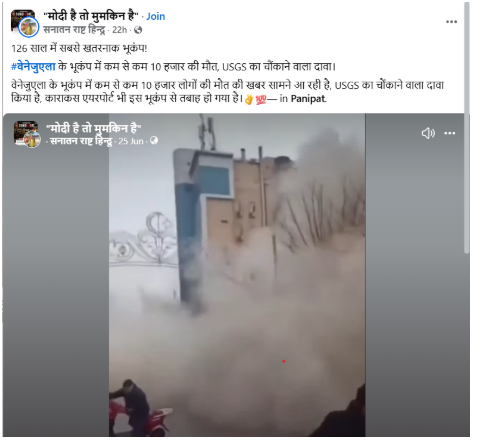
A Facebook user shared the viral video with the caption: “The most dangerous earthquake in 126 years! At least 10,000 deaths in Venezuela earthquake, shocking claim by USGS. Reports say massive destruction has occurred, Caracas airport has also been destroyed. Statement by Yogi Adityanath after Bharat Tiwari’s encounter.” The post link, archived link, and screenshots are provided below.
https://www.facebook.com/groups/2438255879794217/posts/4830038697282578/
FactCheck
To verify the claim, we performed a reverse image search of the video keyframes using Google Lens. During the search, we found the same video on WION’s Facebook page, where it was published on February 6, 2023. The original post link and screenshots are provided below. https://www.facebook.com/watch/?v=917786002738401
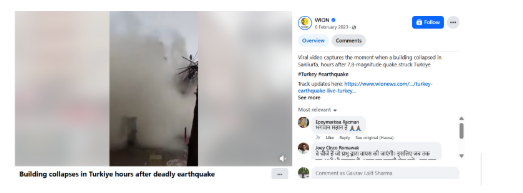
The original caption of the video clearly states that it shows a building collapse in Sanliurfa, Turkey, occurring hours after the 7.8-magnitude earthquake that struck the country. Based on clues from the Facebook post, we further searched using relevant keywords and found a report published by The Guardian on February 6, 2023, which also included the viral footage. https://www.theguardian.com/world/video/2023/feb/06/building-collapses-earthquake-aftershock-turkey-video

The report confirms that the video is from the aftermath of the devastating 2023 Turkey earthquake in Sanliurfa, not Venezuela.
Conclusion:
Our research confirms that the viral video has no connection to any recent earthquake in Venezuela. The footage is actually from the 2023 Turkey earthquake and is being falsely shared with a misleading context on social media.
