
#FactCheck- AI-generated deepfake video falsely attributes remarks to Lt Gen P.R. Shankar on Army Chief designate Lt Gen Dhiraj Seth
Executive Summary: A video circulating on social media claims that retired Lieutenant General P.R. Shankar questioned the capability of newly appointed Army Chief Lt Gen Dhiraj Seth, suggesting he may not be able to effectively counter Pakistan or China. The clip further alleges that the appointment involved political influence and favoritism. CyberPeace Research Wing research found the claim to be false and misleading. The original video contains no such remarks regarding the new Army Chief or his appointment.
Claim: An X user shared the viral video on June 16, 2026, alleging that Lt Gen P.R. Shankar raised concerns over the appointment of the new Army Chief and questioned his competence in handling threats from Pakistan and China. https://x.com/indiain24hr/status/2066916021982908502 , https://archive.ph/vAnjo
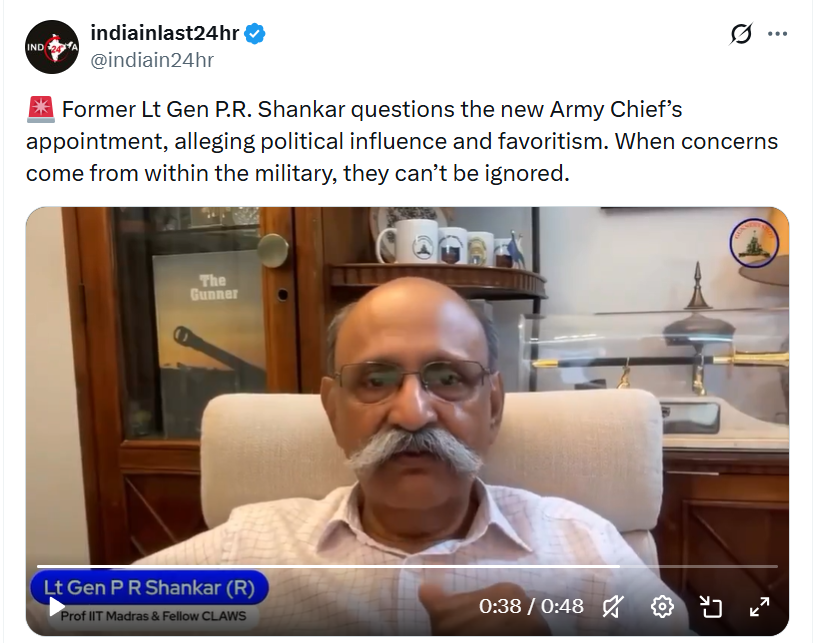
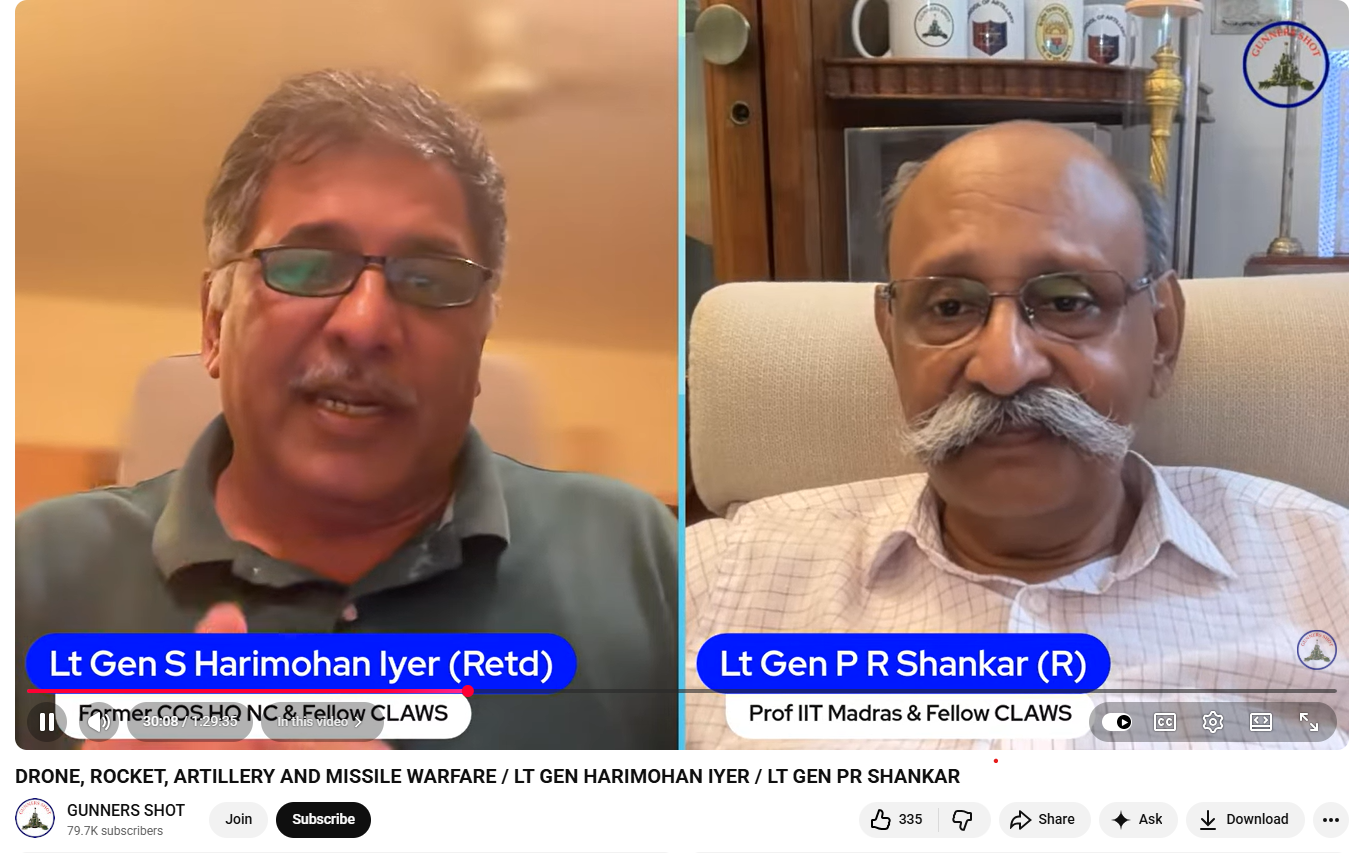
Fact Check: A Google search using relevant keywords did not yield any credible media reports supporting the claim, raising initial doubts about its authenticity. A reverse image search of keyframes from the viral video led to a YouTube livestream uploaded on June 13, 2026. The original video showed Lt Gen P.R. Shankar discussing modern military concepts such as drone warfare, rocket systems, artillery and missile warfare (DRaM Warfare), with no reference to Lt Gen Dhiraj Seth or his appointment.
https://www.youtube.com/live/60JMMlHRmjA
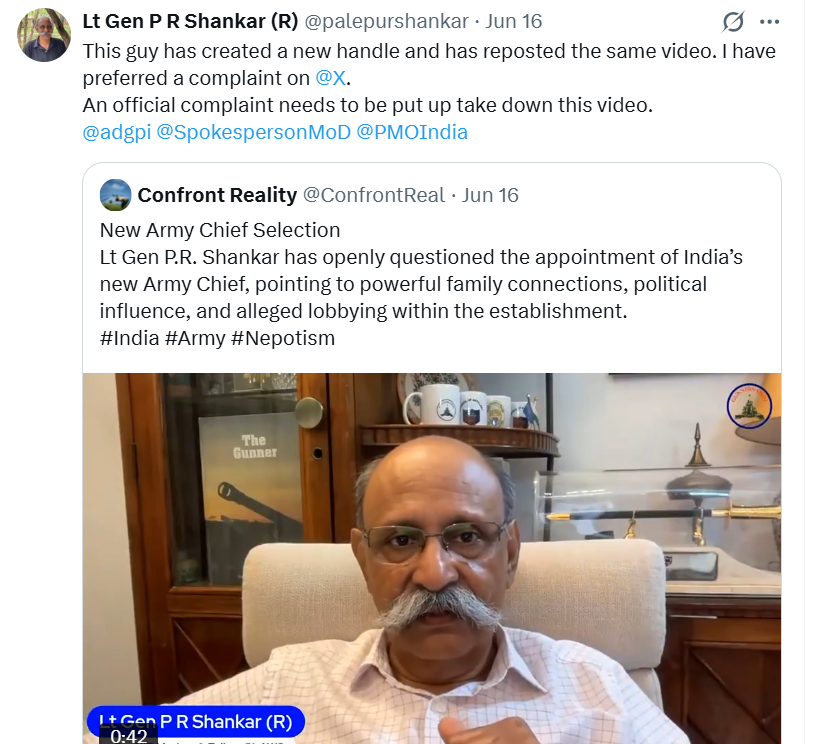
Further verification revealed that Lt Gen P.R. Shankar himself has labelled the circulating clip as fake on his official X account and has stated that a formal complaint has been filed against such manipulated content.
https://x.com/palepurshankar/status/2066826145707024778
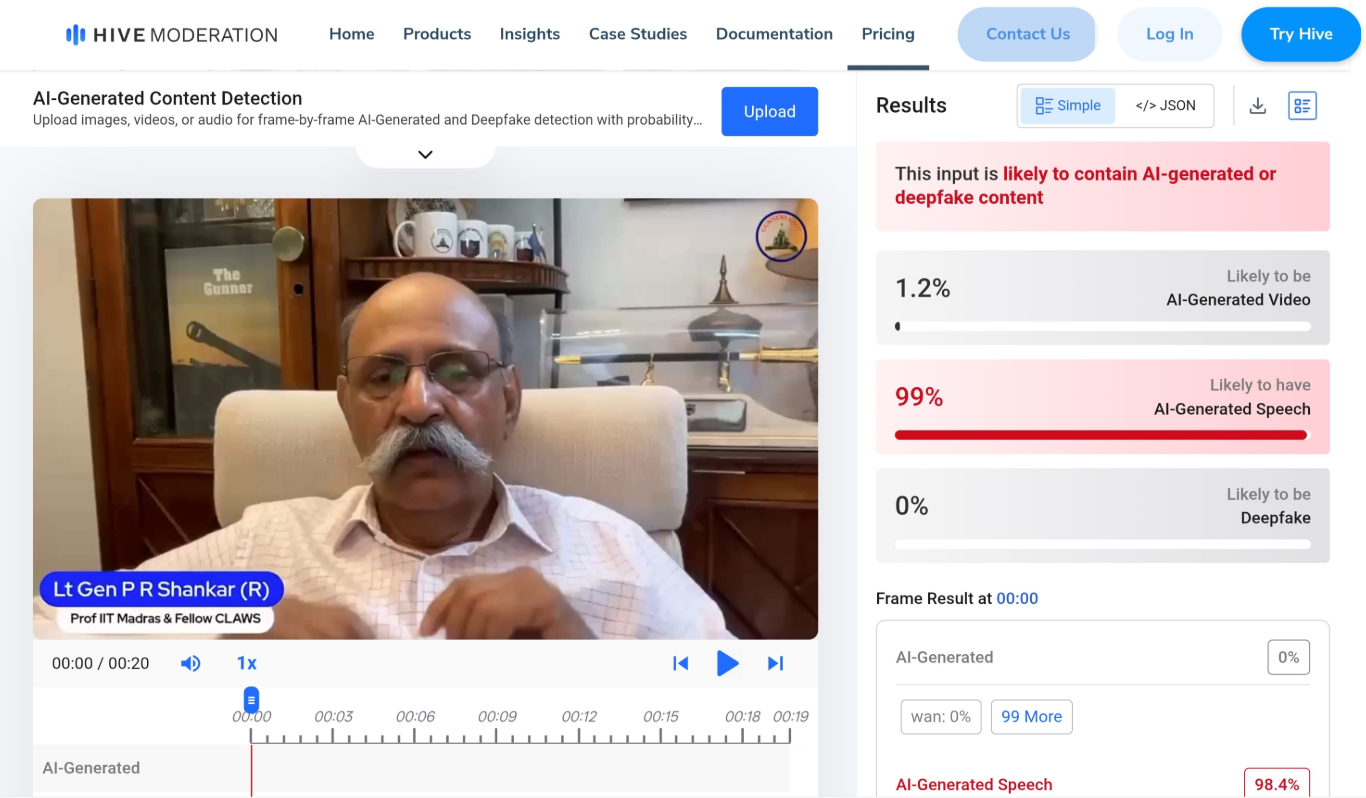
Additionally, AI detection analysis using Hive Moderation indicated that the audio in the viral video has a 99% probability of being AI-generated.
Conclusion: The research confirms that the viral video is an AI-generated deepfake. The original video does not contain any remarks about Lt Gen Dhiraj Seth or his appointment. The content has been digitally manipulated and is being circulated with a misleading narrative.

Related Blogs
Executive Summary
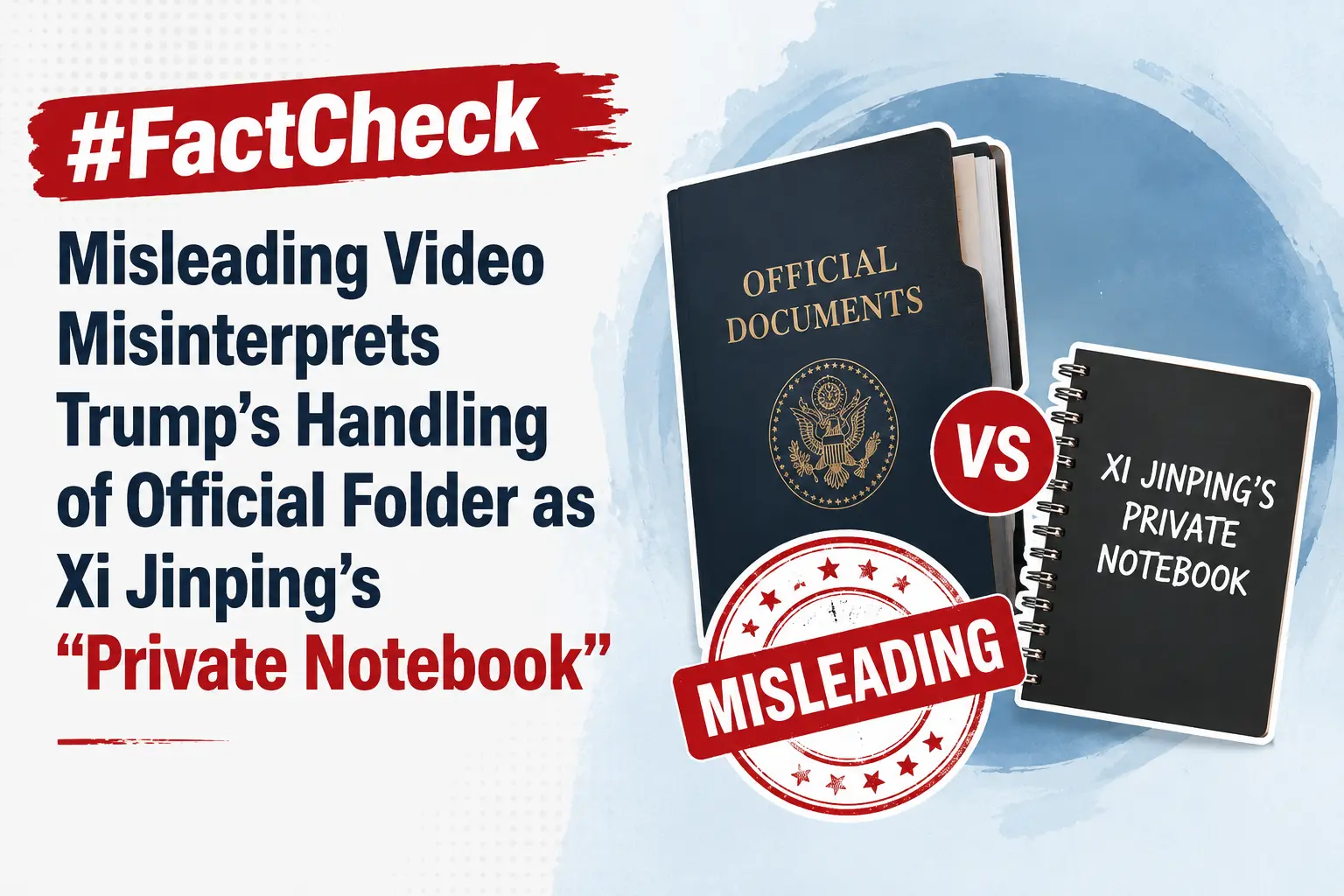
A video circulating on social media claims that during a summit in Beijing, Donald Trump was seen peeking into Chinese President Xi Jinping’s “private notebook” while Xi briefly stepped away. However, a fact-check by CyberPeace Research Wing found the claim to be baseless. A review of the full event footage clearly shows that the folder in question belonged to Donald Trump himself, not Xi Jinping. The viral interpretation is therefore misleading.
Claim
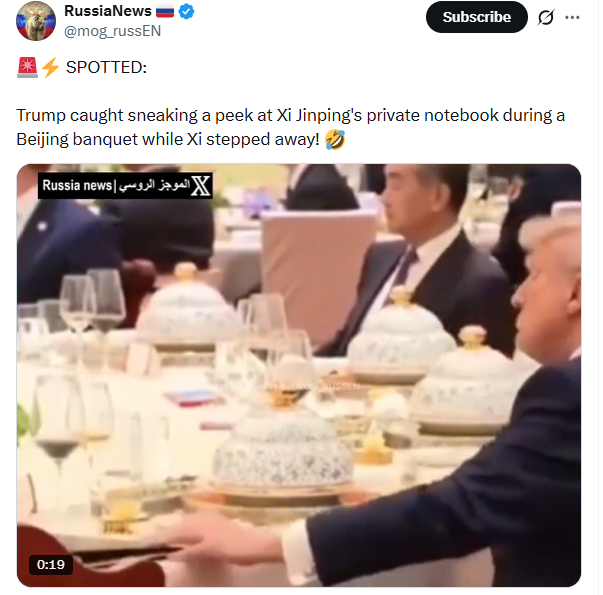
An X user shared the clip alleging, “Trump caught sneaking a peek at Xi Jinping’s private notebook during a Beijing banquet while Xi stepped away.”
Fact Check
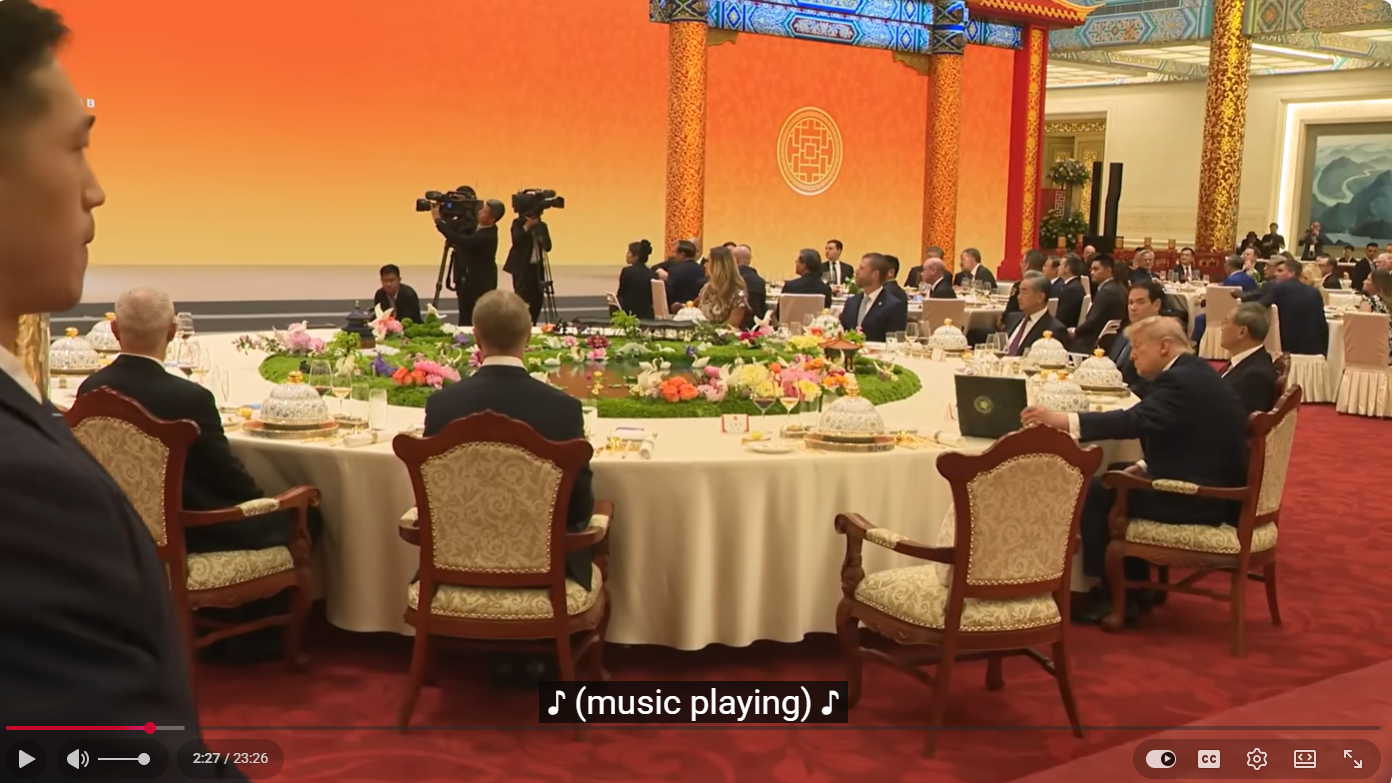
A longer version of the video, shared by NBC News on May 14, shows the state banquet held at the Great Hall of the People in Beijing. Around the 1-minute-50-second mark, Xi Jinping, seated to Trump’s left, gets up and walks to the podium. The viral clip follows shortly after, showing Trump opening the folder placed to his left and flipping through its pages.

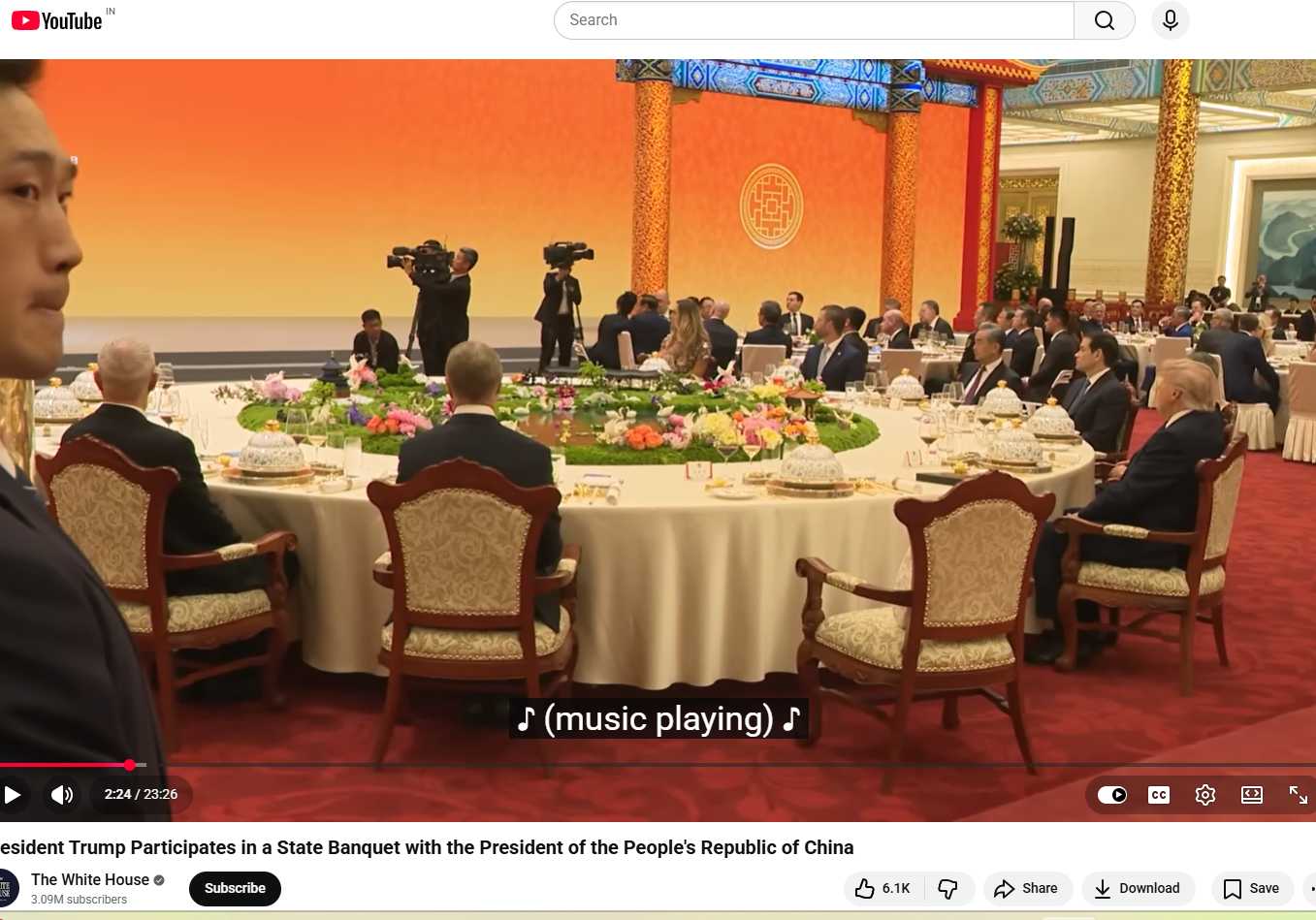
The White House also uploaded the full footage on its official YouTube channel, showing wider, uninterrupted shots of the event. Around the two-minute mark, the announcer says, “And now a toast by President Xi,” after which Xi Jinping stands up. Immediately after, Trump is seen opening the folder on his left and reading from it.
Later in the video, around the 12-minute mark, when Xi returns to his seat, Trump is seen standing up, taking the folder with him to the podium, turning pages, and reading from it. The same sequence can also be seen in the NBC News footage at around 11 minutes and 50 seconds. This clearly indicates that the folder belonged to the U.S. President and not Xi Jinping, and that Trump was not peeking into any private notebook. Another key detail is the embossed emblem on the folder, which closely resembles the Seal of the President of the United States. The American bald eagle, the national bird of the United States, is clearly visible at the centre. A comparison between the viral screenshot and the official seal shows they are nearly identical.
Conclusion
The viral claim is misleading and taken out of context. A detailed review of the full footage, including official recordings from NBC News and the White House, clearly shows that the folder in question belonged to Donald Trump and not Chinese President Xi Jinping. At multiple points in the video, Trump is seen opening, handling, and reading from the same folder, including while Xi Jinping is away from his seat and later after he returns. The visual evidence from the event also supports this conclusion. The embossed seal on the folder matches the official Seal of the President of the United States, further confirming that it was part of Trump’s official briefing material and not any private document belonging to Xi Jinping. Taken together, the full sequence of events and official video sources make it clear that the viral narrative has been incorrectly framed. There is no evidence to suggest that Trump was peeking into Xi Jinping’s personal notebook.
.webp)
Introduction
Privacy has become a concern for netizens and social media companies have access to a user’s data and the ability to use the said data as they see fit. Meta’s business model, where they rely heavily on collecting and processing user data to deliver targeted advertising, has been under scrutiny. The conflict between Meta and the EU traces back to the enactment of GDPR in 2018. Meta is facing numerous fines for not following through with the regulation and mainly failing to obtain explicit consent for data processing under Chapter 2, Article 7 of the GDPR. ePrivacy Regulation, which focuses on digital communication and digital data privacy, is the next step in the EU’s arsenal to protect user privacy and will target the cookie policies and tracking tech crucial to Meta's ad-targeting mechanism. Meta’s core revenue stream is sourced from targeted advertising which requires vast amounts of data for the creation of a personalised experience and is scrutinised by the EU.
Pay for Privacy Model and its Implications with Critical Analysis
Meta came up with a solution to deal with the privacy issue - ‘Pay or Consent,’ a model that allows users to opt out of data-driven advertising by paying a subscription fee. The platform would offer users a choice between free, ad-supported services and a paid privacy-enhanced experience which aligns with the GDPR and potentially reduces regulatory pressure on Meta.
Meta presently needs to assess the economic feasibility of this model and come up with answers for how much a user would be willing to pay for the privacy offered and shift Meta’s monetisation from ad-driven profits to subscription revenues. This would have a direct impact on Meta’s advertisers who use Meta as a platform for detailed user data for targeted advertising, and would potentially decrease ad revenue and innovate other monetisation strategies.
For the users, increased privacy and greater control of data aligning with global privacy concerns would be a potential outcome. While users will undoubtedly appreciate the option to avoid tracking, the suggestion does beg the question that the need to pay might become a barrier. This could possibly divide users between cost-conscious and privacy-conscious segments. Setting up a reasonable price point is necessary for widespread adoption of the model.
For the regulators and the industry, a new precedent would be set in the tech industry and could influence other companies’ approaches to data privacy. Regulators might welcome this move and encourage further innovation in privacy-respecting business models.
The affordability and fairness of the ‘pay or consent’ model could create digital inequality if privacy comes at a digital cost or even more so as a luxury. The subscription model would also need clarifications as to what data would be collected and how it would be used for non-advertising purposes. In terms of market competition, competitors might use and capitalise on Meta’s subscription model by offering free services with privacy guarantees which could further pressure Meta to refine its offerings to stay competitive. According to the EU, the model needs to provide a third way for users who have ads but are a result of non-personalisation advertising.
Meta has further expressed a willingness to explore various models to address regulatory concerns and enhance user privacy. Their recent actions in the form of pilot programs for testing the pay-for-privacy model is one example. Meta is actively engaging with EU regulators to find mutually acceptable solutions and to demonstrate its commitment to compliance while advocating for business models that sustain innovation. Meta executives have emphasised the importance of user choice and transparency in their future business strategies.
Future Impact Outlook
- The Meta-EU tussle over privacy is a manifestation of broader debates about data protection and business models in the digital age.
- The EU's stance on Meta’s ‘pay or consent’ model and any new regulatory measures will shape the future landscape of digital privacy, leading to other jurisdictions taking cues and potentially leading to global shifts in privacy regulations.
- Meta may need to iterate on its approach based on consumer preferences and concerns. Competitors and tech giants will closely monitor Meta’s strategies, possibly adopting similar models or innovating new solutions. And the overall approach to privacy could evolve to prioritise user control and transparency.
Conclusion
Consent is the cornerstone in matters of privacy and sidestepping it violates the rights of users. The manner in which tech companies foster a culture of consent is of paramount importance in today's digital landscape. As the exploration by Meta in the ‘pay or consent’ model takes place, it faces both opportunities and challenges in balancing user privacy with business sustainability. This situation serves as a critical test case for the tech industry, highlighting the need for innovative solutions that respect privacy while fostering growth with the specificity of dealing with data protection laws worldwide, starting with India’s Digital Personal Data Protection Act, of 2023.
Reference:
- https://ciso.economictimes.indiatimes.com/news/grc/eu-tells-meta-to-address-consumer-fears-over-pay-for-privacy/111946106
- https://www.wired.com/story/metas-pay-for-privacy-model-is-illegal-says-eu/
- https://edri.org/our-work/privacy-is-not-for-sale-meta-must-stop-charging-for-peoples-right-to-privacy/
- https://fortune.com/2024/04/17/meta-pay-for-privacy-rejected-edpb-eu-gdpr-schrems/

Executive Summary:
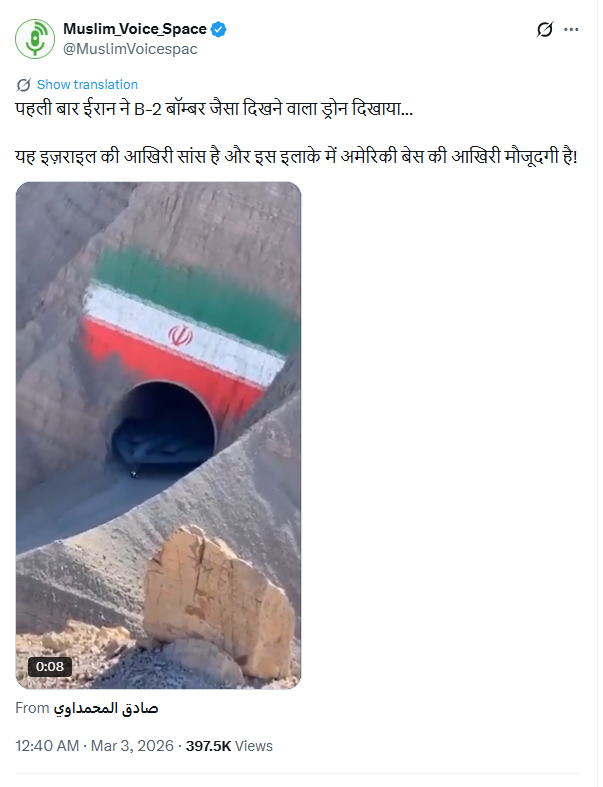
Amid the ongoing war involving the United States, Israel, and Iran, a video clip circulating on social media claims to show Iran unveiling a drone resembling the US B-2 stealth bomber. In the viral clip, an aircraft-like object can be seen emerging from a cave before taking off. Several users are sharing the video with the claim that Iran has deployed a B-2-style drone in the conflict.
However, research by the CyberPeace found that the viral video is not real and was generated using artificial intelligence. While the United States has reportedly used B-2 stealth bombers in strikes against Iran during the conflict, the viral clip does not show an actual Iranian drone.
Claim
X user “Muslim_Voice_Space” posted the video on March 3, 2026, claiming that Iran had rolled out a drone resembling the B-2 bomber for use in the war.
Fact Check
To verify the claim, we first closely examined the viral video. In the opening moments of the clip, the wing of the alleged drone appears to hit the side of the cave while exiting. Despite the apparent collision, the aircraft continues flying smoothly without any visible damage. This unusual detail raised doubts about the authenticity of the footage.
We then analyzed the video using the AI detection tool Hive Moderation, which flagged the clip as likely AI-generated.

Further analysis using the Sightengine AI detection tool also suggested that the video was artificially created. The tool estimated a 75% probability that the footage was generated using AI. It also indicated a 70% likelihood that the clip may have been created using Sora, an AI video-generation tool.

Conclusion
The viral video claiming to show an Iranian drone resembling the US B-2 stealth bomber emerging from a cave is not authentic. Analysis indicates that the clip was created using AI tools and is being misleadingly shared in the context of the ongoing conflict.
