
#FactCheck-AI-Generated Video Falsely Claims Snake Was Spotted on Aircraft Wing During Flight
Executive Summary
A video showing a snake crawling on the wing of an aircraft during a flight is being widely circulated on social media. The video is being shared with the claim that the sighting of a snake on the aircraft wing caused panic among passengers and crew members during the flight. Several users are sharing the video as a genuine incident. CyberPeace Research Wing ’s research found the viral claim to be misleading. The research revealed that the video does not show a real incident and was created using artificial intelligence (AI).
Claim:
A Facebook user shared the viral video on July 26, 2026, claiming that a snake was spotted on an aircraft during a flight, causing panic. The post stated, “Snake spotted on aircraft during flight, video goes viral!”
The link to the post, archive link and screenshot are provided below:
https://www.facebook.com/reel/2845827375780035

Factcheck
To verify the authenticity of the viral video, the Desk analysed several key frames from the footage and conducted a reverse image search.
However, no credible news report, official information, or reliable source was found linking the video to any real incident involving a snake on an aircraft during a flight.
Upon closely examining the video, the Desk suspected that it may have been generated using AI. To verify this, the video was analysed using the AI detection tool HIVE Moderation. The tool’s analysis also indicated that the video was likely AI-generated, suggesting that it does not depict an actual incident.

As part of further verification, the key frames of the video were also examined using another AI detection tool, Sightengine. The tool’s analysis indicated a 99 per cent probability that the visuals were AI-generated.

Conclusion:
The research established that the viral video does not show a real incident of a snake crawling on an aircraft wing during a flight. The video was created using artificial intelligence (AI) and is being circulated on social media with a misleading claim.

Related Blogs

Introduction:
The Ministry of Civil Aviation, GOI, established the initiative ‘DigiYatra’ to ensure hassle-free and health-risk-free journeys for travellers/passengers. The initiative uses a single token of face biometrics to digitally validate identity, travel, and health along with any other data needed to enable air travel.
Cybersecurity is a top priority for the DigiYatra platform administrators, with measures implemented to mitigate risks of data loss, theft, or leakage. With over 6.5 million users, DigiYatra is an important step forward for India, in the direction of secure digital travel with seamless integration of proactive cybersecurity protocols. This blog focuses on examining the development, challenges and implications that stand in the way of securing digital travel.
What is DigiYatra? A Quick Overview
DigiYatra is a flagship initiative by the Government of India to enable paperless travel, reducing identity checks for a seamless airport experience. This technology allows the entry of passengers to be automatically processed based on a facial recognition system at all the checkpoints at the airports, including main entry, security check areas, aircraft boarding, and more.
This technology makes the boarding process quick and seamless as each passenger needs less than three seconds to pass through every touchpoint. Passengers’ faces essentially serve as their documents (ID proof and if required, Vaccine Proof) and their boarding passes.
DigiYatra has also enhanced airport security as passenger data is validated by the Airlines Departure Control System. It allows only the designated passengers to enter the terminal. Additionally, the entire DigiYatra Process is non-intrusive and automatic. In improving long-standing security and operational airport protocols, the platform has also significantly improved efficiency and output for all airport professionals, from CISF personnel to airline staff members.
Policy Origins and Framework
Rooted in the Government of India's Digital India campaign and enabled by the National Civil Aviation Policy (NCAP) 2016, DigiYatra aims to modernise air travel by integrating Aadhaar-based passenger identification. While Aadhaar is currently the primary ID, efforts are underway to include other identification methods. The platform, supported by stakeholders like the Airports Authority of India (26%) and private airports (14.8% each), must navigate stringent cybersecurity demands. Compliance with the Digital Personal Data Protection Act, 2023, ensures the secure use of sensitive facial recognition data, while the Aircraft (Security) Rules, 2023, mandate robust interoperability and data protection mechanisms across stakeholders. DigiYatra also aspires to democratise digital travel, extending its reach to underserved airports and non-tech-savvy travellers. As India refines its cybersecurity and privacy frameworks, learning from global best practices is essential to safeguarding data and ensuring seamless, secure air travel operations.
International Practices
Global practices offer crucial lessons to strengthen DigiYatra's cybersecurity and streamline the seamless travel experience. Initiatives such as CLEAR in the USA and Seamless Traveller initiatives in Singapore offer actionable insights into further expanding the system to its full potential. CLEAR is operational in 58 airports and has more than 17 million users. Singapore has made Seamless Traveller active since the beginning of 2024 and aims to have a 95% shift to automated lanes by 2026.
Some additional measures that India can adopt from international initiatives are regular audits and updates to the cybersecurity policies. Further, India can aim for a cross-border policy for international travel. By implementing these recommendations, DigiYatra can not only improve data security and operational efficiency but also establish India as a leader in global aviation security standards, ensuring trust and reliability for millions of travellers
CyberPeace Recommendations
Some recommendations for further improving upon our efforts for seamless and secure digital travel are:
- Strengthen the legislation on biometric data usage and storage.
- Collaborate with global aviation bodies to develop standardised operations.
- Cybersecurity technologies, such as blockchain for immutable data records, should be adopted alongside encryption standards, data minimisation practices, and anonymisation techniques.
- A cybersecurity-first culture across aviation stakeholders.
Conclusion
DigiYatra represents a transformative step in modernising India’s aviation sector by combining seamless travel with robust cybersecurity. Leveraging facial recognition and secure data validation enhances efficiency while complying with the Digital Personal Data Protection Act, 2023, and Aircraft (Security) Rules, 2023.
DigiYatra must address challenges like secure biometric data storage, adopt advanced technologies like blockchain, and foster a cybersecurity-first culture to reach its full potential. Expanding to underserved regions and aligning with global best practices will further solidify its impact. With continuous innovation and vigilance, DigiYatra can position India as a global leader in secure, digital travel.
References
- https://government.economictimes.indiatimes.com/news/governance/digi-yatra-operates-on-principle-of-privacy-by-design-brings-convenience-security-ceo-digi-yatra-foundation/114926799
- https://www.livemint.com/news/india/explained-what-is-digiyatra-how-it-will-work-and-other-questions-answered-11660701094885.html
- https://www.civilaviation.gov.in/sites/default/files/2023-09/ASR%20Notification_published%20in%20Gazette.pdf

Introduction
Indian Cybercrime Coordination Centre (I4C) was established by the Ministry of Home Affairs (MHA) to provide a framework and eco-system for law enforcement agencies (LEAs) to deal with cybercrime in a coordinated and comprehensive manner. The Indian Ministry of Home Affairs approved a scheme for the establishment of the Indian Cyber Crime Coordination Centre (I4C) in October2018, which was inaugurated by Home Minister Amit Shah in January 2020. I4C is envisaged to act as the nodal point to curb Cybercrime in the country. Recently, on 13th March2024, the Centre designated the Indian Cyber Crime Coordination Centre (I4C) as an agency of the Ministry of Home Affairs (MHA) to perform the functions under the Information Technology Act, 2000, to inform about unlawful cyber activities.
The gazetted notification dated 13th March 2024 read as follows:
“In exercise of the powers conferred by clause (b) of sub-section (3) of section 79 of the Information Technology Act 2000, Central Government being the appropriate government hereby designate the Indian Cybercrime Coordination Centre (I4C), to be the agency of the Ministry of Home Affairs to perform the functions under clause (b) of sub-section (3) of section79 of Information Technology Act, 2000 and to notify the instances of information, data or communication link residing in or connected to a computer resource controlled by the intermediary being used to commit the unlawful act.”
Impact
Now, the Indian Cyber Crime Coordination Centre (I4C) is empowered to issue direct takedown orders under 79(b)(3) of the IT Act, 2000. Any information, data or communication link residing in or connected to a computer resource controlled by any intermediary being used to commit unlawful acts can be notified by the I4C to the intermediary. If an intermediary fails to expeditiously remove or disable access to a material after being notified, it will no longer be eligible for protection under Section 79 of the IT Act, 2000.
Safe Harbour Provision
Section79 of the IT Act also serves as a safe harbour provision for the Intermediaries. The safe harbour provision under Section 79 of the IT Act states that "an intermediary shall not be liable for any third-party information, data, or communication link made available or hosted by him". However, it is notable that this legal immunity cannot be granted if the intermediary "fails to expeditiously" take down a post or remove a particular content after the government or its agencies flag that the information is being used to commit something unlawful. Furthermore, Intermediaries are also obliged to perform due diligence on their platforms and comply with the rules & regulations and maintain and promote a safe digital environment on the respective platforms.
Under the Information Technology (Intermediary Guidelines and Digital Media Ethics Code) Rules, 2021, The government has also mandated that a ‘significant social media intermediary’ must appoint a Chief Compliance Officer (CCO), Resident Grievance Officer (RGO), and Nodal Contact Person and publish periodic compliance report every month mentioning the details of complaints received and action taken thereon.
I4C's Role in Safeguarding Cyberspace
The Indian Cyber Crime Coordination Centre (I4C) is actively working towards initiatives to combat the emerging threats in cyberspace. I4C is one of the crucial extensions of the Ministry of Home Affairs, Government of India, working extensively to combat cyber crimes and ensure the overall safety of netizens. The ‘National Cyber Crime Reporting Portal’ equipped with a 24x7 helpline number 1930, is one of the key component of the I4C.
Components Of The I4C
- National Cyber Crime Threat Analytics Unit
- National Cyber Crime Reporting Portal
- National Cyber Crime Training Centre
- Cyber Crime Ecosystem Management Unit
- National Cyber Crime Research and Innovation Centre
- National Cyber Crime Forensic Laboratory Ecosystem
- Platform for Joint Cyber Crime Investigation Team.
Conclusion
I4C, through its initiatives and collaborative efforts, plays a pivotal role in safeguarding cyberspace and ensuring the safety of netizens. I4C reinforces India's commitment to combatting cybercrime and promoting a secure digital environment. The recent development by designating the I4C as an agency to notify the instances of unlawful activities in cyberspace serves as a significant step to counter cybercrime and promote an ethical and safe digital environment for netizens.
References
- https://www.deccanherald.com/india/centre-designates-i4c-as-agency-of-mha-to-notify-unlawful-activities-in-cyber-world-2936976
- https://www.business-standard.com/india-news/home-ministry-authorises-i4c-to-issue-takedown-notices-under-it-act-124031500844_1.html
- https://www.hindustantimes.com/india-news/it-ministry-empowers-i4c-to-notify-instances-of-cybercrime-101710443217873.html
- https://i4c.mha.gov.in/about.aspx#:~:text=Objectives%20of%20I4C,identifying%20Cybercrime%20trends%20and%20patterns

Executive Summary
Talks between the United States and Iran over a ceasefire reportedly held in Islamabad on Saturday ended without a resolution. Meanwhile, a video circulating on social media claims to show US troops returning home following a ceasefire in the Middle East conflict.
However, a research by the CyberPeace found the claim to be false. The viral video is not linked to any recent ceasefire. It actually dates back to March and shows the return of Iowa National Guard troops after months of deployment in the Middle East.
Claim
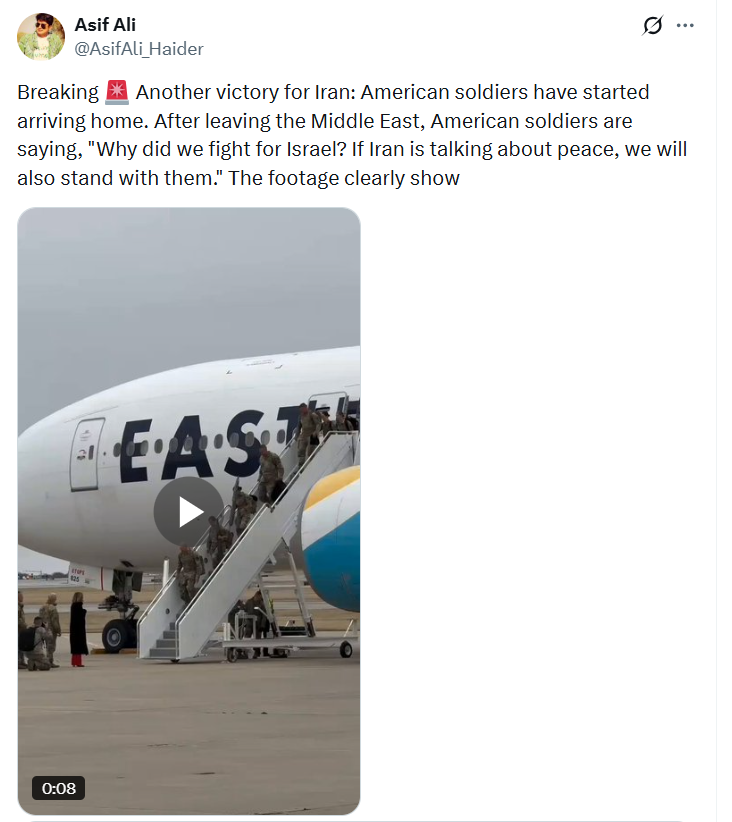
An X (formerly Twitter) user posted the video on April 7, 2026, claiming,“Another victory for Iran: American soldiers have started arriving home. After leaving the Middle East, American soldiers are saying, ‘Why did we fight for Israel? If Iran is talking about peace, we will also stand with them.’”
Fact Check
To verify the claim, we extracted keyframes from the viral video and conducted a reverse image search using Google Lens. This led us to posts by Newsradio 1040 WHO, which had shared the same footage on March 12 across Facebook and Instagram.
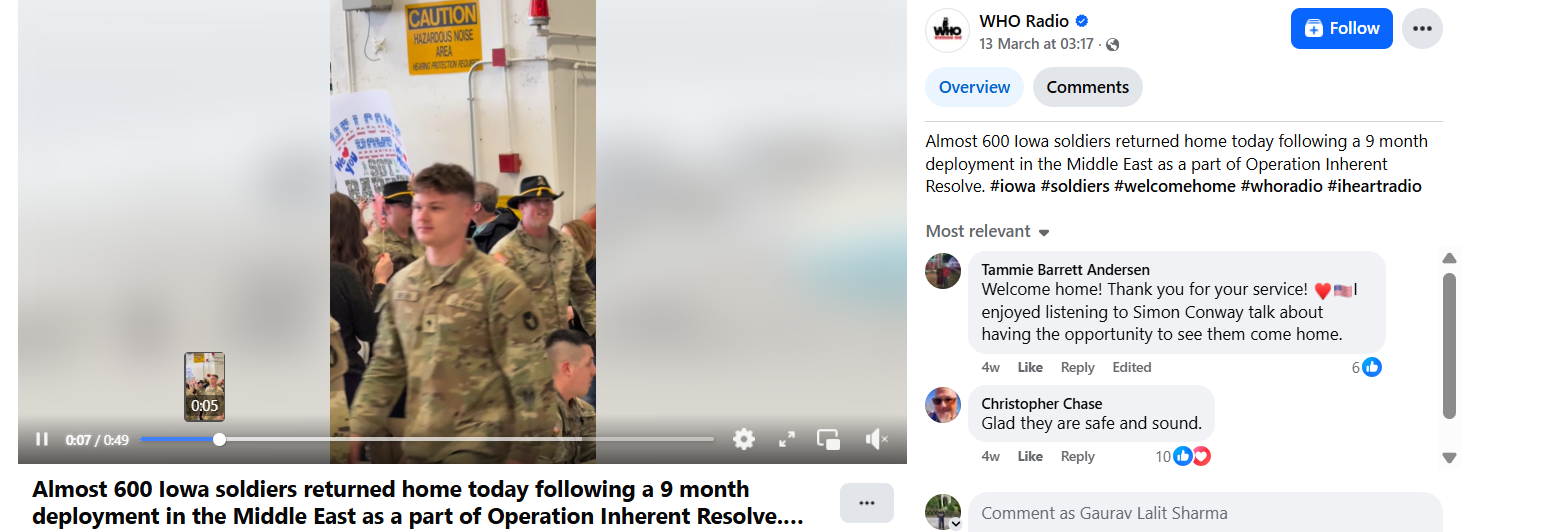
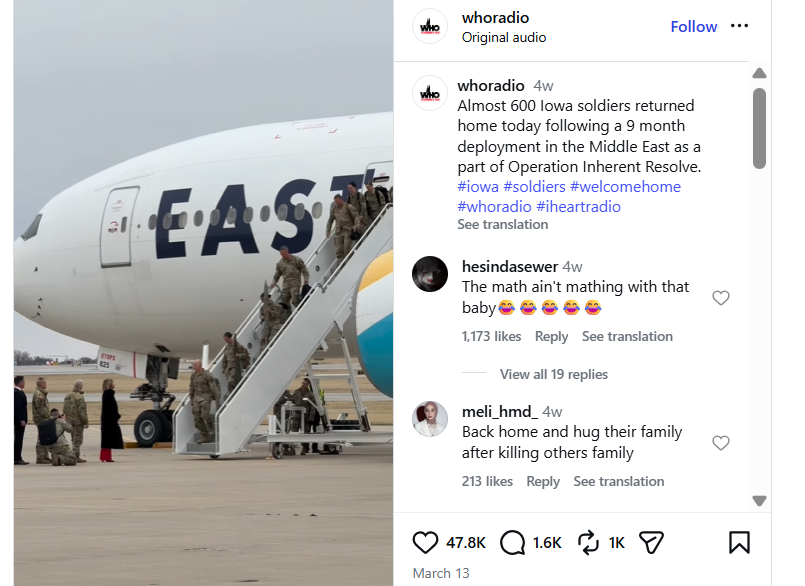
In its caption, the radio station stated that nearly 600 Iowa soldiers had returned home after a nine-month deployment in the Middle East as part of Operation Inherent Resolve. The segment, narrated by journalist Claire Burnett, explained that the soldiers belonged to the 2nd Brigade Combat Team, 34th Infantry Division, and had been deployed to Iraq and Syria. The footage was recorded at the 132nd Wing base of the Iowa Air National Guard in Des Moines.
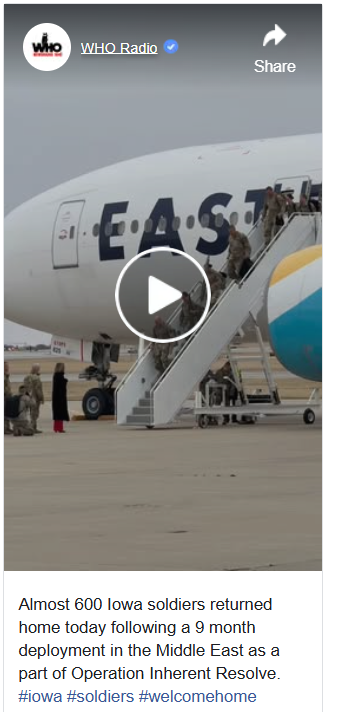
For further confirmation, a March 12 report by KCCI 8 News also showed the same aircraft and troops, verifying the authenticity and timeline of the footage
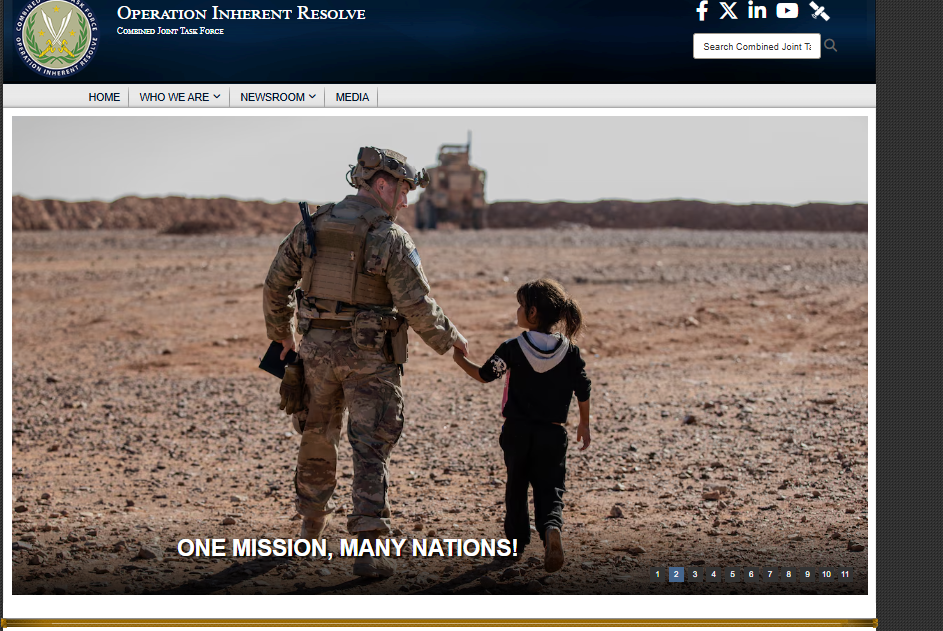
Operation Inherent Resolve, launched in 2014, is a US-led campaign aimed at supporting local forces in the fight against the Islamic State (ISIS) and ensuring its lasting defeat.
https://www.kcci.com/article/iowans-welcome-national-guard-unit-home-from-deployment-in-middle-east/70729105

Conclusion
The viral claim is false and misleading. The video does not show US troops returning due to any recent ceasefire between the United States and Iran. Instead, it captures the routine homecoming of Iowa National Guard soldiers in March after completing a scheduled deployment in the Middle East.There is no evidence linking the footage to current geopolitical developments or any ceasefire agreement. The claim has been taken out of context and shared with a misleading narrative to create confusion around ongoing international events.
