
#FactCheck - Viral Claim About Anti-Trump Protests in the US Is Misleading
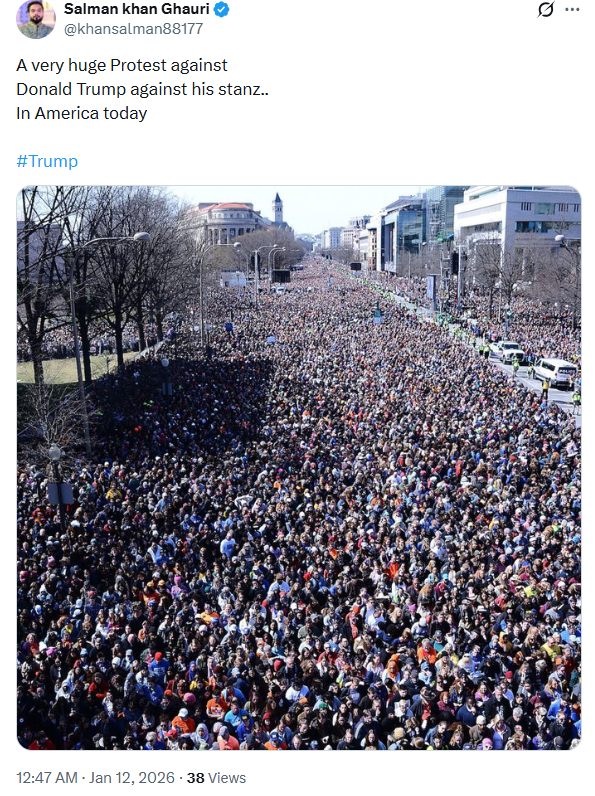
A photograph showing a massive crowd on a road is being widely shared on social media. The image is being circulated with the claim that people in the United States are staging large-scale protests against President Donald Trump.
However, CyberPeace Foundation’s research has found this claim to be misleading. Our fact-check reveals that the viral photograph is nearly eight years old and has been falsely linked to recent political developments.
Claim:
Social media users are sharing a photograph and claiming that it shows people protesting against US President Donald Trump.An X (formerly Twitter) user, Salman Khan Gauri (@khansalman88177), shared the image with the caption:“Today, a massive protest is taking place in America against Donald Trump.”
The post can be viewed here, and its archived version is available here.
FactCheck:
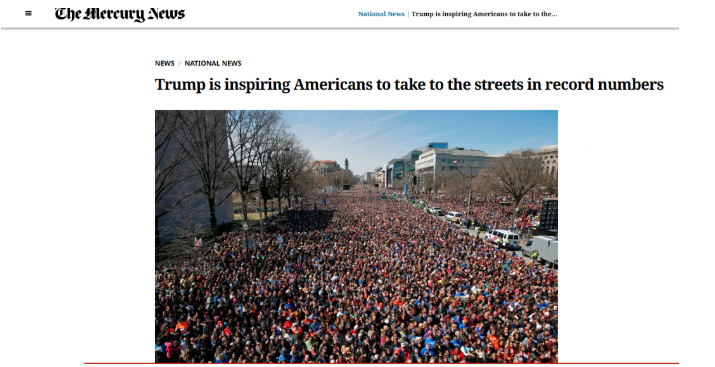
To verify the claim, we conducted a reverse image search of the viral photograph using Google. This led us to a report published by The Mercury News on April 6, 2018.
The report features the same image and states that the photograph was taken on March 24, 2018, during the ‘March for Our Lives’ rally in Washington, DC. The rally was organized to demand stricter gun control laws in the United States. The image shows a large crowd gathered on Pennsylvania Avenue in support of gun reform.
The report further notes that the Associated Press, on March 30, 2018, debunked false claims circulating online which alleged that liberal billionaire George Soros and his organizations had paid protesters $300 each to participate in the rally.
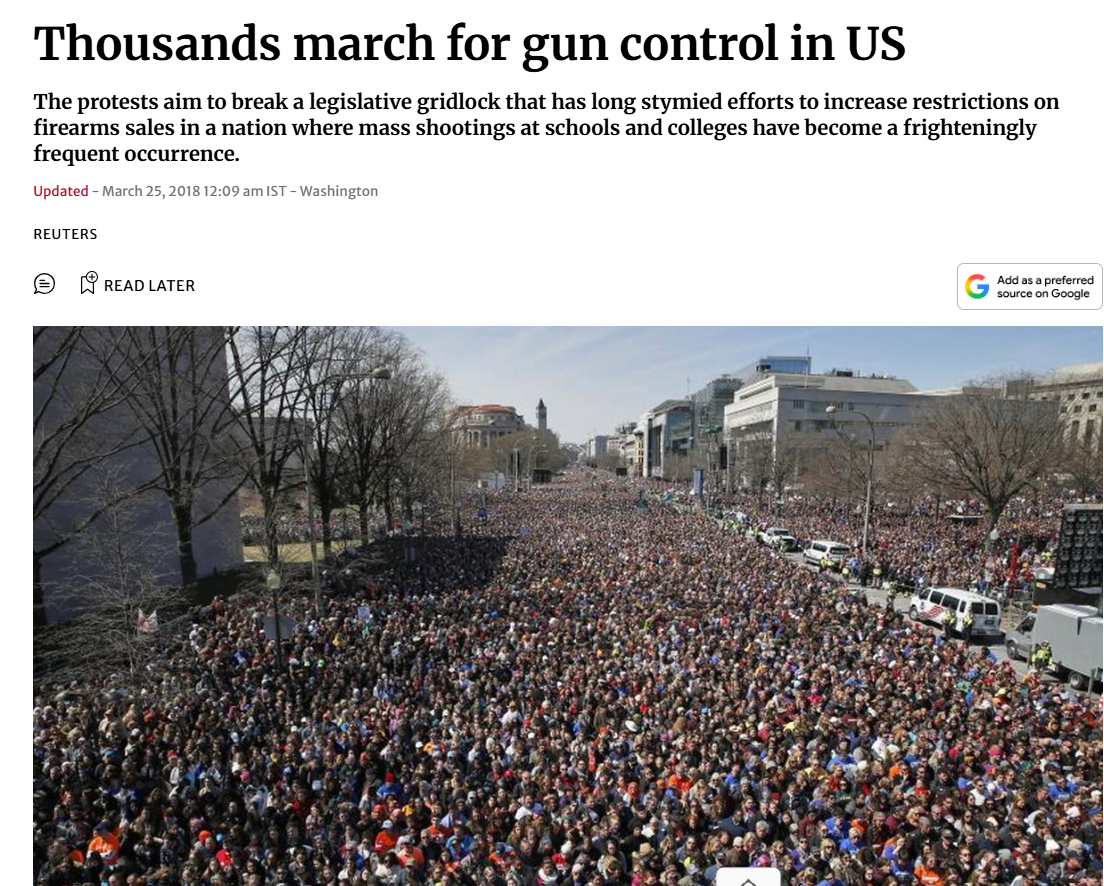
Further research led us to a report published by The Hindu on March 25, 2018, which also carries the same photograph. According to the report, thousands of Americans across the country participated in ‘March for Our Lives’ rallies following a mass shooting at a school in Florida. The protests were led by survivors and victims, demanding stronger gun laws.
The objective of these demonstrations was to break the legislative deadlock that has long hindered efforts to tighten firearm regulations in a country frequently rocked by mass shootings in schools and colleges.
Conclusion
The viral photograph is nearly eight years old and is unrelated to any recent protests against President Donald Trump.The image actually depicts a gun control protest held in 2018 and is being falsely shared with a misleading political claim.By circulating this outdated image with an incorrect context, social media users are spreading misinformation.

Related Blogs

Executive Summary
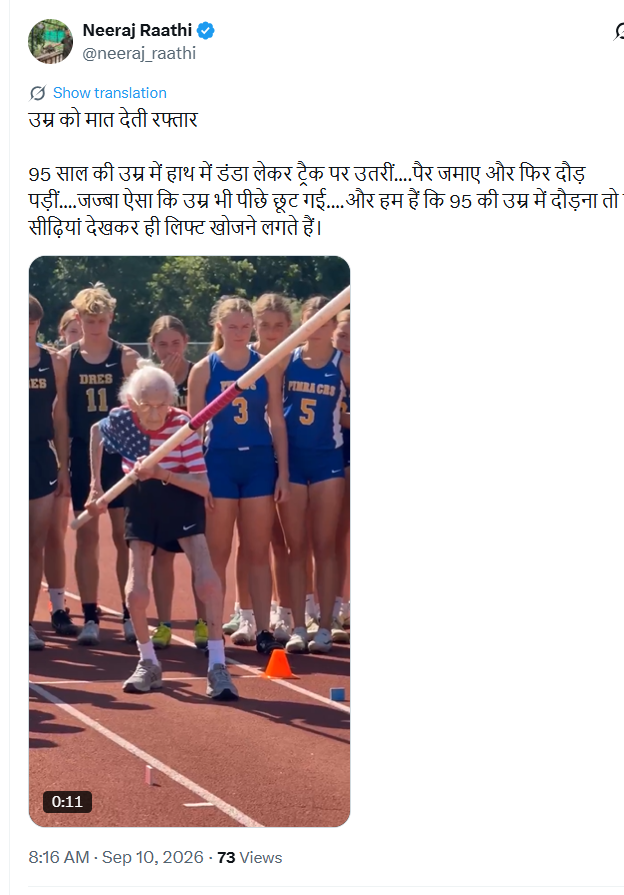
A video of an elderly woman performing a pole vault is being widely shared on social media. The video is being shared with the claim that the woman, who can be seen performing the astonishing feat, is 95 years old. Several people can also be seen around her in the video. She runs at full speed while carrying a pole and then leaps over a bar placed at a height. People present at the venue can be seen applauding her remarkable performance. A research done by the Research Wing of CyberPeace found that the video is not real but AI-generated.
Claim
An X user shared the video with the caption: “Defying age with speed. At the age of 95, she stepped onto the track with a stick in her hand… planted her feet and started running… such determination that even age was left behind… and here we are, at 95, forget running, we start looking for a lift the moment we see the stairs.”
https://x.com/neeraj_raathi/status/2097879324573798613
https://archive.ph/8Invi
Fact Check
To verify the authenticity of the viral video showing the elderly woman performing a pole vault, we first conducted a Google search using relevant keywords. However, we did not find any credible media reports or other reliable sources identifying the video as footage of a real pole vault competition.
We then conducted a keyframe search and found the same video uploaded on September 8, 2026, on a Facebook page called ‘Senior Salute’, an AI content creator. The post also carries an AI-generated content label.

Upon reviewing the Facebook account, we found several similar videos showing elderly people performing various stunts. The account appears to exclusively create and share AI-generated videos.

We also checked the video using another AI detection tool, Truth Scan. In its analysis, the tool gave the viral video a 90 percent score, indicating that it was likely AI-generated.

In addition, we checked the visuals in the viral video using another AI detection platform, AIorNOT. In its analysis, the tool also indicated a high likelihood that the visuals in the video were AI-generated.

Conclusion
The evidence gathered during our research makes it clear that the viral video showing an elderly woman performing a pole vault is not genuine but AI-generated. The same video was found on a Facebook page that primarily shares AI-generated content and was posted with an AI-generated content label. Further, multiple AI detection tools also indicated a high likelihood that the video was created using AI. Therefore, the claim that the video shows a 95-year-old woman performing a real pole vault is false.

Executive Summary
A viral video allegedly featuring cricketer Virat Kohli endorsing a betting app named ‘Aviator’ is being shared widely across the social platform. CyberPeace Research Team’s Investigations revealed that the same has been made using the deepfake technology. In the viral video, we found some potential anomalies that can be said to have been created using Synthetic Media, also no genuine celebrity endorsements for the app exist, we have also previously debunked such Deep Fake videos of cricketer Virat Kohli regarding the misuse of deep fake technology. The spread of such content underscores the need for social media platforms to implement robust measures to combat online scams and misinformation.

Claims:
The claim made is that a video circulating on social media depicts Indian cricketer Virat Kohli endorsing a betting app called "Aviator." The video features an Indian News channel named India TV, where the journalist reportedly endorses the betting app followed by Virat Kohli's experience with the betting app.
Fact Check:
Upon receiving the news, we thoroughly watched the video and found some featured anomalies that are usually found in regular deep fake videos such as the lip sync of the journalist is not proper, and if we see it carefully the lips do not match with the audio that we can hear in the Video. It’s the same case when Virat Kohli Speaks in the video.

We then divided the video into keyframes and reverse searched one of the frames from the Kohli’s part, we found a video similar to the one spread, where we could see Virat Kohli wearing the same brown jacket in that video, uploaded on his verified Instagram handle which is an ad promotion in collaboration with American Tourister.

After going through the entire video, it is evident that Virat Kohli is not endorsing any betting app, rather he is talking about an ad promotion collaborating with American Tourister.
We then did some keyword searches to see if India TV had published any news as claimed in the Viral Video, but we didn’t find any credible source.
Therefore, upon noticing the major anomalies in the video and doing further analysis found that the video was created using Synthetic Media, it's a fake and misleading one.
Conclusion:
The video of Virat Kohli promoting a betting app is fake and does not actually feature the celebrity endorsing the app. This brings up many concerns regarding how Artificial Intelligence is being used for fraudulent activities. Social media platforms need to take action against the spread of fake videos like these.
Claim: Video surfacing on social media shows Indian cricket star Virat Kohli promoting a betting application known as "Aviator."
Claimed on: Facebook
Fact Check: Fake & Misleading

Introduction
In a groundbreaking move, India's Reserve Bank has embarked on a transformative journey with its Central Bank Digital Currency (CBDC) project. As the world grapples with the evolving landscape of digital finance, the implications of India's CBDC initiative extend beyond its borders, potentially reshaping global payment systems. The Union Minister of State for Finance, Shri Pankaj Chaudhary, revealed that on October 7, 2022, the Reserve Bank of India released a proposal note on Central Bank Digital Currency (CBDC). Two pilot projects using blockchain-based technology are described in the concept note: Digital Rupee-Wholesale (e₹-W) and Digital Rupee-Retail (e₹-R). Launched on November 1, 2022, the bulk trading pilot aims to increase intermediary competitiveness, particularly in the resolution of trades in the secondary market involving sovereign debt. In parallel, on December 1, 2022, the retail banking pilot, known as e₹-R, got underway in a limited user group with eight banks taking part in stages.
The digital asset known as e₳-R is issued across financial institutions for Person-to-Person (P2P) and Person-to-Merchant (P2M) transactions. It is intended to serve as a virtual currency that represents legal money and exhibits characteristics similar to actual cash. Based on input gathered during the continuing trial phases, the RBI intends to progressively broaden the pilot project's scope.
Central Bank Digital Currency Pilot Projects
Central Bank Digital Currency (CBDC), which the Central Bank of India is promoting, may easily perform an essential part in payments made across borders, according to Reserve Bank Governor Shaktikanta Das. The CBDC is going to be expanded to the international financial markets after being implemented as a trial in both the retail and wholesale industries.
CBDC in International Payments
He emphasized that although physical currency will still exist, the CBDC will eventually replace all forms of money worldwide.
"CBDC is going to be the future currency of the world and it is necessary that every central bank, every country works on CBDC," he stated. He also stated that as worldwide commerce moves more and more around science and technology, CBDCs will play a significant role since they can effectively and affordably speed up payment processing across different countries. Regarding India's foreign exchange reserves, the governor stated that the selection to increase the resources as a safety net and protection versus contagion possibilities was made consciously.
CBDCs' Place in the Transnational Economic Revolution
In certain economies worldwide, having a CBDC internationally accessible could lead to more replacements for foreign currencies rather than the home currencies, which could cause financial aggregates to become volatile and change the mix of instruments of exchange.
CBDC may have benefits related to first-mover savings of scale, and other consequences even in everyday circumstances. If nations with global currencies have established CBDCs, they could strengthen current advantages and disadvantages, including consequences, particularly in terms of revenue. In a similar vein, CBDC might alter the structure of international liquidity while safeguarding asset supply. Additionally, and particularly if imposed abruptly, CBDC may, in certain circumstances, result in significant capital movements and associated repercussions on the foreign exchange rate as well as additional asset prices. Furthermore, nations may encounter difficulties in getting ready for virtual currencies issued by central banks.
The worldwide and international scope of CBDCs accessible to immigrants may become particularly apparent in situations where there is a widespread flight safety concern. In these circumstances, converting a CBDC into a foreign currency would make it possible for capital markets to deleverage more quickly. The elimination of debt challenges could show up as tight finance constraints and abrupt swings in foreign exchange markets if CBDCS expedited its flight from uncertainty.
Deposits of Foreign Exchange and Self-Dependency
Reserve Bank Governor Shaktikanta Das stated "We must rely on ourselves. We must maintain our robust reserves. In order to achieve that goal, we have been amassing quite substantial reserves, and the outside world has come to feel quite confident that India would be able to fulfil its contractual responsibilities to the international community no matter what the obstacles,"
Involvement of RBI in the Currency Market
Given that the trading community was confident that the Reserve Bank of India would be capable of and able to fulfil its contractual responsibilities, the value of the Indian rupee did not decline as dramatically. The RBI governor stated that the RBI does participate in the economy, but that "our engagement operates in two ways," he would not hesitate to acknowledge this.
The Value of Macroeconomic and Budgetary Cooperation
According to RBI Governor Das, the RBI makes purchases and sales of dollars based on the direction in which the financial sector is trending. However, the RBI does not intend to set a certain level for the rupee because it does not consider any specific threshold for the Indian rupee's conversion rate against the US dollar. He also emphasized how crucial it is for both the financial and monetary authorities to work together.
Conclusion
India's CBDC project signals a transformative shift in the global digital finance landscape. Governor Shaktikanta Das envisions CBDCs as the future global currency, emphasizing their role in international payments. The potential impact on financial systems, cross-border transactions, and the need for self-reliance underscore the significance of India's CBDC initiative in shaping the evolving dynamics of the digital economy. As the project progresses, close cooperation between financial and monetary authorities becomes imperative for navigating the challenges and opportunities associated with this groundbreaking venture.
References
- https://economictimes.indiatimes.com/news/economy/policy/central-bank-digital-currency-can-play-important-role-in-cross-border-payment-rbi-guv/articleshow/104706717.cms
- https://www.bis.org/cpmi/publ/d174.pdf
- https://bfsi.economictimes.indiatimes.com/news/fintech/explained-how-rbi-is-leveraging-upi-to-push-the-use-of-retail-cbdc/103591989
- https://www.imf.org/en/News/Articles/2022/02/09/sp020922-the-future-of-money-gearing-up-for-central-bank-digital-currency
- https://www.business-standard.com/economy/news/cbdc-pilot-projects-show-promising-results-rbi-governor-shaktikanta-das-123102601171_1.html
