
#FactCheck -AI-Generated Image Falsely Claims Mohan Bhagwat Laid Foundation of ‘52nd Shakti Peeth’
Executive Summary
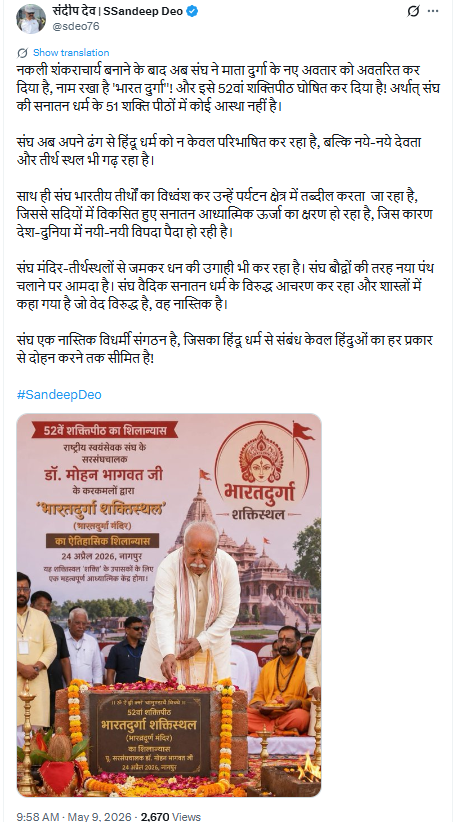
A picture of Mohan Bhagwat is going viral on social media, showing him allegedly laying the foundation stone of a so-called “52nd Shakti Peeth” named Bharatdurga. Users are claiming that the RSS chief insulted Sanatan Dharma by creating a new Shakti Peeth in Nagpur. Research by CyberPeace Research Wing found that the claim is false. The viral image is AI-generated, and Mohan Bhagwat did not inaugurate any “52nd Shakti Peeth.” In reality, he laid the foundation stone of the Bharatdurga Temple.
Claim
An X user named Sandeep Dev shared the viral image and alleged that after creating “fake Shankaracharyas,” the RSS had now introduced a new form of Goddess Durga called “Bharat Durga” and declared it the 52nd Shakti Peeth. The post further claimed that the RSS was redefining Hinduism and creating new religious sites.
Fact Check
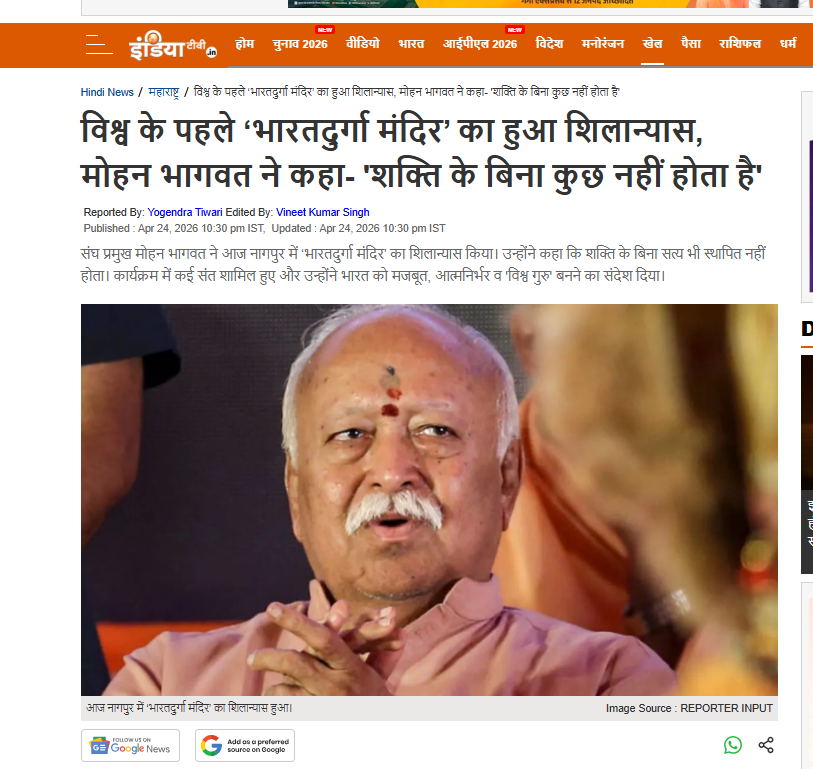
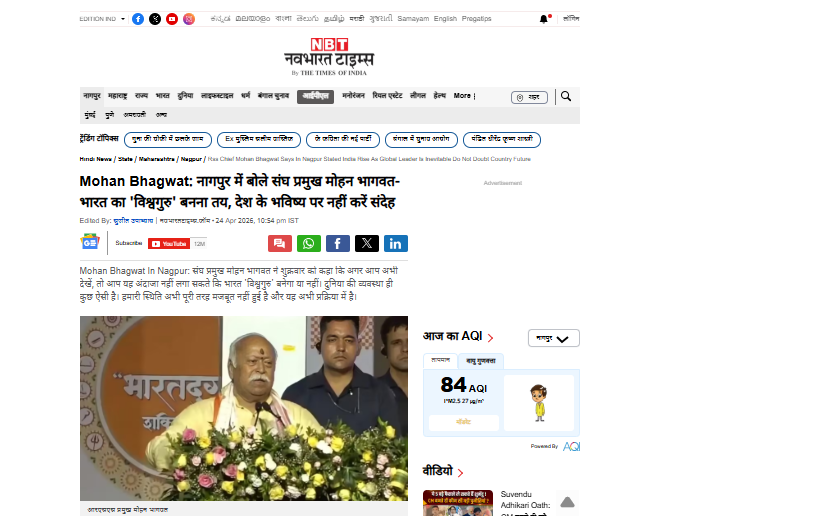
To verify the claim, we searched relevant keywords and found reports published on April 24, 2026, by India TV and Navbharat Times. According to these reports, Mohan Bhagwat laid the foundation stone of the world’s first Bharatdurga Temple in Nagpur during a ceremony organized at the Jamtha campus of Dr. Abaji Thatte Seva and Research Institute. Several prominent saints and religious leaders attended the event. Importantly, none of the reports described the temple as the “52nd Shakti Peeth.”
Further research led us to the full video of the foundation ceremony uploaded on the YouTube channel of Devendra Fadnavis. The stage backdrop and video thumbnail clearly mention “Bharatdurga Temple Foundation Ceremony.” However, the viral image frame was not visible anywhere in the authentic footage.

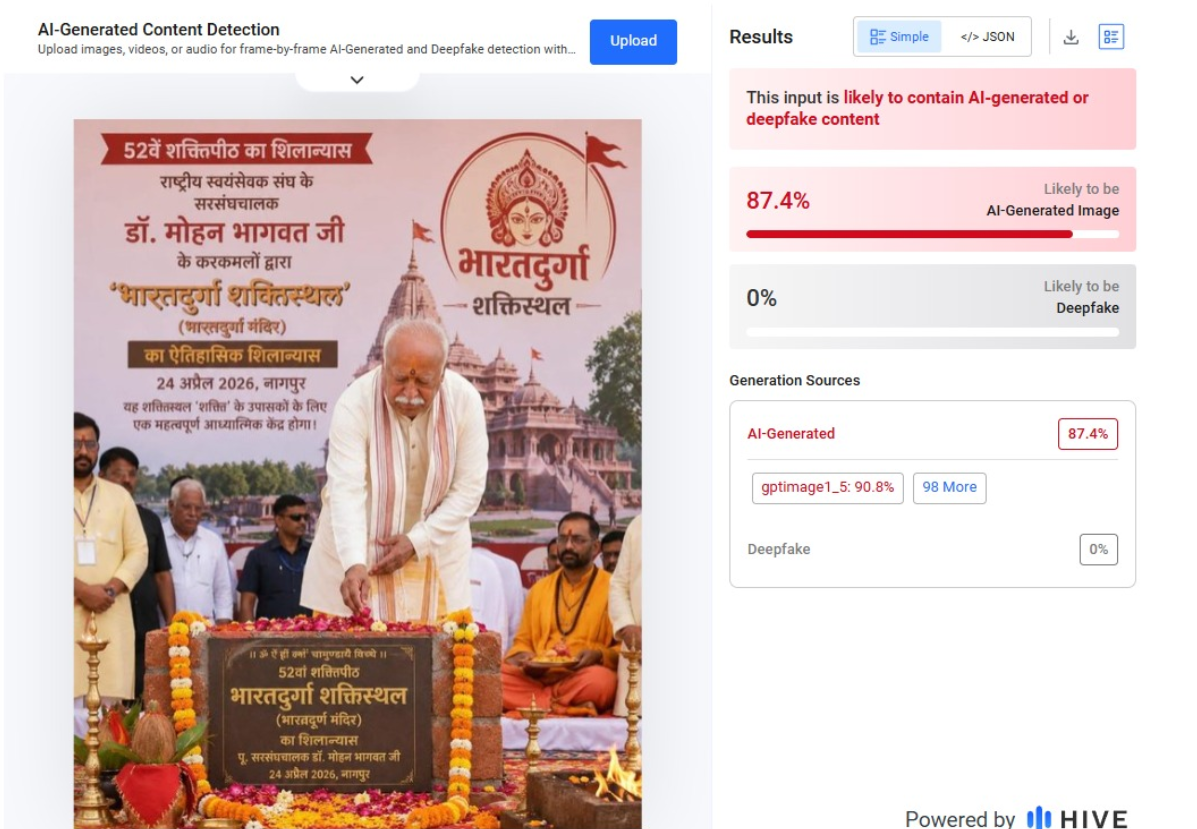
We also analyzed the viral image using AI detection tools, which indicated that the image was AI-generated.
Conclusion
Our research confirms that the claim about Mohan Bhagwat laying the foundation of a “52nd Shakti Peeth” is false. The viral image is AI-generated. In reality, he participated in the foundation ceremony of the Bharatdurga Temple in Nagpur.

Related Blogs

CERT-In, India's national cybersecurity agency, operates under mounting pressure. Cyberattacks in the country have doubled from 1.4 million in FY2022 to 2.9 million in FY2026, even as the window between a vulnerability's discovery and its exploitation continues to narrow. Rather than wait for access to the most advanced AI security tools, some of which face export restrictions, the agency has spent recent months building its own solution.
CERT-In has developed a new sandbox platform built with open-source AI, designed to identify cybersecurity gaps in public-sector systems. The sandbox functions as an isolated testing environment, allowing teams to safely evaluate software and applications without exposing the broader system to risk. Officials have framed this as a foundation rather than a substitute. MeitY Secretary S Krishnan described the platform as a step toward building a secure environment for eventual access to international AI models — suggesting the current approach is understood as an interim measure, not a permanent alternative to global tools.
This effort sits within a broader policy push: encouraging domestic AI development and tightening oversight of AI use in finance and online content. Taken together, these moves suggest a deliberate strategy of capacity-building through incremental, self-reliant steps, rather than a story about capability gaps or resource shortfalls.
A Crisis Measured in Millions
It helps to look at why this matters so much right now. A joint study by the Data Security Council of India and BCG found that recorded cyberattacks in the country roughly doubled in four years, from about 1.4 million in FY22 to 2.9 million in FY26. What's more worrying is how little time defenders now have to react to the average time it takes attackers to exploit a newly found vulnerability dropped from 745 days in FY22 to just 44 days in FY26, largely because attackers are using AI themselves to scout targets and build exploits faster. Banking, financial services, healthcare, telecom and government portals bear the brunt of this, with ransomware-as-a-service groups and state-linked actors increasingly slipping in through vendor portals and supply-chain weak points.
Turning Existing AI Into a Working Defence
CERT-In's Sandbox in Action
Instead of treating the lack of any one frontier model as a dealbreaker, CERT-In simply built its own closed trial platform officials have taken to calling it a "war room" where open-source and other AI models are set loose on software code to find vulnerabilities and shape secure workflows for India's top public sector companies, including in financial services. At a press conference, Meity secretary S. Krishnan pointed out that these substitute models already match roughly 60 to 70 per cent of the performance of the most advanced security-focused systems out there globally. That's a fairly substantial chunk of the capability, and it's coming from tools India can actually access today. The testing has stretched to core digital infrastructure like Aadhaar and government login systems, while some of the country's biggest tech firms are already using currently available AI models to patch widely used enterprise software, banking platforms included. The logic is simple enough: build the muscle now with whatever's on hand, so the enterprise environment is already in better shape by the time more capable tools eventually arrive.
Investing in Sovereign Capability
Arguably the more important move here is a longer-term one , India's bet on building its own frontier-grade security AI. The Centre has reportedly asked domestic AI developers Sarvam AI and BharatGen to build advanced cybersecurity capabilities of their own, hosted on the government's isolated computer infrastructure and eventually put to work protecting critical infrastructure. There's no public timeline yet for when these indigenous models will be ready, but the intent behind the move isn't hard to read: cut India's reliance on any single foreign provider for defending the systems that underpin banking, identity and public administration, while keeping sensitive testing and deployment on Indian soil. Officials have also signalled a preference for on-premises deployment of high-capability AI tools where the stakes are highest, rather than leaning entirely on overseas cloud infrastructure. It's a choice that points toward building lasting, self-reliant capacity rather than making a one-off purchase.
A Tightening Regulatory Net
RBI's Model Risk Guardrails
None of this is happening in a vacuum. On 24 June 2026, the Reserve Bank of India released draft guidance on model risk management that, for the first time, brings AI and machine learning systems used by banks, NBFCs and other regulated entities under a single, board-level governance framework. The draft asks institutions to keep a full inventory of every model they use, rank each one by risk, and build in human override and "kill-switch" mechanisms so a malfunctioning AI system can be shut down immediately. It also makes one thing very clear: banks can't shrug off accountability just because the technology came from a vendor.
MeitY's Deepfake and Synthetic-Content Rules
Around the same time, the Ministry of Electronics and Information Technology notified amendments to the IT Rules that formally define "synthetically generated information," require deepfakes and AI-altered media to carry clear, persistent labels and embedded provenance metadata, and cut the takedown window for unlawful synthetic content down to just three hours. Taken together, the RBI and MeitY rules form the regulatory backbone that CERT-In's technical sandbox is meant to plug into giving India a more coordinated response to both the defensive and the deceptive sides of AI.
One Chain of Command
Officials have gone out of their way to stress that all these moving parts aren't creating confusion in India's cybersecurity reporting structure. CERT-In director general Sanjay Bahl has said the National Security Council Secretariat remains the overarching body, with CERT-In as the top cyber reporting and investigations organisation across sectors, and that sectoral regulators like the RBI and SEBI still report into this one structure rather than running their own parallel systems.
Conclusion
Look at CERT-In's sandbox, the push for sovereign AI, and the tightening regulatory net together, and a clearer picture forms. This isn't really a story about a piece of technology India doesn't have. It's a story about capability being built, deliberately and in the open. The country is using the AI tools available right now to close real security gaps, backing homegrown alternatives for the long haul, and pairing both with governance rules that keep banks, platforms and public infrastructure honest. If there's a lesson in all this, it's that real resilience against a fast-moving cyberthreat landscape rarely arrives all at once. It gets built the way most lasting capability does piece by piece, mostly at home, without waiting for any single outside breakthrough to show up first.
References
- https://inc42.com/buzz/centre-asks-sarvam-ai-bharatgen-to-develop-mythos-like-cyber-ai-models/
- https://inc42.com/buzz/centre-asks-sarvam-ai-bharatgen-to-develop-mythos-like-cyber-ai-models/
- https://www.newkerala.com/news/a/govt-prioritises-access-anthropics-mythos-ai-model-strengthen-475.htm
- https://blog.qualys.com/product-tech/2026/06/24/cert-in-ai-vulnerability-blueprint-machine-speed-risk-operations
- https://www.business-standard.com/technology/tech-news/mythos-threat-govt-tech-firms-test-their-softwares-for-vulnerabilities-126052700386_1.html
- https://inc42.com/buzz/centre-asks-sarvam-ai-bharatgen-to-develop-mythos-like-cyber-ai-models/
- https://www.finextra.com/blogposting/32142/rbis-model-risk-management-guidance-2026--summary
- https://www.medianama.com/2026/06/223-rbi-ai-guidelines-2026-banks-kill-switch/
- https://www.freshfields.com/en/our-thinking/blogs/technology-quotient/india-targets-deepfakes-and-ai-generated-content-key-changes-under-meitys-2026-102mjwn

Introduction
In the age of advanced technology, Cyber threats continue to grow, and so are the cyber hubs. A new name has been added to the cyber hub, Purnia, a city in India, is now evolving as a new and alarming menace-biometric cloning and financial crimes. This emerging cyber threat involves replicating an individual’s biometric data, such as fingerprint or facial recognition, to gain unauthorised access to their bank accounts and carry out fraudulent activities. In this blog, we will have a look at the methods employed, the impact on individuals and institutions, and the necessary steps to mitigate the risk.
The Backdrop
Purnia, a bustling city in the state of Bihar, India, is known for its rich cultural heritage, However, underneath its bright appearance comes a hidden danger—a rising cyber threat with the potential to devastate its citizens’ financial security. Purnia has seen the growth of a dangerous trend in recent years, such as biometric cloning for financial crimes, after several FIRs were registered with Kasba and Amaur police stations. The Police came into action and started an investigation.
Modus Operandi unveiled
The modus Operandi of cyber criminals includes hacking into databases, intercepting data during transactions, or even physically obtaining fingerprints of facial images from objects or surfaces. Let’s understand how they gathered all this data and why Bihar was not targeted.
These criminals are way smart they operate in the three states. They targeted and have open access to obtain registry and agreement paperwork from official websites, albeit it is not available online in Bihar. As a result, the scam was conducted in other states rather than Bihar; further, the fraudsters were involved in downloading the fingerprints, biometrics, and Aadhaar numbers of buyers and sellers from the property registration documents of Andhra Pradesh, Haryana, and Telangana.
After Cloning fingerprints, the fraudster withdrew money after linking with Aadhaar Enabled Payment System (AEPS) from various bank accounts. The fraudsters stamped the fingerprint on rubber trace paper and utilised a polymer stamp machine and heating at a specific temperature with a chemical to make duplicate fingerprints used in unlawful financial transactions from several consumers’ bank accounts.
Investigation Insight
After the breakthrough, the police teams recovered a large number of smartphones, ATM cards, rubber stamps of fingerprints, Aadhar numbers, scanners, Stamp machines, laptops, and chemicals, and along with this, 17 people were arrested.
During the investigation, it was found that the cybercriminals employ Sophisticated money laundering techniques to obscure the illicit origins of the stolen funds. The fraudsters transfer money into various /multiple accounts or use cryptocurrency. Using these tactics makes it more challenging for authorities to trace back money and get it back.
Impact of biometric Cloning scam
The Biometric scam has far-reaching implications both for society, Individuals, and institutions. These kinds of scams cause financial losses and create emotional breakdowns, including anger, anxiety, and a sense of violation. This also broke the trust in a digital system.
It also seriously impacts institutions. Biometric cloning frauds may potentially cause severe reputational harm to financial institutions and organisations. When clients fall prey to such frauds, it erodes faith in the institution’s security procedures, potentially leading to customer loss and a tarnished reputation. Institutions may suffer legal and regulatory consequences, and they must invest money in investigating the incident, paying victims, and improving their security systems to prevent similar instances.
Raising Awareness
Empowering Purnia Residents to Protect Themselves from Biometric Fraud: Purnia must provide its inhabitants with knowledge and techniques to protect their personal information as it deals with the increasing issue of biometric fraud. Individuals may defend themselves from falling prey to these frauds by increasing awareness about biometric fraud and encouraging recommended practices. This blog will discuss the necessity of increasing awareness and present practical recommendations to help Purnia prevent biometric fraud. Here are some tips that one can follow;
- Securing personal Biometric data: It is crucial to safeguard personal biometric data. Individuals should be urged to secure their fingerprints, face scans, and other biometric information in the same way that they protect their passwords or PINs. It is critical to ensure that biometric data is safely maintained and shared with only trustworthy organisations with strong security procedures in place.
- Verifying Service providers: Residents should be vigilant while submitting biometric data to service providers, particularly those providing financial services. Before disclosing any sensitive information, it is important to undertake due diligence and establish the validity and reliability of the organisation. Checking for relevant certificates, reading reviews, and getting recommendations can assist people in making educated judgments and avoiding unscrupulous companies.
- Personal Cybersecurity: Individuals should implement robust cybersecurity practices to reduce the danger of biometric fraud. This includes using difficult and unique passwords, activating two-factor authentication, upgrading software and programs on a regular basis, and being wary of phishing efforts. Individuals should also refrain from providing personal information or biometric data via unprotected networks or through untrustworthy sources.
- Educating the Elderly and Vulnerable Groups: Special attention should be given to educating the elderly and other vulnerable groups who may be more prone to scams. Awareness campaigns may be modified to their individual requirements, emphasising the significance of digital identities, recognising possible risks, and seeking help from reliable sources when in doubt. Empowering these populations with knowledge can help keep them safe from biometric fraud.
Measures to Stay Ahead
As biometric fraud is a growing concern, staying a step ahead is essential. By following these simple steps, one can safeguard themselves.
- Multi-factor Authentication: MFA is one of the best methods for security. MFA creates multi-layer security or extra-layer security against unauthorised access. MFA incorporates a biometric scan and a password.
- Biometric Encryption: Biometric encryption securely stores and transmits biometric data. Rather than keeping raw biometric data, encryption methods transform it into mathematical templates that cannot be reverse-engineered. These templates are utilised for authentication, guaranteeing that the original biometric information is not compromised even if the encrypted data is.
- AI and Machine Learning (ML): AI and ML technologies are critical in detecting and combating biometric fraud. These systems can analyse massive volumes of data in real-time, discover trends, and detect abnormalities. Biometric systems may continually adapt and enhance accuracy by employing AI and ML algorithms, boosting their capacity to distinguish between legitimate users and fraudulent efforts.
Conclusion
The Biometric fraud call needs immediate attention to protect the bankers from the potential consequences. By creating awareness, we can save ourselves; additionally, by working together, we can create a safer digital environment. The use of biometric verification was inculcated to increase factor authentication for a banker. However, we see that the bad actors have already started to bypass the tech and even wreak havoc upon the netizens by draining their accounts of their hard-earned money. The banks and the cyber cells nationwide need to work together in synergy to increase awareness and safety mechanisms to prevent such cyber crimes and create effective and efficient redressal mechanisms for the citizens.
Reference

Executive Summary
A digitally manipulated image of World Bank President Ajay Banga has been circulating on social media, falsely portraying him as holding a Khalistani flag. The image was shared by a Pakistan-based X (formerly Twitter) user, who also incorrectly identified Banga as the President of the International Monetary Fund (IMF), thereby fuelling misleading speculation that he supports the Khalistani movement against India.
The Claim
On February 5, an X user with the handle @syedAnas0101010 posted an image allegedly showing Ajay Banga holding a Khalistani flag. The user misidentified him as the IMF President and captioned the post, “IMF president sending signals to INDIA.” The post quickly gained traction, amplifying false narratives and political speculation. Here is the link and archive link to the post, along with a screenshot:
Fact Check:
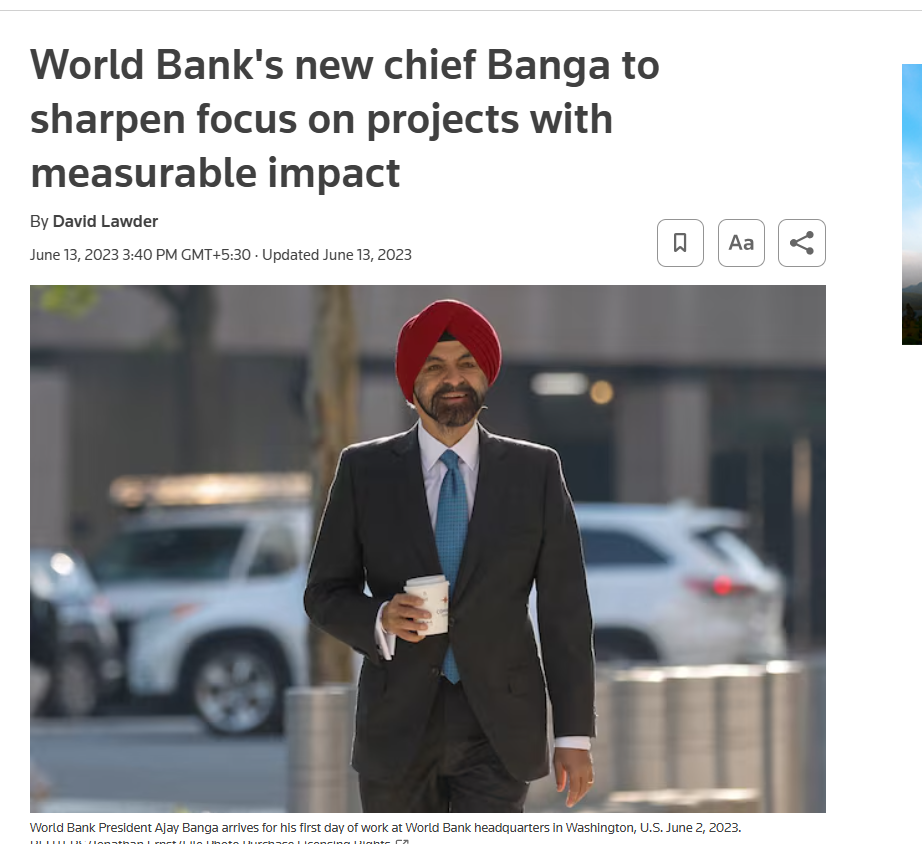
To verify the authenticity of the image, the CyberPeace Fact Check Desk conducted a detailed research . The image was first subjected to a reverse image search using Google Lens, which led to a Reuters news report published on June 13, 2023. The original photograph, captured by Reuters photojournalist Jonathan Ernst, showed Ajay Banga arriving at the World Bank headquarters in Washington, D.C., on June 2, 2023, marking his first day in office. In the authentic image, Banga is seen holding a coffee cup, not a flag.
Further analysis confirmed that the viral image had been digitally altered to replace the coffee cup with a Khalistani flag, thereby misrepresenting the context and intent of the original photograph. Here is the link to the report, along with a screenshot.
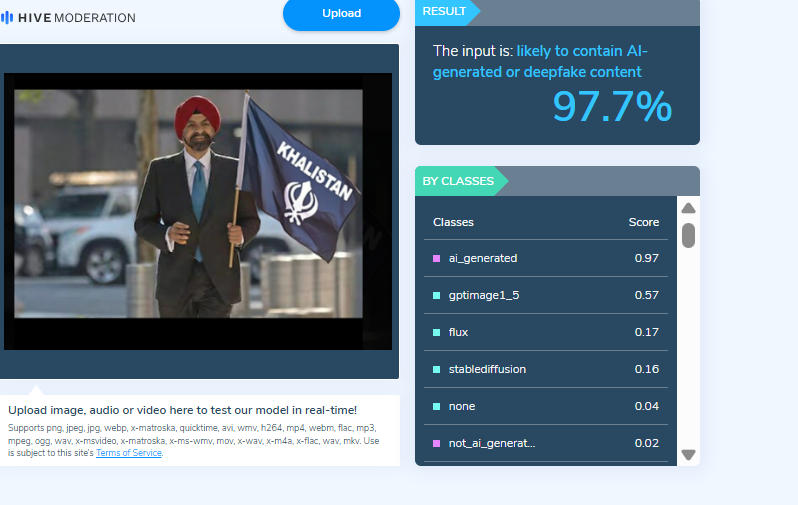
To strengthen the findings, the altered image was also analysed using the Hive Moderation AI detection tool. The tool’s assessment indicated a high likelihood that the image contained AI-generated or manipulated elements, reinforcing the conclusion that the image was not genuine. Below is a screenshot of the result.
Conclusion
The viral image claiming to show World Bank President Ajay Banga holding a Khalistani flag is fake. The photograph was digitally manipulated to spread misinformation and provoke political speculation. In reality, the original Reuters image from June 2023 shows Banga holding a coffee cup during his arrival at the World Bank headquarters. The claim that he supports the Khalistani movement is false and misleading.
