
#FactCheck - Viral video of Defence Minister Rajnath Singh supporting Israeli attacks on Iran is a deepfake
Executive Summary:
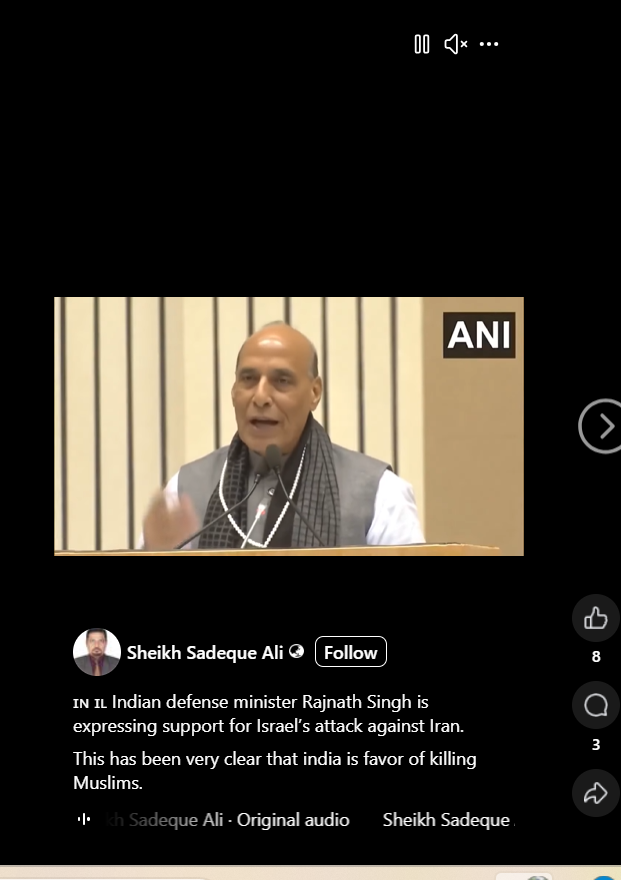
A video of India’s Defence Minister Rajnath Singh is going viral on social media. The post claims that Rajnath Singh is openly supporting Israeli-American attacks against Iran. In the video, he can allegedly be heard saying that Prime Minister Narendra Modi had visited Israel before the war began and warned Tehran that disturbing peace would have serious consequences.
Research by CyberPeace found that the viral video is a deepfake created using Artificial Intelligence (AI). Rajnath Singh has not made any such statement about Iran or the Israel-US conflict.
Claim
A Facebook user “Sheikh Sadeque Ali” shared the video on March 2, 2026. The caption of the post reads, “Indian Defence Minister Rajnath Singh is supporting Israel’s attack on Iran. This clearly shows that India supports the killing of Muslims.”
In the viral video, Rajnath Singh appears to say in English: “Prime Minister Modi’s visit to Israel before the attack on Iran reflects India’s solidarity with its strategic partner… He warned Tehran that hostile actions would have serious consequences for regional peace.”
Fact Check:
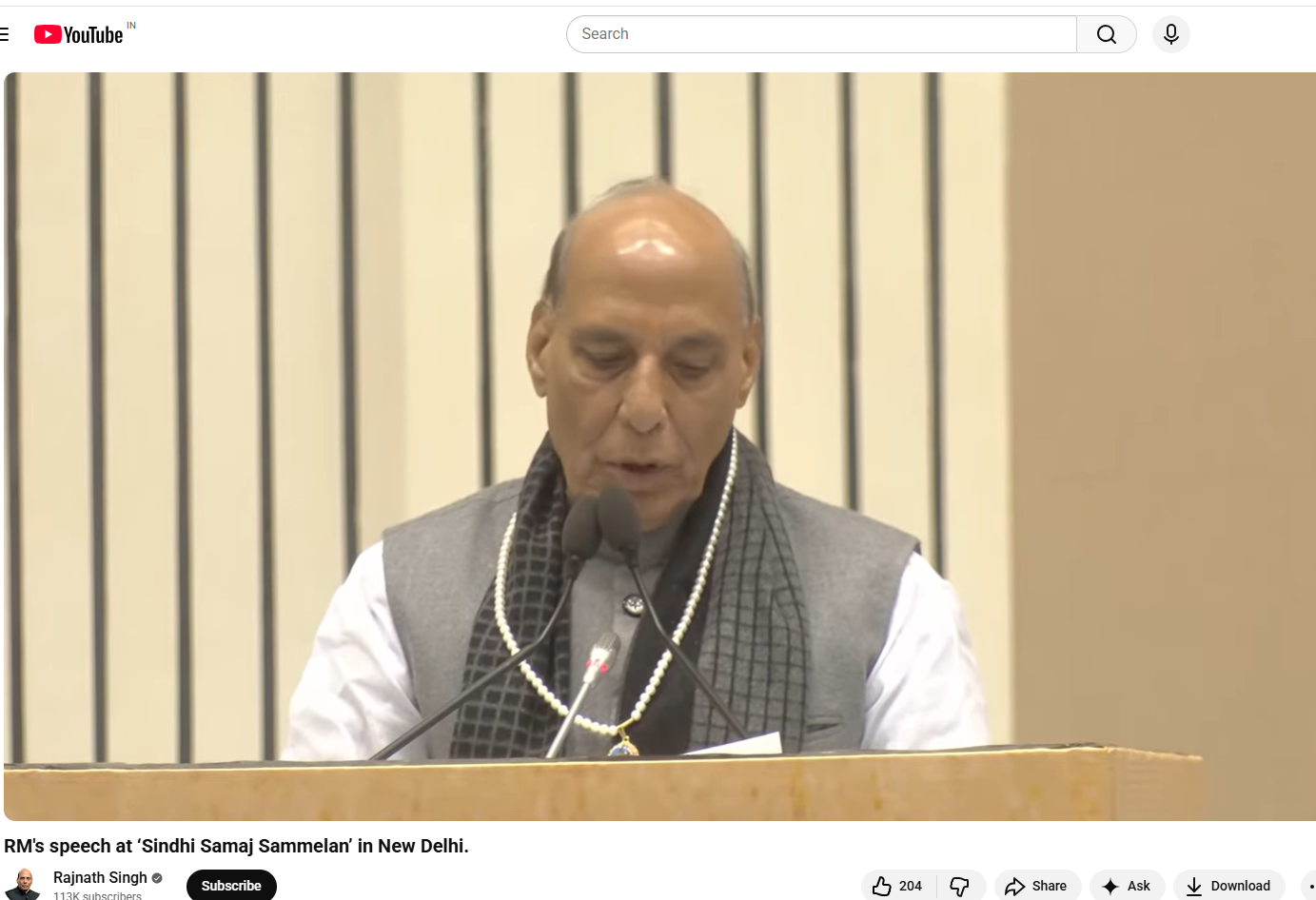
To verify the claim, we extracted keyframes from the viral video and conducted a reverse image search. During the research , we found the original video on Rajnath Singh’s official YouTube channel. The video was uploaded on November 23, 2025.In the original video, Rajnath Singh was addressing a Sindhi community conference in Delhi. During his speech, he was talking about Sindhi culture and the history of Partition. He did not mention Israel, Iran or any Middle East conflict during the entire program.
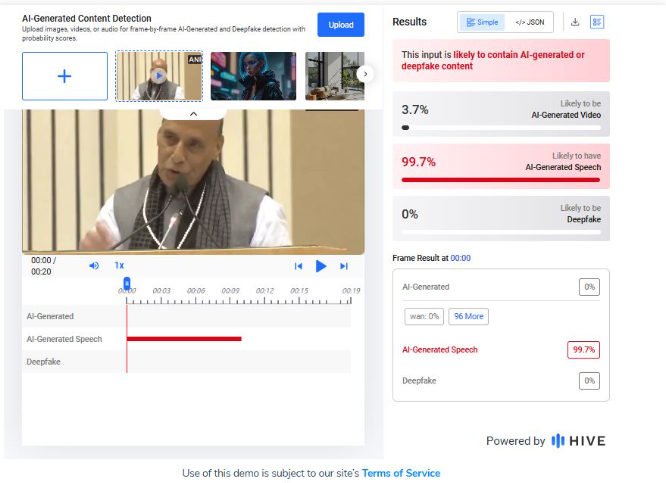
Upon closely examining the viral video, technical inconsistencies between the lip movements and the audio (lip-sync discrepancies) can be observed, which strongly indicate that the video may have been generated using AI. To verify this, we analysed the clip using several AI-detection tools. The AI detection tool Hive Moderation indicated that the video has a 99% probability of being AI-generated.
Conclusion:
Our research found that the viral video of Rajnath Singh is a deepfake. He has not made any statement supporting Israel or opposing Iran. The original video is from a Sindhi community event in Delhi, which has been digitally altered using AI to spread a misleading claim.

Related Blogs

Artificial Intelligence (AI) provides a varied range of services and continues to catch intrigue and experimentation. It has altered how we create and consume content. Specific prompts can now be used to create desired images enhancing experiences of storytelling and even education. However, as this content can influence public perception, its potential to cause misinformation must be noted as well. The realistic nature of the images can make it hard to discern as artificially generated by the untrained eye. As AI operates by analysing the data it was trained on previously to deliver, the lack of contextual knowledge and human biases (while framing prompts) also come into play. The stakes are higher whilst dabbling with subjects such as history, as there is a fine line between the creation of content with the intent of mere entertainment and the spread of misinformation owing to biases and lack of veracity left unchecked. AI-generated images enhance storytelling but can also spread misinformation, especially in historical contexts. For instance, an AI-generated image of London during the Black Death might include inaccurate details, misleading viewers about the past.
The Rise of AI-Generated Historical Images as Entertainment
Recently, generated images and videos of various historical instances along with the point of view of the people present have been floating all over the internet. Some of them include the streets of London during the Black Death in the 1300s in England, the eruption of Mount Vesuvius at Pompeii etc. Hogne and Dan, two creators who operate accounts named POV Lab and Time Traveller POV on TikTok state that they create such videos as they feel that seeing the past through a first-person perspective is an interesting way to bring history back to life while highlighting the cool parts, helping the audience learn something new. Mostly sensationalised for visual impact and storytelling, such content has been called out by historians for inconsistencies with respect to details particular of the time. Presently, artists admit to their creations being inaccurate, reasoning them to be more of an artistic interpretation than fact-checked documentaries.
It is important to note that AI models may inaccurately depict objects (issues with lateral inversion), people(anatomical implausibilities), or scenes due to "present-ist" bias. As noted by Lauren Tilton, an associate professor of digital humanities at the University of Richmond, many AI models primarily rely on data from the last 15 years, making them prone to modern-day distortions especially when analysing and creating historical content. The idea is to spark interest rather than replace genuine historical facts while it is assumed that engagement with these images and videos is partly a product of the fascination with upcoming AI tools. Apart from this, there are also chatbots like Hello History and Charater.ai which enable simulations of interacting with historical figures that have piqued curiosity.
Although it makes for an interesting perspective, one cannot ignore that our inherent biases play a role in how we perceive the information presented. Dangerous consequences include feeding into conspiracy theories and the erasure of facts as information is geared particularly toward garnering attention and providing entertainment. Furthermore, exposure of such content to an impressionable audience with a lesser attention span increases the gravity of the matter. In such cases, information regarding the sources used for creation becomes an important factor.
Acknowledging the risks posed by AI-generated images and their susceptibility to create misinformation, the Government of Spain has taken a step in regulating the AI content created. It has passed a bill (for regulating AI-Generated content) that mandates the labelling of AI-generated images and failure to do so would warrant massive fines (up to $38 million or 7% of turnover on companies). The idea is to ensure that content creators label their content which would help to spot images that are artificially created from those that are not.
The Way Forward: Navigating AI and Misinformation
While AI-generated images make for exciting possibilities for storytelling and enabling intrigue, their potential to spread misinformation should not be overlooked. To address these challenges, certain measures should be encouraged.
- Media Literacy and Awareness – In this day and age critical thinking and media literacy among consumers of content is imperative. Awareness, understanding, and access to tools that aid in detecting AI-generated content can prove to be helpful.
- AI Transparency and Labeling – Implementing regulations similar to Spain’s bill on labelling content could be a guiding crutch for people who have yet to learn to tell apart AI-generated content from others.
- Ethical AI Development – AI developers must prioritize ethical considerations in training using diverse and historically accurate datasets and sources which would minimise biases.
As AI continues to evolve, balancing innovation with responsibility is essential. By taking proactive measures in the early stages, we can harness AI's potential while safeguarding the integrity and trust of the sources while generating images.
References:
- https://www.npr.org/2023/06/07/1180768459/how-to-identify-ai-generated-deepfake-images
- https://www.nbcnews.com/tech/tech-news/ai-image-misinformation-surged-google-research-finds-rcna154333
- https://www.bbc.com/news/articles/cy87076pdw3o
- https://newskarnataka.com/technology/government-releases-guide-to-help-citizens-identify-ai-generated-images/21052024/
- https://www.technologyreview.com/2023/04/11/1071104/ai-helping-historians-analyze-past/
- https://www.psypost.org/ai-models-struggle-with-expert-level-global-history-knowledge/
- https://www.youtube.com/watch?v=M65IYIWlqes&t=2597s
- https://www.vice.com/en/article/people-are-creating-records-of-fake-historical-events-using-ai/?utm_source=chatgpt.com
- https://www.reuters.com/technology/artificial-intelligence/spain-impose-massive-fines-not-labelling-ai-generated-content-2025-03-11/?utm_source=chatgpt.com
- https://www.theguardian.com/film/2024/sep/13/documentary-ai-guidelines?utm_source=chatgpt.com
Introduction
Criminal justice in India is majorly governed by three laws which are – Indian Penal Code, Criminal Procedure Code and Indian Evidence Act. The centre, on 11th August 2023’ Friday, proposes a new bill in parliament Friday, which is replacing the country’s major criminal laws, i.e. Indian Penal Code, Criminal Procedure Code and Indian Evidence Act.
The following three bills are being proposed to replace major criminal laws in the country:
- The Bharatiya Nyaya Sanhita Bill, 2023 to replace Indian Penal Code 1860.
- The Bharatiya Nagrik Suraksha Sanhita Bill, 2023, to replace The Code Of Criminal Procedure, 1973.
- The Bharatiya Sakshya Bill, 2023, to replace The Indian Evidence Act 1872.
Cyber law-oriented view of the new shift in criminal lawNotable changes:Bharatiya Nyaya Sanhita Bill, 2023 Indian Penal Code 1860.
Way ahead for digitalisation
The new laws aim to enhance the utilisation of digital services in court systems, it facilitates online registration of FIR, Online filing of the charge sheet, serving summons in electronic mode, trial and proceedings in electronic mode etc. The new bills also allow the virtual appearance of witnesses, accused, experts, and victims in some instances. This shift will lead to the adoption of technology in courts and all courts to be computerised in the upcoming time.
Enhanced recognition of electronic records
With the change in lifestyle in terms of the digital sphere, significance is given to recognising electronic records as equal to paper records.
Conclusion
The criminal laws of the country play a significant role in establishing law & order and providing justice. The criminal laws of India were the old laws existing under British rule. There have been several amendments to criminal laws to deal with the growing crimes and new aspects. However, there was a need for well-established criminal laws which are in accordance with the present era. The step of the legislature by centralising all criminal laws in their new form and introducing three bills is a good approach which will ultimately strengthen the criminal justice system in India, and it will also facilitate the use of technology in the court system.
%20(1).webp)
Disclaimer:
The information is based on claims made by threat actors and does not imply confirmation of the breach, by CyberPeace. CyberPeace includes this detail solely to provide factual transparency and does not condone any unlawful activities. This information is shared only for research purposes and to spread awareness. CyberPeace encourages individuals and organizations to adopt proactive cybersecurity measures to protect against potential threats.
🚨 Data Breach Alert ⚠️:
Recently The Research Wing of CyberPeace and Autobot Infosec have come across a claim on a threat actor’s dark web website alleging a data breach involving 637k+ records from Federal Bank. According to the threat actor’s claim, the data allegedly includes sensitive details such as-
- 🧑Customer Name
- 🆔Customer ID
- 🏠 Customer Address
- 🎂 Date of Birth
- 🔢 Age
- 🚻 Gender
- 📞Mobile Number
- 🪪 PAN Number
- 🚘 Driving License Number
- 🛂 Passport Number
- 🔑 UID Number
- 🗳️ Voter ID Information
The alleged data was initially discovered on a dark web website, where the threat actors allegedly claimed to be offering the breached information for sale. Following their announcement of the breach, a portion of the data was reportedly published on December 27, 2024. A few days later, the full dataset was allegedly released on the same forum.
About the Threat Actor Group:
Bashe, a ransomware group that emerged in 2024, is claimed to have evolved from the LockBit ransomware group, previously operating under the names APT73 and Eraleig. The group employs data encryption combined with extortion tactics, threatening to release sensitive information if ransom demands are unmet. Their operations primarily target critical industries, including technology, healthcare, and finance, demonstrating a strategic focus on high-value sectors.

Breakdown of the Alleged Post by the Threat Actor:
- Target: Allegedly involves Customer’s Data of Federal Bank.
- Data Volume: Claimed breach includes 637,894 records.
- Data Fields: Threat actor claims the data contains sensitive information, including Customer name, Customer ID, Date of Birth, PAN Number, Age, Gender, Father Name, Spouse Name, Driving Licence, Passport Number, UID Number, Voter ID, District, Zip Code, Home Address, Mailing Address, State etc.
Analysis:
The analysis of the alleged data breach highlights the states purportedly most impacted, along with insights into the affected age groups, gender distribution, and other key insights associated with the compromised data. This evaluation aims to provide a clearer understanding of the claimed breach's scope and its potential demographic and geographic impact.
Top States Impacted:
As per the alleged breached data, Tamil Nadu has the highest number of affected customers, accounting for a significant 34.49% of the total breach. Karnataka follows closely with 26.89%, indicating a substantial number of individuals affected in the state. In contrast states such as Uttar Pradesh, Haryana, Delhi, and Rajasthan report minimal impact, with each state having less than 1% of affected customers. Gujarat records 3.70% of the breach, with a sharp drop in affected numbers from other states, highlighting a significant disparity in the extent of the breach across regions.

Impacted Age Range Statistics:
The alleged data breach has predominantly impacted customers in the 31-40 years age group, which constitutes the largest segment at 35.80% of the affected individuals. Following this, the 21-30 years age group also shows significant impact, comprising 27.72% of those affected. The 41-50 years age group accounts for 20.55% of the impacted population, while individuals aged 50 and above represent 12.68%. In contrast, the 0-20 years age group is the least affected, with only 3.24% of customers falling into this category.

Gender Wise Statistics:
The alleged data breach has predominantly impacted male customers, who constitute the majority at 74.05% of the affected individuals. Female customers account for 23.18%, while a smaller segment, categorized as "Others," constitutes 2.77%.

The alleged dataset from the threat actors indicated that a significant portion of customers' personal identification data was compromised. This includes sensitive information such as driving licenses, passport numbers, UID numbers, voter IDs, and PAN numbers.
Significance of the Allegations:
Though the claims have not been independently verified at our end it underscores the rising risks of cyberattacks and data breaches, especially in the financial and banking sectors. If true, the exposure of such sensitive information could lead to financial fraud, identity theft, and severe reputational damage for individuals and organizations alike.
CyberPeace Advisory:
CyberPeace emphasizes the importance of vigilance and proactive measures to address cybersecurity risks:
- Monitor Your Accounts: Keep a close eye on financial and email accounts for any suspicious activity.
- Update Passwords: Change your passwords immediately and enable Multi Factor Authentication(MFA) wherever possible.
- Beware of Phishing Attacks: Threat actors may exploit the leaked data to craft targeted phishing scams. Do not click on unsolicited links or share sensitive details over email or phone.
- For Organizations: Strengthen data protection mechanisms, regularly audit security infrastructure, and respond swiftly to emerging threats.
- Report: For more assistance or to report cyber incidents, visit https://cybercrime.gov.in or contact our helpline team at helpline@cyberpeace.net.
We advise affected parties and the broader public to stay alert and take necessary precautions. CyberPeace remains committed to raising awareness about cybersecurity threats and advocating for better protection mechanisms. We urge all stakeholders to investigate the claims and ensure appropriate steps are taken to protect the impacted data, if the breach is confirmed. Our Research Wing is actively observing the situation and we aim to collaborate with the stakeholders and relevant agencies to mitigate the impact.
Stay Vigilant! Stay CyberPeaceful.
