
#FactCheck -Deepfake Video of Tharoor Misleads Social Media Users
Executive Summary
A video of senior Congress leader Shashi Tharoor is widely circulating on social media, allegedly showing him praising Pakistan’s diplomatic stance over the ICC T20 World Cup issue. Many users are sharing the clip believing it to be genuine. However, research by the CyberPeace found the claim to be false. The viral video of Tharoor is a deepfake, and the Congress leader himself has described it as fabricated and fake.
Claim
A Facebook page named “Vok Sports” shared the video on February 11, 2026, claiming that Tharoor praised Pakistan. In the viral clip, he is purportedly heard saying in English that Pakistan’s diplomatic handling of the matter was “brilliant” and that it had outmanoeuvred the Indian cricket board, adding that good diplomacy could make a weak nation appear powerful.
The video was widely shared by social media users as authentic. (Archive links and post details provided.)
Fact Check
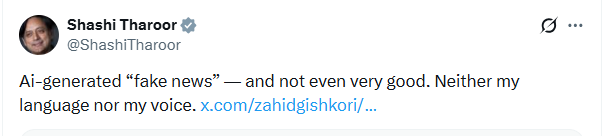
To verify the claim, we first scanned Tharoor’s official X (formerly Twitter) handle. We found a post dated February 12 in which he responded to a Pakistani journalist who had shared the video. Tharoor stated that the clip was AI-generated “fake news,” adding that neither the language nor the voice in the video was his.
A reverse image search using Google Lens led the Desk to a video uploaded on February 10, 2026, by India Today on its official YouTube channel. The visuals in this original video exactly matched those seen in the viral clip showing Tharoor speaking to the media. However, upon analysing the original footage, we found that Tharoor was speaking in Hindi about the controversy surrounding the T20 World Cup. He stated that politics should not be mixed with cricket or sports and did not praise Pakistan or the Pakistan Cricket Board at any point. This indicates that the audio in the viral clip had been manipulated and replaced. In the original video, Tharoor said that politicians should conduct politics separately, diplomats should handle diplomacy, and cricket players should focus on the game, expressing hope that cricket would move forward with the match.
- https://www.youtube.com/watch?v=GkA1mLlAT8Q&t=3s

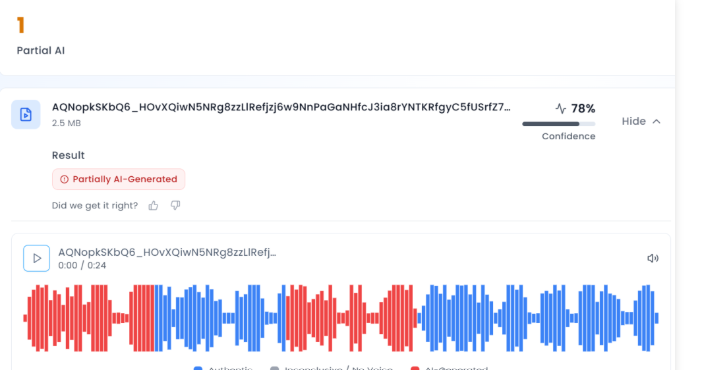
To further verify the authenticity of the video, several AI detection tools were used. Analysis through Aurigin.ai suggested a 78 percent probability that the audio in the viral clip was AI-generated.
Conclusion
The CyberPeace confirmed that the viral video is a deepfake. Tharoor did not praise Pakistan’s diplomatic stance during the T20 World Cup controversy, and the circulating clip has been digitally manipulated.

Related Blogs

Introduction
DDoS – Distributed Denial of Service Attack is one of the cyber-attacks which has been evolving at the fastest pace, the new technologies have created a blanket of vulnerability for the victim which allows the cyber criminals to stay under the radar and keep launching small scale high intensity cyber attacks. A distributed denial-of-service (DDoS) attack is a malicious attempt to disrupt the normal traffic of a targeted server, service, or network by overwhelming the target or its surrounding infrastructure with a flood of Internet traffic. DDoS attacks achieve effectiveness by utilizing multiple compromised computer systems as sources of attack traffic. Exploited machines can include computers and other networked resources such as IoT devices. From a high level, a DDoS attack is like an unexpected traffic jam clogging up the highway, preventing regular traffic from arriving at its destination.
Op Power Off
In a recent Operation by Law enforcement agencies known as Op Power Off, LEAs from United Kingdom, United States of America, Netherlands, Poland, and Germany joined hands to target the cybergroups committing such large-scale attacks which can paralyse the Internet become inaccessible for a large faction of netizens. The services collectively seized were by far the most popular DDoS booter services on the market, receiving top billing on search engines. One such service taken down had been used to carry out over 30 million attacks. As part of this action, seven administrators have been arrested so far in the United States and the United Kingdom, with further actions planned against the users of these illegal services. International police cooperation was central to the success of this operation as the administrators, users, critical infrastructure, and victims were scattered across the world. Europol’s European Cybercrime Centre coordinated the activities in Europe through its Joint Cybercrime Action Taskforce (J-CAT).
Participating Authorities
- United States: US Department of Justice (US DOJ), Federal Bureau of Investigation (FBI)
- United Kingdom: National Crime Agency (NCA)
- The Netherlands: National High Tech Crime Unit Landelijke Eenheid, Cybercrime team Midden-Nederland, Cybercrime team Noord-Holland and Cybercrime team Den Haag
- Germany: Federal Criminal Police Office (Bundeskriminalamt), Hanover Police Department (Polizeidirektion Hannover), Public Prosecutor’s Office Verden (Staatsanwaltschaft Verden)
- Poland: National Police Cybercrime Bureau (Biuro do Walki z Cyber-przestępczością)
Issue related to DDoS Attacks
DDoS booter services have effectively lowered the entry barrier into cybercrime: for a fee as low as EUR 10, any low-skilled individual can launch DDoS attacks with the click of a button, knocking offline whole websites and networks by barraging them with traffic. The damage they can do to victims can be considerable, crippling businesses financially and depriving people of essential services offered by banks, government institutions, and police forces. Emboldened by perceived anonymity, many young IT enthusiasts get involved in this seemingly low-level crime, unaware of the consequences that such online activities can carry. The influence of toolkits available on the dark net has made it easier for criminals to commit such crimes and at times even get away with it as well.
Recent examples of DDoS Attacks
- In February 2020, Amazon Web Services (AWS) suffered a DDoS attack sophisticated enough to keep its incident response teams occupied for several days also affecting customers worldwide.
- In February 2021, the EXMO Cryptocurrency exchange fell victim to a DDoS attack that rendered the organization inoperable for almost five hours.
- Recently, Australia experienced a significant, sustained, state-sponsored DDoS attack.
- Belgium also became a victim of a DDoS attack that targeted the country’s parliament, police services, and universities.
DDoS vs. DoS Attacks: What’s the Difference?
It’s important to avoid confusing a DDoS (distributed denial of service) attack with a DoS (denial of service) attack. Although only one word separates the two, these attacks vary significantly in nature.
- Strictly defined, a typical DDoS attack manipulates many distributed network devices between the attacker and the victim into waging an unwitting attack, exploiting legitimate behavior.
- A traditional DoS attack doesn’t use multiple, distributed devices, nor does it focus on devices between the attacker and the organization. These attacks also tend not to use multiple internet devices.
Conclusion
In this era of cyberspace, it is of paramount importance to maintain digital safety and security equivalent to physical safety, the cybercriminals will not stop at anything and can stoop to any level to target netizens and critical infrastructures in order to commit ransomware and malware attacks. As we can see DDoS-ing is taken seriously by law enforcement, at all levels of users, and are on the radar of law enforcement, be it a gamer booting out the competition out of a video game, or a high-level hacker carrying out DDoS attacks against commercial targets for financial gain.

Introduction
The government has announced that the new criminal laws will come into force on 1st July 2024. The Union Government notified that three recently enacted criminal laws, viz. Bhartiya Nyaya Sanhita 2023, Bharatiya Nagarik Suraksha Sanhita 2023, and Bharatiya Sakshya Adhiniyam 2023 will be effective from 1st July 2024. The Indian Penal Code 1860, Code of Criminal Procedure 1973, and Indian Evidence Act 1872 have been replaced by these new criminal laws.
On 23 February 2024, the Ministry of Home Affairs Announced the Effective Date of new criminal laws as follows:
- Bharatiya Nyaya Sanhita, 2023 Effective from 1-7-2024, except Section 106(2).
- Bharatiya Sakshya Adhiniyam, 2023 Effective from 1-7-2024.
- Bharatiya Nagarik Suraksha Sanhita, 2023 The provisions will come into force on 1-7-2024 except the provisions of the entry relating to section 106(2) of the Bharatiya Nyaya Sanhita, 2023, in the First Schedule.
Section 106(2) Will Not Be Enforced
Truckers protested against this provision, which provides 10 years imprisonment and fines for those who cause death by rash and negligent driving of a vehicle not amounting to culpable homicide, and escape without reporting it to a police officer. As of now, the government has promised truckers and transporters that subsection 2 of Section 106 of Bharatiya Nyay Sanhita (BNS) will not come into force. This subsection deals with fatal hit-and-run cases and prescribes higher penalties for not informing authorities immediately after an accident.
Section 106(2) of Bharatiya Nyaya Sanhita, 2023 read as follows;
106. Causing death by negligence.—
(2) Whoever causes death of any person by rash and negligent driving of vehicle not amounting to culpable homicide, and escapes without reporting it to a police officer or a Magistrate soon after the incident, shall be punished with imprisonment of either description of aterm which may extend to ten years, and shall also be liable to fine.
BHARATIYA SAKSHYA ADHINIYAM, 2023
The Bhartiya Sakshya Adhiniyam 2023 will replace the Indian Evidence Act 1872. The Act has undergone significant modification to maintain its fundamental principles for fair legal proceedings and adapt to technological advancements and changes in societal norms. This Act recognises electronic records as primary evidence under Section 57. It also allows the electronic presentation of oral evidence, enabling remote testimony and ensuring that electronic records will have the same legal effect as paper records.
Bharatiya Nagarik Suraksha Sanhita, 2023
The Bharatiya Nagarik Suraksha Sanhita, 2023 replaces the 1973 Code of Criminal Procedure, introducing certain modifications. This Act, under section 176, requires forensic investigation for crimes punished with seven years' imprisonment or more. Section 530 of BNSS, 2023 is a newly inserted provision which envisages the use of electronic communication audio-video electronic means for trials, inquiries, proceedings, service and issuance of summons. Electronic mode is permitted for all trials, inquiries, and proceedings under section 173 of this Act. The concept of Zero FIR is also introduced under section 173(1) and mandates police stations to register the FIR, irrespective of jurisdiction.
Conclusion
India's new criminal laws are set to take effect on 1st July 2024. These laws modernise the country's legal framework, replacing outdated statutes and incorporating technological advancements. The concerns from stakeholders led to the withholding of enforcement of Section 106(2) of Bharatiya Nyaya Sanhita 2023. The new criminal laws aim to address contemporary society's complexities while upholding justice and fairness.
References
- https://www.indiatoday.in/india/video/new-criminal-laws-to-come-into-effect-from-july-1-2506664-2024-02-24
- https://www.lawrbit.com/article/ipc-crpc-evidence-act-replaced-by-new-criminal-laws/
.webp)
Introduction
The recent investigation of Patan Cyber Crime Police as part of Operation Mule Hunt 2.0 reveals the sheer scale and intricacy of India's burgeoning cyber fraud economy. Police found that a total of 13 current accounts were being operated at a cooperative bank in the Patan district of Gujarat and used for siphoning 398.43 crore of cyber fraud transaction data on 228 cybercrime cases across states. Further investigations against 14 current account holders and intermediaries show the indispensability of mule accounts in laundering criminal money. The recent incident cannot be taken as isolated; the story points at a formalised and industrialised fraud economy with a robust banking infrastructure, a growing payment gateway, and complex networks.
What Is a Mule Account and Why Should You Care?
The term "mule account" is benign but plays a critical role in modern cybercrime networks. The Reserve Bank of India defines a mule account as a bank account that serves as a vehicle to transfer money proceeds from unlawful transactions and can be operated by people coerced by the prospect of high earnings or by way of inducement.
This mechanism can be witnessed through the investigation of the Patan cybercrime incident, where an investor can be defrauded by a fake investment website, employment fraud, or a digital arrest scheme. After transactions from the victim account, funds would quickly flow into the mule account, which would be held by a legitimate KYC customer. These transactions would then be passed on, between 1 lakh and 5 lakh transactions within hours, to multiple accounts as alleged by the Indian Cyber Crime Coordination Centre (I4C) before they get difficult to trace by being passed through informal channels or converted to cryptocurrency.
In the Patan case, it is alleged that the middlemen enticed locals and offered commissions to open firms and current accounts at Harij Nagrik Sahakari Bank and subsequently gave up their ATM cards, checkbooks, SIMs, and net banking facilities to the operators of the account. It is estimated that such accounts channeled an amount of 398.43 crore to 228 Indian cybercrime cases.
The Scale of India's Mule Account Crisis
The scale of the mule account ecosystem is reflected in India's rapidly worsening cybercrime statistics. As of data from the National Cyber Crime Reporting Portal (NCCRP), a total of 22.68 lakh complaints were registered in 2024, a jump by 42% from 2023. This was not even half the rate of financial loss, which jumped by 206% in 2023 (22,845 crore) and stood at 22,495 crore in 2025 (complaints jumped to 28.15 lakh). The increase in fraudulent transactions therefore outweighs the stability in financial losses significantly.
Mule accounts are the backbone of this crime network. To curb this phenomenon, the Indian Cyber Crime Coordination Centre (I4C) launched a Suspect Registry along with Indian banks and financial institutions in September 2024. 24.67 lakh accounts of suspected mules were identified in this, preventing over 8,031 crore in fraudulent transactions. Despite these efforts, a recent statement from the ED found over 12,000 crore being routed via mule accounts, shell firms, and cryptocurrency.
This isn't isolated to certain banks. 2024 alone saw over 65,000 mule accounts detected in Karnataka. By analyzing the Citizen Financial Cyber Frauds Reporting and Management System, about 40,000 such accounts were detected in SBI branches, and thousands more were detected across the PNB, Canara Bank, Kotak Mahindra Bank, and Airtel Payments Bank. The Patan case also clearly highlights that cooperative banks' lack of compliance and lower levels of transaction-monitoring systems contribute to easily creating and using mule accounts.
Operation Mule Hunt: Gujarat's Coordinated Offensive
This bust in Patan is just one manifestation of a much wider coordinated effort by the state government. Operation Mule Hunt 1.0, which ran from November to December 2025 across the state of Gujarat, was a month-long campaign by Gujarat Police's Cyber Centre of Excellence (CCOE) that unearthed 2,289 crore of fraudulent transactions, led to the registration of 565 FIRs, arrest of 638 accused, and impounding of 913 mule accounts with connections to over 4,000 cases of cybercrime nationwide.
This was followed up with the second installment of the operation, which was kicked off in all districts of Gujarat in 2026. The two-week campaign, which began across the state on January 8 this year, resulted in the Surat City Police alone arresting 77 people and uncovering close to 23.85 crore in fraudulent transactions. In what looks like one of the single largest single-district bust-ups in the operation, the Patan incident itself, with a staggering 398.43 crore routed through only 13 accounts, is remarkable.
The extraordinary nature of the operation is seen in the intelligence capabilities that drove it. It wasn't that police accidentally stumbled upon the Patan network; they worked back on it. After using data from the union government’s inter-agency platform, SAMANVAYA, a coordination platform for data on cybercrimes and the NCCRP, they traced suspicious clusters of transactions in the Harij Nagrik Sahakari Bank accounts to build a chain of evidence connecting the accountholders to the middlemen and, from the middlemen, to the whole ring of fraud. Twenty accused have been chargesheeted under the Bharatiya Nyaya Sanhita (BNS), and fourteen have been arrested, while six are still absconding.
The Human Cost Nobody Talks About
Behind every crore of scam money lies a real person who actually lost the real money. Of the 75%+ fraud losses incurred in 2025, 75% are from investment scams alone. Victims of stock trading scams lost ₹4,636 crore, spread across 2.28 lakh complaints filed in 2024. "Digital arrest" scams, in which fraudsters posing as law enforcement officials psychologically blackmail the victims to transfer money, claimed ₹2,576 crore between 2022 and the first quarter of 2025.
For the victims it's never about the money: it's the retired teacher's lifetime savings from Chhattisgarh, the small trader's capital from Rajkot, the emergency money of the Bhopal family, or just savings from an ordinary person. And the mule accounts' networks are why most of it is never retrieved. Once the money is thrown into the layering chain, it's exponentially more difficult to trace it after every jump.
Then there's another category of victims that often gets overlooked, and they are the mule account holders themselves, many being semi-literate people from semi-urban or rural backgrounds approached with ₹10,000 in commission and with no awareness about the legalities of lending their bank details. With the BNS now they stand to get convicted for grave crimes, but the awareness of this trap is very low.
Recommendations and Suggestions
This isn't something India is facing passively. I4C, along with RBI, has developed Mule Account Hunter software. This software can be used by banks for the detection of suspect accounts through the use of behavioral analysis, device intel, and transaction pattern recognition. The Union Home Minister has directly asked all cooperative banks across the country to adopt this software at the earliest. Failure to do so, he warned, would make consumer safety from cyber fraud incomplete.
Apart from technology, three other areas need to go hand in hand: stringent KYC enforcement for cooperative and small finance banks; the prime locations of the mule recruitment network; greater awareness for the masses regarding the criminal liability one takes up when lending their accounts; and efficient inter-agency coordination so that the intelligence gathered on platforms like SAMANVAYA is converted into arrests before the accounts are dumped and the network reforms in another location.
Operation Mule Hunt 2.0 proves that this is feasible. 13 accounts in a small district of Gujarat. 398 crore. 228 victims. 14 arrested. The pipeline did exist, and it has been broken.
Yet, even as one network is broken, another is forming, somewhere right now. The accounts will appear legitimate. The holders of these accounts may not even realize what they have got into. That is the true danger of the mule accounts and work that cannot stop.
Conclusion
The Patan investigation has clearly shown that mule accounts have now moved from being a subsidiary tool of financial crime to becoming the infrastructure that underpins the economy of cyber-fraud in India. Every financial fraud, including investment fraud, digital arrest fraud, and phishing scams, is backed by a string of real bank accounts where the proceeds of crime are transferred and the trail is obscured. Though attempts such as the I4C Suspect Registry have made attempts to break down this network, it remains an overwhelming task. Robust KYC norms, real-time monitoring of transactions, and coordination between banks, police, and regulators are the key in preventing further industrialisation of cyber financial fraud in India.
References
- https://timesofindia.indiatimes.com/city/ahmedabad/operation-mule-hunt-2-0-gujarat-
- police-bust-rs-398-43-crore-cyber-fraud-14-held/articleshow/131594240.cms?utm_source=contentofinterest&utm_medium=text&utm_campaign=cppst
- https://the420.in/india-cybercrime-2024-42-percent-spike-sims-imei-mule-accounts/
- https://www.thehansindia.com/news/national/ed-explains-how-mule-accounts-and-crypto-networks-enabled-12000-crore-cyber-fraud-1047606
- https://www.zigram.tech/article/mule-accounts-tier-1-tier-2-cities-india/
- https://risk.lexisnexis.com/global/en/insights-resources/article/stopping-money-mules-in-india
- https://timesofindia.indiatimes.com/city/ahmedabad/operation-mule-hunt-2-0-gujarat-police-bust-rs-398-43-crore-cyber-fraud-14-held/articleshow/131594240.cms
