
#FactCheck - AI-Generated Video Falsely Shows US Soldiers Surrendering to Iranian Forces
Executive Summary:
Amid the ongoing conflict between the United States, Israel, and Iran, a video circulating widely on social media claims to show American soldiers kneeling and surrendering to Iranian forces. In the clip, several soldiers appear to be sitting on their knees in front of armed personnel, creating the impression that they have been captured on the battlefield.
The video is being shared with the claim that the Iranian military has taken US soldiers prisoner during the war.
However, an research by the CyberPeace found that the claim is false. The viral clip is not authentic and has been generated using artificial intelligence. There is no credible evidence to support the claim that American soldiers have been captured by Iranian forces.
Claim
A Facebook user named “News Tick” shared the video on March 12, 2026, claiming that Iran had released footage of captured US soldiers. In the clip, the soldiers can be seen kneeling while armed personnel stand around them, giving the scene a highly dramatic appearance.

Fact Check
To verify the claim, we first searched the internet using relevant keywords. We found no credible reports from reputable news organizations confirming that US soldiers had been captured by Iran during the conflict. A closer examination of the video revealed several visual inconsistencies. The weapons carried by the soldiers appear unclear and oddly shaped. Additionally, the background looks unusually blurred and overly dramatic. The lighting and textures in the footage also appear artificial—common indicators of AI-generated visuals.
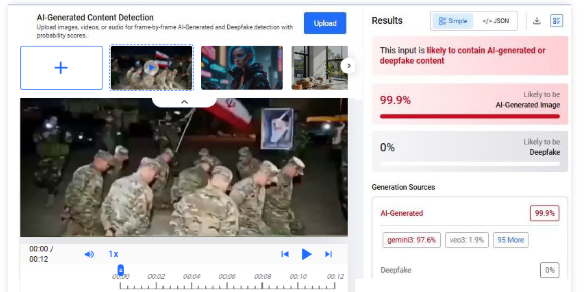
To confirm this suspicion, we analyzed the clip using multiple AI detection tools. The tool Hive Moderation indicated a 99% probability that the video was created using artificial intelligence.
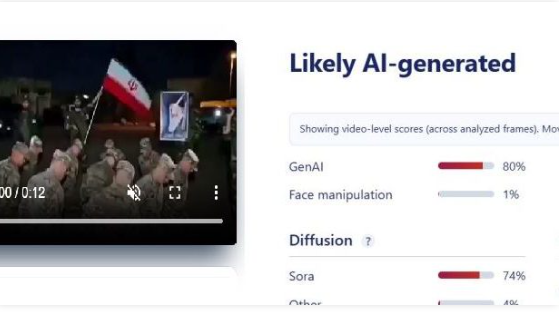
Further analysis using Sightengine also suggested that the video was likely AI-generated, estimating an 80% probability of AI creation.
Conclusion
Our research shows that the viral video claiming to depict American soldiers surrendering and being captured by Iranian forces is fake. The footage has been generated using AI and does not represent a real incident.

Related Blogs

Introduction
The Telecom Regulatory Authority of India (TRAI) issued a consultation paper titled “Encouraging Innovative Technologies, Services, Use Cases, and Business Models through Regulatory Sandbox in Digital Communication Sector. The paper presents a draft sandbox structure for live testing of new digital communication products or services in a regulated environment. TRAI seeks comments from stakeholders on several parts of the framework.
What is digital communication?
Digital communication is the use of internet tools such as email, social media messaging, and texting to communicate with other people or a specific audience. Even something as easy as viewing the content on this webpage qualifies as digital communication.
Aim of Paper
- Frameworks are intended to support regulators’ desire for innovation while also ensuring economic resilience and consumer protection. Considering this, the Department of Telecom (DoT) asked TRAI to offer recommendations on a regulatory sandbox framework. TRAI approaches the issue with the goal of encouraging creativity and hastening the adoption of cutting-edge digital communications technologies.
- Artificial intelligence, the Internet of Things, edge computing, and other emerging technologies are revolutionizing how we connect, communicate, and access information, driving the digital communication sector to rapidly expand. To keep up with this dynamic environment, an enabling environment for the development and deployment of novel technologies, services, use cases, and business models is required.
- The regulatory sandbox concept is becoming increasingly popular around the world as a means of encouraging innovation in a range of industries. A regulatory sandbox is a regulated environment in which businesses and innovators can test their concepts, commodities, and services while operating under changing restrictions.
- Regulatory Sandbox will benefit the telecom startup ecosystem by providing access to a real-time network environment and other data, allowing them to evaluate the reliability of new applications before releasing them to the market. Regulatory Sandbox also attempts to stimulate cross-sectoral collaboration for carrying out such testing by engaging the assistance of other ministries and departments in order to give the starting company with a single window for acquiring all clearances.
What is regulatory sandbox?
- A regulatory sandbox is a controlled regulatory environment in which new products or services are tested in real-time.
- It serves as a “safe space” for businesses because authorities may or may not allow certain relaxations for the sole purpose of testing.
- The sandbox enables the regulator, innovators, financial service providers, and clients to perform field testing in order to gather evidence on the benefits and hazards of new financial innovations, while closely monitoring and mitigating their risks.
What are the advantages of having a regulatory sandbox?
- Firstly, regulators obtain first-hand empirical evidence on the benefits and risks of emerging technologies and their implications, allowing them to form an informed opinion on the regulatory changes or new regulations that may be required to support useful innovation while mitigating the associated risks.
- Second, sandbox customers can evaluate the viability of a product without the need for a wider and more expensive roll-out. If the product appears to have a high chance of success, it may be authorized and delivered to a wider market more quickly.
Digital communication sector and Regulatory Sandbox
- Many countries’ regulatory organizations have built sandbox settings for telecom tech innovation.
- These frameworks are intended to encourage regulators’ desire for innovation while also promoting economic resilience and consumer protection.
- In this context, the Department of Telecom (DoT) had asked TRAI to give recommendations on a regulatory sandbox framework.
- Written comments on the drafting framework will be received until July 17, 2023, and counter-comments will be taken until August 1, 2023. The Authority’s goal in the digital communication industry is to foster creativity and expedite the use of emerging technologies such as artificial intelligence (AI), the Internet of Things (IoT), and edge computing. These technologies are changing the way individuals connect, engage, and access information, causing rapid changes in the industry.
Conclusion
According to TRAI, these technologies are changing how individuals connect, engage, and obtain information, resulting in significant changes in the sector.
The regulatory sandbox also wants to stimulate cross-sectoral collaboration for carrying out such testing by engaging the assistance of other ministries and departments in order to give the starting company with a single window for acquiring all clearances. The consultation paper covers some of the worldwide regulatory sandbox frameworks in use in the digital communication industry, as well as some of the frameworks in use inside the country in other sectors.
The digital ecosystem of India has experienced rapid growth, which has created numerous opportunities for economic development, better governance and increased social connections. The increasing use of digital technology has resulted in a higher incidence of cyber-enabled crimes, which include online fraud and cyber harassment, child exploitation and the spread of misinformation. The Government of India has established multiple initiatives to enhance a complete and unified framework that will help in combatting cybercrime more effectively. The latest updates presented to Parliament demonstrate how different institutional frameworks and legal provisions, capacity building efforts, and public awareness programs work together to handle new cyber threats.
A Coordinated Institutional Framework
The Indian system for investigating and prosecuting cybercrimes assigns responsibility to States and Union Territories, which operate their own Law Enforcement Agencies. The central government established the Indian Cyber Crime Coordination Centre (I4C) to support these operations through its Ministry of Home Affairs.
The I4C functions as a central hub that allows various stakeholders in cybercrime prevention and investigation to share intelligence and build their operational capacities. The initiative establishes a cybersecurity system that will improve its organisational structure through better central and state agency collaboration.
The National Cyber Crime Reporting Portal (NCCRP) serves as a primary project of this framework by providing online cyber incident reporting for citizens. The portal enables users to register complaints more efficiently while enhancing access to crime reporting, which particularly benefits victims of crimes against women and children. The system offers special channels which allow users to report Child Sexual Exploitative and Abuse Material (CSEAM) and rape-related materials while providing options for anonymous reporting and case tracking. After a complaint is lodged, the appropriate state authorities initiate the process to investigate the matter and proceed with legal procedures.
Capacity Building and Cyber Forensics
The response to cybercrime requires both expert investigators and advanced forensic technology systems. The Cyber Crime Prevention against Women and Children (CCPWC) Scheme, which provides financial backing and technical training to states and union territories, was instituted by the Ministry of Home Affairs to address this requirement.
The scheme has authorised the release of ₹132.93 crore for developing cyber forensic facilities and investigative technologies. The funding has supported the establishment of cyber forensic-cum-training laboratories across multiple states and union territories. The total number of operational laboratories has reached 33 at this time.
The organisation has prioritised its training initiatives together with its infrastructure development projects. More than 24,600 law enforcement personnel, prosecutors, and judicial officers have received training on cybercrime investigation, digital evidence handling, and forensic analysis. The capacity-building initiatives were designed to provide investigators and judicial authorities with essential skills needed to handle advanced cyber incidents.
International Cooperation for Child Protection
International cooperation is essential for addressing online child exploitation because these crimes utilise digital networks that connect multiple countries. The National Crime Records Bureau (NCRB) established a partnership with the National Centre for Missing and Exploited Children (NCMEC) of the United States in 2019 through a Memorandum of Understanding, which aims to enhance regional collaboration in this field.
The partnership enables the sharing of tipline reports about online child exploitation, which Indian authorities use for their investigative work. Under the Information Technology Act provisions, NCRB has received official powers to issue removal notices to intermediaries because they oversee child sexual abuse material and other dangerous content.
Promoting Online Safety Awareness
Cybercrime prevention requires two essential elements, which are public knowledge and digital expertise. The National Commission for Protection of Child Rights (NCPCR) has developed several resources to educate children, parents, teachers, and school administrators about online safety. The guidelines include Being Safe Online, together with school safety manuals that protect against cyberbullying and the 2024 updates, which provide new recommendations for cyberbullying prevention. The commission has established multiple conferences and training sessions throughout various states to educate both educators and school administrators about child protection regulations and school security measures, and cyber protection standards.
The digital responsibility programs educate communities about proper online conduct and teach them how to recognise and handle cybersecurity threats.
Legal Framework for Digital Safety
The Information Technology Act of 2000, together with the Information Technology Intermediary Guidelines and Digital Media Ethics Code Rules of 2021, (Updated as of 2026) serve as the core legal foundation through which India combats cybercrime. The laws establish penalties for online distribution of obscene and sexually explicit material while requiring digital intermediaries to block access to illegal content.
The Bharatiya Nyaya Sanhita 2023 contains additional legal provisions that deal with two types of offences that involve disseminating obscene material and spreading dangerous misinformation.
The regulatory framework requires intermediaries to eliminate illegal content within specified timeframes, while they must prevent their platforms from being used to conduct dangerous or unlawful activities.
Conclusion
India establishes its cybercrime response strategy through a multi-layered method that uses different institutional systems, technological systems, legal systems, and public education programs. Cyber threats develop through technological progress, yet authorities must establish effective cybersecurity, which depends on their ability to investigate, their systems for reporting incidents, and their dedication to maintaining proper online conduct.
India needs continuous cooperation among government bodies, police forces, technology companies, and community organisations to maintain secure and strong digital networks that provide equal access to all citizens.
References
- https://www.pib.gov.in/PressReleasePage.aspx?PRID=2238260®=3&lang=2
- https://www.policyedge.in/p/rajya-sabha-strengthening-indias-coordinated-response-to-cyber-crimes

India is the world's largest democracy, and conducting free and fair elections is a mammoth task shouldered by the Election Commission of India. But technology is transforming every aspect of the electoral process in the digital age, with Artificial Intelligence (AI) being integrated into campaigns, voter engagement, and election monitoring. In the upcoming Bihar elections of 2025, all eyes are on how the use of AI will influence the state polls and the precedent it will set for future elections.
Opportunities: Harnessing AI for Better Elections
Breaking Language Barriers with AI:
AI is reshaping political outreach by making speeches accessible in multiple languages. At the Kashi Tamil Sangamam in 2024, the PM’s Hindi address was AI-dubbed in Tamil in real time. Since then, several speeches have been rolled out in eight languages, ensuring inclusivity and connecting with voters beyond Hindi-speaking regions more effectively.
Monitoring and Transparency
During Bihar’s Panchayat polls, the State Election Commission used Staqu’s JARVIS, an AI-powered system that connects with CCTV cameras to monitor EVM screens in real time. By reducing human error, JARVIS brought greater accuracy, speed, and trust to the counting process.
AI for Information Access on Public Service Delivery
NaMo AI is a multilingual chatbot that citizens can use to inquire about the details of public services. The feature aims to make government schemes easy to understand, transparent, and help voters connect directly with the policies of the government.
Personalised Campaigning
AI is transforming how campaigns connect with voters. By analysing demographics and social media activity, AI builds detailed voter profiles. This helps craft messages that feel personal, whether on WhatsApp, a robocall, or a social media post, ensuring each group hears what matters most to them. This aims to make political outreach sharper and more effective.
Challenges: The Dark Side of AI in Elections
Deepfakes and Disinformation
AI-powered deepfakes create hyper-realistic videos and audio that are nearly impossible to distinguish from the real. In elections, they can distort public perception, damage reputations, or fuel disharmony on social media. There is a need for mandatory disclaimers stating when content is AI-generated, to ensure transparency and protect voters from manipulative misinformation.
Data Privacy and Behavioural Manipulation
Cambridge Analytica’s consulting services, provided by harvesting the data of millions of users from Facebook without their consent, revealed how personal data can be weaponised in politics. This data was allegedly used to “microtarget” users through ads, which could influence their political opinions. Data mining of this nature can be supercharged through AI models, jeopardising user privacy, trust, safety, and casting a shadow on democratic processes worldwide.
Algorithmic Bias
AI systems are trained on datasets. If the datasets contain biases, AI-driven tools could unintentionally reinforce stereotypes or favor certain groups, leading to unfair outcomes in campaigning or voter engagement.
The Road Ahead: Striking a Balance
The adoption of AI in elections opens a Pandora's box of uncertainties. On the one hand, it offers solutions for breaking language barriers and promoting inclusivity. On the other hand, it opens the door to manipulation and privacy violations.
To counter risks from deepfakes and synthetic content, political parties are now advised to clearly label AI-generated materials and add disclaimers in their campaign messaging. In Delhi, a nodal officer has even been appointed to monitor social media misuse, including the circulation of deepfake videos during elections. The Election Commission of India constantly has to keep up with trends and tactics used by political parties to ensure that elections remain free and fair.
Conclusion
With Bihar’s pioneering experiments with JARVIS in Panchayat elections to give vote counting more accuracy and speed, India is witnessing both sides of this technological revolution. The challenge lies in ensuring that AI strengthens democracy rather than undermining it. Deepfakes algorithms, bias, and data misuse remind us of the risk of when technology oversteps. The real challenge is to strike the right balance in embracing AI for elections to enhance inclusivity and transparency, while safeguarding trust, privacy, and the integrity of democratic processes.
References
- https://timesofindia.indiatimes.com/india/how-ai-is-rewriting-the-rules-of-election-campaign-in-india/articleshow/120848499.cms#
- https://m.economictimes.com/news/elections/lok-sabha/india/2024-polls-stand-out-for-use-of-ai-to-bridge-language-barriers/articleshow/108737700.cms
- https://www.ndtv.com/india-news/namo-ai-on-namo-app-a-unique-chatbot-that-will-answer-everything-on-pm-modi-govt-schemes-achievements-5426028
- https://timesofindia.indiatimes.com/gadgets-news/staqu-deploys-jarvis-to-facilitate-automated-vote-counting-for-bihar-panchayat-polls/articleshow/87307475.cms
- https://www.drishtiias.com/daily-updates/daily-news-editorials/deepfakes-in-elections-challenges-and-mitigation
- https://internetpolicy.mit.edu/blog-2018-fb-cambridgeanalytica/
- https://www.deccanherald.com/elections/delhi/delhi-assembly-elections-2025-use-ai-transparently-eci-issues-guidelines-for-political-parties-3357978#
