
#FactCheck - Viral Clip Not Harish Rana’s Farewell, Linked to Surat Woman’s Organ Donation
Executive Summary
Amid reports that AIIMS Delhi has initiated the process to implement the Supreme Court’s decision allowing passive euthanasia for Harish Rana, a video is being shared on social media claiming to show his emotional farewell. However, research by the CyberPeace found the viral claim to be misleading. Our research revealed that the video has no connection to the Harish Rana case. In reality, the footage is from Surat, Gujarat, where the family of a 45-year-old brain-dead woman donated her organs.
Claim:
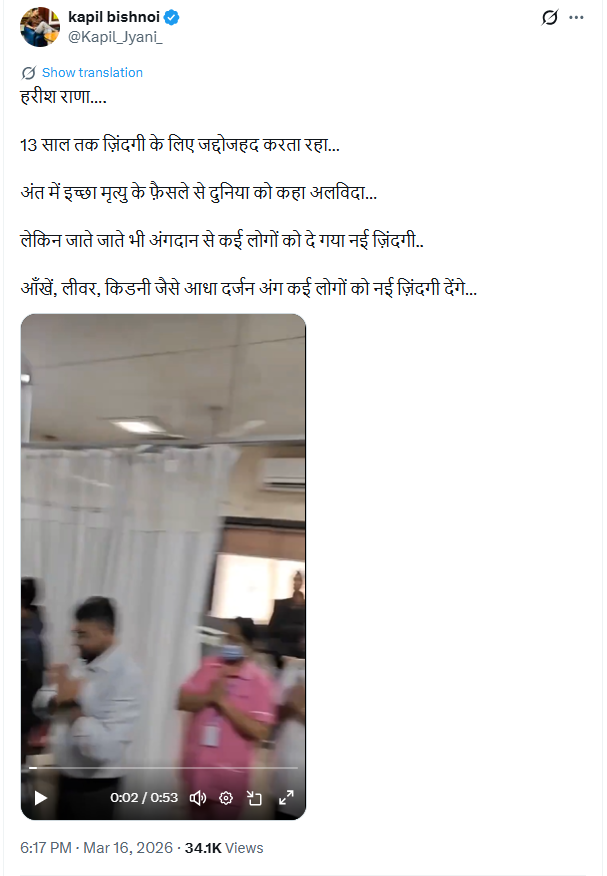
On social media platform X (formerly Twitter), a user shared the viral video on March 16, 2026, with the caption:
“Harish Rana… struggled for life for 13 years… in the end said goodbye to the world through euthanasia… but even while leaving, gave new life to many through organ donation… eyes, liver, kidneys and several other organs will give a new life to many…”
Post link and archive link are given below:
Fact Check
We took screenshots from the viral video and conducted a reverse image search. This led us to an Instagram handle where the same video was uploaded on January 27, 2026.
- https://www.instagram.com/reels/DUAt_42k2ME/
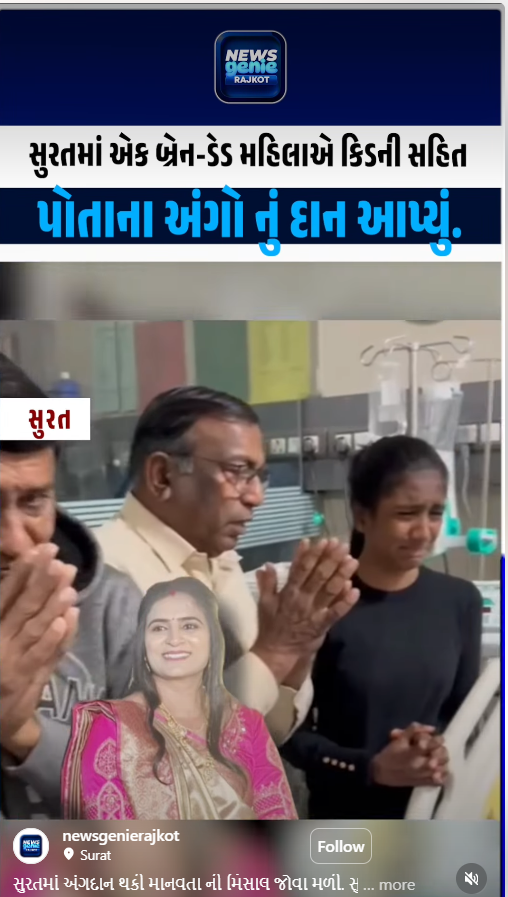
According to the caption on the Instagram post, the video shows a brain-dead woman in Surat whose liver, both kidneys, and eyes were donated. The post also included an image of the woman. Based on clues from the viral video, we conducted a keyword search on Google and found a report on the website of News18 Gujarati.
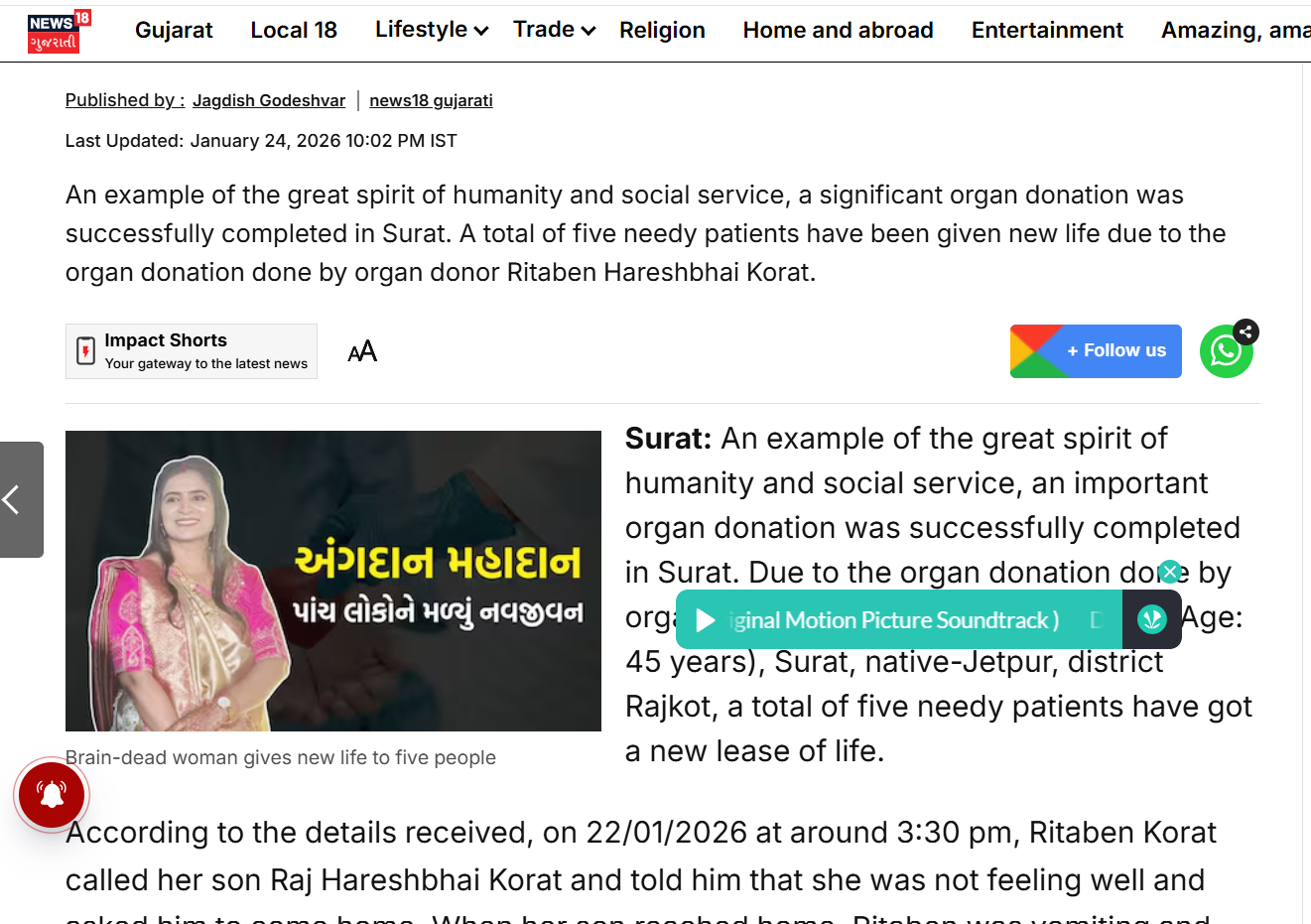
According to the report, organ donation by Ritaben Hareshbhai Korat in Surat gave a new life to five patients. The report also carried her photograph, matching the visuals seen in the viral video.
Conclusion:
Our research found that the viral video has no connection to Harish Rana. It actually shows an incident from Surat, Gujarat, where the family of a 45-year-old brain-dead woman, Ritaben Korat, donated her organs.

Related Blogs
Introduction
Picture this - you wake up one morning, check your phone, and discover that a fraudster has emptied your bank account overnight. Your first instinct is to call someone, anyone, who can stop the money from vanishing for good. For millions of Indians today, that number is 1930, the national cybercrime helpline. At a high-level review meeting in June 2026, Union Home Minister Amit Shah directed that the helpline undergo a comprehensive revamp, one that brings in artificial intelligence, multilingual support, and a stronger framework for resolving victim grievances. This is not a minor patch. It is a signal that India wants to treat cybercrime response as a serious governance priority rather than an administrative checkbox.
The Evolution of 1930: From a Pilot Number to National Infrastructure
The helpline’s origin lies in 155260 (Old helpline no.), launched in 2020 by the Indian Cyber Crime Coordination Centre (I4C) with the Reserve Bank of India and the banking sector, built specifically to intercept financial fraud before funds could be laundered across accounts. In 2021, it was renamed 1930 to make the number easier for citizens to recall under stress, a small but telling decision: a security architecture only works if people can remember it during a crisis. It was paired with the National Cybercrime Reporting Portal, launched in August 2019 to strengthen reporting and response mechanisms nationwide, which was later expanded to cover all categories of cybercrime after starting out limited to content-related offences. Over five years, state police forces extended 1930 into round-the-clock, multi-line operations and linked it to local cyber cells, turning a central scheme into genuinely federated infrastructure. The numbers now justify that investment: more than ₹7,000 crore has been saved nationally through the Citizen Financial Cyber Fraud Reporting and Management System, while Mumbai alone blocked or recovered nearly ₹202 crore for victims in 2025 through the helpline. What began as a pilot number has become a core node in India’s financial security architecture.
AI and Multilingual Support as a Citizen-Centric Governance Shift
What makes Shah’s directive significant is not the technology itself but the design philosophy it embeds. The instruction to integrate AI and multilingual support is explicitly aimed at removing language barriers and enabling faster, more efficient complaint registration across the country. For a country with no single dominant spoken language, this is not a feature addition; it is a recognition that uniform, English-or-Hindi-first service design has been quietly excluding the citizens most vulnerable to fraud. Multilingual access addresses a long-standing gap by allowing citizens from non-Hindi-speaking states to report cybercrime in their own languages, significantly broadening reach. This marks a shift away from treating digital governance as a one-size-fits-all portal and toward treating it as a service obligation that adapts to the citizen rather than the reverse, a principle with implications well beyond cybercrime reporting.
Routing, Tracking and Escalation: Engineering Accountability into Redressal
The proposed reforms move beyond the front-end call experience into the architecture of follow-through. AI integration is expected to improve call routing, enable faster identification of fraud patterns, and assist real-time coordination between central and state law enforcement agencies. This matters because cyber fraud is intrinsically cross-jurisdictional: a victim in one state is often defrauded through an account opened in another. Shah directed central agencies to work closely with state governments to ensure that every call received on the helpline is followed through to its logical conclusion — language that, in policy terms, is an attempt to convert a complaint-registration system into a complaint-resolution system. Intelligent routing and case tracking, if implemented well, replace ad hoc coordination between states with a traceable escalation mechanism, the missing link that has historically allowed cases to stall after the first call was logged.
Frozen Accounts and the Procedural Burden on Victims
No part of the revamp is more consequential for ordinary victims than the directive on bank account freezes. The problem is compounded when a cybercrime complaint is registered in one state while the frozen account sits in another, leaving legitimate account holders, sometimes innocent third parties, locked out of their own funds for weeks. Shah directed that grievances arising from the freezing of bank accounts linked to financial frauds be addressed promptly, an instruction that responds directly to a problem now before the courts Judicial scrutiny on this exact question is intensifying: the Karnataka High Court recently held that banks cannot freeze an account completely when investigating agencies have directed only a partial freeze limited to a specified amount. A national, technology-backed mechanism for resolving such freezes would convert a recurring source of citizen grievance into a procedural safeguard, addressing one of the most cited failures of the existing system.
Reading the Reforms Within India’s Broader Cyber Resilience Strategy
Positioned within India’s wider digital governance trajectory, the 1930 revamp fits a recognisable pattern: build foundational infrastructure first, then layer intelligence and personalisation onto it once adoption is proven. The same logic shaped Aadhaar, UPI and the Digital India programme more broadly. India has seen a sharp rise in digital financial fraud, investment scams, sextortion and phishing attacks in recent years, and the Ministry of Home Affairs’ response, expanding I4C, building specialised cybercrime units, and now investing in AI-led citizen interfaces, signals that cyber resilience is being treated less as a law-enforcement afterthought and more as a core pillar of financial-system integrity, alongside RBI and NPCI-led safeguards.
Will These Reforms Strengthen Trust?
The credibility of any reform lies in implementation, not announcement. Public commentary on the revamp captures this tension well: citizens have welcomed the intent while noting that earlier promises of coordination did not always translate into resolved cases, and that awareness gaps in rural India persist regardless of how sophisticated the backend becomes The 1930 revamp will be judged not by how quickly complaints are registered, an area where India already performs reasonably, but by how reliably they are closed. If AI-driven routing and a genuine national escalation mechanism reduce the gap between complaint and resolution, particularly on account freezes, the reform will have done more for citizen trust than any awareness campaign could. If implementation falters at the state-bank coordination layer, the technology will simply make an old problem move faster without making it smaller.
Conclusion
The story of 1930 is the story of Indian digital governance maturing in real time: from a hastily assembled fraud helpline to a piece of national financial security infrastructure now being re-engineered for scale, language diversity and accountability. Amit Shah’s directive should be read not as a single announcement but as an acknowledgment that citizen-facing systems must keep pace with the sophistication of the threats they are built to counter. Whether this becomes a genuine trust-building reform or another well-intentioned upgrade depends entirely on what happens after the press statement — in LEA’s call centres, bank back-offices and state coordination desks across the country.
References
- https://www.republicworld.com/india/amit-shah-orders-major-overhaul-of-national-cybercrime-helpline-1930-calls-for-ai-upgrade-2026-06-17-128739
- https://the420.in/amit-shah-national-cybercrime-helpline-revamp/
- https://inc42.com/buzz/home-minister-amit-shah-calls-for-ai-led-revamp-of-national-cybercrime-helpline/
- https://thenewsmill.com/2026/06/amit-shah-directs-ai-upgrade-for-national-cybercrime-helpline-1930/
- https://risingkashmir.com/national/amit-shah-reviews-national-cybercrime-helpline-1930-calls-for-ai-upgrade-12048424
- https://www.newkerala.com/news/a/amit-shah-reviews-national-cybercrime-helpline-1930-calls-929.htm
- https://simple.wikipedia.org/wiki/1930_(Indian_Cybercrime_Helpline)
- https://www.newsonair.gov.in/over-rs-7000-crore-saved-through-citizen-financial-cyber-fraud-reporting-and-management-system
- https://the420.in/mumbai-1930-cyber-helpline-saves-202-crore-2025

Executive Summary:
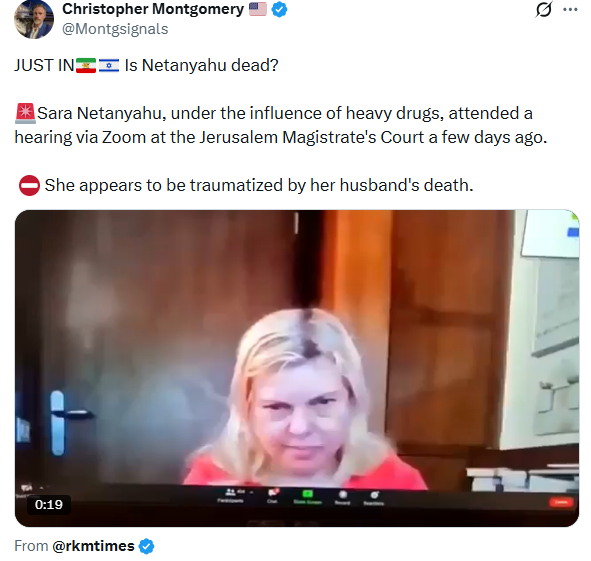
A video featuring Sara Netanyahu, wife of Israeli Prime Minister Benjamin Netanyahu, is being widely circulated on social media. In the clip, she is seen attending an online meeting and repeatedly closing her eyes. The video is being shared with claims that it is recent and shows her under the influence of drugs. Some posts also suggest that Prime Minister Netanyahu has died. However, research by the CyberPeace found that the claim is misleading. The video is not recent and has been online since 2020.
Claim:
Social media users are sharing the video claiming that Sara Netanyahu appeared intoxicated following the alleged death of Prime Minister Benjamin Netanyahu. The clip is also being falsely presented as a recent development. An X user, Christopher Montgomery (@Montgsignals), shared the video with the caption suggesting that Netanyahu may have died and that his wife appeared in a drug-influenced state during a recent court hearing via Zoom.
Fact Check:
To verify the claim, we first examined reports regarding the alleged death of Benjamin Netanyahu. There is no credible evidence supporting this claim. In fact, on March 20, Netanyahu himself addressed the media and dismissed such rumours, confirming that he is alive.

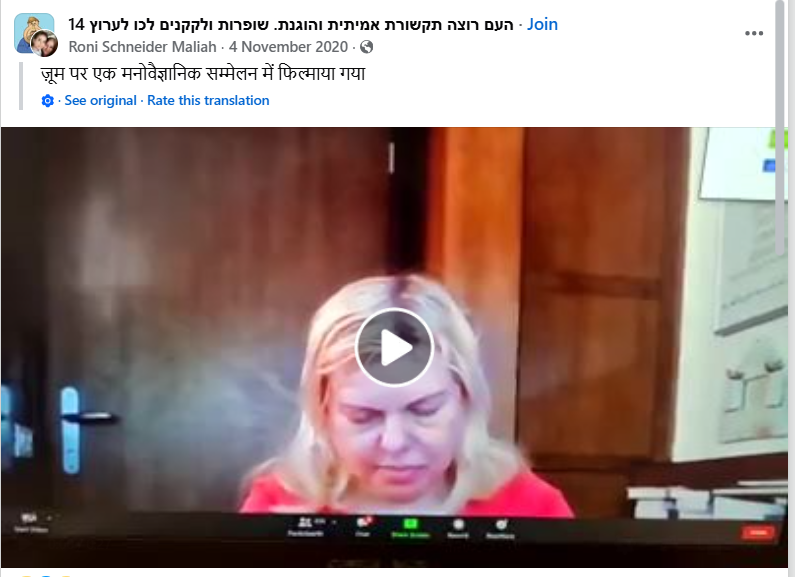
We then analyzed the viral video by extracting keyframes and conducting a reverse search. This led us to the same video posted on a Facebook account under the name Roni Schneider Malia on November 4, 2020. The Hebrew caption associated with the post translates to: “Filmed during a psychological conference on Zoom.”
This confirms that the video is old and unrelated to any recent developments.
Conclusion:
The viral claim is misleading. The video of Sara Netanyahu is not recent but has been available online since 2020. It is being falsely linked to baseless claims about Prime Minister Benjamin Netanyahu’s death

Executive Summary
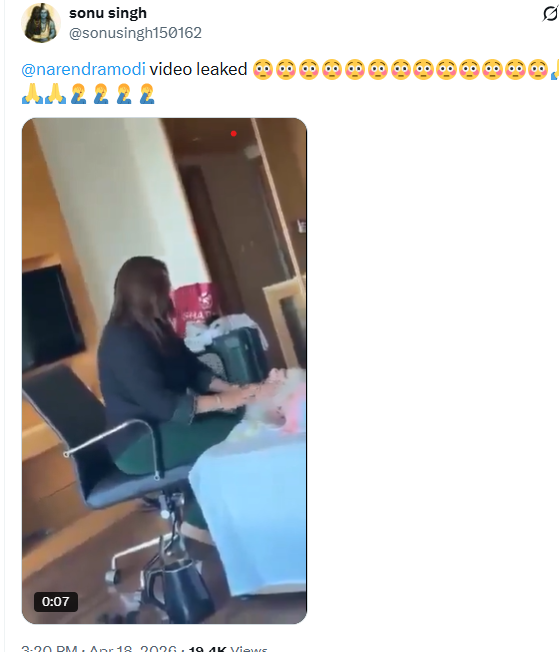
A video showing a woman giving a facial massage to an elderly man with a white beard is going viral on social media, with users claiming that the man is Prime Minister Narendra Modi. Some posts describe it as a “leaked massage video” of the Prime Minister, while others sarcastically link it to the glow on his face. However, research by the CyberPeace Research Wing found that the claim is false. The viral video has no connection to Narendra Modi and is being shared with a misleading narrative.
Claim
An X user named Sonu Singh shared the video with the caption: “Narendra Modi video leaked.”
Fact Check
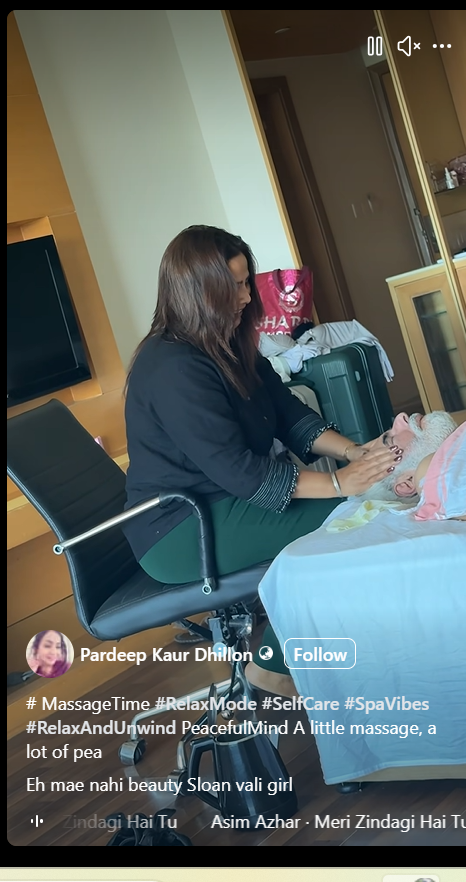
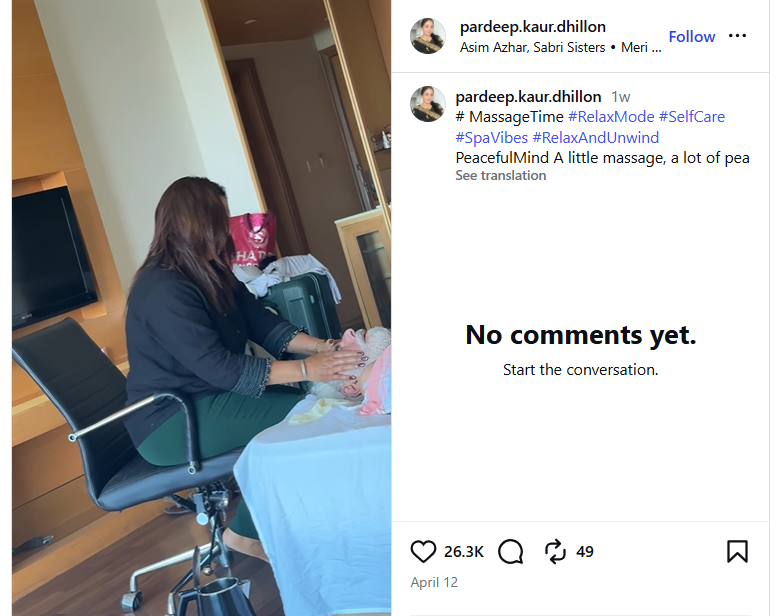
To verify the claim, we extracted keyframes from the viral video and conducted a reverse image search. This led us to the same video uploaded on April 12, 2026, on the Instagram and Facebook pages of content creator Pradeep Kaur Dhillon, where it was captioned “Massage time.”
Further checks revealed another similar video posted on March 28, 2026, on the same social media accounts, with the caption: “Stylish, Spa day for him… kyunki self-care sirf ladies layi nahi.”
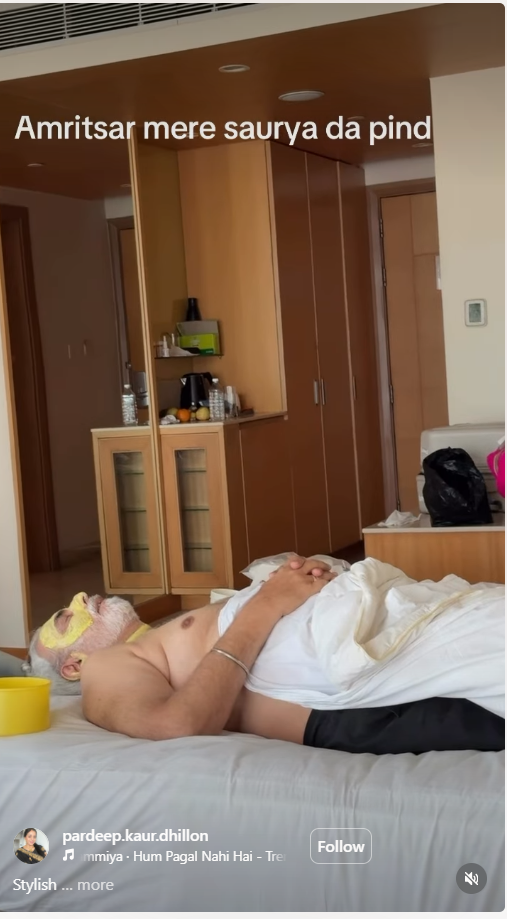
During the research, we also found that the man seen in the video is Jaspal Singh, Dhillon’s partner, who frequently appears in her social media posts. According to publicly available profile details, the duo resides in New Jersey, USA, and originally belongs to Amritsar, Punjab, India.

Conclusion
The viral claim is false. The video does not show Prime Minister Narendra Modi. It features content creators Pradeep Kaur Dhillon and Jaspal Singh and is being circulated online with a false and misleading claim.
