
#FactCheck- Viral video of UP Police patrolling on e-rickshaw is AI-generated
Executive Summary
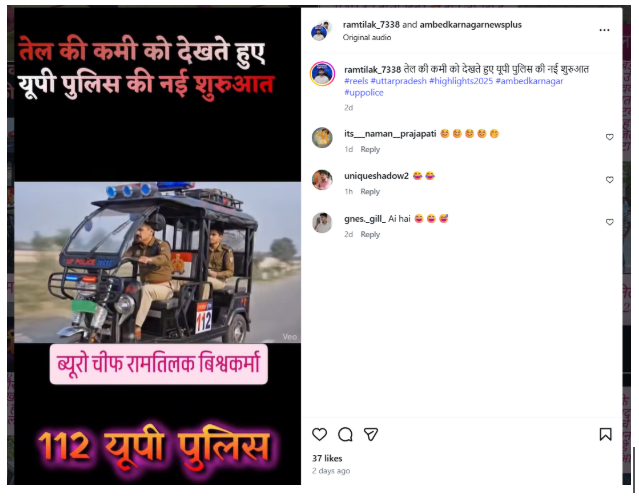
A video is being widely shared on social media showing a police officer driving an e-rickshaw, while two other policemen are seen in the back seat. Users sharing the clip claim that, due to a shortage of petrol, this is a new initiative by the Uttar Pradesh Police. However, research by CyberPeace found the viral claim to be false. Our research also confirms that the video is not real but AI-generated.
Claim
An Instagram user shared the viral video claiming that due to fuel shortages, Uttar Pradesh Police has started patrolling using e-rickshaws.
- Post link: https://www.instagram.com/reel/DWepKWXAeiE/
- Archive: https://archive.ph/QBNXs
Fact Check
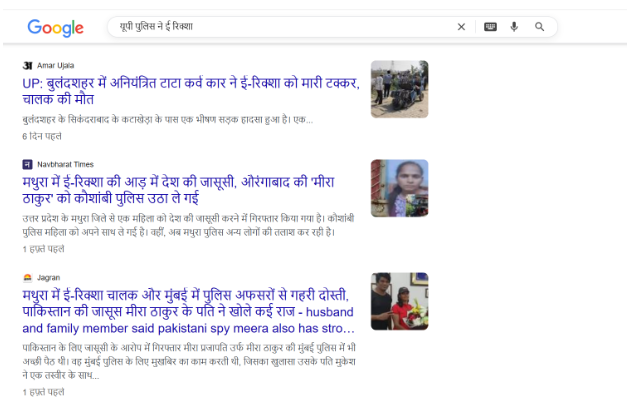
To verify the claim, we first conducted a keyword search on Google but found no credible media reports supporting this claim.
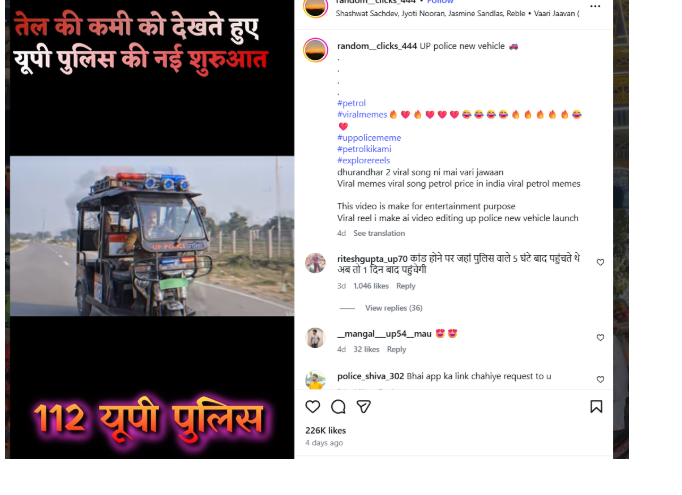
Next, we extracted keyframes from the viral video and performed a reverse image search using Google Lens. During this process, we found the same video uploaded on an Instagram channel on March 28, 2026. The uploader clearly mentioned that the video was created purely for entertainment purposes.
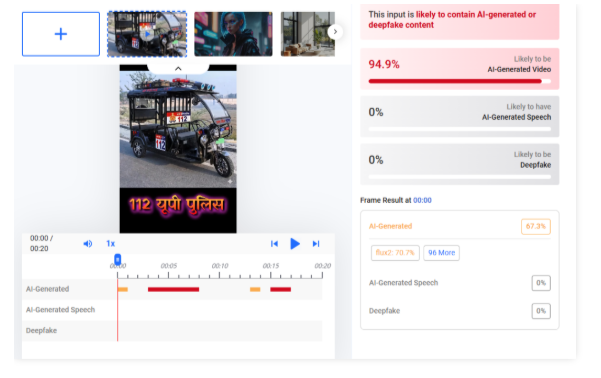
We further analyzed the video using AI detection tools. When scanned with Hive Moderation, the results indicated that the video is approximately 94% AI-generated.
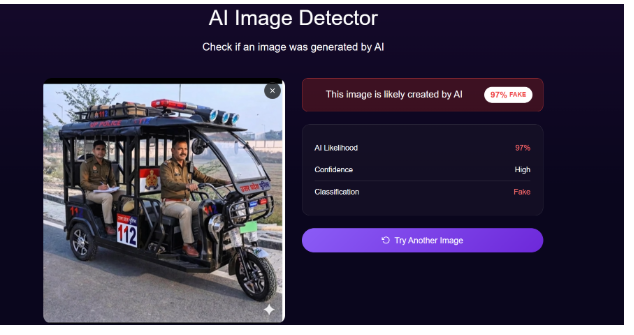
In the next step, we also tested the clip using DeepAI. According to its analysis, the video is about 97% AI-generated.
Conclusion
Our research clearly shows that the viral video is not authentic. It is an AI-generated clip created for entertainment purposes, and the claim that Uttar Pradesh Police has started e-rickshaw patrolling due to petrol shortage is false.

Related Blogs

Introduction
The Telecom Regulatory Authority of India (TRAI) on 20th August 2024 issued directives requiring Access Service Providers to adhere to the specific guidelines to protect consumer interests and prevent fraudulent activities. TRAI has mandated all Access Service Providers to abide by the directives. These steps advance TRAI's efforts to promote a secure messaging ecosystem, protecting consumer interests and eliminating fraudulent conduct.
Key Highlights of the TRAI’s Directives
- For improved monitoring and control, TRAI has directed that Access Service Providers move telemarketing calls, beginning with the 140 series, to an online DLT (Digital Ledger Technology) platform by September 30, 2024, at the latest.
- All Access Service Providers will be forbidden from sending messages that contain URLs, APKs, OTT links, or callback numbers that the sender has not whitelisted, the rule is to be effective from September 1st, 2024.
- In an effort to improve message traceability, TRAI has made it mandatory for all messages, starting on November 1, 2024, to include a traceable trail from sender to receiver. Any message with an undefined or mismatched telemarketer chain will be rejected.
- To discourage the exploitation or misuse of templates for promotional content, TRAI has introduced punitive actions in case of non-compliance. Content Templates registered in the wrong category will be banned, and subsequent offences will result in a one-month suspension of the Sender's services.
- To assure compliance with rules, all Headers and Content Templates registered on DLT must follow the requirements. Furthermore, a single Content Template cannot be connected to numerous headers.
- If any misuse of headers or content templates by a sender is discovered, TRAI has instructed an immediate ‘suspension of traffic’ from all of that sender's headers and content templates for their verification. Such suspension can only be revoked only after the Sender has taken legal action against such usage. Furthermore, Delivery-Telemarketers must identify and disclose companies guilty of such misuse within two business days, or else risk comparable repercussions.
CyberPeace Policy Outlook
TRAI’s measures are aimed at curbing the misuse of messaging services including spam. TRAI has mandated that headers and content templates follow defined requirements. Punitive actions are introduced in case of non-compliance with the directives, such as blacklisting and service suspension. TRAI’s measures will surely curb the increasing rate of scams such as phishing, spamming, and other fraudulent activities and ultimately protect consumer's interests and establish a true cyber-safe environment in messaging services ecosystem.
The official text of TRAI directives is available on the official website of TRAI or you can access the link here.
References
- https://www.trai.gov.in/sites/default/files/Direction_20082024.pdf
- https://www.trai.gov.in/sites/default/files/PR_No.53of2024.pdf
- https://pib.gov.in/PressReleaseIframePage.aspx?PRID=2046872
- https://legal.economictimes.indiatimes.com/news/regulators/trai-issues-directives-to-access-providers-to-curb-misuse-fraud-through-messaging/112669368

Introduction
Criminal justice in India is majorly governed by three laws which are – Indian Penal Code, Criminal Procedure Code and Indian Evidence Act. The centre, on 11th August 2023’ Friday, proposes a new bill in parliament Friday, which is replacing the country’s major criminal laws, i.e. Indian Penal Code, Criminal Procedure Code and Indian Evidence Act.
The following three bills are being proposed to replace major criminal laws in the country:
- The Bharatiya Nyaya Sanhita Bill, 2023 to replace Indian Penal Code 1860.
- The Bharatiya Nagrik Suraksha Sanhita Bill, 2023, to replace The Code Of Criminal Procedure, 1973.
- The Bharatiya Sakshya Bill, 2023, to replace The Indian Evidence Act 1872.
Cyber law-oriented view of the new shift in criminal lawNotable changes:Bharatiya Nyaya Sanhita Bill, 2023 Indian Penal Code 1860.
Way ahead for digitalisation
The new laws aim to enhance the utilisation of digital services in court systems, it facilitates online registration of FIR, Online filing of the charge sheet, serving summons in electronic mode, trial and proceedings in electronic mode etc. The new bills also allow the virtual appearance of witnesses, accused, experts, and victims in some instances. This shift will lead to the adoption of technology in courts and all courts to be computerised in the upcoming time.
Enhanced recognition of electronic records
With the change in lifestyle in terms of the digital sphere, significance is given to recognising electronic records as equal to paper records.
Conclusion
The criminal laws of the country play a significant role in establishing law & order and providing justice. The criminal laws of India were the old laws existing under British rule. There have been several amendments to criminal laws to deal with the growing crimes and new aspects. However, there was a need for well-established criminal laws which are in accordance with the present era. The step of the legislature by centralising all criminal laws in their new form and introducing three bills is a good approach which will ultimately strengthen the criminal justice system in India, and it will also facilitate the use of technology in the court system.
Executive Summary
A video is being widely shared on social media showing a delivery boy risking his life by jumping in front of a speeding truck to save a small child. The dramatic footage has drawn widespread praise, with many users calling the delivery worker a "real hero," "Superman," and even "an angel." Several social media users have claimed that the incident took place in Mumbai, alleging that the delivery boy's quick thinking prevented a fatal accident. CyberPeace Research Wing ’s research found the viral claim to be false. Our research revealed that the video is not real but AI-generated, and is being circulated with a misleading claim.
Claim
An X (formerly Twitter) user shared the viral video on July 12, 2026, with the caption: "This cannot be called a human, but an angel. Such an incredible feat by a delivery boy from Mumbai is hard to believe. At first glance, it seemed like he had sacrificed his life to save the child, but in the next moment, he saved not only himself but also the child's life. Watch this incredible video."
https://x.com/virjust18/status/2076270467569320072

Fact Check
To verify the viral claim, we conducted a keyword search on Google. However, we found no credible media reports or authentic sources confirming that such an incident had occurred in Mumbai or anywhere else. During the research, we found the same video uploaded on the Instagram account 'ai_nature_of_beauty_01' on July 12, 2026. Although the post's caption did not provide any details about the incident, a review of the account revealed that it regularly uploads AI-generated videos featuring fictional and digitally created scenarios. This strongly indicates that the viral clip is not footage of an actual event but content created using Artificial Intelligence.
https://www.instagram.com/reels/Das5IJ9FFF5/

We further analysed the video using the AI detection tool Hive Moderation, which indicated a 96.1% probability that the footage was AI-generated. The analysis strongly suggests that the video was created using artificial intelligence rather than recorded in the real world.

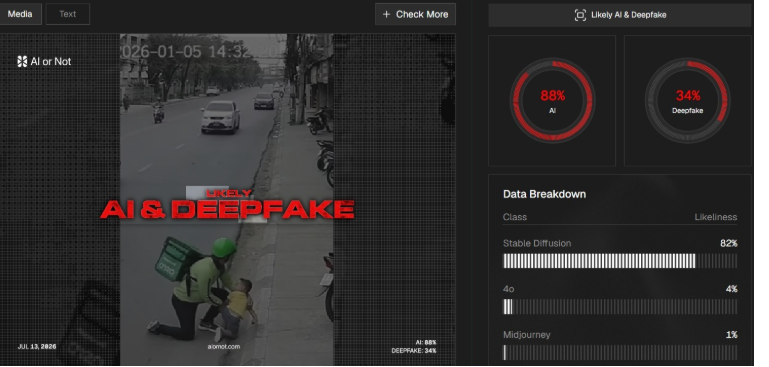
For additional verification, we also examined the video using another AI detection platform, AI or Not. The tool likewise identified the scenes in the viral clip as likely AI-generated, reinforcing our findings.
Conclusion
Our research found that the viral video does not depict a real rescue. It is AI-generated content that has been falsely circulated as footage of a delivery boy saving a child from a speeding truck in Mumbai. There is no credible evidence to support the claim that such an incident actually occurred.
