
#FactCheck-Fake Quote Falsely Attributed to Mojtaba Khamenei on India’s Prime Minister and Indira Gandhi
Executive Summary
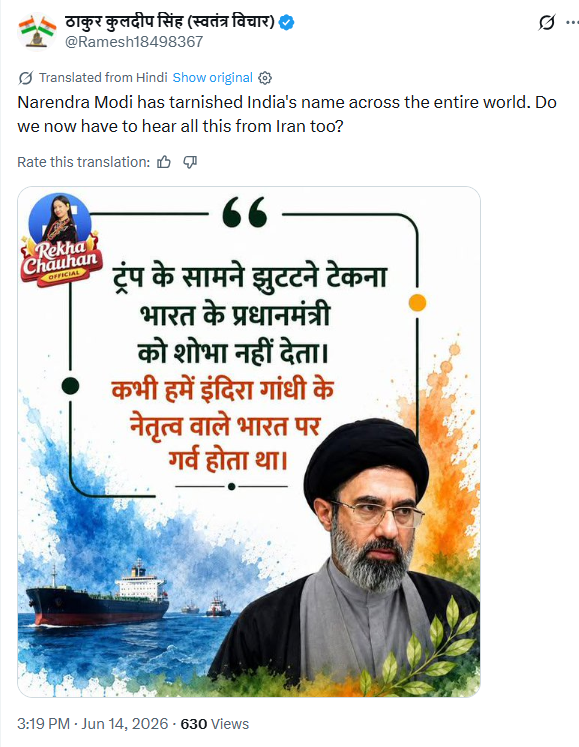
A graphic featuring a photograph of Mojtaba Khamenei, the son of Iran’s Supreme Leader Ayatollah Ali Khamenei, is being widely circulated on social media. The graphic carries a statement attributed to him: “It is not appropriate for the Prime Minister of India to bow before Trump, and India was a matter of pride under Indira Gandhi.” The graphic claims that Mojtaba Khamenei made this statement. CyberPeace Research Wing’s research found that Mojtaba Khamenei did not make any such statement. The research revealed that there is no credible evidence, official statement, interview, or verified social media post supporting the claim. Had such a statement been made by him, it would have been reported by credible media outlets.
Claim
Sharing the graphic, an X user named Thakur Kuldeep Singh wrote:“Narendra Modi has tarnished India’s name across the entire world. Do we now have to hear all this from Iran too?”
https://x.com/Ramesh18498367/status/2066095602954649607?s=20
Fact Check
As part of our fact-checking process, we conducted a keyword search on Google using terms such as “Mojtaba Khamenei criticized India’s Prime Minister for bowing before Trump” and “Mojtaba Khamenei praised India under Indira Gandhi.” However, we found no credible news reports, official statements, interviews, or verified social media posts supporting the claim that Mojtaba Khamenei made such remarks. During our research, we also found a report published by NDTV on March 12, 2026, which mentioned remarks made by a representative of Iran’s Supreme Leader regarding Iran-India relations.

According to the report, the representative stated that Mojtaba Khamenei “loves India” and values the long-standing civilizational ties between the two countries. He further said that Iran’s leadership has historically admired India’s culture, philosophy, and history and has consistently supported stronger relations between the two nations.
Conclusion
Our research found that the claim attributing a statement to Mojtaba Khamenei criticizing India’s Prime Minister for bowing before Trump and praising India during Indira Gandhi’s tenure is false. There is no credible news report, official statement, interview, or verified social media post confirming that Mojtaba Khamenei made such a statement. The viral graphic is being circulated with a false attribution.

Related Blogs

Introduction
Have you ever wondered how the internet works? Yes, there are screens and wires, but what’s going on beneath the surface? Every time you open a website, send an email, chat on messaging apps, or stream movies, you’re relying on something you probably don’t think about: the TCP/IP protocol suite. Without it, the internet as we know it wouldn’t exist. Let’s take a look at why this unassuming set of rules allows us to connect to anyone anywhere in the world.
The Problem: Networks That Couldn't Talk to Each Other
The internet is widely called a network of networks. A network is a group of devices that are connected and can share data with each other.
Researchers and governments began building early computer networks in the 1960s and 70s. But as the Cold War intensified, the U.S. military felt the need to establish a robust data-sharing infrastructure through interconnected networks that could withstand attacks. At the time, each network had different standards and protocols, which meant getting networks to communicate wasn’t easy or efficient. One network would have to be subsumed into another. This would lead to major problems in the reliability of data relay, flexibility of including more nodes, scalability of the interconnected network, and innovation.
The Breakthrough: Open Architecture Networking
This changed in the 1970s, when Bob Kahn proposed the concept of open architecture networking. It was a simple but revolutionary idea. He envisioned a system where all networks could talk to each other as equals. In this conceptualisation, all networks, even though unique in design and interface, could connect as peers to facilitate end-to-end communication. End-to-end communication helps deliver data between the source and destination without relying on intermediate nodes to control or modify it. This helps to make data relay more reliable and less prone to errors.
Along with Vint Cerf, he developed a network protocol, the TCP/IP suite, that would go on to enable different networks across satellite, wired, and non-wired domains to communicate with one another.
What Is TCP/IP?
TCP/IP stands for Transmission Control Protocol / Internet Protocol. It’s a set of communication rules that allow computers and devices to exchange information across different networks.
It’s powerful because:
- Layered and open architecture: Each function (like data delivery or routing) is handled by a specific layer. This modular design makes it easy to build new technologies like the World Wide Web or streaming services on top of it.
- Decentralisation: There's no single point of control. Any device can connect to another across the internet, making it scalable and resilient.
- Standardisation: TCP/IP works across all kinds of hardware and operating systems, making it truly universal.
The Core Components
- TCP (Transmission Control Protocol): Ensures that data is delivered accurately and in order. If any piece is lost or duplicated, TCP handles it.
- IP (Internet Protocol): Handles addressing and routing. It decides where each packet of data should go and how it gets there.
- UDP (User Datagram Protocol): A lightweight version of TCP, used when speed is more important than accuracy, such as for video calls or online gaming.
Why It Matters
The TCP/IP protocol suite introduced a set of standardised guidelines that enable networks to communicate, thereby laying the foundation of the Internet. It has made the Internet global, open, reliable, interoperable, scalable, and resilient, — features because of which the Internet has come to become the backbone of modern communication systems. So the next time you open a browser or send a message, remember: it’s TCP/IP quietly making it all possible.
References
- https://www.techtarget.com/searchnetworking/definition/ARPANET
- https://www.internetsociety.org/internet/history-internet/brief-history-internet/
- https://www.geeksforgeeks.org/tcp-ip-model/
- https://www.oreilly.com/library/view/tcpip-network-administration/0596002971/ch01.html
Executive Summary
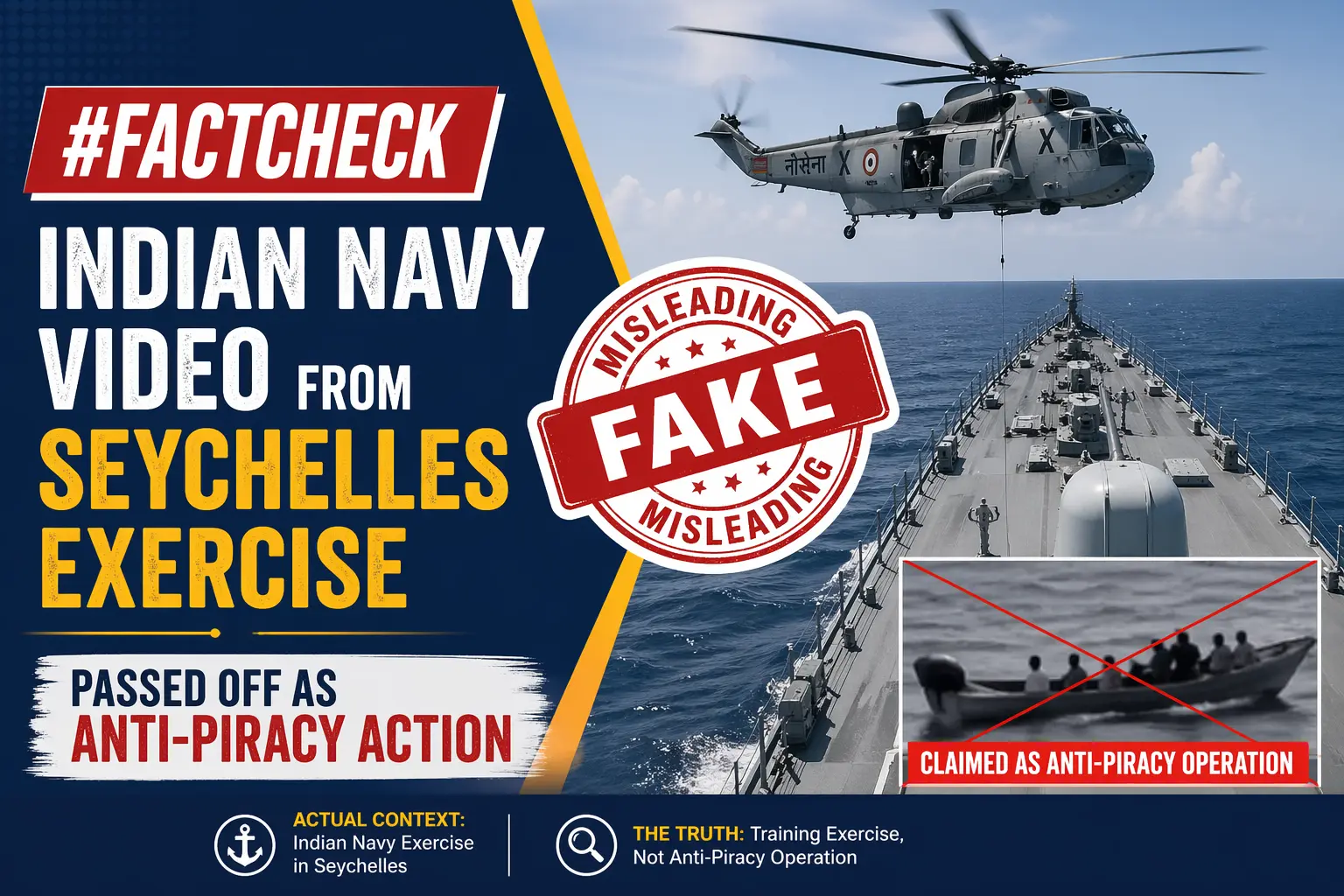
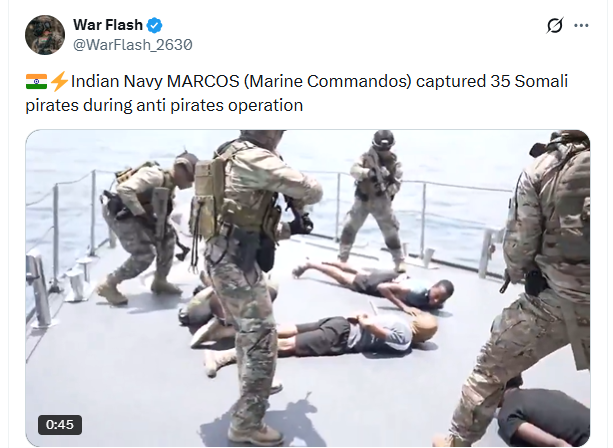
A video showing armed personnel detaining individuals on board a ship is being widely shared on social media with the claim that Indian Navy’s MARCOS captured 35 Somali pirates during a recent anti-piracy operation. However, research by the CyberPeace Research Wing found the claim to be misleading. The viral video is actually from the joint military exercise ‘LAMITIYE 2026’, held in Seychelles in March, involving the Indian Armed Forces and the Seychelles Defence Forces.
Claim
Users on X (formerly Twitter) shared the clip with captions such as: “Indian Navy MARCOS captured 35 Somali pirates,” presenting it as footage of a recent anti-piracy mission.
Fact Check
To verify the claim, we extracted keyframes from the viral video and conducted a reverse image search. This led us to the same video posted on March 20 by a Facebook page named “Defence Squad.” The caption identified the visuals as showing Indian Navy MARCOS and the Seychelles Defence Forces’ Special Operations Unit during the joint military exercise LAMITIYE 2026.
Link:
- https://www.facebook.com/reel/1263962865936234
- https://www.facebook.com/reel/1263962865936234
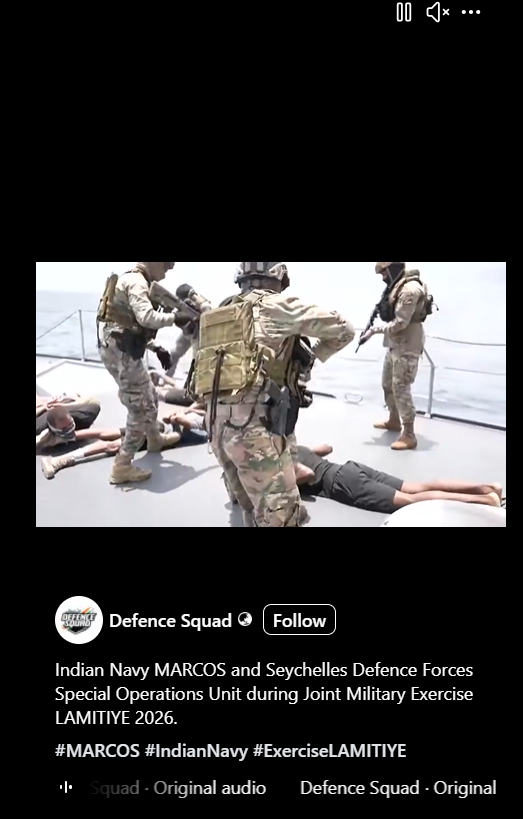
Further keyword searches led to multiple news reports carrying screenshots from the same video. These reports confirmed that the 11th India-Seychelles joint military exercise, LAMITIYE 2026, was conducted in Seychelles from March 9 to March 20.
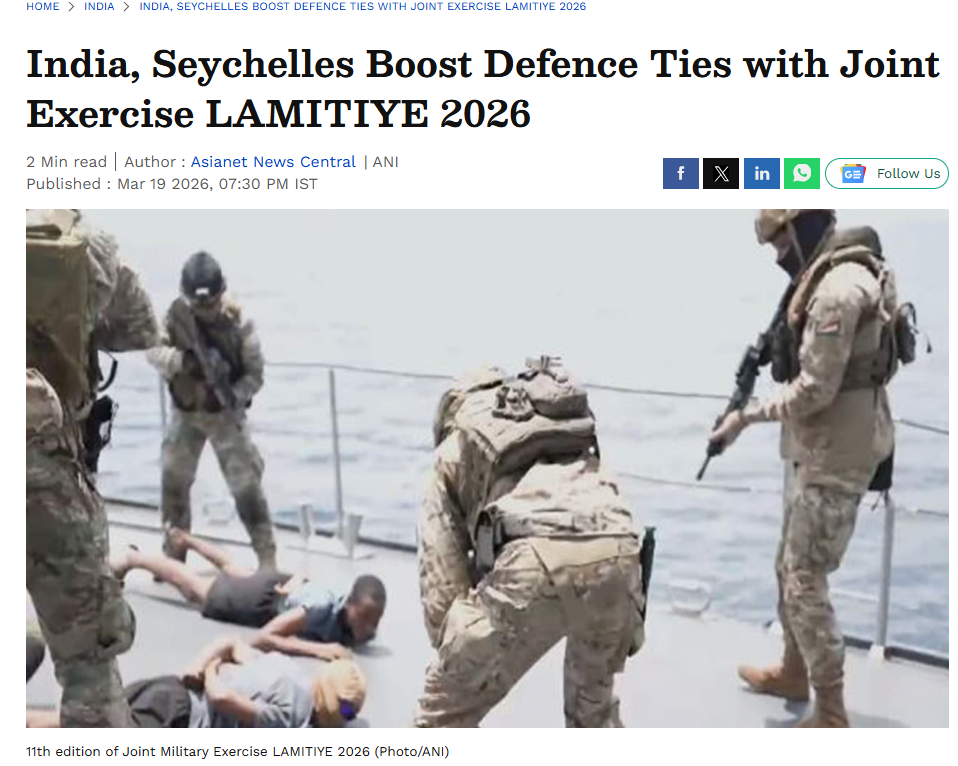
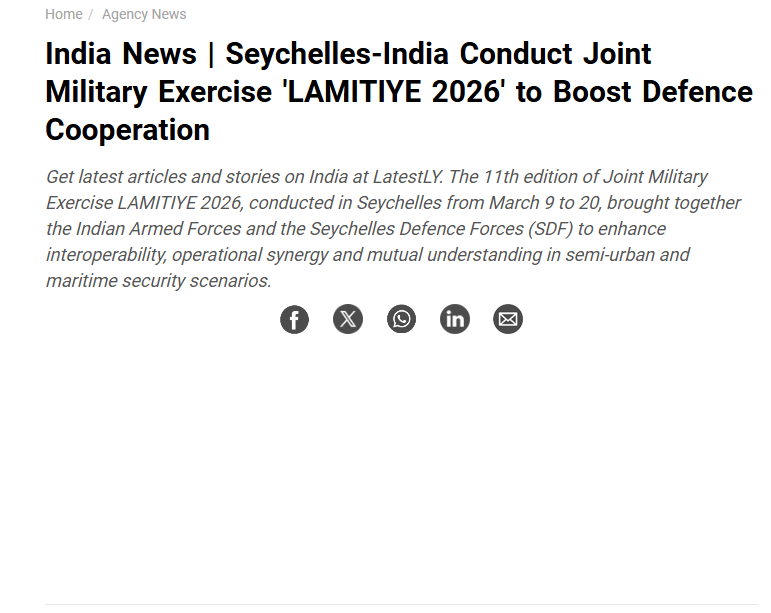
We did not find any recent reports about the Indian Navy capturing Somali pirates. However, in March 2024, the Indian Navy had captured 35 Somali pirates who had hijacked a bulk carrier and taken hostages. The suspects were later handed over to Mumbai Police for legal proceedings.
Conclusion
The viral claim is misleading. The video being circulated as footage of an anti-piracy operation by the Indian Navy does not show the capture of Somali pirates. Instead, it is from the India-Seychelles joint military exercise ‘LAMITIYE 2026’, conducted in March with the participation of the Indian Armed Forces and the Seychelles Defence Forces. While the Indian Navy had indeed captured 35 Somali pirates in a separate incident in March 2024, there are no credible or recent reports linking such an operation to the viral video. The clip has been taken out of context and is being shared with a false narrative, leading to misinformation about a routine military exercise.
Executive Summary
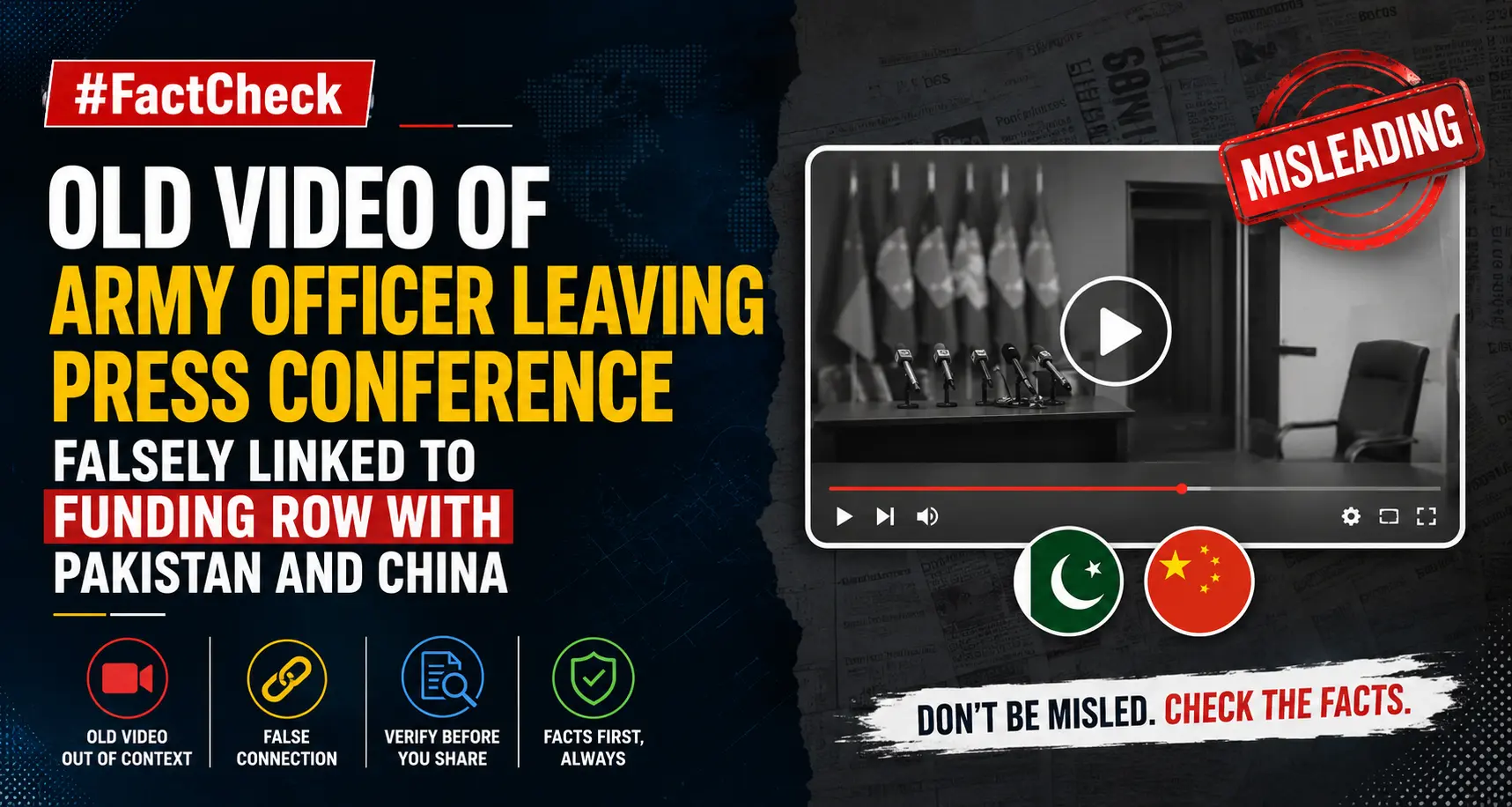
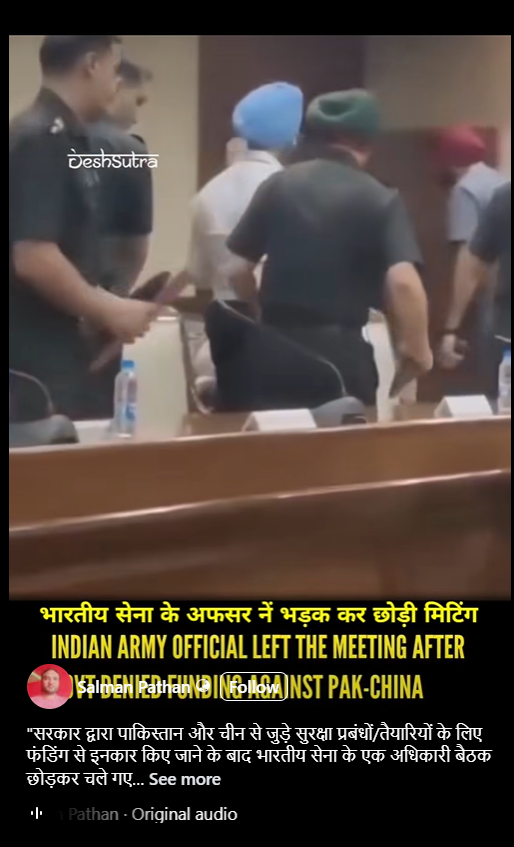
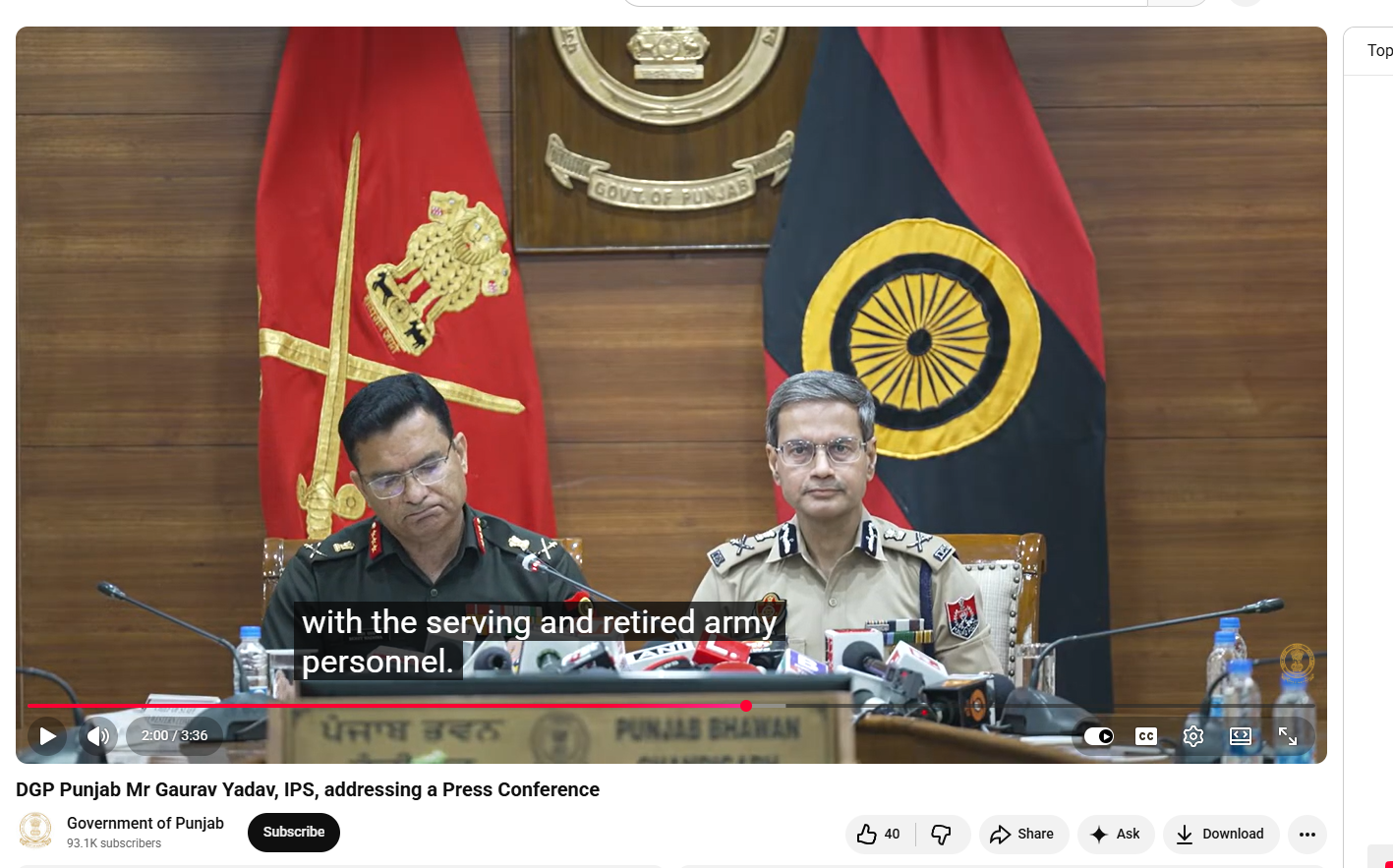
A video of an Indian Army officer leaving a meeting alongside a police official is being widely circulated on social media. Some users are sharing the clip with the claim that the officer walked out of a meeting after the government refused to provide funding for security preparations related to Pakistan and China. CyberPeace Research Wing’s research found the viral claim to be false. Our research revealed that the video is not related to any dispute over defence funding. It actually shows a press conference held in Patiala in March 2025 regarding an attack on an Indian Army Colonel. During the press conference, the Army officer demanded a transparent, time-bound, fair and impartial research, while the police official provided details about the action taken in the case.
Claim
Facebook user ‘Salman Pathan’ shared the video on July 15, 2026, with the claim: “After the government refused funding for security arrangements/preparations related to Pakistan and China, an Indian Army officer left the meeting.” The post further questioned the government over alleged priorities in spending public money.
https://www.facebook.com/reel/3995874277215044
https://perma.cc/JL7A-2A6B?type=standard
Fact Check
To verify the claim, we extracted keyframes from the viral video and conducted a reverse image search using Google Lens. During the research, we found that the same video was uploaded on March 25, 2025, by X user ‘Man Aman Singh Chhina’. The post stated:
“Chief of Staff of Western Command Lieutenant General Mohit Wadhwa left along with senior officers after reading a statement on the Patiala Colonel case without answering any questions. The DGP also read his statement and left, but at least he answered media questions.”
https://x.com/manaman_chhina/status/1904492655720988850?s=20

Further research revealed that the Government of Punjab’s official YouTube channel had uploaded the video of the same press conference on March 25, 2025. At the end of the press conference, when the Army and police officials leave the venue, the same question from journalists that appears in the viral clip can be heard.
https://www.youtube.com/live/7i3Nxc6vTpU
According to a report published by Amar Ujala on July 16, 2025, the Punjab and Haryana High Court, dissatisfied with the research conducted by the Chandigarh Police SIT, transferred the case to the Central Bureau of research (CBI).

Conclusion
Our research found that an old and unrelated video from March 2025 is being falsely circulated with the claim that an Army officer left a meeting after the government refused funding for security preparations related to Pakistan and China. The viral video actually relates to a press conference regarding the attack on Colonel Pushpinder Singh Bath in Patiala and has no connection with any defence funding issue. The viral claim is therefore false and misleading.
