
#FactCheck -AI-Generated Video Falsely Attributes Communal Remarks to Suvendu Adhikari; Fact Check Finds No Authentic Evidence
Executive Summary
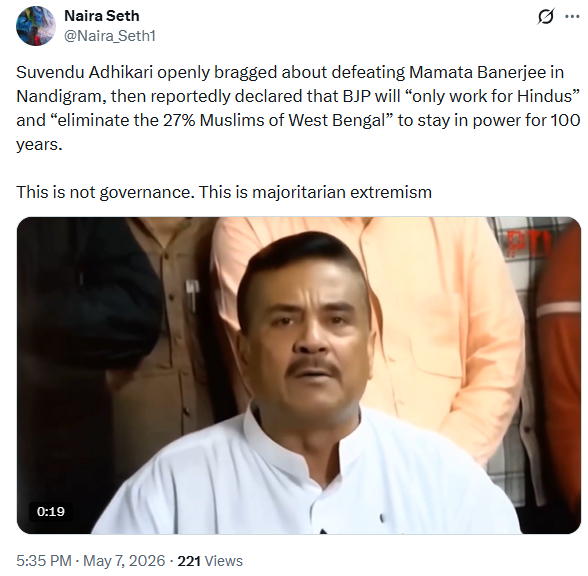
A video circulating on social media falsely claims to show West Bengal leader Suvendu Adhikari making inflammatory and communal remarks. In the viral clip, he is allegedly heard saying that if elected, his party would “work only for Hindus” and “eliminate the 27% Muslim population in West Bengal,” while also claiming that the BJP would remain in power for over 100 years. CyberPeace Research Wing research found that the viral video, which allegedly shows West Bengal leader Suvendu Adhikari making a statement about eliminating the Muslim population in West Bengal to ensure long-term BJP rule, is AI-generated and not real.
Claim
An X user (@Naira_Seth1) shared the clip alleging it reflects “majoritarian extremism disguised as politics,” suggesting that Suvendu Adhikari made communally charged and unconstitutional statements.
Fact Check
A detailed analysis of the video shows clear signs of manipulation. The person appearing in the latter part of the clip does not match Suvendu Adhikari.

Additionally, the video was tested using an AI detection tool (Hive Moderation), which indicated a 98.8% probability of AI-generated content, particularly around the 0:25 timestamp.
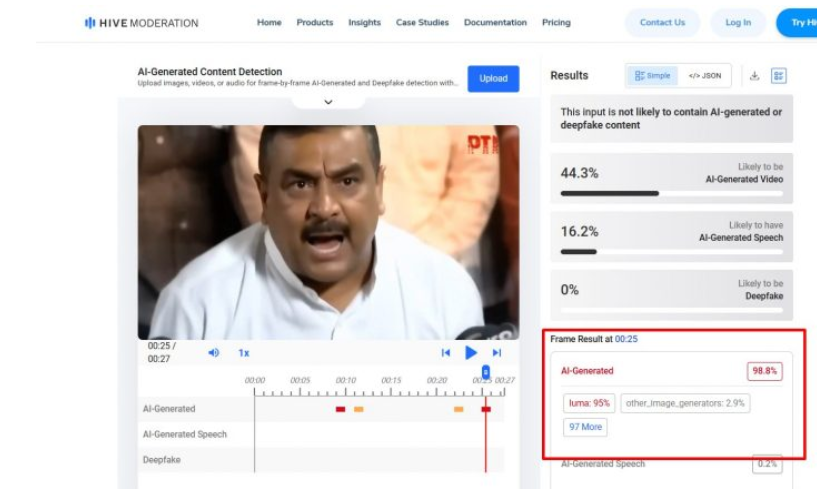
Further verification through reverse image search of key frames led to an original press byte of Suvendu Adhikari posted by PTI News on May 6. In that authentic video, he is seen speaking about taking strict legal action against criminals, with no mention of any religious community or communal statements.
https://x.com/PTI_News/status/2052020784152068114?s=20

Conclusion
The viral video allegedly showing Suvendu Adhikari making communal remarks is AI-generated and misleading. The original footage confirms that no such statements were made, and the clip has been digitally manipulated to spread misinformation.

Related Blogs

Introduction
Cert-In (Indian Computer Emergency Response Team) has recently issued the “Guidelines on Information Security Practices” for Government Entities for Safe & Trusted Internet. The guideline has come at a critical time when the Draft Digital India Bill is about to be released, which is aimed at revamping the legal aspects of Indian cyberspace. These guidelines lay down the policy framework and the requirements for critical infrastructure for all government organisations and institutions to improve the overall cyber security of the nation.
What is Cert-In?
A Computer Emergency Response Team (CERT) is a group of information security experts responsible for the protection against, detection of and response to an organisation’s cybersecurity incidents. A CERT may focus on resolving data breaches and denial-of-service attacks and providing alerts and incident handling guidelines. CERTs also conduct ongoing public awareness campaigns and engage in research aimed at improving security systems. The Ministry of Electronics and Information Technology (MeitY) oversees CERT-In. It regularly releases alerts to help individuals and companies safeguard their data, information, and ICT (Information and Communications Technology) infrastructure.
Indian Computer Emergency Response Team (CERT-In) has been established and appointed as national agency in respect of cyber incidents and cyber security incidents in terms of the provisions of section 70B of Information Technology (IT) Act, 2000.
CERT-In requests information from service providers, intermediaries, data centres, and body corporates to coordinate reaction actions and emergency procedures regarding cyber security incidents. It is a focal point for incident reporting and offers round-the-clock security services. It manages cyber occurrences that are tracked and reported while continuously analysing cyber risks. It strengthens the security barriers for the Indian Internet domain.
Background
India is fast becoming one of the world’s largest connected nations – with over 80 Crore Indians (Digital Nagriks) presently connected and using the Internet and cyberspace – and with this number is expected to touch 120 Crores in the coming few years. The Digital Nagriks of the country are using the Internet for business, education, finance and various applications and services including Digital Government services. Internet provides growth and innovation and at the same time it has seen rise in cybercrimes, user harm and other challenges to online safety. The policies of the Government are aimed at ensuring an Open, Safe & Trusted and Accountable Internet for its users. Government is fully cognizant and aware of the growing cyber security threats and attacks.
It is the Government of India’s objective to ensure that Digital Nagriks experience a Safe & Trusted Internet. Along with ubiquitous applications of Information & Communication Technologies (ICT) in almost all facets of service delivery and operations, continuously evolving cyber threats have become a concern for the Government. Cyber-attacks can come in the form of malware, ransomware, phishing, data breach etc., that adversely affect an organisation’s information and systems. Cyber threats leading to cyber-attacks or incidents can compromise the confidentiality, integrity, and availability of an organisation’s information and systems and can have far reaching impact on essential services and national interests. To protect against cyber threats, it is important for government entities to implement strong cybersecurity measures and follow best practices. As ICT infrastructure of the Government entities is one of the preferred targets of the malicious actors, responsibility of implementing good cyber security practices for protecting computers, servers, applications, electronic systems, networks, and data from digital attacks, also remain with the ICT assets’ owner i.e. Government entity.
What are the new Guidelines about?
The Government of India (distribution of business) Rules, 1961’s First Schedule lists a number of Ministries, Departments, Secretariats, and Offices, along with their affiliated and subordinate offices, which are all subject to the rules. They also comprise all governmental organisations, businesses operating in the public sector, and other governmental entities under their administrative control.
“The government has launched a number of steps to guarantee an accessible, trustworthy, and accountable digital environment. With a focus on capabilities, systems, human resources, and awareness, we are extending and speeding our work in the area of cyber security, according to Rajeev Chandrasekhar, Minister of State for Electronics, Information Technology, Skill Development, and Entrepreneurship.
The Recommendations
- Various security domains are covered in the standards, including network security, identity and access management, application security, data security, third-party outsourcing, hardening procedures, security monitoring, incident management, and security audits.
- For instance, the rules advise using only a Standard User (non-administrator) account to use computers and laptops for regular work regarding desktop, laptop, and printer security in the workplace. Users may only be granted administrative access with the CISO’s consent.
- The usage of lengthy passwords containing at least eight characters that combine capital letters, tiny letters, numerals, and special characters; Never save any usernames or passwords in your web browser. Likewise, never save any payment-related data there.
- They include guidelines created by the National Informatics Centre for Chief Information Security Officers (CISOs) and staff members of Central government Ministries/Departments to improve cyber security and cyber hygiene in addition to adhering to industry best practises.
Conclusion
The government has been proactive in the contemporary times to eradicate the menace of cybercrimes and therreats from the Indian cyberspace and hence now we have seen a series of new bills and polices introduced by the Ministry of Electronics and Information Technology, and various other government organisations like Cert-In and TRAI. These policies have been aimed towards being relevant to time and current technologies. The threats from emerging technologies like web 3.0 cannot be ignored and hence with active netizen participation and synergy between government and corporates will lead to a better and improved cyber ecosystem in India.

Executive Summary
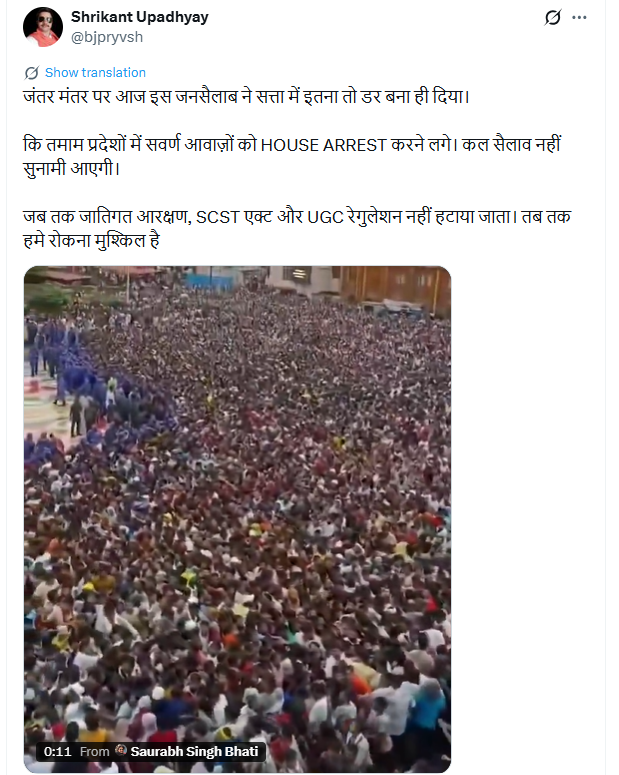
A video showing a massive crowd is being shared on social media with the claim that it shows an anti-reservation protest held at Jantar Mantar. However, a research done by the research wing of the CyberPeace revealed that the video is not from any anti-reservation protest at Jantar Mantar, but from the Jagannath Rath Yatra organized in Puri, Odisha.
Claim:
The video is being shared on X (formerly Twitter) with a viral caption that translates to: “Today, this massive gathering at Jantar Mantar created so much fear in the ruling government that upper-caste voices are being put under HOUSE ARREST across various states. Tomorrow will bring a tsunami, not just a surge. Until caste-based reservation, the SC/ST Act, and UGC regulations are removed, it will be difficult to stop us.”
https://x.com/bjpryvsh/status/2091554860785438887?s=20
Fact Check:
To investigate the viral video, reverse image searches were conducted using keyframes extracted from the clip. This led to an Instagram post uploaded on July 18. The caption accompanying the video clearly identified the footage as being from the Jagannath Rath Yatra in Puri, Odisha.
https://www.instagram.com/p/Da7tF2Etiae/
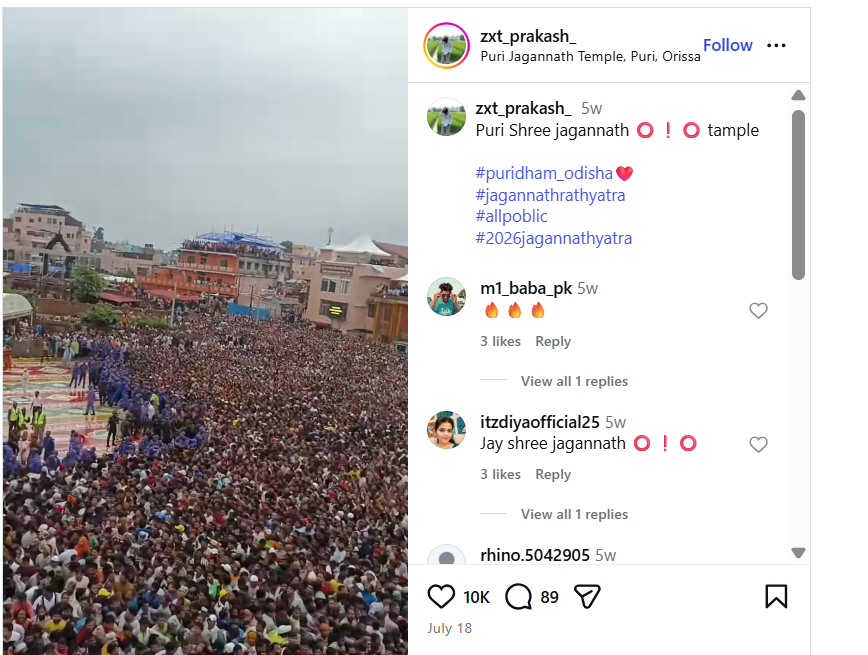
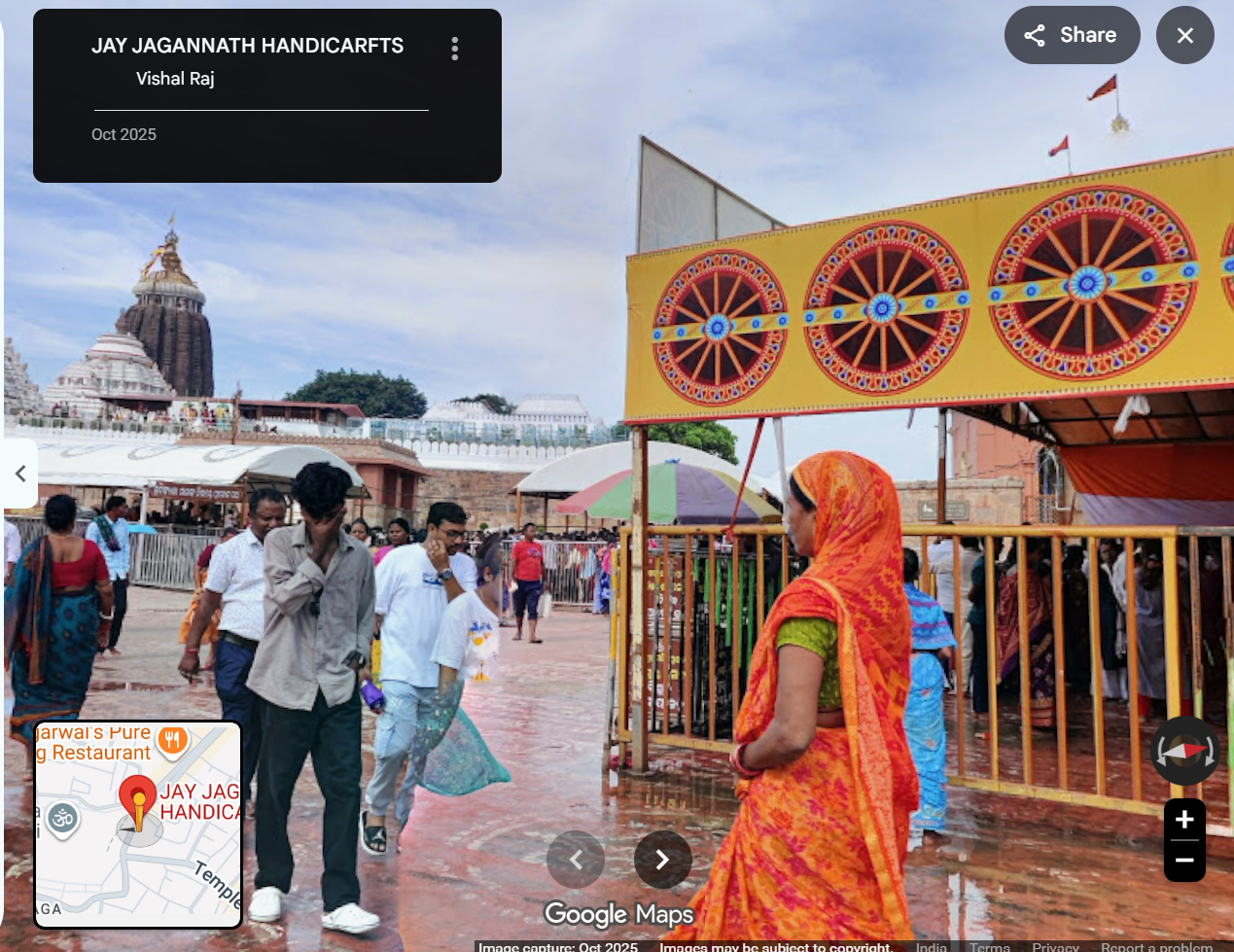
The visuals in the video were matched with the surroundings of the Jagannath Temple in Puri available on Google Maps Street View, confirming beyond doubt that the location in the video is near the Jagannath Temple in Puri.
https://www.google.com/maps/place/JAY+JAGANNATH+HANDICARFTS/@
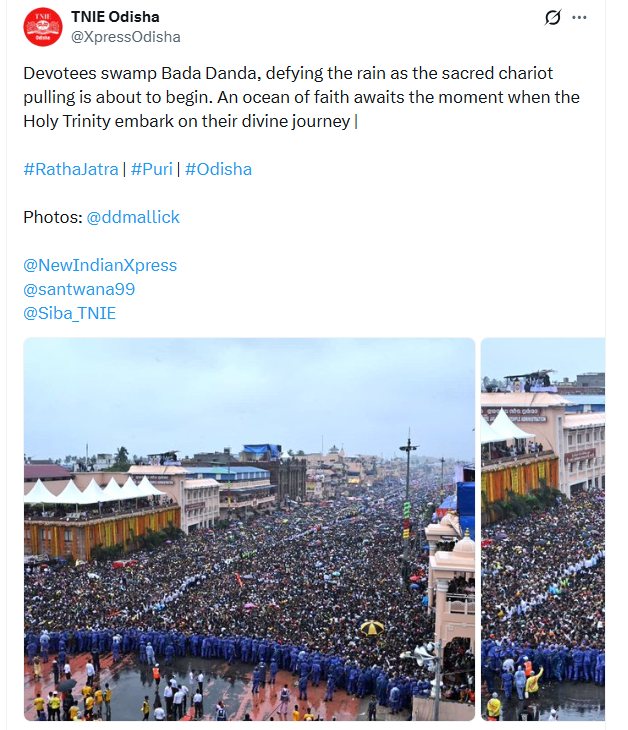
Similar visuals were found in photos uploaded by the X account of The New Indian Express Odisha on July 16, 2026. The imagery in these photographs closely matched the scenes in the viral video, and the caption stated that they were captured during the Jagannath Rath Yatra in Puri.
https://x.com/XpressOdisha/status/2077697637688775015
Conclusion:
Based on the evidence gathered during our research, it is clear that the video being falsely circulated as an anti-reservation protest at Jantar Mantar is actually footage of the Jagannath Rath Yatra in Puri, Odisha.

A video circulating on social media shows a man allegedly rolling out bhature on his stomach and then frying them in a pan. The clip is being shared with a communal narrative, with users making derogatory remarks while falsely linking the act to a particular community.
CyberPeace Foundation’s research found the viral claim to be false. Our probe confirms that the video is not real but has been created using artificial intelligence (AI) tools and is being shared online with a misleading and communal angle.
Claim
On January 5, 2025, several users shared the viral video on social media platform X (formerly Twitter). One such post carried a communal caption suggesting that the person shown in the video does not belong to a particular community and making offensive remarks about hygiene and food practices..
- The post link and archived version can be viewed here: https://x.com/RightsForMuslim/status/2008035811804291381
- Archive Link: https://archive.ph/lKnX5

Fact Check:
Upon closely examining the viral video, several visual inconsistencies and unnatural movements were observed, raising suspicion about its authenticity. These anomalies are commonly associated with AI-generated or digitally manipulated content.
To verify this, the video was analysed using the AI detection tool HIVE Moderation. According to the tool’s results, the video was found to be 97 percent AI-generated, strongly indicating that it was not recorded in real life but synthetically created.

Conclusion
CyberPeace Foundation’s research clearly establishes that the viral video is AI-generated and does not depict a real incident. The clip is being deliberately shared with a false and communal narrative to mislead users and spread misinformation on social media. Users are advised to exercise caution and verify content before sharing such sensational and divisive material online.
