
#FactCheck - AI-Generated Video Falsely Claims Death of Iran’s Supreme Leader
Executive Summary
Iran’s Supreme Leader Ayatollah Ali Khamenei was reportedly killed in a major attack carried out by Israel and the United States, with claims circulating that Iranian state media confirmed his death early Sunday morning. Amid these claims, a video is being widely shared on social media. The viral video shows a body trapped under debris. Users sharing the clip claim that the body seen in the footage is that of Ayatollah Ali Khamenei. However, research conducted by CyberPeace found the viral claim to be false. Our research revealed that the video is not authentic but AI-generated.
Claim:
On March 1, 2026, an Instagram user shared the viral video with the caption: “Shaheed Ayatollah Sayyid Ali Hosseini Khamenei — Neither fled nor hid in a bunker, embraced death like a brave man.” The link to the post and its archived version are provided below along with a screenshot.

Fact Check:
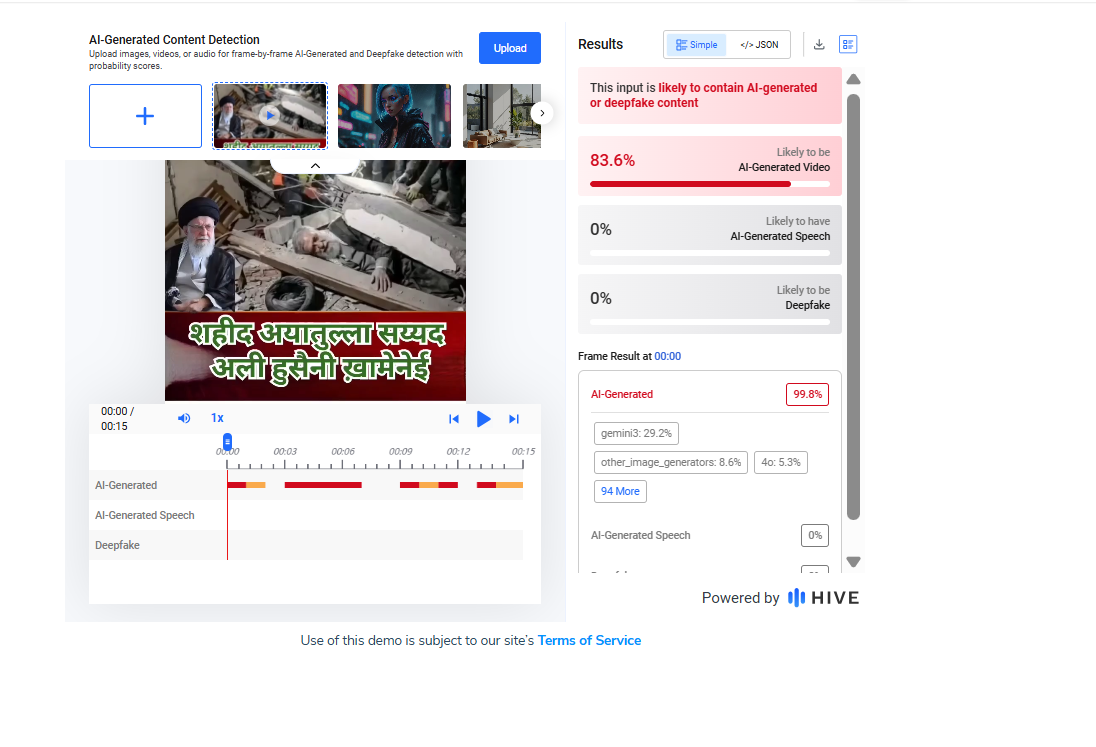
Upon closely examining the viral video, we noticed several visual irregularities and technical inconsistencies. This raised suspicion about its authenticity. We then scanned the video using the AI detection tool Hive Moderation. The results indicated that approximately 83 percent of the content showed signs of being AI-generated.
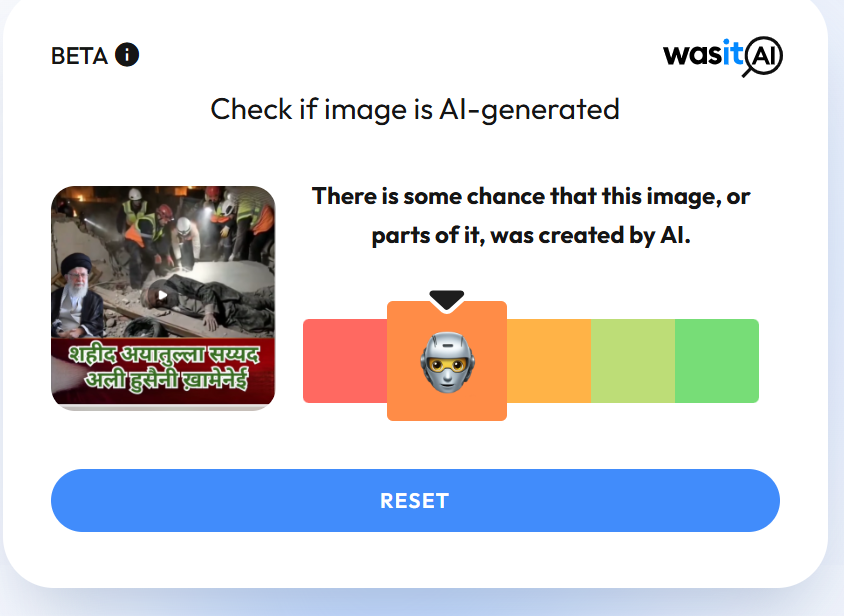
To further verify the claim, we also analyzed the video using another AI detection tool, WasItAI. The findings similarly suggested that the video was generated using artificial intelligence.
Conclusion:
Our research establishes that the viral video is not real. It has been artificially generated using AI and is being shared with misleading claims.

Related Blogs
.webp)
Introduction
India's digital governance system is experiencing a significant transformation. The Department of Telecommunications (DoT) has extended the deadline for implementing SIM binding requirements for messaging platforms to December 31, 2026, while also stepping back from earlier proposals such as mandatory periodic web logouts.
The government extended the current proposal but decided to cancel its previous requirement, which mandated messaging platforms to implement mandatory logout periods. The authorities implemented this action to control the increasing occurrence of digital impersonation, financial fraud, online scams and identity theft, which occurs through messaging applications.
The authorities are said to have implemented this action to control the increasing occurrence of digital impersonation, financial fraud, online scams and identity theft, which occurs through messaging applications.
What Has Changed
The SIM binding mandate, which the Telecommunication Cyber Security framework introduced in late 2025 requires messaging platforms to maintain user account connections with active SIM cards that match their registered mobile numbers.
Platforms received a brief period for compliance with the original rules. Industry stakeholders, which included messaging services and device manufacturers, reported that they faced major technical and operational problems when trying to constantly verify SIM status on different devices and operating systems.
The government postponed the compliance date to December 2026 to give organisations extra time for the gradual implementation of requirements. The policy now permits platforms to use risk-based or adaptive logout mechanisms, which enable security management without enforcing standard security procedures through their web messaging application platforms.
Why the Extension Was Necessary
The extension operates as a recognition of both technical feasibility constraints and ecosystem's complex nature. Multiple devices at present enable messaging platforms to function which includes smartphones and desktops and web interfaces with real time synchronization. The system needs complete operational system and hardware component integration to maintain active SIM verification throughout all environments because stakeholders estimated that this process would take time to achieve proper results.
The operating system providers and smartphone manufacturers expressed their worries about system limitations, which include testing procedures and compatibility problems.
The government recognised through its deadline extension that security requirements need technical feasibility and scalability to function properly without causing service interruptions or requiring immediate implementation.
Security Rationale Behind SIM Binding
The SIM binding system serves its main purpose to enhance accountability while it protects digital communication systems from unauthorised use. Authorities have identified that messaging accounts can remain active even after the associated SIM card is removed, deactivated, or moved across regions. The situation creates paths for criminals to commit fraud and impersonation while perpetrating cybercrime across international borders because they can use digital identities that are hard to trace.
The SIM binding system exists to solve this problem by
- requiring active, Virtual KYC-verified SIMs to authenticate messaging accounts.
- Users cannot access the system until they connect their active SIM.
- The system maintains the capacity to track and authenticate digital identities.
The measure aims to eliminate a security gap that digital communication systems currently use for fraudulent activities and identity theft.
Shift Toward Risk-Based Regulation
The current development marks a major change because it no longer applies fixed rules that used to determine what organisations must do, but now uses risk assessment methods. The previous plan, which required users to log out every six hours from web sessions, has been replaced by platforms that now log users out based on their risk assessment. The shift demonstrates that cybersecurity needs to implement security measures that require specific context and need to match the existing environment. Organisations face challenges when trying to apply standard rules because users exhibit various behaviours while using different devices on multiple platforms.
The risk-based model enables platforms to detect suspicious activity through dynamic monitoring, which establishes strict security measures for high-risk situations while preserving system access during periods of low risk.
Implications for the Digital Ecosystem
The extension, together with its related policy alterations, creates significant effects for organisations. The extra time allows the industry to create systems that can work together with different ecosystems while testing their implementation process and matching their required operational standards.
The shift shows policymakers that they should adopt a process that combines multiple rounds of assessment with stakeholder input to develop their regulations.
The upcoming changes will create invisible effects for users, which will determine the future methods of digital identity verification and the security functions of communication platforms.
Conclusion
The extension of the SIM binding deadline represents a new approach to regulations instead of being a regulatory rollback. The process requires both dedicated efforts and actual implementation to create secure digital environments.
India needs to establish secure and scalable user-friendly systems while advancing its digital infrastructure development. The current developments show progress toward achieving a solution that protects cybersecurity needs while considering technological facts and user experience. Organisations face two main obstacles in modern interdependent systems: they must protect their systems while maintaining user trust and system protection, and their capability to operate over extended periods.
References
- https://www.thehindu.com/sci-tech/technology/government-shelves-periodic-web-logout-for-chat-apps-extends-sim-binding-to-december-31/article70811929.ece
- https://www.gadgets360.com/telecom/news/dot-sim-binding-mandate-extension-2026-report-11301917

Executive Summary
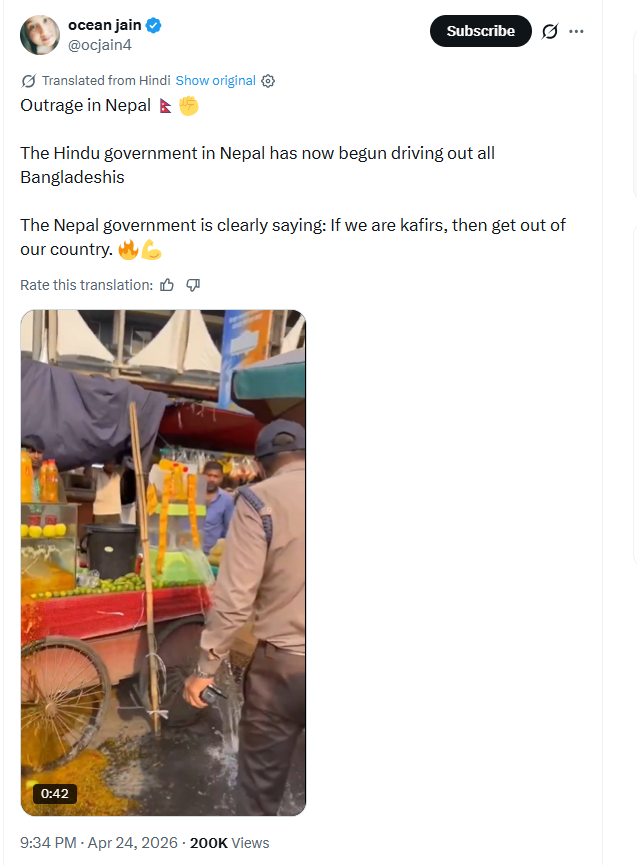
A video showing uniformed personnel removing street vendors and damaging roadside stalls is being circulated on social media with the false claim that the Nepal government has started expelling Bangladeshis from the country. The viral clip is around 49 seconds long and shows authorities clearing vendors from a public area. Nepali audio can also be heard in the background, which appears to have added to the misleading narrative.
However, an research by the CyberPeace Research Wing found that the claim is false. The video is not from Nepal, but from Bangladesh’s capital Dhaka, where authorities were carrying out an anti-encroachment operation near the National Stadium.
Claim:
The video was shared on X with a caption claiming that a Hindu-led government in Nepal had begun driving Bangladeshis out of the country.
Fact Check:
A close examination of the video revealed several signs contradicting the claim. Text written in Bengali can be seen at multiple places in the footage. The caps worn by uniformed personnel also appear to display “Bangladesh Police.” Investigators also noticed a stadium-like structure in the background. Comparing the visuals with street-view imagery available on Google Maps led to a match near the National Stadium area in Dhaka, Bangladesh.


Further verification found a video uploaded on March 18, 2025, by a Bangladeshi news portal on YouTube containing scenes matching the viral clip. The caption described it as footage from an anti-encroachment drive in the Gulistan area of Dhaka.

A similar version of the video was also found on a Bangladeshi Instagram account uploaded on March 17, where it was again described as police action against illegal encroachments. The video credit was attributed to a person named Zahir Rehan.

While the exact date of the original footage could not be independently confirmed, available evidence clearly links the video to Bangladesh and not Nepal.
Conclusion:
The viral claim that Nepal has begun expelling Bangladeshis is false. The video actually shows an anti-encroachment drive carried out by authorities in Dhaka, Bangladesh.
.webp)
Think about the difference between a video game and gambling the way most people were taught to understand it. A video game is something you play, maybe you spend money on it upfront, maybe you buy an expansion pack, but what you get in return is fixed and known. Gambling is different: you put money in, and what comes back is uncertain, decided by chance, with real financial stakes attached to the outcome. For decades, that distinction was reasonably clear. It no longer is.
Across a growing number of mobile games and gaming platforms, the two have started to blend into each other. Games increasingly include features where a player pays real money for a randomised reward, a mechanic structurally identical to a slot machine or a scratch card, just wrapped in animation, sound effects, and gaming language that makes it feel like part of the game rather than a bet. Because this trend targets an audience that skews young, and because it deliberately makes gambling like behaviour feel like ordinary play, the UN Office on Drugs and Crime recently flagged it as a serious and growing concern. Understanding exactly what is happening, and why it matters, starts with their warning.
What UNODC is actually warning about
The claim traces back to UNODC's July 2026 report, An Interconnected Criminal Ecosystem: Transnational Organised Crime Threat Assessment for Southeast Asia 2026. Delphine Schantz, UNODC's regional representative for South-East Asia and the Pacific, put the core problem plainly: the line between online gaming and online gambling is becoming increasingly blurred, and platforms have converged through design features that deliberately exploit that ambiguity. Online gaming, by definition, never required money changing hands. What the report documents is a shift where mobile accessibility, deliberately addictive design, and the introduction of real monetary stakes are pulling younger users into something that looks and feels like gaming but functions, mechanically, like gambling.
The report's most striking finding is not really about the games themselves. It is about what happens after. UNODC found that illegal online gambling platforms operating across the region do not simply extract money from young users; they generate a secondary population of indebted, criminally exposed young people who become vulnerable to recruitment into broader criminal networks, including debt collection operations, money mule schemes, and the scam compounds the report documents elsewhere. In other words, the gambling loss is often only the first harm. The debt it creates becomes the entry point into something considerably worse.
The mechanics of the convergence
This is not a vague, impressionistic claim. Academic researchers have spent close to a decade documenting the specific design features responsible for blurring gaming and gambling, and loot boxes sit at the centre of that research. A loot box is a purchasable in game item containing randomised rewards, structurally similar to a scratch card or a slot pull, wrapped in gaming aesthetics, animated reveal sequences, anticipation building sound design, that make the underlying mechanic easy to overlook. Researchers writing in Nature Human Behaviour as early as 2018 argued loot boxes are psychologically akin to gambling, and subsequent studies have consistently found meaningful associations between loot box engagement and problem gambling severity in young people. One widely cited cross sectional study estimated that between 16 and 21 percent of surveyed young people had engaged in gambling like video game practices at least once in the preceding year, and found that people who engaged in one such practice were highly likely to engage in several more, suggesting these mechanics function less as isolated features and more as an interconnected ecosystem designed to normalise wagering behaviour early.
What makes this genuinely difficult to regulate is precisely the ambiguity Schantz pointed to. A loot box does not always pay out in real currency; often the reward is a cosmetic item, a weapon skin, or in game currency that can then be resold or traded on secondary markets, creating real monetary value once removed from the platform that generated it. That one extra step, converting a virtual reward into tradeable value outside the game itself, has repeatedly let gambling like mechanics avoid classification under gambling law, even as researchers increasingly argue the psychological experience for the user is functionally identical. Regulators in several countries, including the UK, South Korea, and parts of Europe, have wrestled with exactly this classification problem for years, generally landing on disclosure requirements, probability labelling, and age restrictions rather than outright bans, an approach critics argue leaves the core mechanic intact while addressing only its edges.
The mobile phone has made all of this considerably harder to contain. Where gambling once required a physical location, an ID check, or at minimum a desktop browser, mobile gaming apps put the same monetised, chance based mechanics directly into a pocket, often accessible without any meaningful age verification beyond a self reported birth date a user can simply falsify. UNODC's own framing of "mobile access" as a driving factor is not incidental; it is arguably the single structural change that turned what was once a manageable regulatory grey zone into a rapidly scaling public health concern.
Why age matters so much here
Financial literacy research is fairly consistent on this point: the capacity to reason clearly about risk, probability, and long term financial consequence continues developing well into a person's twenties. Marketing a mechanic engineered around variable reward schedules, the same principle behind slot machine design, to an audience whose risk judgment is still forming is not an accident of overlapping demographics. It is, as UNODC's own language suggests, closer to a deliberate exploitation of that gap.
Where India fits into this picture
India has arguably moved further and faster on this exact concern than most jurisdictions. The Promotion and Regulation of Online Gaming Act, 2025, alongside its accompanying 2026 Rules that came into force on 1 May 2026, drew a hard statutory line most countries have avoided: real money online games, including fantasy sports, rummy, poker, and online casino style platforms, are now categorically prohibited in India, not merely regulated. A newly created central regulator, the Online Gaming Authority of India, oversees a separate, permitted category for e-sports and social games, requiring registration, age gating, and grievance redressal mechanisms, while offshore and unregistered real money platforms are now explicitly illegal to operate or use, backed by bank freeze powers and potential prosecution of platform directors.
The government's own stated rationale mirrors UNODC's warning almost exactly. Lawmakers cited addiction and social harm linked to real money games, reports that Indian users lose close to 20,000 crore rupees annually on these platforms, concerns about money laundering and potential terror financing routed through gaming networks, and specifically flagged the vulnerability of teenagers increasingly drawn into fantasy leagues and online poker as a driving justification. India's approach, an outright prohibition on monetary stakes rather than a licensed regulatory model similar to the UK's Gambling Commission or Malta's Gaming Authority, is distinctive by global standards, and reflects a judgement that the gaming gambling boundary has already become too difficult to police through disclosure and age verification alone.
The larger question this leaves open
Whether prohibition succeeds where lighter touch regulation elsewhere has struggled remains genuinely unresolved, and enforcement against offshore platforms determined to evade an Indian ban is likely to be an ongoing challenge rather than a solved problem. What UNODC's warning underscores, and what India's own legislative response implicitly concedes, is that voluntary industry self regulation was never going to be sufficient on its own. Platforms have commercial incentive to keep the gaming gambling boundary blurry, not to clarify it, because that ambiguity is precisely what lets monetised, addictive design features reach audiences who would otherwise be walled off from gambling entirely. Closing that gap convincingly will likely require the kind of cross sector coordination, spanning gaming regulators, financial authorities, and platform accountability, that UNODC's own statement called for, rather than any single fix applied in isolation.
References
- UNODC, "An Interconnected Criminal Ecosystem: Transnational Organised Crime Threat Assessment for Southeast Asia 2026," July 2026.
- The Hawk, "UNODC warns young gamers lured into online gambling." https://www.thehawk.in/news/india/unodc-warns-young-gamers-lured-into-online-gambling
- IAG, "UNODC report says Southeast Asian illegal online gambling creating cycle of crime that targets youth." https://asgam.com/2026/07/22/unodc-report-says-southeast-asian-illegal-online-gambling-creating-cycle-of-crime-that-targets-the-youth/
- GambleAware, "Lifting the Lid on Loot Boxes: Chance-based purchases in videogames and the convergence of gaming and gambling." https://www.gambleaware.org/media/aswow4lr/gaming_and_gambling_report_final_0.pdf Drummond
- A, Sauer JD, "Video game loot boxes are psychologically akin to gambling," Nature Human Behaviour, 2018. PubMed, "Loot Boxes, Gambling, and Problem Gambling Among Young People: Results from a Cross-Sectional Online Survey." https://pubmed.ncbi.nlm.nih.gov/33103911/
- Mondaq, "Play By The New Rules: India's 2026 Online Gaming Law Decoded." https://www.mondaq.com/india/gaming/1785180/play-by-the-new-rules-indias-2026-online-gaming-law-decoded
- CAclubindia, "India's Online Gaming Revolution: A Complete Guide to the Promotion and Regulation of Online Gaming w.e.f 1st May, 2026." https://www.caclubindia.com/articles/indias-online-gaming-revolution-a-complete-guide-to-the-promotion-and-regulation-of-online-gaming-wef-1st-may-2026-55118.asp
- https://www.meity.gov.in/static/uploads/2025/10/8a7f103cefc68ed8aaa2ebc9a2ed7c13.pdf
- https://x.com/UNODC/status/2100560453319467298?s=48&t=3CXE-95D2WFgsLsKDkX_Jg
