
#Fact Check: Old Video Shared to Fuel Netanyahu Death Rumours
Executive Summary:
A video featuring Sara Netanyahu, wife of Israeli Prime Minister Benjamin Netanyahu, is being widely circulated on social media. In the clip, she is seen attending an online meeting and repeatedly closing her eyes. The video is being shared with claims that it is recent and shows her under the influence of drugs. Some posts also suggest that Prime Minister Netanyahu has died. However, research by the CyberPeace found that the claim is misleading. The video is not recent and has been online since 2020.
Claim:
Social media users are sharing the video claiming that Sara Netanyahu appeared intoxicated following the alleged death of Prime Minister Benjamin Netanyahu. The clip is also being falsely presented as a recent development. An X user, Christopher Montgomery (@Montgsignals), shared the video with the caption suggesting that Netanyahu may have died and that his wife appeared in a drug-influenced state during a recent court hearing via Zoom.

Fact Check:
To verify the claim, we first examined reports regarding the alleged death of Benjamin Netanyahu. There is no credible evidence supporting this claim. In fact, on March 20, Netanyahu himself addressed the media and dismissed such rumours, confirming that he is alive.

We then analyzed the viral video by extracting keyframes and conducting a reverse search. This led us to the same video posted on a Facebook account under the name Roni Schneider Malia on November 4, 2020. The Hebrew caption associated with the post translates to: “Filmed during a psychological conference on Zoom.”
This confirms that the video is old and unrelated to any recent developments.

Conclusion:
The viral claim is misleading. The video of Sara Netanyahu is not recent but has been available online since 2020. It is being falsely linked to baseless claims about Prime Minister Benjamin Netanyahu’s death

Related Blogs

Executive Summary
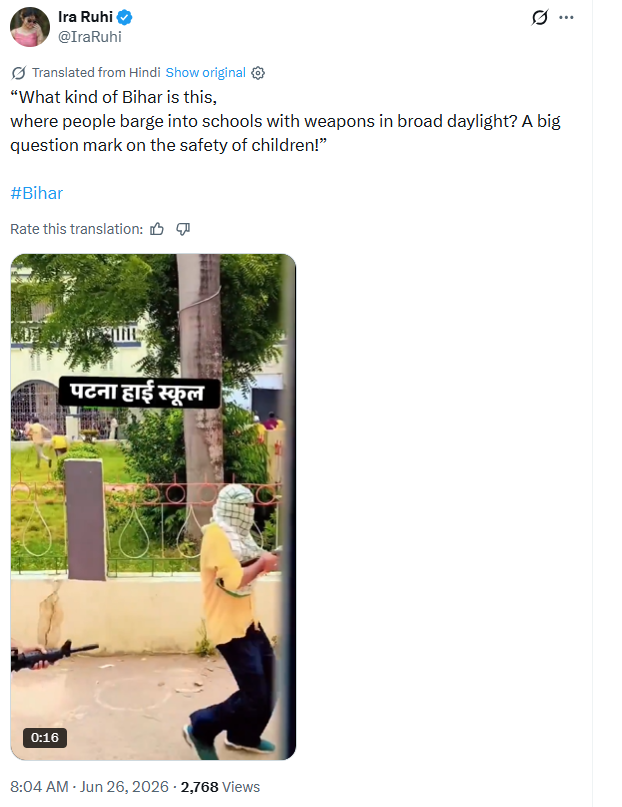
A 22-second video is circulating on social media platform X (formerly Twitter) with a claim that a shooting incident took place at Patna High School in Bihar. The video shows several masked men running around with weapons in their hands, accompanied by the sound of gunfire. A text overlay on the video reads "Patna High School." However, an research by the CyberPeace Research Wing has revealed that this claim is entirely fake and misleading. The video does not depict a real shooting; it captures an authorized movie/web series shooting on the school premises.
The Claim
Social media users are sharing the video claiming that a real firing incident occurred at Patna High School in Patna, Bihar. https://x.com/IraRuhi/status/2070334893830357499
Fact Check
Keyframes from the viral video were analyzed using reverse image search. This led to identical videos uploaded on Facebook and Instagram on June 25, 2026. The captions on both uploads explicitly stated that the footage was from a movie and web series shoot. Furthermore, a closer inspection of the videos revealed professional filmmaking equipment, such as a black flag and a skimmer, visible on the set. https://www.facebook.com/reel/2160248068089642

https://www.instagram.com/p/DaBE0gQglUF/

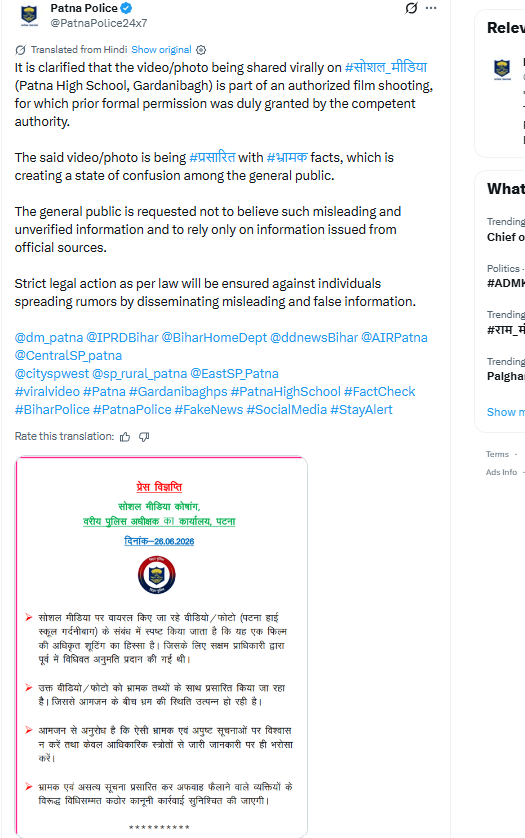
A targeted keyword search led to a YouTube video uploaded on June 20, 2026. The visuals in this video perfectly matched the viral footage, and the individuals seen in the viral clip could be spotted wearing the exact same clothes. "Regarding the video/photo being circulated on social media (Patna High School, Gardanibagh), it is clarified that this is part of an authorized film shooting, for which due permission was previously granted by the competent authority."

To verify further, official statements were checked. The Patna Police issued a formal press release on June 26, 2026, completely dismissing the viral rumors. https://x.com/PatnaPolice24x7/status/2070501501529960581
Conclusion
The evidence gathered confirms that there was no shooting incident at Patna High School. The viral video is behind-the-scenes footage from a pre-approved film production.
Background
Cyber slavery and online trafficking have become alarming challenges in Southeast Asia. Against this backdrop, India successfully rescued 197 of its citizens from Mae Sot in Thailand on November 10, 2025, using two Indian Air Force flights. The evacuees had fled Myanmar’s Myawaddy region in October after intense military operations forced them to escape. This was India’s second rescue effort within a week, following the November 6 mission that brought back 270 nationals from similar conditions. The operations were coordinated by the Indian Embassy in Bangkok and the Consulate in Chiang Mai, with crucial assistance from the Royal Thai Government.
The Operation and Bilateral Cooperation
The operation was carried out with the presence and supervision of Prime Minister Anutin Charnvirakul of Thailand and Indian Ambassador Nagesh Singh, who were both present at the ceremony in Mae Sot. This way, the two countries have not only proved but also cemented their bond to fight the crimes which were mentioned before and more than that, they have even promised to facilitate communication between their authorities. Prime Minister Charnvirakul thanked India for the quick intervention and added that Thailand would be giving the needed support for the repatriation of the other victims as well.
“Both parties reaffirmed their strong commitment to the fight against cross-border crimes, including cyber scams and human trafficking, in the region and to improving cooperation among the relevant agencies in both countries.”, Embassy of India, Bangkok.
The Cyber Scam Network
The Myawaddy area in Myanmar has made a quick shift to become a hotspot for the entire world of cybercrimes. Moreover, the crimes are especially committed by the organised criminal groups that take advantage of foreign nationals. After the Myanmar military imposed a restriction in late October, over 1,500 people from 28 nations moved to Thailand because of the KK Park cyber hub and other centres being raided.
A UN report (2025) indicated that this fraud activity is part of a larger network that extends the countries populated with very low-tech criminals who target the most naïve, and they are the very ones who end up being tortured. The trafficked persons often belong to the local population or come from neighbouring countries and are recruited with the promise of high salaries as IT or customer service agents, only to be imprisoned in a compound where they are forced to perform phishing, investment fraud, and cryptocurrency scams aimed at the victims all over the globe. These centres operate in border territories having poor governance, easy-to-cross borders, and little police presence, hence making human trafficking a major factor contributing to cybercrime.
India’s Response and Preventive Measures
The Indian Embassy in Thailand worked hand in hand with the Thai government to facilitate bringing back and repatriating the Indian citizens who had entered Thailand illegally when they were escaping Myanmar.
The embassy was far from helpless in the matter. In the case of the embassy's advisory, they suggested to the citizens that:
- It is mandatory to check the authenticity of the job offers and the agents before securing employment in other countries.
- Such employment by means of tourist or visa-free entry permits should be avoided, as such entries allow only for a short-duration visit or tourism.
- Be careful of ads claiming high pay for online or remote work in Southeast Asia.
The embassy reiterated the Government of India’s commitment to ensuring easy access to assistance for citizens overseas and to addressing the growing intersection between cyber fraud and human trafficking.
CyberPeace Analysis and Advisory
The case of Myawaddy demonstrates that cybercrime and human trafficking have grappled to become a complicated global threat. The scam centres gradually come to depend on the trafficked labour of people who are being forced to commit the fraud digitally under coercion. This underlines the requirement for the cybersecurity measures that consider the rights of humans and the protection of the victims, not only the technical defence.
- Cybercrime–Human Trafficking Convergence:
Cybercrime has moved up to the level of a human trafficking operation. The unwilling victims of such fraud schemes are scared for their very lives or even more, not of a reliable way out. This situation is such that one cannot tell where cyber exploitation ends and forced labour begins.
- Cross-Border Enforcement Challenges:
To effectively carry out their unlawful acts, the criminals use legal and jurisdictional loopholes that are present across borders. Dismantling such networks requires the regional cooperation of India, Thailand, and ASEAN countries.
- Socioeconomic Vulnerability:
The situation with unemployment being stagnant and the public not being educated about the situation makes people, especially the youth, very prone to scams of getting hired overseas. Thus, to prevent this uneducated flocking to the fraudsters, it is necessary to constantly implant in them the knowledge of online literacy and the importance of verification of job offers.
- Public–Private Coordination:
The scammers’ mode of operation usually includes online recruitment through social media and encrypted platforms where their victims can be found and contacted. In this regard, cooperation among government institutions, tech platforms, and civil society is imperative to put an end to the operation of these digital trafficking channels.
CyberPeace Expert Advisory
To lessen the possibility of such incidents, CyberPeace suggests the following preventive and policy measures:
Individuals:
- Trust but verify: Before giving your approval to anything, always verify the job offer by official embassy websites or MEA-approved recruiting agencies first.
- Watch out for red flags: If a recruiter offers a very high salary for almost no work, asks for tourist visas, or gives no written contract, be very careful and pull out immediately.
- Protect your documents: Give a trusted person the responsibility of keeping both digital and physical copies of your passport and visa, and also register your travel with the MADAD portal.
- Report if in doubt: If an agent looks suspicious, contact the nearest Indian Embassy or Consulate or report it to cybercrime.gov.in or the 1930 Helpline.
Policymakers and Agencies:
- Strengthen Bilateral Task Forces: Set up armed forces of cyber and human trafficking enforcement units in South and Southeast Asian countries.
- Support Regional Awareness Campaigns: In addition to targeted advisories in local languages, the most vulnerable job seekers in Tier-2 and Tier-3 cities should also receive such awareness in their languages.
- Overseas Employment Advertising should be regulated: All digital job postings should be made to meet transparency standards and fraudulent recruitment should be punished with heavy fines.
- Invest in Digital Forensics and Intelligence Sharing: Create common databases for monitoring international cybercriminal groups.
Conclusion
The return of Indian citizens from Thailand represents a significant humanitarian and diplomatic milestone and highlights that cybercrime, though carried out through digital channels, remains deeply human in nature. International cooperation, well-informed citizens, and a rights-based cybersecurity approach are the minimum requirements for a global campaign against the new breed of cybercrime that is characterised by fraud and trafficking working hand in hand. CyberPeace reminds everyone that digital vigilance, verification, and collaboration across borders are the most effective ways to prevent online abuse and such crimes.
Reference
- https://www.ndtv.com/india-news/197-indians-repatriated-from-thailand-by-special-indian-air-force-flights-9611934
- https://www.thehindu.com/news/national/india-airlifts-citizens-who-worked-in-myanmar-cybercrime-hub-from-thailand/article70264322.ece
- https://www.mea.gov.in/Images/attach/03-List-4-2024.pdf
.webp)
Introduction
Personalised advertisements deploy a mechanism that derives from the collection of the user’s data. Although it allows for a more tailored user experience, one cannot ignore the method through which this is achieved. Recently, as per a report by the Indian Express on 13th November 2024, Meta has come up with a less personalised ad option on Facebook and Instagram for its users in the European Union (EU). This was done due to the incompatibility of their previous ad offer with the EU’s Digital Markets Act (DMA).
Relevant Legislation
In October 2023, Meta came up with a “Pay or Consent” option for their users in the EU. It gave the users two options: either to pay a monthly subscription fee to avail of the ad-free usage variant of Facebook and Instagram, or to give consent to see personalised ads based on the user’s data. This consent model was introduced in their attempts to comply with the EU’s DMA. However, this was found to be incompatible with the said mandate, according to the EU regulators, as they believed that the users should not only have the option to consent to ads but also have access to less personalised but equivalent alternatives. It is this decision that pushed Meta to come up with less personalised ad options for users in the EU. The less-personalised ad option claims to rely on limited data and show ads that are only based on the context of what is being viewed i.e. during a Facebook or Instagram session requiring a minimum set of data points such as location, age, gender, and the user’s engagement with the ads. However, choosing this option also allows for such ads to be less skippable.
The EU’s Digital Markets Act came into force on November 1, 2022. The purpose was to make the digital marketing sector fairer and in doing so, identify what they consider to be “Gatekeepers” (core platform services such as messenger services, search engines, and app stores) and a list of do’s and don’ts for them. One of them, applicable to the case mentioned above, is the effective consent required by the user in case the gatekeeper decides to target advertisements enabled by tracking the users' activity outside the gatekeeper's core platform services.
The Indian Context
Although no such issues have been raised in India yet, it is imperative to know that in the Indian context, the DPDP (Digital Personal Data Protection) Act 2023 governs personal data regulation. This includes rules for Data Fiduciaries (those who, alone or in partnership with others, determine the means and purpose of processing personal data), the Data Principal (those who give data), Consent Managers, and even rules regarding processing data of children.
CyberPeace Recommendations:
At the level of the user, one can take steps to ensure limited collection of personal data by following the mentioned steps:
- Review Privacy Settings- Reviewing Privacy settings for one’s online accounts and devices is a healthy practice to avoid giving unnecessary information to third-party applications.
- Private Browsing- Browsing through private mode or incognito is encouraged, as it prevents websites from tracking your activity and personal data.
- Using Ad-blockers- Certain websites have a user option to block ads when the user first visits their page. Availing of this prevents spam advertisements from the respective websites.
- Using VPN- Using Virtual Private Networks enables users to hide their IP address and their data to be encrypted, preventing third-party actors from tracking the users' online activities
- Other steps include clearing cookies and cache data and using the location-sharing feature with care.
Conclusion
Meta’s compliance with the EU’s DMA signals that social media platforms cannot circumnavigate their way around rules. Balancing the services provided while respecting user privacy is of the utmost importance. The EU has set precedence for a system that respects this and can be used as an example to help set guidelines for how other countries can continue to deal with similar issues and set standards accordingly.
References
- https://indianexpress.com/article/technology/tech-news-technology/meta-less-personalised-ads-eu-regulatory-demands-9667266/
- https://rainmaker.co.in/blog/view/the-price-of-personalization-how-targeted-advertising-breaches-data-privacy-and-challenges-the-gdprs-shield
- https://www.infosecurity-magazine.com/magazine-features/fines-data-protection-violations/
- https://www.forbes.com/councils/forbestechcouncil/2023/09/01/the-landscape-of-personalized-advertising-efficiency-versus-privacy/
- https://iapp.org/news/a/pay-or-consent-personalized-ads-the-rules-and-whats-next
- https://economictimes.indiatimes.com/news/how-to/how-to-safeguard-privacy-in-the-era-of-personalised-ads/articleshow/102748711.cms?from=mdr
- https://www.business-standard.com/technology/tech-news/facebook-instagram-users-in-europe-can-opt-for-less-personalised-ads-124111201558_1.html
- https://digital-markets-act.ec.europa.eu/about-dma_en
