
#FactCheck -AI-Generated Image Falsely Shows Kavya Maran Hugging Young Cricketer Vaibhav Suryavanshi
Executive Summary
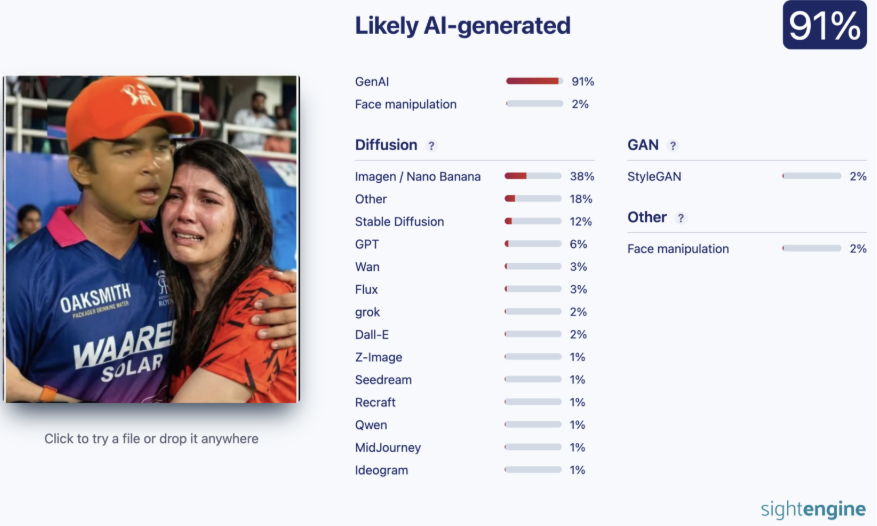
A picture allegedly showing Sunrisers Hyderabad (SRH) owner Kavya Maran emotionally hugging young cricketer Vaibhav Suryavanshi has gone viral on social media. The image is being shared as a genuine photograph from a cricket-related event, with users claiming that Kavya Maran was seen embracing Vaibhav Suryavanshi. However, CyberPeace Research Wing research found the claim to be false. No credible news reports, official statements, or authentic photographs support the incident depicted in the viral image.
Claim
A Facebook user shared the viral image with the caption: “Kavya Maran Hug Vaibhav Suryavanshi 🥰🔥 #cricketnews #RRvsSRH” The link to the post and its screenshot are provided below.

Fact Check
During the research, we found no credible news reports, official statements, or authentic images confirming that Kavya Maran hugged Vaibhav Suryavanshi as shown in the viral picture. To further verify the image, it was analysed using AI detection tools, including Sightengine and Hive Moderation. Both tools indicated a high probability that the image was generated using Artificial Intelligence. The findings suggest that the viral photograph is not a genuine image captured at a real event but a digitally created visual.

Conclusion
Our research found that the viral image showing Kavya Maran emotionally hugging Vaibhav Suryavanshi is not authentic. The picture was generated using AI and does not depict a real incident.

Related Blogs

Introduction
Attempts at countering the spread of misinformation can include various methods and differing degrees of engagement by different stakeholders. The inclusion of Artificial Intelligence, user awareness and steps taken on the part of the public at a larger level, focus on innovation to facilitate clear communication can be considered in the fight to counter misinformation. This becomes even more important in spaces that deal with matters of national security, such as the Indian army.
IIT Indore’s Intelligent Communication System
As per a report in Hindustan Times on 14th November 2024, IIT Indore has achieved a breakthrough on their project regarding Intelligent Communication Systems. The project is supported by the Department of Telecommunications (DoT), the Ministry of Electronics and Information Technology (MeitY), and the Council of Scientific and Industrial Research (CSIR), as part of a specialised 6G research initiative (Bharat 6G Alliance) for innovation in 6G technology.
Professors at IIT Indore claim that the system they are working on has features different from the ones currently in use. They state that the receiver system can recognise coding, interleaving (a technique used to enhance existing error-correcting codes), and modulation methods together in situations of difficult environments, which makes it useful for transmitting information efficiently and securely, and thus could not only be used for telecommunication but the army as well. They also mention that previously, different receivers were required for different scenarios, however, they aim to build a system that has a single receiver that can adapt to any situation.
Previously, in another move that addressed the issue of misinformation in the army, the Ministry of Defence designated the Additional Directorate General of Strategic Communication in the Indian Army as the authorised officer to issue take-down notices regarding instances of posts consisting of illegal content and misinformation concerning the Army.
Recommendations
Here are a few policy implications and deliberations one can explore with respect to innovations geared toward tackling misinformation within the army:
- Research and Development: In this context, investment and research in better communication through institutes have enabled a system that ensures encrypted and secure communication, which helps with ways to combat misinformation for the army.
- Strategic Deployment: Relevant innovations can focus on having separate pilot studies testing sensitive data in the military areas to assess their effectiveness.
- Standardisation: Once tested, a set parameter of standards regarding the intelligence communication systems used can be encouraged.
- Cybersecurity integration: As misinformation is largely spread online, innovation in such fields can encourage further exploration with regard to integration with Cybersecurity.
Conclusion
The spread of misinformation during modern warfare can have severe repercussions. Sensitive and clear data is crucial for safe and efficient communication as a lot is at stake. Innovations that are geared toward combating such issues must be encouraged, for they not only ensure efficiency and security with matters related to defence but also combat misinformation as a whole.
References
- https://timesofindia.indiatimes.com/city/indore/iit-indore-unveils-groundbreaking-intelligent-receivers-for-enhanced-6g-and-military-communication-security/articleshow/115265902.cms
- https://www.hindustantimes.com/technology/6g-technology-and-intelligent-receivers-will-ease-way-for-army-intelligence-operations-iit-official-101731574418660.html

Introduction
Significantly, in March 2023, the Prevention of Money Laundering Act, 2002's regulations placed Virtual Digital Asset Service Providers functioning located under the purview of the Anti Money Laundering/Counter Financing of Terrorism (AML-CFT) scheme. An important step toward controlling VDA SP operations and guaranteeing adherence to Anti-Money Laundering and Combating the Financing of Terrorism (AML-CFT) regulations.
The significance of AML-CFT procedures
The AML-CFT framework's incorporation of Virtual Digital Asset Service Providers (VDA SPs) is essential for protecting the banking industry from illegal activities including the laundering of funds and counter-financing of terrorist attacks. These regulations become more crucial as the market for digital assets develops and becomes more well-known.
The practice of money laundering is hiding the source of the sum received illegally, thus it's critical to have strict policies in place to track down and stop these kinds of operations. Furthermore, funding for terrorism is a serious danger to international safety, hence stopping the flow of money to terrorist companies is a top concern for global officials.
The goal of policymakers' move to include VDA SPs in the AML-CFT architecture is to set up control and surveillance procedures that will guarantee these organisations' open and honest operations. This involves tracking transactions, flagging questionable activity, and conducting extensive customer investigations. Incorporating such procedures not only reduces the potential for financial crimes but also builds confidence and trust in the electronic asset market.
It is important to see the significance of AML-CFT procedures and the changes in the legal framework to reflect the evolving characteristics of digital currencies. These procedures are essential to preserving the reliability and safety of the wider banking system.
Notifications of Compliance Show Cause
Under Section 13 of the PMLA Act 2002, FIU IND sent adherence Show Cause Notices to nine offshore Virtual Digital Asset Service Providers (VDA SPs) as part of its dedication to upholding compliance with regulations. This affirmative step requires organisations to be scrutinised and attempted to bring them under inspection.
Governmental Response
The Director of FIU IND has addressed the Secretary of the Ministry of Electronics and Information Technology to take further measures due to the disregard of offshore firms. According to the notification, URLs connected to these organisations that operate in India in violation of the PML Act's requirements must be blocked.
Mandatory Registration for VDA SPs
Virtual Digital Asset Service Providers (both onshore and offshore) who perform a range of operations, including the trading of digital goods for monetary currencies, the distribution of digital currency, and the management or preservation of electronic assets, are now obliged to register with FIU.
Range of Statutory Responsibilities
In accordance with the PML Act, VDA SPs are subject to several requirements, including documentation, disclosure, and other duties. One of their responsibilities is to register with the FIU IND. The primary focus is on guaranteeing that VDA SPs comply with AML-CFT protocols, hence enhancing the general reliability of the banking industry.
Difficulties with Offshore Compliance
There are many obstacles in guaranteeing that offshore organisations comply with Anti Money Laundering/Counter Financing of Terrorism (AML-CFT), chief amongst them being their unwillingness to undergo registration. Some overseas Virtual Digital Asset Service Providers (VDA SPs) have been reluctant to comply with the existing rules and regulations, even though they cater to a significant number of Indian users. There are several reasons for this hesitation, such as worries about heightened monitoring, the expense of compliance, and the apparent complexity of governmental processes. Regulatory organisations have taken steps to close the discrepancy between offshore businesses' real activities and the regulations they must follow. In addition to maintaining the trustworthiness of the economic system, resolving the issues with offshore adherence is essential for promoting confidence and openness in the market for electronic assets.
Conclusion
FIU IND has demonstrated its dedication to creating an effective regulatory framework for Virtual Digital Asset Service Providers through its recent measures. India hopes to fortify its countermeasures against money laundering and safeguard the financial well-being of its users by expanding the AML-CFT legislation to offshore firms. The continuous efforts to restrict the URLs of non-compliant companies show a proactive approach to stopping illicit activity and fostering a safe and law-abiding virtual asset ecosystem. The safety and soundness of the banking sector will be crucially maintained by laws and regulations as the digital world develops.
References
- https://pib.gov.in/PressReleasePage.aspx?PRID=1991372
- https://www.thehindubusinessline.com/books/reviews/business-economy/fiu-ind-issues-compliance-showcause-notices-to-nine-offshore-vda-sps/article67684613.ece
- https://business.outlookindia.com/news/fiu-issues-notice-to-9-offshore-crypto-platforms-writes-to-meity-for-blocking-of-urls
%203rd%20Sep%2C%202025.webp)
In the past decade, India’s gaming sector has seen a surprising but swift advancement, which brought along millions of players and over billions in investments and has even been estimated to be at $23 billion. Whether it's fantasy cricket and Ludo apps, high-stakes poker, or rummy platforms, investing real money in online gaming and gambling has become a beloved hobby for many. Moreover, it not only gave a boost to the economy but also contributed to creative innovation and the generation of employment.
The real concern lies behind the glossy numbers, tales of addiction, financial detriment, and the never-ending game of cat and mouse with legal loopholes. The sector’s meteoric rise has raised various concerns relating to national financial integrity, regulatory clarity and consumer safety.
In light of this, the Promotion and Regulation of Online Gaming Act, 2025, which was passed by Parliament and signed into law on August 22, stands out as a significant development. The Act, which is positioned as a consumer protection and sector-defining law, aims to distinguish between innovation and exploitation by acknowledging e-sport as a legitimate activity and establishing unambiguous boundaries around the larger gaming industry.
Key Highlights of the Act
- Complete Ban on all games involving Real-Money: All e-games, whether based on skill or luck, that involve monetary stakes have been banned.
- Prohibition of Ads: Promotion of such e-games has also been disallowed across all platforms.
- Legal Ramifications: Operation of such games may lead to up to 3 years in prison with a 1 cr fine; Advertisement for the same may lead to up to 2 years in prison with a 50 lakh fine. However, in case of repeat offences, this may go up to 3-5 years in prison and 2 cr in fines.
- Creation of Online Gaming Authority: The creation of a national-level regulatory body to classify and monitor games, register platforms and enforce the dedicated rules.
- Support for eSports and Social & Educational games: All kinds of games that are non-monetary, promote social and educational growth, will not only be recognised but encouraged. Meanwhile, eSports will also gain official recognition under the Ministry of Sports.
Positive Impacts
- Addressal & Tackling of Addiction and Financial Ruin: The major reason behind the ban is to reduce the cases of players, mainly youth, getting into gambling and losing huge amounts of money to betting apps and games, and to protect vulnerable users
- Boost to eSports & Regulatory Clarity: The law not only legitimises the eSport sector but also provides opportunities for scholarship and other financial benefits, along with windows for professional tournaments and platforms on global stages. Along with this aims to bring about an order around e-games of skill versus luck.
- Fraud Monitoring & Control: The law makes sure to block off avenues for money laundering, gambling and illegal betting networks.
- Promotion of Safe Digital Ecosystem: Encouraging social, developmental and educational games to focus on skill, learning and fun.
Challenges
The fact that the Promotion and Regulation of Online Gaming Act, 2025 is still in its early stages, which must be recognised. In the end, its effectiveness will rely not only on the letter of the law but on the strength of its enforcement and the wisdom of its application. The Act has the potential to safeguard the interests of at-risk youth from the dangers of gambling and its addiction, if it is applied carefully and clearly, all the while maintaining the digital ecosystem as a place of innovation, equity, and trust.
- Blanket Ban: By imposing a blanket ban on games that have long been justified as skill-based like rummy or fantasy cricket, the Act runs the risk of suppressing respectable enterprises and centres of innovation. Many startups that were once hailed for being at the forefront of India’s digital innovation may now find it difficult to thrive in an unpredictable regulatory environment.
- Rise of Illegal Platforms: History offers a sobering lesson, prohibition does not eliminate demand, it simply drives it underground. The prohibition of money games may encourage the growth of unregulated, offshore sites, where players are more vulnerable to fraud, data theft, and abuse and have no way to seek consumer protection.
Conclusion
The Act is definitely a tough and bold stand to check and regulate India’s digital gaming industry, but it is also a double-edged sword. It brings in much-needed consumer protection regulations in place and legitimises e-Sports. However, it also casts a long shadow over a successful economy and runs the risk of fostering a black market that is more harmful than the issue it was intended to address.
Therefore, striking a balance between innovation and protection, between law and liberty, will be considered more important in the coming years than the success of regulations alone. India’s legitimacy as a digital economy ready for global leadership, as well as the future of its gaming industry, will depend on how it handles this delicate balance.
References:
- https://economictimes.indiatimes.com/tech/technology/gaming-bodies-write-to-amit-shah-urge-to-block-blanket-ban-warn-of-rs-20000-crore-tax-loss/articleshow/123392342.cms
- https://m.economictimes.com/news/india/govt-estimates-45-cr-people-lose-about-rs-20000-cr-annually-from-real-money-gaming/articleshow/123408237.cms
- https://www.cyberpeace.org/resources/blogs/promotion-and-regulation-of-online-gaming-bill-2025-gets-green-flag-from-both-houses-of-parliament
- https://www.thehindu.com/business/Industry/real-money-gaming-firms-wind-down-operations/article69965196.ece
