
#FactCheck-Viral Video of Crying Girl Amid Floodwaters Is AI-Generated, Not From Nepal
Executive Summary
A video is being shared on social media showing a little girl crying while holding onto a pole amid muddy water covering a road. The video is being shared with the claim that it shows the situation during the recent floods in Nepal. A research by CyberPeace’s Research Wing found the viral claim to be false. Our research revealed that the viral video is AI-generated and is being shared with a misleading claim.
Claim:
A user on the social media platform Instagram shared the viral video with the caption: “The situation in Nepal looks extremely frightening after the floods. Floodwater has covered the area, and the frightened face of a little girl amid the water is moving everyone emotionally. Seeing the innocent girl’s condition in this difficult situation has raised concerns among people.”
https://www.instagram.com/reels/DctRY9OF0Th/

Fact Check
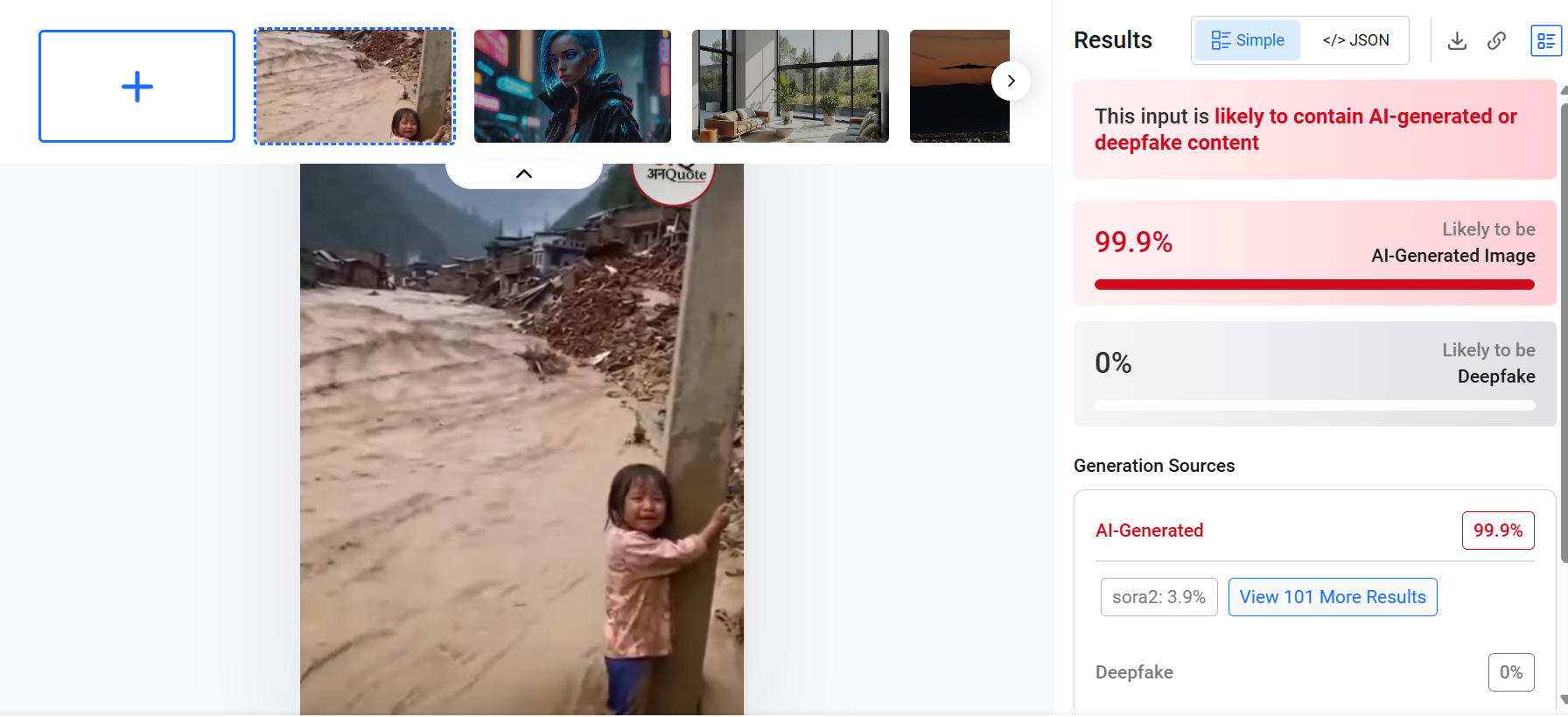
A reverse image search of keyframes from the viral video on Google did not yield any credible media reports related to the video. Upon closely examining the viral video, we suspected that it might be AI-generated. We subsequently scanned the video using the AI detection tool Hive Moderation. According to the results, the video has a 99 percent probability of being AI-generated.
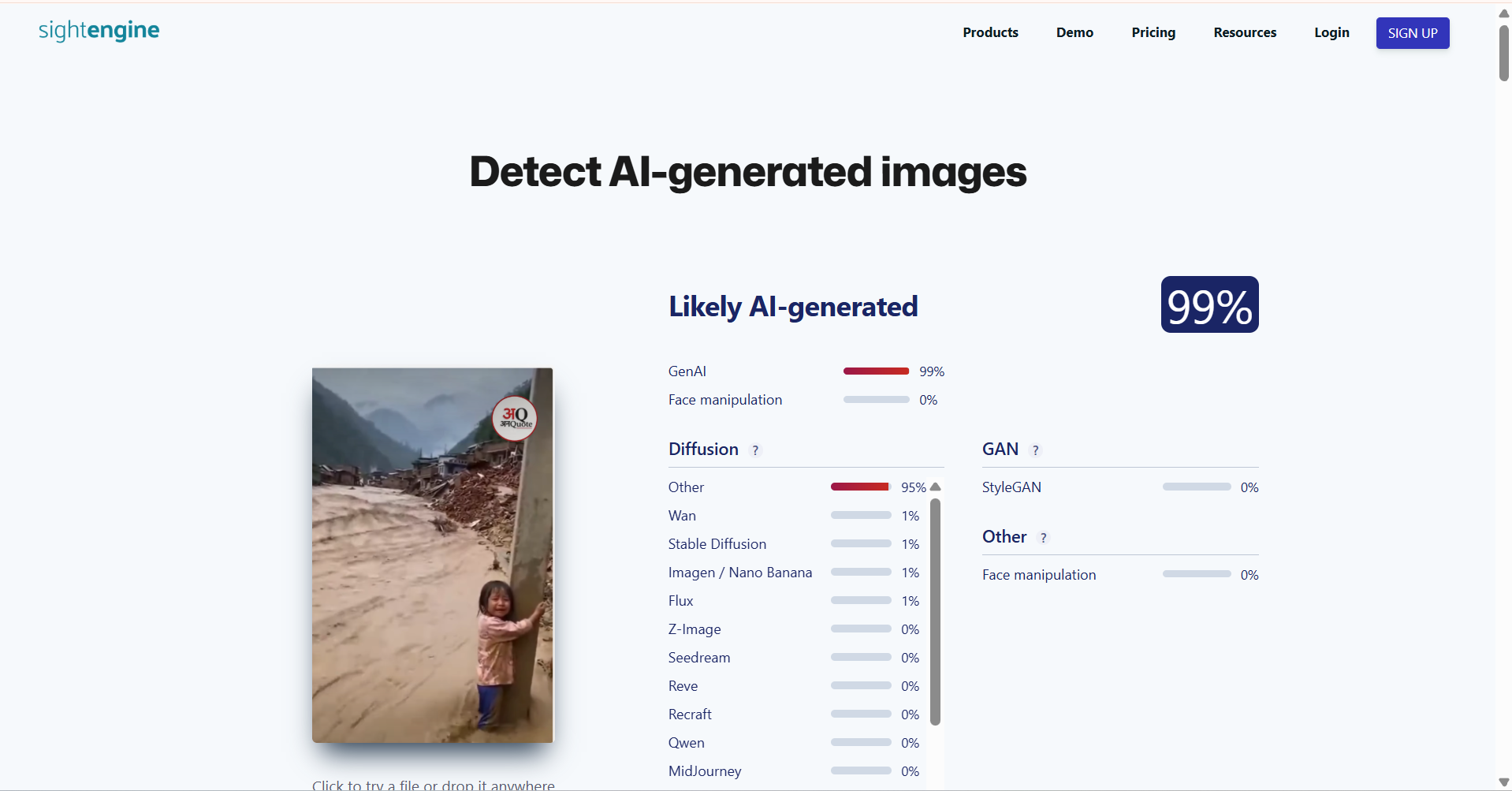
As part of the next step of ourresearch, we scanned the viral video using another AI detection tool, Sightengine. According to the results, the video has a 99 percent probability of being AI-generated.
Conclusion
Our research found that the viral video is AI-generated and is being shared with a misleading claim.

Related Blogs

Executive Summary:
A photoshopped image circulating online suggests Prime Minister Narendra Modi met with militant leader Hafiz Saeed. The actual photograph features PM Modi greeting former Pakistani Prime Minister Nawaz Sharif during a surprise diplomatic stopover in Lahore on December 25, 2015.
The Claim:
A widely shared image on social media purportedly shows PM Modi meeting Hafiz Saeed, a declared terrorist. The claim implies Modi is hostile towards India or aligned with terrorists.

Fact Check:
On our research and reverse image search we found that the Press Information Bureau (PIB) had tweeted about the visit on 25 December 2015, noting that PM Narendra Modi was warmly welcomed by then-Pakistani PM Nawaz Sharif in Lahore. The tweet included several images from various angles of the original meeting between Modi and Sharif. On the same day, PM Modi also posted a tweet stating he had spoken with Nawaz Sharif and extended birthday wishes. Additionally, no credible reports of any meeting between Modi and Hafiz Saeed, further validating that the viral image is digitally altered.


In our further research we found an identical photo, with former Pakistan Prime Minister Nawaz Sharif in place of Hafiz Saeed. This post was shared by Hindustan Times on X on 26 December 2015, pointing to the possibility that the viral image has been manipulated.
Conclusion:
The viral image claiming to show PM Modi with Hafiz Saeed is digitally manipulated. A reverse image search and official posts from the PIB and PM Modi confirm the original photo was taken during Modi’s visit to Lahore in December 2015, where he met Nawaz Sharif. No credible source supports any meeting between Modi and Hafiz Saeed, clearly proving the image is fake.
- Claim: Debunking the Edited Image Claim of PM Modi with Hafiz Saeed
- Claimed On: Social Media
- Fact Check: False and Misleading
Introduction
In 2025, the internet is entering a new paradigm and it is hard not to witness it. The internet as we know it is rapidly changing into a treasure trove of hyper-optimised material over which vast bot armies battle to the death, thanks to the amazing advancements in artificial intelligence. All of that advancement, however, has a price, primarily in human lives. It turns out that releasing highly personalised chatbots on a populace that is already struggling with economic stagnation, terminal loneliness, and the ongoing destruction of our planet isn’t exactly a formula for improved mental health. This is the truth of 75% of the kids and teen population who have had chats with chatbot-generated fictitious characters. AI, or artificial intelligence, Chatbots are becoming more and more integrated into our daily lives, assisting us with customer service, entertainment, healthcare, and education. But as the impact of these instruments grows, accountability and moral behaviour become more important. An investigation of the internal policies of a major international tech firm last year exposed alarming gaps: AI chatbots were allowed to create content with child romantic roleplaying, racially discriminatory reasoning, and spurious medical claims. Although the firm has since amended aspects of these rules, the exposé underscores an underlying global dilemma - how can we regulate AI to maintain child safety, guard against misinformation, and adhere to ethical considerations without suppressing innovation?
The Guidelines and Their Gaps
The tech giants like Meta and Google are often reprimanded for overlooking Child Safety and the overall increase in Mental health issues in children and adolescents. According to reports, Google introduced Gemini AI kids, a kid-friendly version of its Gemini AI chatbot, which represents a major advancement in the incorporation of generative artificial intelligence (Gen-AI) into early schooling. Users under the age of thirteen can use supervised accounts on the Family Link app to access this version of Gemini AI Kids.
AI operates on the premise of data collection and analysis. To safeguard children’s personal information in the digital world, the Digital Personal Data Protection Act, 2023 (DPDP Act) introduces particular safeguards. According to Section 9, before processing the data of children, who are defined as people under the age of 18, Data Fiduciaries, entities that decide the goals and methods of processing personal data, must get verified consent from a parent or legal guardian. Furthermore, the Act expressly forbids processing activities that could endanger a child’s welfare, such as behavioural surveillance and child-targeted advertising. According to court interpretations, a child's well-being includes not just medical care but also their moral, ethical, and emotional growth.
While the DPDP Act is a big start in the right direction, there are still important lacunae in how it addresses AI and Child Safety. Age-gating systems, thorough risk rating, and limitations specific to AI-driven platforms are absent from the Act, which largely concentrates on consent and damage prevention in data protection. Furthermore, it ignores the threats to children’s emotional safety or the long-term psychological effects of interacting with generative AI models. Current safeguards are self-regulatory in nature and dispersed across several laws, such as the Bhartiya Nyaya Sanhita, 2023. These include platform disclaimers, technology-based detection of child-sexual abuse content, and measures under the IT (Intermediary Guidelines and Digital Media Ethics Code) Rules, 2021.
Child Safety and AI
- The Risks of Romantic Roleplay - Enabling chatbots to engage in romantic roleplaying with youngsters is among the most concerning discoveries. These interactions can result in grooming, psychological trauma, and relaxation to inappropriate behaviour, even if they are not explicitly sexual. Having illicit or sexual conversations with kids in cyberspace is unacceptable, according to child protection experts. However, permitting even "flirtatious" conversation could normalise risky boundaries.
- International Standards and Best Practices - The concept of "safety by design" is highly valued in child online safety guidelines from around the world, including UNICEF's Child Online Protection Guidelines and the UK's Online Safety Bill. This mandating of platforms and developers to proactively remove risks, not reactively to respond to harms, is the bare minimum standard that any AI guidelines must meet if they provide loopholes for child-directed roleplay.
Misinformation and Racism in AI Outputs
- The Disinformation Dilemma - The regulations also allowed AI to create fictional narratives with disclaimers. For example, chatbots were able to write articles promulgating false health claims or smears against public officials, as long as they were labelled as "untrue." While disclaimers might give thin legal cover, they add to the proliferation of misleading information. Indeed, misinformation tends to spread extensively because users disregard caveat labels in favour of provocative assertions.
- Ethical Lines and Discriminatory Content - It is ethically questionable to allow AI systems to generate racist arguments, even when requested. Though scholarly research into prejudice and bias may necessitate such examples, unregulated generation has the potential to normalise damaging stereotypes. Researchers warn that such practice brings platforms from being passive hosts of offensive speech to active generators of discriminatory content. It is a difference that makes a difference, as it places responsibility squarely on developers and corporations.
The Broader Governance Challenge
- Corporate Responsibility and AI Material generated by AI is not equivalent to user speech—it is a direct reflection of corporate training, policy decisions, and system engineering. This fact requires a greater level of accountability. Although companies can update guidelines following public criticism, that there were such allowances in the first place indicates a lack of strong ethical regulation.
- Regulatory Gaps Regulatory regimes for AI are currently in disarray. The EU AI Act, the OECD AI Principles, and national policies all emphasise human rights, transparency, and accountability. The few, though, specify clear guidelines for content risks such as child roleplay or hate narratives. This absence of harmonised international rules leaves companies acting in the shadows, establishing their own limits until contradicted.
An active way forward would include
- Express Child Protection Requirements: AI systems must categorically prohibit interactions with children involving flirting or romance.
- Misinformation Protections: Generative AI must not be allowed to generate knowingly false material, disclaimers being irrelevant.
- Bias Reduction: Developers need to proactively train systems against generating discriminatory accounts, not merely tag them as optional outputs.
- Independent Regulation: External audit and ethics review boards can supply transparency and accountability independent of internal company regulations.
Conclusion
The guidelines that are often contentious are more than the internal folly of just one firm; they point to a deeper systemic issue in AI regulation. The stakes rise as generative AI becomes more and more integrated into politics, healthcare, education, and social interaction. Racism, false information, and inadequate child safety measures are severe issues that require quick resolution. Corporate regulation is only one aspect of the future; other elements include multi-stakeholder participation, stronger global systems, and ethical standards. In the end, rather than just corporate interests, trust in artificial neural networks will be based on their ability to preserve the truth, protect the weak, and represent universal human values.
References
- https://www.esafety.gov.au/newsroom/blogs/ai-chatbots-and-companions-risks-to-children-and-young-people
- https://www.lakshmisri.com/insights/articles/ai-for-children/#
- https://the420.in/meta-ai-chatbot-guidelines-child-safety-racism-misinformation/
- https://www.unicef.org/documents/guidelines-industry-online-child-protection
- https://www.oecd.org/en/topics/sub-issues/ai-principles.html
- https://artificialintelligenceact.eu/

Introduction
In the dynamic realm of online gaming, where virtual worlds and competitive landscapes converge, ensuring the safety of players has become an imperative task. As the digital gaming community expands, so do the challenges of navigating potential risks and threats. There is a need for crucial strategies and measures aimed at safeguarding players and fostering a secure environment where gamers can fully immerse themselves in their passion without compromising their well-being. Online gaming, a thriving industry, makes gamers attractive targets for cyber theft, including account takeovers (ATO). ATO involves stealing characters, inventory, in-game currencies, achievements, and skins, with high-level accounts as prime targets. Gamers face real-life consequences as fraud within games can compromise personal information, including location, credentials, credit card details, and more. Protecting oneself involves maintaining privacy in sharing information, enabling two-factor authentication, and employing strong, unique passwords with security solutions that provide additional safeguards for an uninterrupted gaming experience.
Online Gaming Carries The Following Major Risks
Viruses and malware: Searching for less expensive or free downloads of your preferred games puts you in danger of accidentally downloading malware and viruses.
Theft of identity: Hackers gather information that is personally identifiable to create victimised identities. The chat feature is one of the possible risks of playing video games online with random people.
Invasion of a profile: It's not advisable to use an identical password and username across all of your preferred video game platforms since if hackers manage to obtain your login information, they may hack all of your player accounts and perhaps take control of them.
Swatting and doxing: Doxxing is the practice of hackers publishing your residential location or telephone number online after obtaining your private data. Swatting is a dangerous harassment tactic originating from online gaming, involving false emergency reports to provoke an excessive police response at the unsuspecting victim's location.
How Hacking Poses Serious Risks to Online Gaming Security
The video game industry has experienced rapid growth in recent times, catering to millions of players throughout the globe who relish an extensive array of engaging adventures. But because of its widespread use, hackers are now more likely to target it in an attempt to take advantage of its weaknesses.
Hackers are drawn to the gaming business for a number of reasons.
Due to its enormous income potential, this sector is an appealing option for investment. Players' large audience offers a treasure trove of private data that can be used for fraudulent transactions and other nefarious activities. Because of its high exposure, the sector is a tempting target for attackers looking to achieve recognition or make an impression. Customers wish to add modifications, cheats, or other external software to their contest, which increases the threat. In this sector, there is fierce competition, and winners take home large cash awards. This encourages players to use DDoS attacks to their advantage in order to outperform their rivals.
Importance of Secure Servers
Upgrade server applications and Modifications
Maintaining the most recent versions of all server software is a basic step in gaming server security. Updates and patches are regularly released by developers to address security flaws, therefore it's imperative to install them right away. If you ignore updates, your server becomes vulnerable to known vulnerabilities and a prime target for cybercriminals.
Put Strict Access Controls in Place
It is essential to manage who has permission to access your gaming system to avoid violations and unwanted access. Use strong password regulations and mandate complicated passwords for administrators on the system.
Two-factor authentication (2FA) into place
Restrict access rights to those who need them for administrative tasks to lessen the possibility of unlicensed individuals taking over a server.Safety Measures Players should be urged to adhere to best practices, which include:
Using secure passwords.
Avoid clicking on dubious links.
Updating software & apps regularly.
Upgrading antivirus software regularlyImproving cybersecurity practices and bringing attention to possible risks can greatly improve the general population's safety in gaming.
Conclusion
The internet gaming industry's rapid expansion has resulted in increased security threats in addition to recreation. Players confront various threats, including growing hacking attempts, sensitive information leaks, malware, identity theft, and doxing. To reduce these dangers, secure servers are essential. They emphasise the importance of frequent upgrades, restricting access, and user training. It becomes essential to enable security measures to keep ahead of emerging dangers. Enhancing safety measures guarantees a more secure gaming environment, safeguarding the large population that participates in this quickly changing digital space.
References
https://www.kaspersky.com/resource-center/threats/top-10-online-gaming-risks
https://www.imperva.com/blog/cyber-attacks-gaming-industry/
https://www.techslang.com/securing-gaming-servers-cybersecurity-best-practices-for-online-gaming-communities/
https://www.vox.com/policy-and-politics/2018/1/13/16888710/barris-swatting-death-charges
