
#FactCheck-Viral Video Claiming to Show Flooded Chapra Railway Station Is AI-Generated
Executive Summary
A video is being shared on social media showing a railway station completely submerged in water. The video is being shared with the claim that it shows Chapra Railway Station in Bihar, where severe waterlogging occurred following heavy rainfall. The water level in the video appears so high that even the platforms are not visible. A research done by the Research Wing of the CyberPeace found the viral claim to be false. Our research revealed that the viral video is AI-generated and is being shared on social media with a misleading claim.
Claim:
A user on the social media platform Facebook shared the viral video on August 31, 2026, claiming that Chapra Railway Station had been inundated. The link to the post, archived link, and screenshots are provided below.
https://www.facebook.com/reel/1393870102719178

Fact Check
To debunk the viral claim, we searched Google using relevant keywords. However, we could not find any credible media reports confirming the claim. As the next step in our research, we also checked the status of trains arriving at and departing from Chapra Railway Station. We reasoned that if the station had actually been submerged to the extent shown in the video, rail operations would likely have been disrupted and some trains might have been cancelled. However, our research found no information about any train operating from Chapra being cancelled.

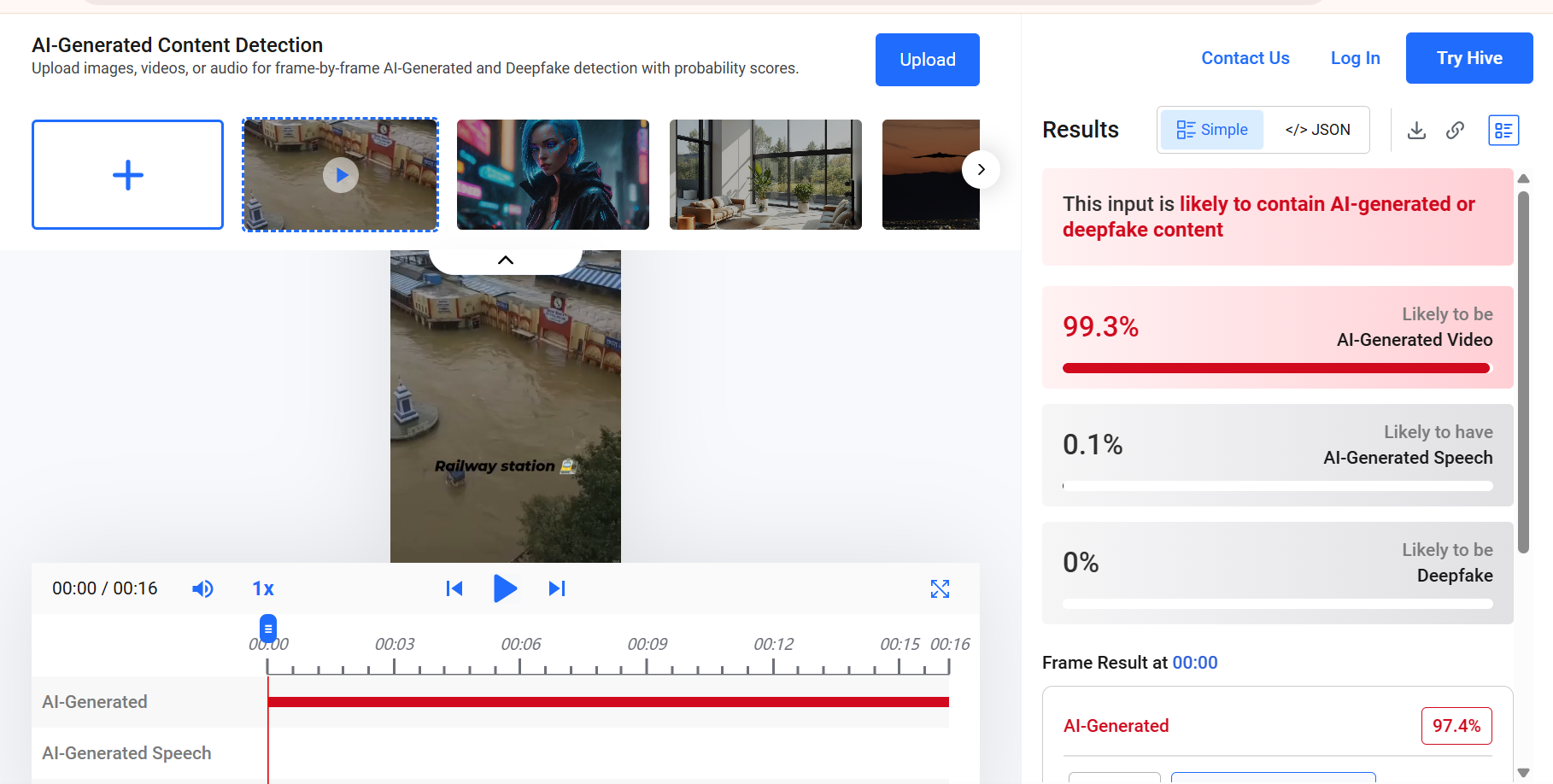
Upon closely examining the viral video, we suspected that it might be AI-generated. We subsequently scanned the video using the AI detection tool Hive Moderation. According to the tool’s results, the viral video was found to be 99 percent AI-generated.
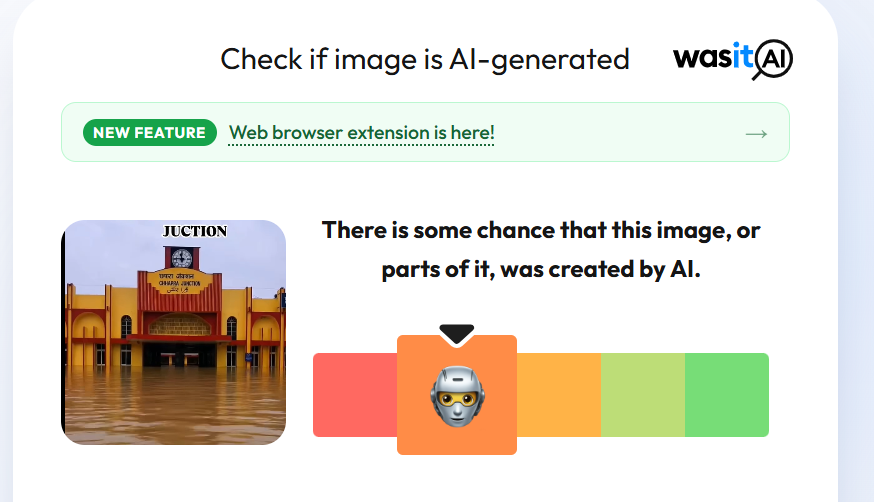
As part of the next step of our research, we scanned the viral video using another AI detection tool, Wasitai AI. According to the tool’s results, the viral video is AI-generated.
Conclusion
Our research found that the viral video is AI-generated and is being shared on social media with a misleading claim.

Related Blogs

THREE CENTRES OF EXCELLENCE IN ARTIFICIAL INTELLIGENCE:
India’s Finance Minister, Mrs. Nirmala Sitharaman, with a vision of ‘Make AI for India’ and ‘Make AI work for India, ’ announced during the presentation of Union Budget 2023 that the Indian Government is planning to set up three ‘Centre of Excellence’ for Artificial Intelligence in top Educational Institutions to revolutionise fields such as health, agriculture, etc.
Under the ‘Amirt Kaal,’ i.e., the budget of 2023 is a stepping stone by the government to have a technology-driven knowledge-based economy and the seven priorities that have been set up by the government called ‘Saptarishi’ such as inclusive development, reaching the last mile, infrastructure investment, unleashing potential, green growth, youth power, and financial sector will guide the nation in this endeavor along with leading industry players that will partner in conducting interdisciplinary research, developing cutting edge applications and scalable problem solutions in such areas.
The government has already formed the roadmap for AI in the nation through MeitY, NASSCOM, and DRDO, indicating that the government has already started this AI revolution. For AI-related research and development, the Centre for Artificial Intelligence and Robotics (CAIR) has already been formed, and biometric identification, facial recognition, criminal investigation, crowd and traffic management, agriculture, healthcare, education, and other applications of AI are currently being used.
Even a task force on artificial intelligence (AI) was established on August 24, 2017. The government had promised to set up Centers of Excellence (CoEs) for research, education, and skill development in robotics, artificial intelligence (AI), digital manufacturing, big data analytics, quantum communication, and the Internet of Things (IoT) and by announcing the same in the current Union budget has planned to fulfill the same.
The government has also announced the development of 100 labs in engineering institutions for developing applications using 5G services that will collaborate with various authorities, regulators, banks, and other businesses.
Developing such labs aims to create new business models and employment opportunities. Among others, it will also create smart classrooms, precision farming, intelligent transport systems, and healthcare applications, as well as new pedagogy, curriculum, continual professional development dipstick survey, and ICT implementation will be introduced for training the teachers.
POSSIBLE ROLES OF AI:
The use of AI in top educational institutions will help students to learn at their own pace, using AI algorithms providing customised feedback and recommendations based on their performance, as it can also help students identify their strengths and weaknesses, allowing them to focus their study efforts more effectively and efficiently and will help train students in AI and make the country future-ready.
The main area of AI in healthcare, agriculture, and sustainable cities would be researching and developing practical AI applications in these sectors. In healthcare, AI can be effective by helping medical professionals diagnose diseases faster and more accurately by analysing medical images and patient data. It can also be used to identify the most effective treatments for specific patients based on their genetic and medical history.
Artificial Intelligence (AI) has the potential to revolutionise the agriculture industry by improving yields, reducing costs, and increasing efficiency. AI algorithms can collect and analyse data on soil moisture, crop health, and weather patterns to optimise crop management practices, improve yields and the health and well-being of livestock, predict potential health issues, and increase productivity. These algorithms can identify and target weeds and pests, reducing the need for harmful chemicals and increasing sustainability.
ROLE OF AI IN CYBERSPACE:
Artificial Intelligence (AI) plays a crucial role in cyberspace. AI technology can enhance security in cyberspace, prevent cyber-attacks, detect and respond to security threats, and improve overall cybersecurity. Some of the specific applications of AI in cyberspace include:
- Intrusion Detection: AI-powered systems can analyse large amounts of data and detect signs of potential cyber-attacks.
- Threat Analysis: AI algorithms can help identify patterns of behaviour that may indicate a potential threat and then take appropriate action.
- Fraud Detection: AI can identify and prevent fraudulent activities, such as identity theft and phishing, by analysing large amounts of data and detecting unusual behaviour patterns.
- Network Security: AI can monitor and secure networks against potential cyber-attacks by detecting and blocking malicious traffic.
- Data Security: AI can be used to protect sensitive data and ensure that it is only accessible to authorised personnel.
CONCLUSION:
Introducing AI in top educational institutions and partnering it with leading industries will prove to be a stepping stone to revolutionise the development of the country, as Artificial Intelligence (AI) has the potential to play a significant role in the development of a country by improving various sectors and addressing societal challenges. Overall, we hope to see an increase in efficiency and productivity across various industries, leading to increased economic growth and job creation, improved delivery of healthcare services by increasing access to care and, improving patient outcomes, making education more accessible and effective as AI has the potential to improve various sectors of a country and contribute to its overall development and progress. However, it’s important to ensure that AI is developed and used ethically, considering its potential consequences and impact on society.
References:

Introduction
Prebunking is a technique that shifts the focus from directly challenging falsehoods or telling people what they need to believe to understanding how people are manipulated and misled online to begin with. It is a growing field of research that aims to help people resist persuasion by misinformation. Prebunking, or "attitudinal inoculation," is a way to teach people to spot and resist manipulative messages before they happen. The crux of the approach is rooted in taking a step backwards and nipping the problem in the bud by deepening our understanding of it, instead of designing redressal mechanisms to tackle it after the fact. It has been proven effective in helping a wide range of people build resilience to misleading information.
Prebunking is a psychological strategy for countering the effect of misinformation with the goal of assisting individuals in identifying and resisting deceptive content, hence increasing resilience against future misinformation. Online manipulation is a complex issue, and multiple approaches are needed to curb its worst effects. Prebunking provides an opportunity to get ahead of online manipulation, providing a layer of protection before individuals encounter malicious content. Prebunking aids individuals in discerning and refuting misleading arguments, thus enabling them to resist a variety of online manipulations.
Prebunking builds mental defenses for misinformation by providing warnings and counterarguments before people encounter malicious content. Inoculating people against false or misleading information is a powerful and effective method for building trust and understanding along with a personal capacity for discernment and fact-checking. Prebunking teaches people how to separate facts from myths by teaching them the importance of thinking in terms of ‘how you know what you know’ and consensus-building. Prebunking uses examples and case studies to explain the types and risks of misinformation so that individuals can apply these learnings to reject false claims and manipulation in the future as well.
How Prebunking Helps Individuals Spot Manipulative Messages
Prebunking helps individuals identify manipulative messages by providing them with the necessary tools and knowledge to recognize common techniques used to spread misinformation. Successful prebunking strategies include;
- Warnings;
- Preemptive Refutation: It explains the narrative/technique and how particular information is manipulative in structure. The Inoculation treatment messages typically include 2-3 counterarguments and their refutations. An effective rebuttal provides the viewer with skills to fight any erroneous or misleading information they may encounter in the future.
- Micro-dosing: A weakened or practical example of misinformation that is innocuous.
All these alert individuals to potential manipulation attempts. Prebunking also offers weakened examples of misinformation, allowing individuals to practice identifying deceptive content. It activates mental defenses, preparing individuals to resist persuasion attempts. Misinformation can exploit cognitive biases: people tend to put a lot of faith in things they’ve heard repeatedly - a fact that malicious actors manipulate by flooding the Internet with their claims to help legitimise them by creating familiarity. The ‘prebunking’ technique helps to create resilience against misinformation and protects our minds from the harmful effects of misinformation.
Prebunking essentially helps people control the information they consume by teaching them how to discern between accurate and deceptive content. It enables one to develop critical thinking skills, evaluate sources adequately and identify red flags. By incorporating these components and strategies, prebunking enhances the ability to spot manipulative messages, resist deceptive narratives, and make informed decisions when navigating the very dynamic and complex information landscape online.
CyberPeace Policy Recommendations
- Preventing and fighting misinformation necessitates joint efforts between different stakeholders. The government and policymakers should sponsor prebunking initiatives and information literacy programmes to counter misinformation and adopt systematic approaches. Regulatory frameworks should encourage accountability in the dissemination of online information on various platforms. Collaboration with educational institutions, technological companies and civil society organisations can assist in the implementation of prebunking techniques in a variety of areas.
- Higher educational institutions should support prebunking and media literacy and offer professional development opportunities for educators, and scholars by working with academics and professionals on the subject of misinformation by producing research studies on the grey areas and challenges associated with misinformation.
- Technological companies and social media platforms should improve algorithm transparency, create user-friendly tools and resources, and work with fact-checking organisations to incorporate fact-check labels and tools.
- Civil society organisations and NGOs should promote digital literacy campaigns to spread awareness on misinformation and teach prebunking strategies and critical information evaluation. Training programmes should be available to help people recognise and resist deceptive information using prebunking tactics. Advocacy efforts should support legislation or guidelines that support and encourage prebunking efforts and promote media literacy as a basic skill in the digital landscape.
- Media outlets and journalists including print & social media should follow high journalistic standards and engage in fact-checking activities to ensure information accuracy before release. Collaboration with prebunking professionals, cyber security experts, researchers and advocacy analysts can result in instructional content and initiatives that promote media literacy, prebunking strategies and misinformation awareness.
Final Words
The World Economic Forum's Global Risks Report 2024 identifies misinformation and disinformation as the top most significant risks for the next two years. Misinformation and disinformation are rampant in today’s digital-first reality, and the ever-growing popularity of social media is only going to see the challenges compound further. It is absolutely imperative for all netizens and stakeholders to adopt proactive approaches to counter the growing problem of misinformation. Prebunking is a powerful problem-solving tool in this regard because it aims at ‘protection through prevention’ instead of limiting the strategy to harm reduction and redressal. We can draw parallels with the concept of vaccination or inoculation, reducing the probability of a misinformation infection. Prebunking exposes us to a weakened form of misinformation and provides ways to identify it, reducing the chance false information takes root in our psyches.
The most compelling attribute of this approach is that the focus is not only on preventing damage but also creating widespread ownership and citizen participation in the problem-solving process. Every empowered individual creates an additional layer of protection against the scourge of misinformation, not only making safer choices for themselves but also lowering the risk of spreading false claims to others.
References
- [1] https://www3.weforum.org/docs/WEF_The_Global_Risks_Report_2024.pdf
- [2] https://prebunking.withgoogle.com/docs/A_Practical_Guide_to_Prebunking_Misinformation.pdf
- [3] https://ijoc.org/index.php/ijoc/article/viewFile/17634/3565

Introduction
The advent of Electronic Vehicles (EVs) represents a transformative leap towards a more sustainable and environmentally conscious transportation future by nations. However, as these vehicles become increasingly connected and reliant on advanced technological systems, a parallel concern emerges—data privacy. Integrating sophisticated technologies in EVs, such as GPS tracking, biometric authentication, and in-car connectivity, raises substantial questions about the collection, storage, and potential misuse of sensitive personal information. This intersection of automotive innovation and data privacy underscores the need for comprehensive solutions and regulatory frameworks to ensure that the benefits of electric vehicles are realised without compromising the privacy and security of their users.
Electronic vehicles primarily record three types of data;
- Driving behaviour and patterns: The e-vehicle records braking and driving patterns, including acceleration, speed, and swerve. Some vehicles even track air conditioning usage and airbag deployment to determine the point of failure in the event of a crash.
- Location data: The e-vehicles also track GPS systems to gauge the speed and direction of the vehicle.
- EV functions and use of telematic services: Monitoring of EV functions includes battery use management, battery charging history, battery deterioration, electrical system functions and software version information.
Data Privacy requirements of companies
Companies manufacturing e-vehicles are saddled with several data privacy requirements as concerns about consumer safety. Data collected by e-vehicles may be sensitive in nature. Location tracking is a key issue that has garnered attention. The constant recording of a driver's whereabouts can lead to the creation of detailed profiles, raising questions about the potential misuse or unauthorised access to this sensitive information. The risk of surveillance, stalking, or even theft of valuable personal data is a genuine concern for EV owners.
Moreover, integrating smart features, such as voice recognition, biometric authentication, and in-car personal assistants, adds another layer of complexity. These features require the collection and processing of personal data. If not handled securely, they may become vulnerable to hacking or unauthorised access, leading to identity theft or other malicious activities. Additionally, Smart charging systems offer convenience by allowing remote monitoring and control of charging, but they also gather extensive data. The geographical data collected during charging may raise concerns about location privacy.
Striking a delicate balance between leveraging this data for enhancing vehicle performance and user experience while safeguarding the privacy of EV owners is paramount. Transparent privacy policies, secure data storage practices, and stringent encryption protocols are essential components of a comprehensive approach to data protection. If a company is eyeing the international market or utilising cloud-based software with decentralised global data storage, it must also navigate international privacy and data protection laws. A prime example is the General Data Protection Regulation (GDPR), a globally recognised and stringent data protection law applicable to both European-based companies and international entities providing goods, services, or monitoring activities of residents within Europe.
Manufacturers of these vehicles are subjected to compliance with this comprehensive legal framework. Obligations on companies are levied by them being data fiduciaries; dual liability may also emanate since some data fiduciaries may also qualify as data processors. Special care must be taken when data is being transferred to third parties.
Further, compliance with consumer safety laws is also an important consideration. In India, the Consumer Protection Act of 2019 safeguards the rights of consumers, holding manufacturers, sellers, and service providers responsible for any harm resulting from faulty or defective products. This extends the Act's coverage to include manufacturers and sellers of internet and technology-based products. When read with the Digital Personal Data Protection Act of 2023 (DPDP Act), the Consumer Protection Act of 2019 takes on additional significance. The DPDP Act, focusing on the security of an individual's digital personal data, introduces provisions such as mandatory consent, purpose limitation, data minimisation, obligatory security measures by organisations, data localisation, and enforcing accountability and compliance. These provisions apply to information generated by and for consumers, offering a comprehensive framework for protecting digital personal data.
Conclusion
The intersection of e-vehicles and data privacy necessitates a careful and comprehensive approach to ensure the coexistence of automotive innovation and user security. As electric vehicles record intricate data related to driving behaviour, location, and telematic services, companies manufacturing these vehicles must navigate a complex landscape of data privacy requirements. The potential risks associated with location tracking, smart features, and the extensive data collected during charging underscore the importance of transparent privacy policies, secure data storage practices, and stringent encryption protocols. Moreover, as companies expand globally, compliance with international privacy laws like the GDPR becomes imperative. Balancing the enhancement of vehicle performance and user experience with the safeguarding of privacy is paramount. Manufacturers, deemed as data fiduciaries, must exercise diligence, especially when transferring data to third parties. Additionally, adherence to consumer safety laws, such as the Consumer Protection Act of 2019, further emphasises the need for a holistic and vigilant approach to ensure the responsible use of data in the evolving landscape of e-vehicles.
References
- https://digitalcommons.law.scu.edu/cgi/viewcontent.cgi?article=1556&context=chtlj
- https://cyberswitching.com/electric-car-charging-and-data-privacy/#:~:text=Smart%20charging%20systems%20provide%20convenience,in%20safeguarding%20EV%20user%20privacy
