
#FactCheck- Viral Video Misleadingly Linked to Iran–US Tensions and Kuwait Military Base Claim
Executive Summary
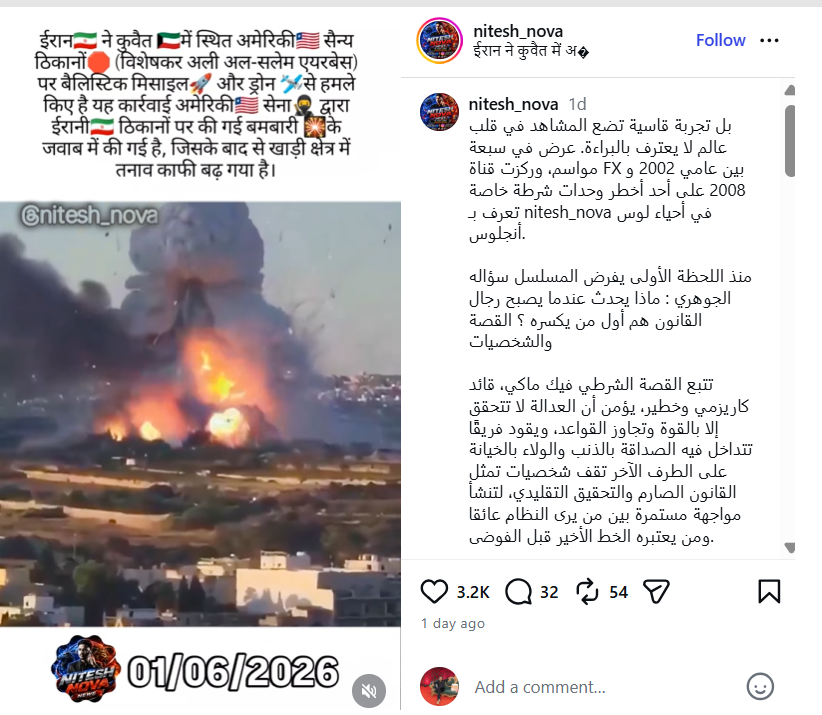
Amid heightened tensions in West Asia, claims are circulating on social media alleging that Iran carried out missile and drone strikes on US military bases in Kuwait, particularly the Ali Al-Salem Air Base. The claim is being accompanied by a viral video showing massive explosions, fire, and thick plumes of smoke, which users say depicts the alleged Iranian attack. CyberPeace Research Wing research found that the viral video is from an explosion at a fireworks factory in Malta, a European country. It has no connection to the ongoing tensions in West Asia. However, Iran has claimed that it targeted US military bases in response to American strikes. Meanwhile, the United States has stated that it successfully intercepted and neutralized several Iranian missile and drone attacks.
Claim:
Instagram user ‘nitesh_nova’ posted a video on June 2, 2026 (archive link), stating: “Iran has carried out ballistic missile and drone attacks on US military bases in Kuwait, particularly the Ali Al-Salem Air Base. This action was taken in response to US airstrikes on Iranian positions, following which tensions in the Gulf region have significantly escalated.”
https://perma.cc/PQ7N-JYQS?type=standard
https://www.instagram.com/nitesh_nova/
Fact Check
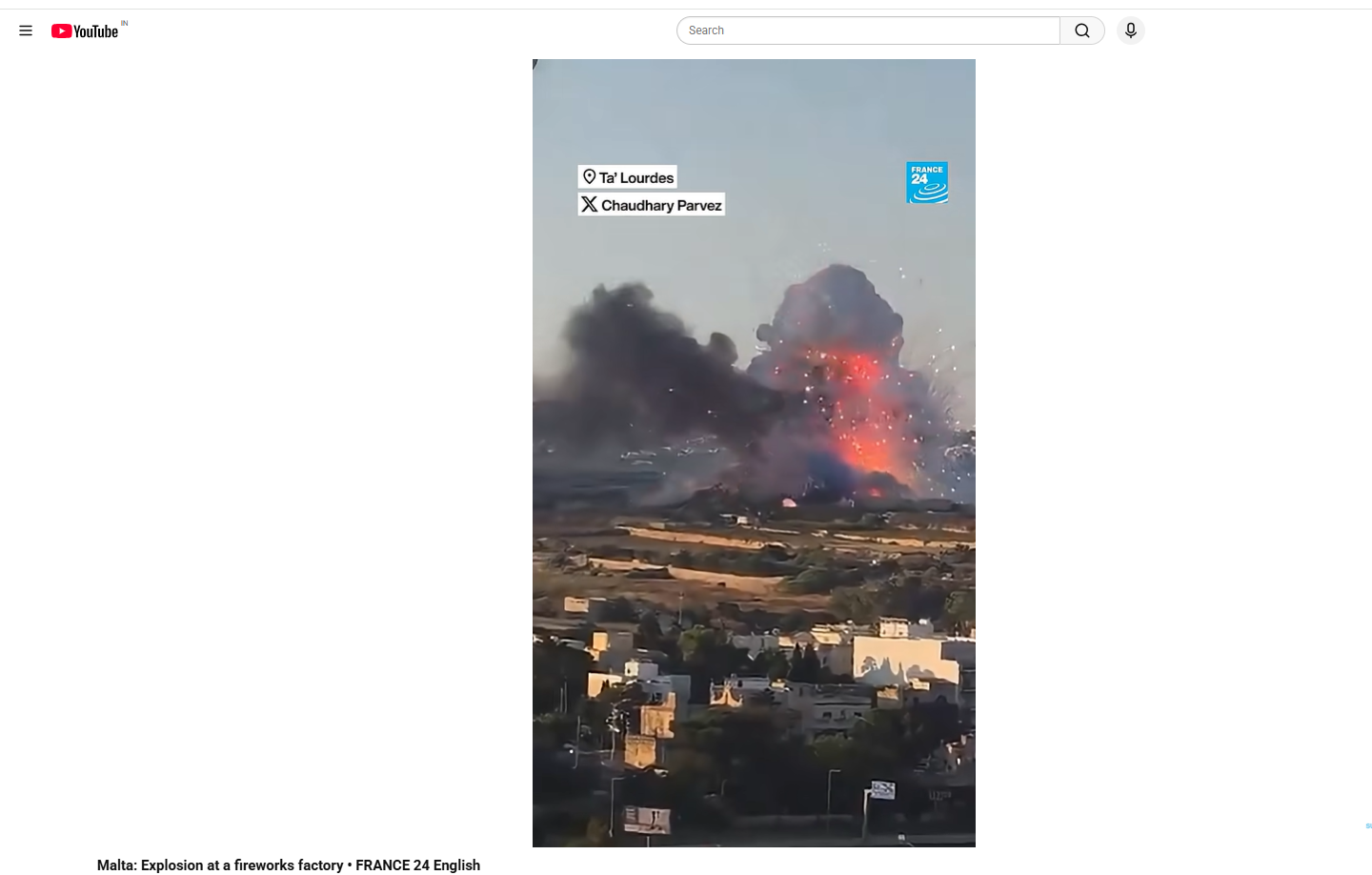
A review of keyframes from the video using reverse image search tools led to reports identifying the footage as an industrial accident. The same visuals were found in news coverage published by France 24, which confirmed that the explosion occurred at a fireworks factory in Malta on June 1, 2026. The incident resulted in injuries to two individuals, although no workers were present inside the facility at the time of the blast.
https://www.youtube.com/watch?v=LTLGO-fu_QA
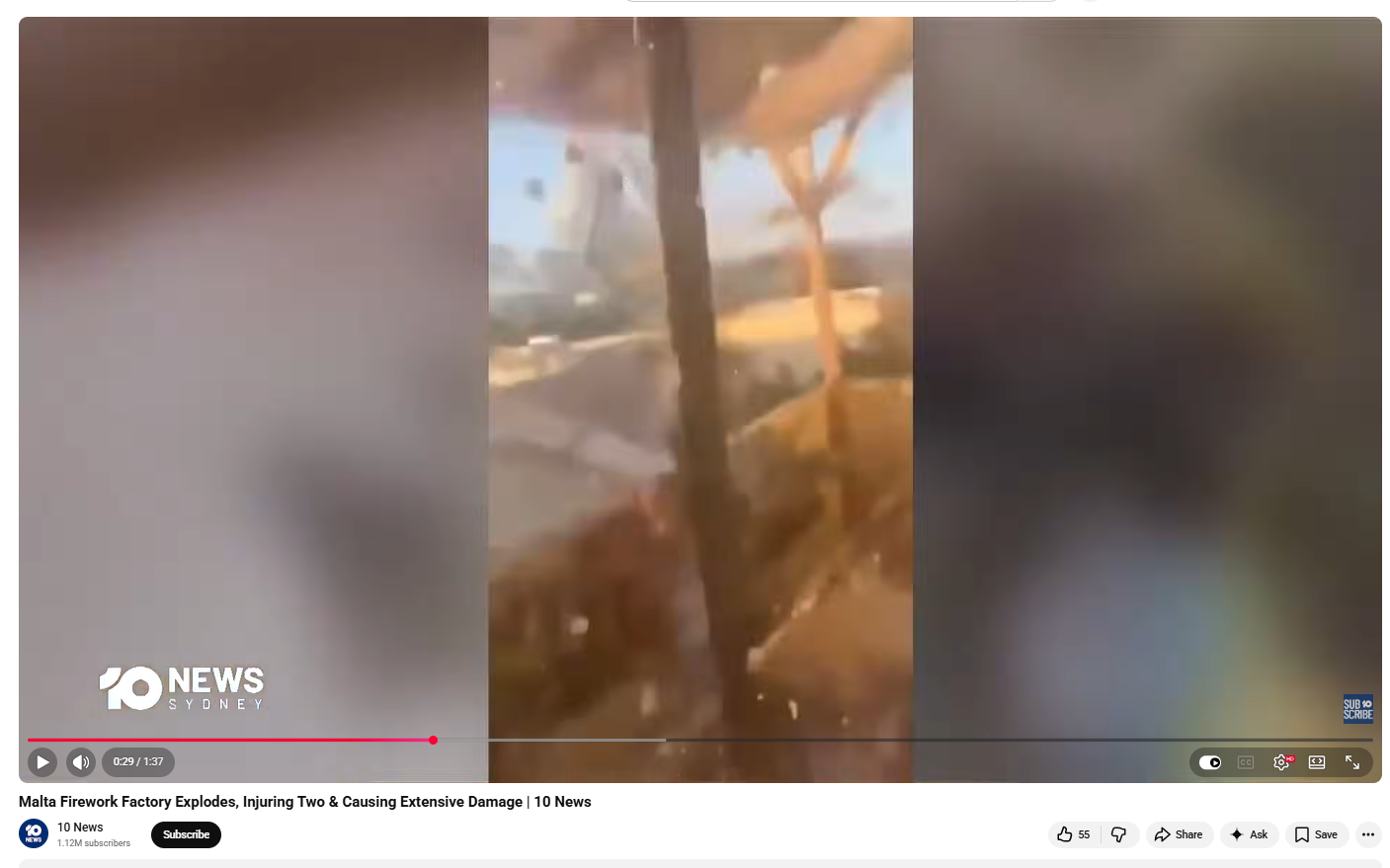
Further verification from 10 News Australia also supports the same context, showing the identical footage and reporting it as a fireworks factory explosion in Malta, posted on June 2, 2026.10 News Australia report
https://www.youtube.com/watch?v=8Lppvtdr50k
Conclusion:
The viral video being shared with claims of an Iranian missile strike on a US military base in Kuwait is misleading. The footage actually shows a fireworks factory explosion in Malta and has no connection to the ongoing geopolitical tensions in West Asia. Social media users are advised to verify such sensitive content before sharing, as misattributed visuals can significantly distort the understanding of real-world conflicts.

Related Blogs

Executive Summary:
The viral image in the social media which depicts fake injuries on the face of the MP(Member of Parliament, Lok Sabha) Kangana Ranaut alleged to have been beaten by a CISF officer at the Chandigarh airport. The reverse search of the viral image taken back to 2006, was part of an anti-mosquito commercial and does not feature the MP, Kangana Ranaut. The findings contradict the claim that the photos are evidence of injuries resulting from the incident involving the MP, Kangana Ranaut. It is always important to verify the truthfulness of visual content before sharing it, to prevent misinformation.

Claims:
The images circulating on social media platforms claiming the injuries on the MP, Kangana Ranaut’s face were because of an assault incident by a female CISF officer at Chandigarh airport. This claim hinted that the photos are evidence of the physical quarrel and resulting injuries suffered by the MP, Kangana Ranaut.


Fact Check:
When we received the posts, we reverse-searched the image and found another photo that looked similar to the viral one. We could verify through the earring in the viral image with the new image.

The reverse image search revealed that the photo was originally uploaded in 2006 and is unrelated to the MP, Kangana Ranaut. It depicts a model in an advertisement for an anti-mosquito spray campaign.
We can validate this from the earrings in the photo after the comparison between the two photos.

Hence, we can confirm that the viral image of the injury mark of the MP, Kangana Ranaut has been debunked as fake and misleading, instead it has been cropped out from the original photo to misrepresent the context.
Conclusion:
Therefore, the viral photos on social media which claimed to be the results of injuries on the MP, Kangana Ranaut’s face after being assaulted allegedly by a CISF officer at the airport in Chandigarh were fake. Detailed analysis of the pictures provided the fact that the pictures have no connection with Ranaut; the picture was a 2006 anti-mosquito spray advertisement; therefore, the allegations that show these images as that of Ranaut’s injury are fake and misleading.
- Claim: photos circulating on social media claiming to show injuries on the MP, Kangana Ranaut's face following an assault incident by a female CISF officer at Chandigarh airport.
- Claimed on: X (Formerly known as Twitter), thread, Facebook
- Fact Check: Fake & Misleading

Introduction
Whatsapp is one of the leading OTT messaging platforms, which has been owned by the tech giant Meta since 2013. WhatsApp enjoys a user base of nearly 2.24 billion people globally, with almost 487 million users in India. Since the advent of Whatsapp, it has been the most commonly used messaging app, and it has made an impact to such an extent that it is used for professional as well as personal purposes. Meta powers the platform and follows similar guidelines and policies as its parent company.
The New Feature
Users of WhatsApp on the web and desktop can now access one account from various devices. One WhatsApp account may now be used on up to four handsets thanks to a new update from Meta. Be aware that the multi-device capability has been planned for some time and is finally being made available to stable WhatsApp users. Each linked device (up to four devices can be linked) will function independently, and the independent devices will continue to receive messages even if the central device’s network connection is lost. Remember that WhatsApp will automatically log out of all the companion devices if the primary smartphone is dormant for an extended period. Four more gadgets may be a mix of four PCs and smartphones or four smartphones. This feature is now available for updates and downloads on Android as well as iOS platforms.
Potential issues
As we go deeper into the digital age, it is the responsibility of the tech giants to pilot innovation with features of security by design. Thus such new features should be accompanied by coherent safety and security policies or advisories to ensure the users understand the implications of the new features. Convenience over conditions is an essential part of cyberspace. It points to the civic duty of netizens to go through the conditions of any app rather than only focus on the convenience it creates. The following potential issues may arise from the new features on Whatsapp –
- Increased cybercrime- The bad actors now do not need to access SIM cards to commit frauds over the platforms as now on a single number 4 devices can be used hence the cybercriminal activity can increase over the platform. It is also pertinent for the platform to create SoPs for fake accounts which use multiple devices, as they pose a direct threat to the users and their interests.
- Difficulty in identifying and tracing- The LEAs will face a significant issue in identifying the bad actors and tracing them as the individual’s involvement through a linked device needs to be given legal validity and scope for investigation. This may also cause issues in evidence handling and analysis.
- Surge in Misinformation and Disinformation- With access to multiple devices, the screen time of an individual is also bound to increase. This leads to more time spent online, thus causing a rise in instances of misinformation and disinformation by bad actors. Thus the aspect of fack checking is of prime importance.
- Potential Oversharing of Personal Data- With the increased accessibility on different devices, it is very easy for the app to seek data from all devices on which the app is running, thus leading to a bigger reservoir of personal data for the platforms and data fiduciaries.
- Higher risk of Phishing, Ransomware and Malware Attacks- As the devices under the same login credentials and mobile number will increase, the message can be viewed on all the devices, thus increasing the risk of widespread embedded ransomware and malware in multiple devices is and ever-present threat.
- One number, more criminals- This feature will allow cybercriminals to operate using one device only, earlier they used to forge Adhaar cards to get new sims, but this feature will enable the bad actors to commit crimes and attacks from one single SIM using 4 different devices.
- Rise in Digital Footprint- As the number of devices increases, the users will generate more digital footprints. As a tech giant, Meta will have access to a bigger database, which increases the risk of data breaches by third-party actors.
Conclusion
In the fast-paced digital world, it is important to remain updated about new software, technologies and policies for our applications or forms of tech. This was a long-awaited feature from WhatsApp, and its value of it doesn’t lie in technological advancement only but also in the formulation of policies to govern this technology towards the trust and safety aspect of users. The platforms, in synergy with the policy makers, need to create a robust framework to accommodate the new features and add-ons on apps vehicle, staying in compliance with the laws of the land. Awareness about new features and vulnerabilities is a must for all netizens, and it is a shared responsibility for all netizens to spread the word about safety and security mechanisms.

Executive Summary:
A viral post on social media shared with misleading captions about a National Highway being built with large bridges over a mountainside in Jammu and Kashmir. However, the investigation of the claim shows that the bridge is from China. Thus the video is false and misleading.

Claim:
A video circulating of National Highway 14 construction being built on the mountain side in Jammu and Kashmir.

Fact Check:
Upon receiving the image, Reverse Image Search was carried out, an image of an under-construction road, falsely linked to Jammu and Kashmir has been proven inaccurate. After investigating we confirmed the road is from a different location that is G6911 Ankang-Laifeng Expressway in China, highlighting the need to verify information before sharing.


Conclusion:
The viral claim mentioning under-construction Highway from Jammu and Kashmir is false. The post is actually from China and not J&K. Misinformation like this can mislead the public. Before sharing viral posts, take a brief moment to verify the facts. This highlights the importance of verifying information and relying on credible sources to combat the spread of false claims.
- Claim: Under-Construction Road Falsely Linked to Jammu and Kashmir
- Claimed On: Instagram and X (Formerly Known As Twitter)
- Fact Check: False and Misleading
