
#FactCheck: Viral Photo Shows Sun Ways Project, Incorrectly Linked to Indian Railways
Executive Summary:
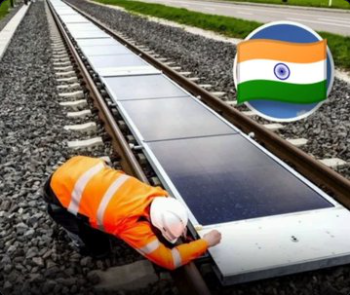
Social media has been overwhelmed by a viral post that claims Indian Railways is beginning to install solar panels directly on railway tracks all over the country for renewable energy purposes. The claim also purports that India will become the world's first country to undertake such a green effort in railway systems. Our research involved extensive reverse image searching, keyword analysis, government website searches, and global media verification. We found the claim to be completely false. The viral photos and information are all incorrectly credited to India. The images are actually from a pilot project by a Swiss start-up called Sun-Ways.
Claim:
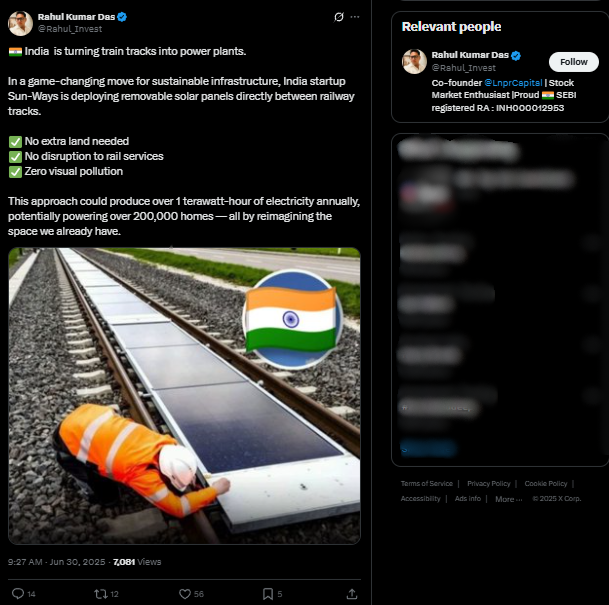
According to a viral post on social media, Indian Railways has started an all-India initiative to install solar panels directly on railway tracks to generate renewable energy, limit power expenses, and make global history in environmentally sustainable rail operations.
Fact check:
We did a reverse image search of the viral image and were soon directed to international media and technology blogs referencing a project named Sun-Ways, based in Switzerland. The images circulated on Indian social media were the exact ones from the Sun-Ways pilot project, whereby a removable system of solar panels is being installed between railway tracks in Switzerland to evaluate the possibility of generating energy from rail infrastructure.

We also thoroughly searched all the official Indian Railways websites, the Ministry of Railways news article, and credible Indian media. At no point did we locate anything mentioning Indian Railways engaging or planning something similar by installing solar panels on railway tracks themselves.
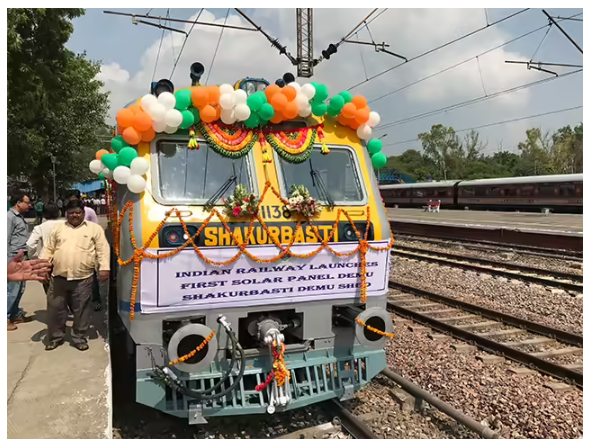
Indian Railways has been engaged in green energy initiatives beyond just solar panel installation on program rooftops, and also on railway land alongside tracks and on train coach roofs. However, Indian Railways have never installed solar panels on railway tracks in India. Meanwhile, we found a report of solar panel installations on the train launched on 14th July 2025, first solar-powered DEMU (diesel electrical multiple unit) train from the Safdarjung railway station in Delhi. The train will run from Sarai Rohilla in Delhi to Farukh Nagar in Haryana. A total of 16 solar panels, each producing 300 Wp, are fitted in six coaches.

We also found multiple links to support our claim from various media links: Euro News, World Economy Forum, Institute of Mechanical Engineering, and NDTV.

Conclusion:
After extensive research conducted through several phases including examining facts and some technical facts, we can conclude that the claim that Indian Railways has installed solar panels on railway tracks is false. The concept and images originate from Sun-Ways, a Swiss company that was testing this concept in Switzerland, not India.
Indian Railways continues to use renewable energy in a number of forms but has not put any solar panels on railway tracks. We want to highlight how important it is to fact-check viral content and other unverified content.
- Claim: India’s solar track project will help Indian Railways run entirely on renewable energy.
- Claimed On: Social Media
- Fact Check: False and Misleading

Related Blogs

As e-commerce companies expand their base and sell a wide range of products on their platforms, attackers continue to look for newer avenues to exploit and potential loopholes to perpetuate scams. A recent method used by scammers is the brushing scam, which targets online shoppers to drive sales. As per reports, it is already being conducted on popular and trusted e-commerce websites such as Amazon and Alibaba Express, and online shoppers must exercise caution with regard to the packages they receive.
The Brushing Scam
Deriving its name from China’s e-commerce practice, this scam includes sellers creating and sending fake orders to unsuspecting individuals, posing to be from e-commerce websites in order to ‘brush up’ the sales figures of their product. The products received are usually low quality and contain items such as low-cost jewellery, seeds, and random gadgets, among other things. The aim is to manipulate reviews for a particular product and make it seem popular so other buyers online are encouraged to purchase the items marketed. Most online shoppers today check reviews before making a purchase, and popular items and seemingly-trustworthy reviews can go a long way towards influencing customer behaviour. Since many platforms do include labels to authenticate reviews tied to genuine purchases to counter fake reviews, scammers have evolved a step further to develop an MO for fake reviews that holds up against basic levels of scrutiny. Some of the packages received under the brushing scam also have QR codes which once scanned lead the receiver to malicious websites.
CyberPeace Insights
Mysterious deliveries that have no information but your name and address may seem tempting to many, as receivers might assume that it could be a marketing gig and free products to try for the sake of promoting a product. The credibility of such deliveries increases as they are packaged to show that these are delivered through trusted online shopping and e-commerce sites. However, even though receiving products for free might seem harmless, it is advised that unknown items be dealt with carefully, more so when addressed to an individual with personal details. Receiving an order itself is an indication that personal information such as one’s name and address has been compromised, and it is likely that the sellers are involved in procuring personal information through a third party, often using illegal methods.
Registering complaints to the concerned e-commerce websites is encouraged, as the frequency of cases raises questions and encourages platforms to take action to ensure a secure buying and delivery experience from their end. An awareness of such scams being carried out for their customers could encourage caution on the part of these platforms and prove to be helpful in addressing the issue on multiple levels. On the part of the receivers, they can change the passwords of their e-commerce accounts and use a 2FA (2-factor authentication) for better security. They should also exercise caution while receiving such parcels, and avoid scanning QR codes on suspicious items.
References
- https://www.livemint.com/technology/tech-news/brushing-scam-explained-from-fake-orders-to-reviews-how-fraudsters-are-manipulating-online-shopping-platforms-11735824384866.html
- https://www.indiatvnews.com/technology/news/beware-of-amazon-scams-how-fraudsters-use-fake-reviews-to-sell-counterfeit-products-2025-01-02-969115
- https://www.indiatoday.in/technology/news/story/brushing-scam-now-makes-buzz-as-it-targets-online-shoppers-everything-you-need-to-know-2659172-2025-01-03
- https://www.msn.com/en-in/money/news/brushing-scam-now-makes-buzz-as-it-targets-online-shoppers-everything-you-need-to-know/ar-AA1wTvon

Executive Summary
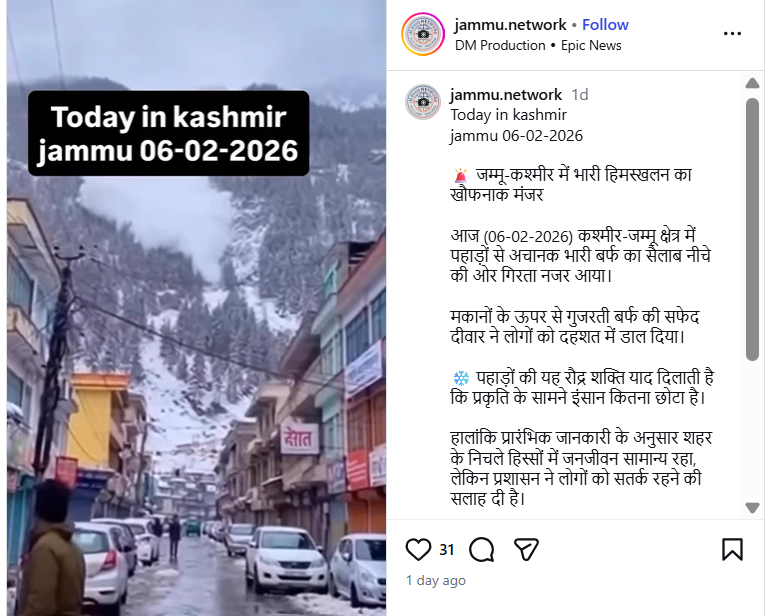
A video is being shared on social media claiming to show an avalanche in Kashmir. The caption of the post alleges that the incident occurred on February 6. Several users sharing the video are also urging people to avoid unnecessary travel to hilly regions. CyberPeace’s research found that the video being shared as footage of a Kashmir avalanche is not real. The research revealed that the viral video is AI-generated.
Claim
The video is circulating widely on social media platforms, particularly Instagram, with users claiming it shows an avalanche in Kashmir on February 6. The archived version of the post can be accessed here. Similar posts were also found online. (Links and archived links provided)
Fact Check:
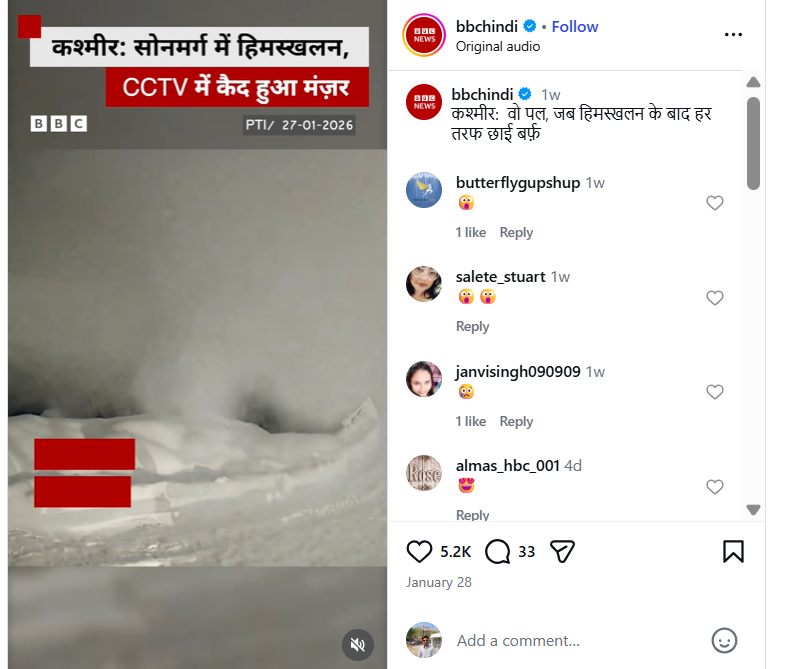
To verify the claim, we searched relevant keywords on Google. During this process, we found a video posted on the official Instagram account of the BBC. The BBC post reported that an avalanche occurred near a resort in Sonamarg, Kashmir, on January 27. However, the BBC post does not contain the viral video that is being shared on social media, indicating that the circulating clip is unrelated to the real incident.
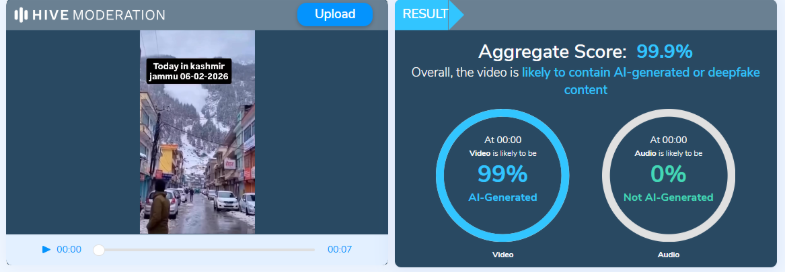
A close examination of the viral video revealed several inconsistencies. For instance, during the alleged avalanche, people present at the site are not seen panicking, running for cover, or moving toward safer locations. Additionally, the movement and flow of the falling snow appear unnatural. Such visual anomalies are commonly observed in videos generated using artificial intelligence. As part of the research , the video was analyzed using the AI detection tool Hive Moderation. The tool indicated a 99.9% probability that the video was AI-generated.
Conclusion
Based on the evidence gathered during our research , it is clear that the video being shared as footage of a Kashmir avalanche is not genuine. The clip is AI-generated and misleading. The viral claim is therefore false.

Executive Summary
A claim is circulating on social media that the U.S. military successfully rescued a missing crew member of an F-15E fighter jet in Iran. Along with this claim, a photo is being widely shared, allegedly showing the rescued U.S. airman after the high-risk operation. However, researches reveal that the viral image is not authentic and has been generated using artificial intelligence tools.
The Claim
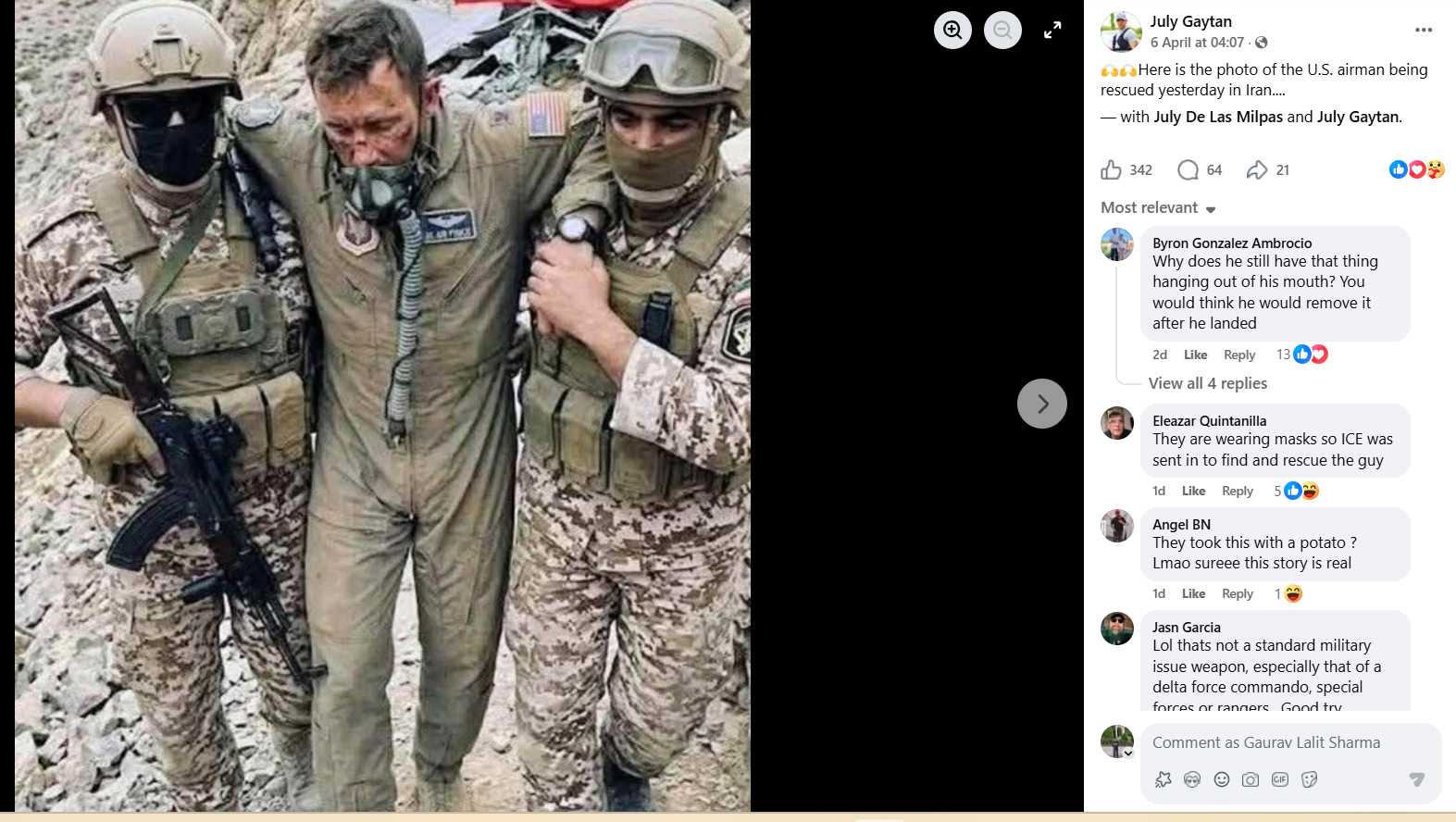
On April 6, 2026, a social media user named “July Gaytan” shared the viral image with the caption: “Here is the photo of the U.S. airman being rescued yesterday in Iran.”
The post quickly gained traction, with many users believing it to be genuine.
- https://www.facebook.com/photo/?fbid=1724007721903888&set=a.116284172676259
- https://perma.cc/URM4-KEJA
Fact Check
Despite extensive searches, no credible media report or official source has published any real image of the rescued crew members. This raised suspicion about the authenticity of the viral photo. Hive Moderation analysis indicated a 100% probability that the image was generated using Google’s Gemini AI.
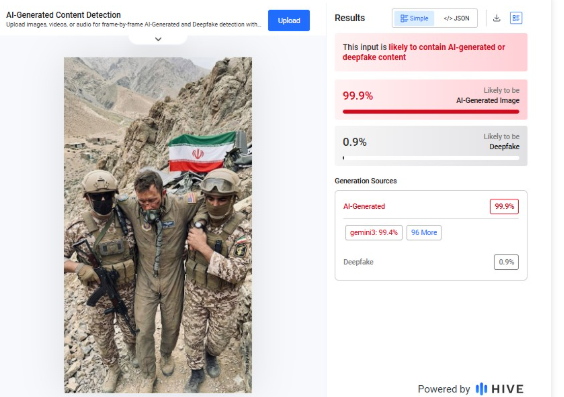
A second scan using Undetectable AI also concluded that the image is AI-generated.
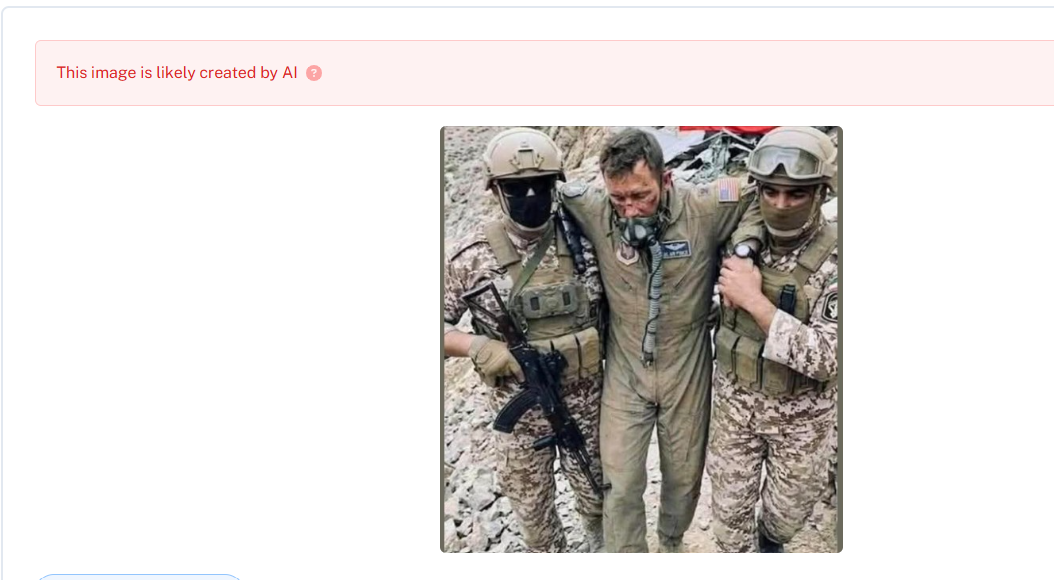
Reports indicate that a U.S. Air Force F-15E Strike Eagle was shot down in Iran. The aircraft had two crew members on board: a pilot and a Weapon Systems Officer (WSO).
- The pilot was rescued shortly after the incident.
- The WSO was initially missing and remained inside Iranian territory in an injured condition.
- The U.S. later carried out a high-risk rescue operation and successfully evacuated the WSO from Iran.
U.S. President Donald Trump also confirmed the “brave and risky” rescue mission in a detailed post on his platform, Truth Social. The statement was further shared by the official White House account.
- https://x.com/WhiteHouse/status/2040644451513598220?s=20

Conclusion
The viral image claiming to show a rescued U.S. airman in Iran is not real. It has been created using AI tools, likely Google’s Gemini. While it is true that the U.S. conducted a high-risk operation to rescue the missing crew member, no authentic image of the rescue or the personnel has been publicly released.
