#FactCheck-Viral Mother-Child Image Linked to Bargi Dam Tragedy Is AI-Generated
Executive Summary
Following the tragic cruise accident at Bargi Dam in Jabalpur, a heartbreaking image of a woman lying unconscious in a river with a child resting on top of her has gone viral on social media. Users are claiming that the picture shows victims of the recent Bargi Dam accident. Research by CyberPeace Research Wing found that the viral claim is false. The circulating image was created using AI (Artificial Intelligence) and is now being misleadingly linked to the real tragedy. However, reports indicate that a similar real-life image of a mother and child did emerge after the accident.
Claim
An X user shared the viral image on May 1, 2026, claiming that despite wearing a life jacket, the mother lost her life while trying to save her child. The emotional post praised mothers’ sacrifice and linked the image directly to the Bargi Dam cruise mishap An X user shared the viral image on May 1, 2026, claiming that despite wearing a life jacket, the mother lost her life while trying to save her child. The emotional post praised mothers’ sacrifice and linked the image directly to the Bargi Dam cruise mishap
Fact Check
To verify the claim, we searched relevant keywords on Google but found no credible news reports connecting the viral image to the Bargi Dam accident. A closer examination of the image revealed multiple visual inconsistencies. The hands of the woman and child appear unnaturally merged at one point, while the woman’s eyebrows seem split into two sections. Such distortions are common indicators of AI-generated imagery.
We then analyzed the picture using AI detection tool Hive Moderation, which estimated nearly a 90% probability that the image was AI-generated.

During the research , we also found a clarification post from the official Facebook account of the Jabalpur District Collector, who stated that the viral image was AI-generated or sourced elsewhere and had no connection with the Bargi cruise accident.

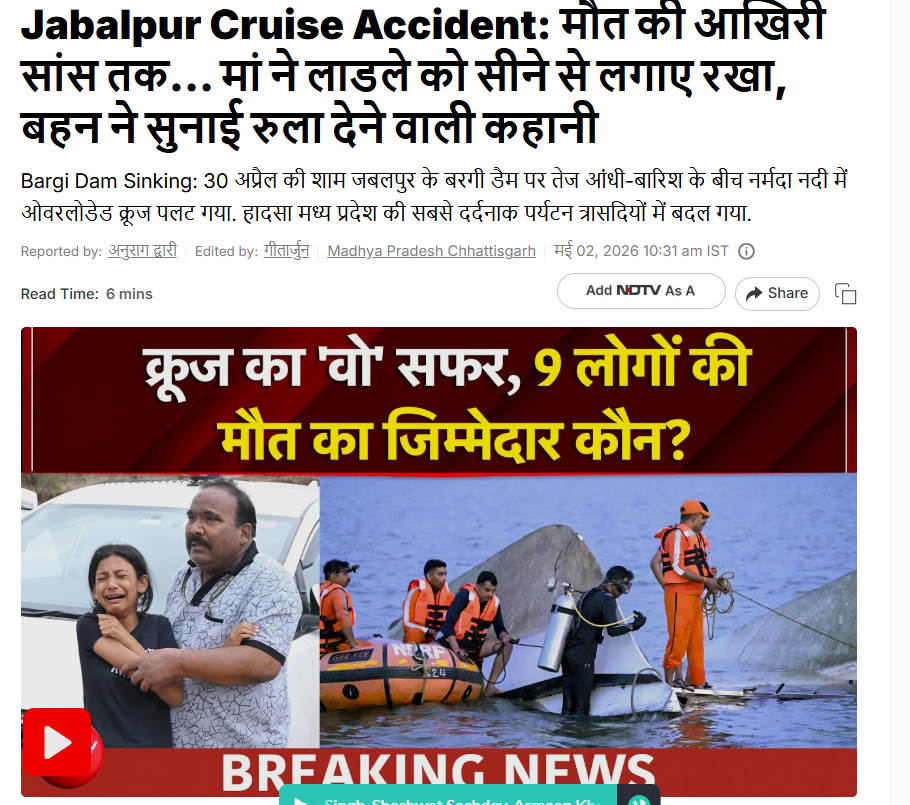
According to a report published by NDTV on May 2, 2026, the accident occurred on April 30 near Khamaria Island when an overloaded tourist cruise capsized amid strong winds, heavy rain, and rising waves. At least nine people died, while 28 others were rescued.
Conclusion
Our research confirms that the viral mother-child image being linked to the Bargi Dam tragedy is fake. The picture was created using AI and falsely circulated in connection with the real cruise accident.
Related Blogs

Amid the popularity of OpenAI’s ChatGPT and Google’s announcement of introducing its own Artificial Intelligence chatbot called Bard, there has been much discussion over how such tools can impact India at a time when the country is aiming for an AI revolution.
During the Budget Session, Finance Minister Nirmala Sitharaman talked about AI, while her colleague, Minister of State (MoS) for Electronics and Information Technology Rajeev Chandrasekhar discussed it at the India Stack Developer Conference.
While Sitharaman stated that the government will establish three centres of excellence in AI in the country, Chandrashekhar at the event mentioned that India Stack, which includes digital solutions like Aadhaar, Digilocker and others, will become more sophisticated over time with the inclusion of AI.
As AI chatbots become the buzzword, News18 discusses with experts how such tech tools will impact India.
AI IN INDIA
Many experts believe that in a country like India, which is extremely diverse in nature and has a sizeable population, the introduction of technologies and their right adoption can bring a massive digital revolution.
For example, Manoj Gupta, Cofounder of Plotch.ai, a full-stack AI-enabled SaaS product, told News18 that Bard is still experimental and not open to everyone to use while ChatGPT is available and can be used to build applications on top of it.
He said: “Conversational chatbots are interesting since they have the potential to automate customer support and assisted buying in e-commerce. Even simple banking applications can be built that can use ChatGPT AI models to answer queries like bank balance, service requests etc.”
According to him, such tools could be extremely useful for people who are currently excluded from the digital economy due to language barriers.
Ashwini Vaishnaw, Union Minister for Communications, Electronics & IT, has also talked about using such tools to reduce communication issues. At World Economic Forum in Davos, he said: “We integrated our Bhashini language AI tool, which translates from one Indian language to another Indian language in real-time, spoken and text everything. We integrated that with ChatGPT and are seeing very good results.”
‘DOUBLE-EDGED SWORD’
Sundar Balasubramanian, Managing Director, India & SAARC, at Check Point Software, told News18 that generative AI like ChatGPT is a “double-edged sword”.
According to him, used in the right way, it can help developers write and fix code quicker, enable better chat services for companies, or even be a replacement for search engines, revolutionising the way people search for information.
“On the flip side, hackers are also leveraging ChatGPT to accelerate their bad acts and we have already seen examples of such exploitations. ChatGPT has lowered the bar for novice hackers to enter the field as they are able to learn quicker and hack better through asking the AI tool for answers,” he added.
Balasubramanian also stated that CPR has seen the quality of phishing emails improve tremendously over the past 3 months, making it increasingly difficult to discern between legitimate sources and a targeted phishing scam.
“Despite the emergence of the use of generative AI impacting cybercrime, Check Point is continually reminding organisations and individuals of the significance of being vigilant as ChatGPT and Codex become more mature, it can affect the threat landscape, for both good and bad,” he added.
While the real-life applications of ChatGPT include several things ranging from language translation to explaining tricky math problems, Balasubramanian said it can also be used for making the work of cyber researchers and developers more efficient.
“Generative AI or tools like ChatGPT can be used to detect potential threats by analysing large amounts of data and identifying patterns that may indicate malicious activity. This can help enterprises quickly identify and respond to a potential threat before it escalates to something more,” he added.
POSITIVE FACTORS
Major Vineet Kumar, Founder and Global President of CyberPeace Foundation, believes that the deployment of AI chatbots has proven to be highly beneficial in India, where a booming economy and increasing demand for efficient customer service have led to a surge in their use. According to him, both ChatGPT and Bard have the potential to bring significant positive change to various industries and individuals in India.
“ChatGPT has already made an impact by revolutionising customer service, providing instant and accurate support, and reducing wait time. It has automated tedious and complicated tasks for businesses and educational institutions, freeing up valuable time for more significant activities. In the education sector, ChatGPT has also improved learning experiences by providing quick and reliable information to students and educators,” he added.
He also said there are several possible positive impacts that the AI chatbots, ChatGPT and Bard, could have in India and these include improved customer experience, increased productivity, better access to information, improved healthcare, improved access to education and better financial services.
Reference Link : https://www.news18.com/news/explainers/confused-about-chatgpt-bard-experts-tell-news18-how-openai-googles-ai-chatbots-may-impact-india-7026277.html
.webp)
Introduction
Smartphones have revolutionised human connectivity. In 2023, it was estimated that almost 96% of the global digital population is accessing the internet via their mobile phones and India alone has 1.05 billion users. Information consumption has grown exponentially due to the enhanced accessibility that these mobiles provide. These devices allow accessibility to information no matter where one is, and have completely transformed how we engage with the world around us, be it to skim through work emails while commuting, video streaming during breaks, reading an ebook at our convenience or even catching up on news at any time or place. Mobile phones grant us instant access to the web and are always within reach.
But this instant connection has its downsides too, and one of the most worrying of these is the rampant rise of misinformation. These tiny screens and our constant, on-the-go dependence on them can be directly linked to the spread of “fake news,” as people consume more and more content in rapid bursts, without taking the time to really process the same or think deeply about its authenticity. There is an underlying cultural shift in how we approach information and learning currently: the onslaught of vast amounts of “bite-sized information” discourages people from researching what they’re being told or shown. The focus has shifted from learning deeply to consuming more and sharing faster. And this change in audience behaviour is making us vulnerable to misinformation, disinformation and unchecked foreign influence.
The Growth of Mobile Internet Access
More than 5 billion people are connected to the internet and web traffic is increasing rapidly. The developed countries in North America and Europe are experiencing mobile internet penetration at a universal rate. Contrastingly, the developing countries of Africa, Asia, and Latin America are experiencing rapid growth in this penetration. The introduction of affordable smartphones and low-cost mobile data plans has expanded access to internet connectivity. 4G and 5G infrastructure development have further bridged any connectivity gaps. This widespread access to the mobile internet has democratised information, allowing millions of users to participate in the digital economy. Access to educational resources while at the same time engaging in global conversations is one such example of the democratisation of information. This reduces the digital divide between diverse groups and empowers communities with unprecedented access to knowledge and opportunities.
The Nature of Misinformation in the Mobile Era
Misinformation spread has become more prominent in recent times and one of the contributing factors is the rise of mobile internet. This instantaneous connection has made social media platforms like Facebook, WhatsApp, and X (formerly Twitter) available on a single compact and portable device. These social media platforms enable users to share content instantly and to a wide user base, many times without verifying its accuracy. The virality of social media sharing, where posts can reach thousands of users in seconds, accelerates the spread of false information. This ease of sharing, combined with algorithms that prioritise engagement, creates a fertile ground for misinformation to flourish, misleading vast numbers of people before corrections or factual information can be disseminated.
Some of the factors that are amplifying misinformation sharing through mobile internet are algorithmic amplification which prioritises engagement, the ease of sharing content due to instant access and user-generated content, the limited media literacy of users and the echo chambers which reinforce existing biases and spread false information.
Gaps and Challenges due to the increased accessibility of Mobile Internet
Despite growing concerns about misinformation spread due to mobile internet, policy responses remain inadequate, particularly in developing countries. These gaps include: the lack of algorithm regulation, as social media platforms prioritise engaging content, often fueling misinformation. Inadequate international cooperation further complicates enforcement, as addressing the cross-border nature of misinformation has been a struggle for national regulations.
Additionally, balancing content moderation with free speech remains challenging, with efforts to curb misinformation sometimes leading to concerns over censorship.
Finally, a deficit in media literacy leaves many vulnerable to false information. Governments and international organisations must prioritise public education to equip users with the required skills to evaluate online content, especially in low-literacy regions.
CyberPeace Recommendations
Addressing misinformation via mobile internet requires a collaborative, multi-stakeholder approach.
- Governments should mandate algorithm transparency, ensuring social media platforms disclose how content is prioritised and give users more control.
- Collaborative fact-checking initiatives between governments, platforms, and civil society could help flag or correct false information before it spreads, especially during crises like elections or public health emergencies.
- International organisations should lead efforts to create standardised global regulations to hold platforms accountable across borders.
- Additionally, large-scale digital literacy campaigns are crucial, teaching the public how to assess online content and avoid misinformation traps.
Conclusion
Mobile internet access has transformed information consumption and bridged the digital divide. At the same time, it has also accelerated the spread of misinformation. The global reach and instant nature of mobile platforms, combined with algorithmic amplification, have created significant challenges in controlling the flow of false information. Addressing this issue requires a collective effort from governments, tech companies, and civil society to implement transparent algorithms, promote fact-checking, and establish international regulatory standards. Digital literacy should be enhanced to empower users to assess online content and counter any risks that it poses.
References
- https://www.statista.com/statistics/1289755/internet-access-by-device-worldwide/
- https://www.forbes.com/sites/kalevleetaru/2019/05/01/are-smartphones-making-fake-news-and-disinformation-worse/
- https://www.pewresearch.org/short-reads/2019/03/07/7-key-findings-about-mobile-phone-and-social-media-use-in-emerging-economies/ft_19-02-28_globalmobilekeytakeaways_misinformation/
- https://www.psu.edu/news/research/story/slow-scroll-users-less-vigilant-about-misinformation-mobile-phones

Introduction
As the sun rises on the Indian subcontinent, a nation teeters on the precipice of a democratic exercise of colossal magnitude. The Lok Sabha elections, a quadrennial event that mobilises the will of over a billion souls, is not just a testament to the robustness of India's democratic fabric but also a crucible where the veracity of information is put to the sternest of tests. In this context, the World Economic Forum's 'Global Risks Report 2024' emerges as a harbinger of a disconcerting trend: the spectre of misinformation and disinformation that threatens to distort the electoral landscape.
The report, a carefully crafted document that shares the insights of 1,490 experts from the interests of academia, government, business and civil society, paints a tableau of the global risks that loom large over the next decade. These risks, spawned by the churning cauldron of rapid technological change, economic uncertainty, a warming planet, and simmering conflict, are not just abstract threats but tangible realities that could shape the future of nations.
India’s Electoral Malice
India, as it strides towards the general elections scheduled in the spring of 2024, finds itself in the vortex of this hailstorm. The WEF survey positions India at the zenith of vulnerability to disinformation and misinformation, a dubious distinction that underscores the challenges facing the world's largest democracy. The report depicts misinformation and disinformation as the chimaeras of false information—whether inadvertent or deliberate—that are dispersed through the arteries of media networks, skewing public opinion towards a pervasive distrust in facts and authority. This encompasses a panoply of deceptive content: fabricated, false, manipulated and imposter.
The United States, the European Union, and the United Kingdom too, are ensnared in this web of varying degrees of misinformation. South Africa, another nation on the cusp of its own electoral journey, is ranked 22nd, a reflection of the global reach of this phenomenon. The findings, derived from a survey conducted over the autumnal weeks of September to October 2023, reveal a world grappling with the shadowy forces of untruth.
Global Scenario
The report prognosticates that as close to three billion individuals across diverse economies—Bangladesh, India, Indonesia, Mexico, Pakistan, the United Kingdom, and the United States—prepare to exercise their electoral rights, the rampant use of misinformation and disinformation, and the tools that propagate them, could erode the legitimacy of the governments they elect. The repercussions could be dire, ranging from violent protests and hate crimes to civil confrontation and terrorism.
Beyond the electoral arena, the fabric of reality itself is at risk of becoming increasingly polarised, seeping into the public discourse on issues as varied as public health and social justice. As the bedrock of truth is undermined, the spectre of domestic propaganda and censorship looms large, potentially empowering governments to wield control over information based on their own interpretation of 'truth.'
The report further warns that disinformation will become increasingly personalised and targeted, honing in on specific groups such as minority communities and disseminating through more opaque messaging platforms like WhatsApp or WeChat. This tailored approach to deception signifies a new frontier in the battle against misinformation.
In a world where societal polarisation and economic downturn are seen as central risks in an interconnected 'risks network,' misinformation and disinformation have ascended rapidly to the top of the threat hierarchy. The report's respondents—two-thirds of them—cite extreme weather, AI-generated misinformation and disinformation, and societal and/or political polarisation as the most pressing global risks, followed closely by the 'cost-of-living crisis,' 'cyberattacks,' and 'economic downturn.'
Current Situation
In this unprecedented year for elections, the spectre of false information looms as one of the major threats to the global populace, according to the experts surveyed for the WEF's 2024 Global Risk Report. The report offers a nuanced analysis of the degrees to which misinformation and disinformation are perceived as problems for a selection of countries over the next two years, based on a ranking of 34 economic, environmental, geopolitical, societal, and technological risks.
India, the land of ancient wisdom and modern innovation, stands at the crossroads where the risk of disinformation and misinformation is ranked highest. Out of all the risks, these twin scourges were most frequently selected as the number one risk for the country by the experts, eclipsing infectious diseases, illicit economic activity, inequality, and labor shortages. The South Asian nation's next general election, set to unfurl between April and May 2024, will be a litmus test for its 1.4 billion people.
The spectre of fake news is not a novel adversary for India. The 2019 election was rife with misinformation, with reports of political parties weaponising platforms like WhatsApp and Facebook to spread incendiary messages, stoking fears that online vitriol could spill over into real-world violence. The COVID-19 pandemic further exacerbated the issue, with misinformation once again proliferating through WhatsApp.
Other countries facing a high risk of the impacts of misinformation and disinformation include El Salvador, Saudi Arabia, Pakistan, Romania, Ireland, Czechia, the United States, Sierra Leone, France, and Finland, all of which consider the threat to be one of the top six most dangerous risks out of 34 in the coming two years. In the United Kingdom, misinformation/disinformation is ranked 11th among perceived threats.
The WEF analysts conclude that the presence of misinformation and disinformation in these electoral processes could seriously destabilise the real and perceived legitimacy of newly elected governments, risking political unrest, violence, and terrorism, and a longer-term erosion of democratic processes.
The 'Global Risks Report 2024' of the World Economic Forum ranks India first in facing the highest risk of misinformation and disinformation in the world at a time when it faces general elections this year. The report, released in early January with the 19th edition of its Global Risks Report and Global Risk Perception Survey, claims to reveal the varying degrees to which misinformation and disinformation are rated as problems for a selection of analyzed countries in the next two years, based on a ranking of 34 economic, environmental, geopolitical, societal, and technological risks.
Some governments and platforms aiming to protect free speech and civil liberties may fail to act effectively to curb falsified information and harmful content, making the definition of 'truth' increasingly contentious across societies. State and non-state actors alike may leverage false information to widen fractures in societal views, erode public confidence in political institutions, and threaten national cohesion and coherence.
Trust in specific leaders will confer trust in information, and the authority of these actors—from conspiracy theorists, including politicians, and extremist groups to influencers and business leaders—could be amplified as they become arbiters of truth.
False information could not only be used as a source of societal disruption but also of control by domestic actors in pursuit of political agendas. The erosion of political checks and balances and the growth in tools that spread and control information could amplify the efficacy of domestic disinformation over the next two years.
Global internet freedom is already in decline, and access to more comprehensive sets of information has dropped in numerous countries. The implication: Falls in press freedoms in recent years and a related lack of strong investigative media are significant vulnerabilities set to grow.
Advisory
Here are specific best practices for citizens to help prevent the spread of misinformation during electoral processes:
- Verify Information:Double-check the accuracy of information before sharing it. Use reliable sources and fact-checking websites to verify claims.
- Cross-Check Multiple Sources:Consult multiple reputable news sources to ensure that the information is consistent across different platforms.
- Be Wary of Social Media:Social media platforms are susceptible to misinformation. Be cautious about sharing or believing information solely based on social media posts.
- Check Dates and Context:Ensure that information is current and consider the context in which it is presented. Misinformation often thrives when details are taken out of context.
- Promote Media Literacy:Educate yourself and others on media literacy to discern reliable sources from unreliable ones. Be skeptical of sensational headlines and clickbait.
- Report False Information:Report instances of misinformation to the platform hosting the content and encourage others to do the same. Utilise fact-checking organisations or tools to report and debunk false information.
- Critical Thinking:Foster critical thinking skills among your community members. Encourage them to question information and think critically before accepting or sharing it.
- Share Official Information:Share official statements and information from reputable sources, such as government election commissions, to ensure accuracy.
- Avoid Echo Chambers:Engage with diverse sources of information to avoid being in an 'echo chamber' where misinformation can thrive.
- Be Responsible in Sharing:Before sharing information, consider the potential impact it may have. Refrain from sharing unverified or sensational content that can contribute to misinformation.
- Promote Open Dialogue:Open discussions should be promoted amongst their community about the significance of factual information and the dangers of misinformation.
- Stay Calm and Informed:During critical periods, such as election days, stay calm and rely on official sources for updates. Avoid spreading unverified information that can contribute to panic or confusion.
- Support Media Literacy Programs:Media Literacy Programs in schools should be promoted to provide individuals with essential skills to sail through the information sea properly.
Conclusion
Preventing misinformation requires a collective effort from individuals, communities, and platforms. By adopting these best practices, citizens can play a vital role in reducing the impact of misinformation during electoral processes.
References:
- https://thewire.in/media/survey-finds-false-information-risk-highest-in-india
- https://thesouthfirst.com/pti/india-faces-highest-risk-of-disinformation-in-general-elections-world-economic-forum/