
#FactCheck-Viral Clip Misleadingly Attributes Altered Remarks to Former CDS Anil Chauhan
Executive Summary
A video of former Chief of Defence Staff (CDS) General Anil Chauhan is going viral on social media. The video is being shared with the claim that, referring to the losses suffered by India during Operation Sindoor, he said, “Even if we lose four aircraft or 40 aircraft, India will still remain a larger economy. What matters is your ability to recover from the losses. Whatever losses we suffered, we can recover much faster than Pakistan.” A research done by the Research Wing of the CyberPeace examined the claims made in the video and compared them with General Anil Chauhan’s original remarks at the event.The research found that the viral video’s audio has been digitally manipulated. The alleged statement heard in the viral clip does not appear in the original footage.
Claim:
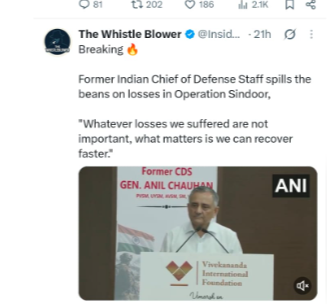
A Pakistani user on social media platform X shared the viral video with the caption: “BREAKING: Former Indian Chief of Defence Staff revealed details about the losses suffered during Operation Sindoor, saying, ‘Whatever losses we suffered are not important. What matters is that we can recover quickly.’”
The link to the post and a screenshot are provided below.
https://x.com/InsiderWB/status/2092559622225940952
Fact Check
Upon closely examining the viral video, we noticed the ANI logo. We then conducted a reverse image search of keyframes from the viral clip. During the search, we found the original video published by ANI, in which General Chauhan discusses the relationship between political objectives and military strategy.
https://x.com/ANI/status/2092217553355743409
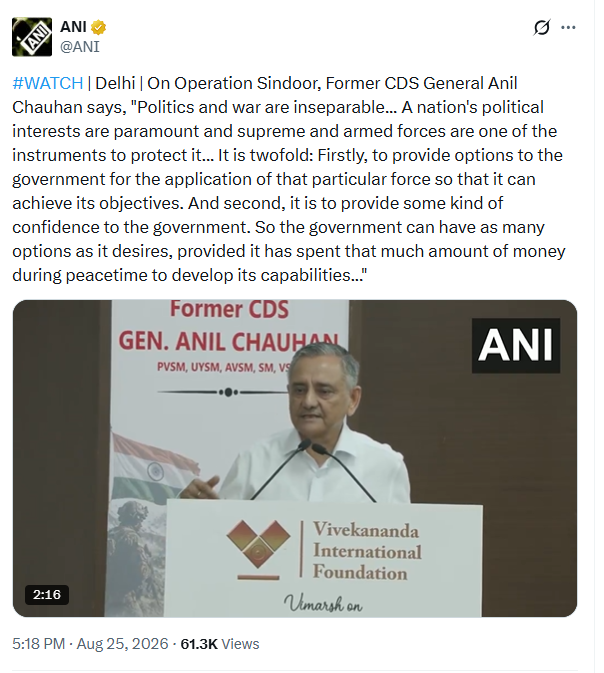
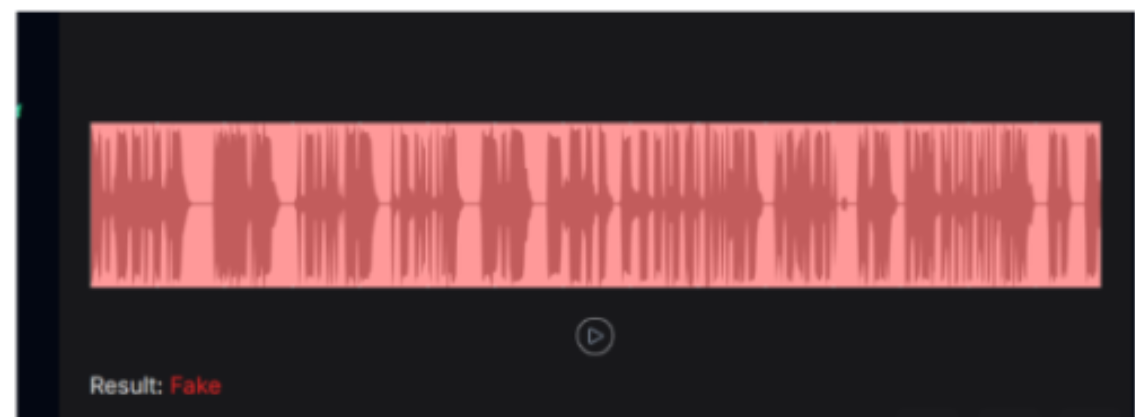
He said, “Politics and war are inseparable.” He further explained that a nation’s political interests are paramount, while the armed forces are one of several instruments used to safeguard those interests. General Chauhan also discussed the role of military leadership in presenting various options to the political leadership, as well as the importance of peacetime preparedness and training. He also spoke about training, contingency planning, and the need to balance military risks with political objectives. Notably, the statement attributed to him in the viral video,“Whatever losses we suffered are not important. What matters is that we can recover quickly” — does not appear anywhere in the original video. Additionally, the audio used in the viral video was also analysed using Resemble AI. The tool’s analysis identified the audio as AI-generated, indicating that the audio in the viral clip had been manipulated.
Conclusion
The research found that General Chauhan’s voice in the viral video has been digitally manipulated. The alleged statement heard in the viral clip does not appear in the original video.

Related Blogs

Introduction
As the world seemingly shrinks under the vast, ever-stretching canopy of the internet, the channels through which information flows are becoming increasingly enigmatic and tangled. In the digital world, the gulf between fact and fabrication narrows dramatically, with the veracity of information too often lost in the flood. Amidst the torrents of data, platforms like YouTube, a veritable Goliath in the video streaming sphere, are finding themselves at the forefront of a critical battle against the dark forces of fake news and disinformation—a war that is waged with the intensity of any historical conflict over truth and influence.
It is in this volatile theatre that Google's video behemoth, YouTube, under the scrutiny of the global eye, announces its strategic campaign to shield against the onslaught of misinformation. With India, the world's most populous democracy, on the cusp of its monumental general elections, the stakes could hardly be higher. YouTube's involvement thus evolves beyond corporate social responsibility—it becomes a crusade for the integrity of information, a paladin for the democratic process, and a protector of the public’s right to factual reporting.
The Campaign
The campaign envisioned by YouTube India's vanguard is multifaceted and robust, aimed at rooting out the insidious tendrils of fake news where they lie. At the heart of this mission are two pivotal strategies that form the backbone of YouTube's defense. Firstly, a rigorous misinformation policy, which heralds as a bastion against content designed with duplicitous intent. YouTube Indian Head Ishan Chatterjee elucidates, 'Our misinformation policies clearly state that if the content has been technically manipulated with the intent to deceive a user and there's a danger of real-world harm...we will act against that content.' It is an exhortation of YouTube's commitment to a culture of truth and an acknowledgement of the platform's influence and responsibility. This process, however, is more complex than it appears; it is tangled in socio-political nuances and demands an uncompromising vigilance to identify and dispel falsehoods.
Yet, this is merely the foundation upon which YouTube’s strategy rests. The second prong of their stratagem is even more ambitious—intending not only to eradicate the chaff of misinformation but also to till the soil with the seeds of verifiable, authoritative news content. This is an initiative to resuscitate the public's faith in digital information sources. By allying with credible news publishers and fostering a symbiosis with independent journalists, YouTube has taken up the mantle of an institution that not just police content, but cultivates it, transforming the barren desert of online falsehoods into an oasis of enlightenment.
News on YouTube is symbiotic with the larger consciousness of its users, driving content consumption and engaging millions who seek out current affairs, investigative reports, and in-depth analysis on the platform. The democratisation of news, once the hallowed ground of traditional broadcast and print media, now finds its theatre online. Chatterjee insightfully notes the ascending trend of news story engagement on YouTube Shorts and Connected TV (CTV)—two emergent platforms that have revolutionised content delivery and consumption. CTV, in particular, has skyrocketed in popularity within the past five years, boasting over 58 million viewers in India consuming YouTube content from the comfort of their living rooms as of June 2023, per analytics.
This phenomenon is acutely observed by YouTube's Director and Global Head of Responsibility, Tim Katz, who delineates a portrait of the Indian market's distinctive hunger for live content, particularly news, on CTV. Katz's observations carry an air of fascination, 'The other two things that have been exciting to see are that we've seen a lot of growth, particularly during sensitive moments, with large news stories occurring certainly during an election cycle, and we just see very large growth from many of our authoritative partners.'
The Implications of the Campaign
The tapestry of YouTube's news ecosystem is a rich mosaic of diversity, including independent journalists, broadcasters, legacy print publications, and digital-first media organisations. Katz underscores the gravity of nurturing such a broad and dynamic news environment on the platform, a gesture of YouTube's commitment to a holistic information landscape.
An illuminating report from the Google News Initiative, forged in cooperation with Kantar, reiterates the dominance of video as the consummate medium for news consumption across a spectrum of languages and formats in India. It paints a picture of a nation of insatiable news consumers, with nearly every second Indian language internet user engaging with news content, a substantial proportion hailing from urban locales. Of particular resonance is hyperlocal news, which plucks the chords of local interests and concerns, touching the lives of seven out of ten citizens.
Moreover, the economic impetus behind YouTube’s role in the media firmament is brought to light in the Oxford Economics Impact Report, revealing a staggering 70% of Indian media and music companies with a YouTube presence acknowledge the platform as a crucial revenue stream.
Conclusion
Poised upon the sharp edge of an electric election season—a season that will no doubt be drenched in a spectrum of information, both fact and fable—YouTube's convictions stand as a beacon of reliability. Their initiative is more than a method—it's a philosophy, a dedication to purifying the information sphere. In the digital epoch, where the battle lines for truth are drawn in bytes and bandwidth, YouTube’s rallying cry for responsibility, its vow to safeguard democratic ideals, and its unyielding commitment to illuminating the corridors of knowledge are more than strategies; they are pillars on which a well-informed, engaged, and enlightened citizenry can lean.
Reference

Introduction
The 2023-24 annual report of the Union Home Ministry states that WhatsApp is among the primary platforms being targeted for cyber fraud in India, followed by Telegram and Instagram. Cybercriminals have been conducting frauds like lending and investment scams, digital arrests, romance scams, job scams, online phishing etc., through these platforms, creating trauma for victims and overburdening law enforcement, which is not always the best equipped to recover their money. WhatsApp’s scale, end-to-end encryption, and ease of mass messaging make it both a powerful medium of communication and a vulnerable target for bad actors. It has over 500 million users in India, which makes it a primary subject for scammers running illegal lending apps, phishing schemes, and identity fraud.
Action Taken by Whatsapp
As a response to this worrying trend and in keeping with Rule 4(1)(d) of the Information Technology (Intermediary Guidelines and Digital Media Ethics Code) Rules, 2021, [updated as of 6.4.2023], WhatsApp has been banning millions of Indian accounts through automated tools, AI-based detection systems, and behaviour analysis, which can detect suspicious activity and misuse. In July 2021, it banned over 2 million accounts. By February 2025, this number had shot up to over 9.7 million, with 1.4 million accounts removed proactively, that is, before any user reported them. While this may mean that the number of attacks has increased, or WhatsApp’s detection systems have improved, or both, what it surely signals is the acknowledgement of a deeper, systemic challenge to India’s digital ecosystem and the growing scale and sophistication of cyber fraud, especially on encrypted platforms.
CyberPeace Insights
- Under Rule 4(1)(d) of the IT Rules, 2021, significant social media intermediaries (SSMIs) are required to implement automated tools to detect harmful content. But enforcement has been uneven. WhatsApp’s enforcement action demonstrates what effective compliance with proactive moderation can look like because of the scale and transparency of its actions.
- Platforms must treat fraud not just as a content violation but as a systemic abuse of the platform’s infrastructure.
- India is not alone in facing this challenge. The EU’s Digital Services Act (DSA), for instance, mandates large platforms to conduct regular risk assessments, maintain algorithmic transparency, and allow independent audits of their safety mechanisms. These steps go beyond just removing bad content by addressing the design of the platform itself. India can draw from this by codifying a baseline standard for fraud detection, requiring platforms to publish detailed transparency reports, and clarifying the legal expectations around proactive monitoring. Importantly, regulators must ensure this is done without compromising encryption or user privacy.
- WhatsApp’s efforts are part of a broader, emerging ecosystem of threat detection. The Indian Cyber Crime Coordination Centre (I4C) is now sharing threat intelligence with platforms like Google and Meta to help take down scam domains, malicious apps, and sponsored Facebook ads promoting illegal digital lending. This model of public-private intelligence collaboration should be institutionalized and scaled across sectors.
Conclusion: Turning Enforcement into Policy
WhatsApp’s mass account ban is not just about enforcement but an example of how platforms must evolve. As India becomes increasingly digital, it needs a forward-looking policy framework that supports proactive monitoring, ethical AI use, cross-platform coordination, and user safety. The digital safety of users in India and those around the world must be built into the architecture of the internet.
References
- https://scontent.xx.fbcdn.net/v/t39.8562-6/486805827_1197340372070566_282096906288453586_n.pdf?_nc_cat=104&ccb=1-7&_nc_sid=b8d81d&_nc_ohc=BRGwyxF87MgQ7kNvwHyyW8u&_nc_oc=AdnNG2wXIN5F-Pefw_FTt2T4K6POllUyKpO7nxwzCWxNgQEkVLllHmh81AHT2742dH8&_nc_zt=14&_nc_ht=scontent.xx&_nc_gid=iaQzNQ8nBZzxuIS4rXLOkQ&oh=00_AfEnbac47YDXvymJ5vTVB-gXteibjpbTjY5uhP_sMN9ouw&oe=67F95BF0
- https://scontent.xx.fbcdn.net/v/t39.8562-6/217535270_342765227288666_5007519467044742276_n.pdf?_nc_cat=110&ccb=1-7&_nc_sid=b8d81d&_nc_ohc=aj6og9xy5WQQ7kNvwG9Vzkd&_nc_oc=AdnDtVbrQuo4lm3isKg5O4cw5PHkp1MoMGATVpuAdOUUz-xyJQgWztGV1PBovGACQ9c&_nc_zt=14&_nc_ht=scontent.xx&_nc_gid=gabMfhEICh_gJFiN7vwzcA&oh=00_AfE7lXd9JJlEZCpD4pxW4OOc03BYcp1e3KqHKN9-kaPGMQ&oe=67FD6FD3
- https://www.hindustantimes.com/india-news/whatsapp-is-most-used-platform-for-cyber-crimes-home-ministry-report-101735719475701.html
- https://www.indiatoday.in/technology/news/story/whatsapp-bans-over-97-lakhs-indian-accounts-to-protect-users-from-scam-2702781-2025-04-02

Introduction
Autonomous transportation, smart cities, remote medical care, and immersive augmented reality are just a few of the revolutionary applications made possible by the global rollout of 5G technology. However, along with this revolution in connectivity, a record-breaking rise in vulnerabilities and threats has emerged, driven by software-defined networks, growing attack surfaces, and increasingly complex networks. As work on next-generation 6G networks accelerates, with commercialisation starting in 2030, security issues are piling up, including those related to AI-driven networks, terahertz communications, and quantum computing attacks. For a nation like India, poised to become a global technological leader, next-generation network procurement is not merely a technical necessity but a strategic imperative. Initiatives such as India-UK collaboration on telecom security in recent years say a lot about how international alliances are the order of the day to address these challenges.
Why Cybersecurity in 5G and 6G Networks is Crucial
With the launch of global 5G services and the rapid introduction of 6G technologies, the telecom sector is seeing a fundamental transformation. Besides expanding connectivity, future networks are also creating the building blocks for networked and highly intelligent environments. With its ultra-high speed of 10 Gbps, network slicing, and ultra-low latency, 5G provides new capabilities that are perfectly suited for mission-critical applications such as telemedicine, autonomous vehicles, and industrial IoT. Sixth-generation wireless technology is still in development, and it will be approximately one hundred times faster than fifth-generation. Here are a few drawbacks and challenges:
- Decentralised Infrastructure (edge computing nodes): Increased number of entry points for attack.
- Virtual Network Functions (VNFs): Greater vulnerability to configuration issues and software exploitation.
- Billions of IoT devices with different security states, thus forming networks that are more difficult to secure.
Although these challenges are unparalleled, the advancement in technology also creates new opportunities.
Understanding the Cyber Threat Landscape for 5G and 6G
The move to 5G and the upgrade to 6G open great opportunities, but also open doors for new cybersecurity risks. Open RAN usage offers flexibility and vendor selection but exposes the supply chain to untested third-party components and attacks. SBA security vulnerabilities can be exploited to disrupt vital network services, resulting in outages or data breaches. Similarly, widespread adoption of edge computing to reduce latency creates multiple entry points for an attacker to target. Compounding the problem is the explosion of IoT device connections through 5G, which, if breached, can fuel massive botnets capable of conducting massive distributed denial-of-service (DDoS) attacks.
Challenges in 6G
- AI-Powered Cyberattacks: AI-native 6G networks are susceptible to adversarial machine learning attacks, data model poisoning, both for security and for traffic optimisation.
- Quantum Threats: Post-quantum cryptography may be required if quantum computing renders current encryption algorithms outdated.
- Privacy Concerns with Digital Twins: 6G may result in creating enormous privacy and data protection issues in addition to offering real-time virtual replicas of the physical world.
- Cross-Border Data Flow Risks: Secure interoperability frameworks and standardised data sovereignty are essential for the worldwide rollout of 6G.
A Critical Step Toward Secure Telecom: The India-UK Partnership
India's recent foray with the UK reflects its active role in shaping the future of telecom security. Major points of the UK-India Telecom Roundtable are:
- MoU between SONIC Labs and C-DOT: Dedicated to Open RAN and AI integration security in 4G/5G deployments. This will offer supply chain diversity without sacrificing resilience.
- Research Partnerships for 6G: Partnerships with UK institutions like CHEDDAR (Cloud & Distributed Computing Hub) and the University of Glasgow 6G Research Centre are focused on developing AI-driven network security solutions, green 6G, and quantum-resistant design.
- Telecom Cybersecurity Centres of Excellence: Constructing two-way CoEs for telecom cybersecurity, ethical AI, and digital twin security models.
- Standardisation Efforts: Joint contribution to ITU for the creation of IMT-2030 standards, in a way that cybersecurity-by-design principles are integrated into worldwide 6G specifications.
- Future Initiatives:
- Application of privacy-enhancing technologies (PETs) for cross-sectoral data usage.
- Secure quantum communications to be used for satellite and submarine cable connections.
- Encouragement of native telecommunication stacks for strategic independence.
Global Policy and Regulatory Aspects
- India's Bharat 6G Vision: India will lead the global standardisation process in the Bharat 6G Alliance with a vision of inclusive, secure, and sustainable connectivity.
- International Harmonisation:
- 3GPP and ITU's joint effort towards standardisation of 6G security.
- Cross-border privacy and cybersecurity compliance system designs to enable secure flows of data.
- Cyber Diplomacy for Telecom Security: Cross-border sharing of information architectures, threat intelligence sharing, and coordinated incident response schemes are essential to 6G security resilience globally.
Building a Secure and Resilient Future for 5G and 6G
Establishing a safe and future-proof 5G and 6G environment should be an end-to-end effort involving governments, industry, and technology vendors. Security should be integrated into the underlying architecture of the networks and not an afterthought feature to be optionally provided. Active engagement in international bodies to establish homogeneous security and privacy standards across geographies is also required. Public-private partnerships, including academia partnerships, will be the driver for innovation and the creation of advanced protection mechanisms. Simultaneously, creating a competent talent pool to manage AI-based threat analysis, quantum-resistant cryptography, and next-generation cryptographic methods will be required to combat the advanced menace of new telecom technologies.
Conclusion
Given 6G on the way and 5G technologies already changing global connections, cybersecurity needs to continue to be a key focus. The partnership between India and the UK serves as an example of why the safe rise of tomorrow's networks depends on global collaboration, AI-driven security measures, plus quantum preparedness. The world can unleash the potential for transformation of 5G and 6G through combining security by design, supporting international standards, and encouraging innovation via cooperation. This will result in an online future that is not only quick and egalitarian but also solid and trustworthy.
References:
- https://www.pib.gov.in/PressReleasePage.aspx?PRID=2105225
- https://www.itu.int/en/ITU-R/study-groups/rsg5/rwp5d/imt-2030/pages/default.aspx
- https://dot.gov.in/sites/default/files/Bharat%206G%20Vision%20Statement%20-%20full.pdf
- https://www.gsma.com/solutions-and-impact/technologies/security/wp-content/uploads/2024/07/FS.40-v3.0-002-19-July.pdf
