
#FactCheck-Old Bengal Panchayat Poll Video Falsely Linked to 2026 Assembly Elections
Executive Summary
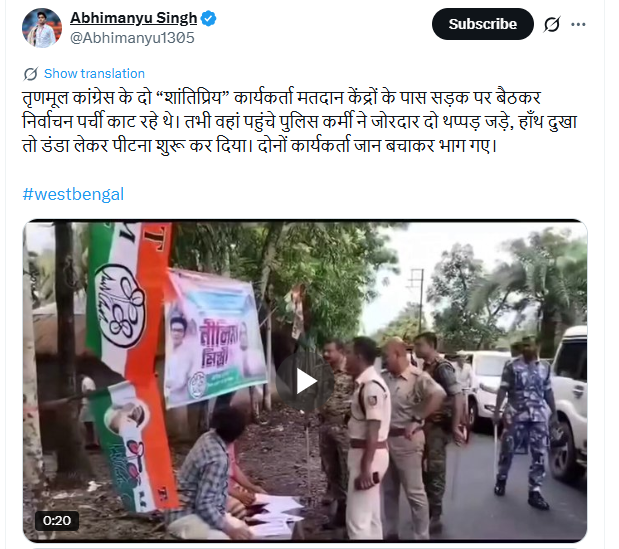
A video is being widely shared on social media showing two men seated on chairs when police personnel arrive and begin assaulting them. A flag of West Bengal Chief Minister Mamata Banerjee’s party, the Trinamool Congress (TMC), can also be seen in the footage. The video is being circulated with the claim that during the first phase of polling held on April 23, 2026, two TMC workers were issuing voter slips near a polling booth when security forces reached the spot and beat them. However, research by the CyberPeace Research Wing found the claim to be false. The footage is not recent and has no connection to the 2026 West Bengal Assembly elections.
Claim:
Social media users alleged that police assaulted TMC workers during the 2026 West Bengal Assembly elections. An X user, Abhimanyu Singh, shared the clip claiming that two “peaceful” TMC workers were sitting near polling stations issuing voter slips when a policeman slapped and beat them with a baton, forcing them to flee.
- https://x.com/Abhimanyu1305/status/2047317736825790549
- https://archive.ph/0ceXH
Fact Check:
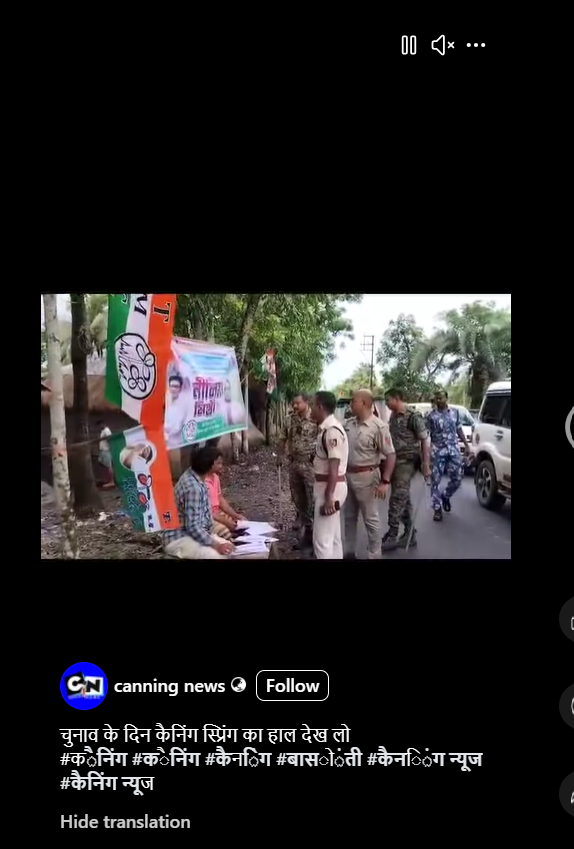
To verify the claim, keyframes from the viral video were subjected to a reverse image search. This led to the same video being found on a Facebook page named Canning News, where it had been uploaded in 2023. The caption stated: “Take a look at the situation in Basanti, Canning, on election day.”
Further searches found the clip published by News18 Bangla on July 6, 2023. The report described unrest during the 2023 Panchayat elections, stating that allegations of bomb throwing had surfaced in Basanti the previous night. On the morning of polling, a bomb was reportedly recovered from the roadside, creating panic in the area.

According to the report, police intervened to control the situation and took action wherever crowds had gathered. The footage showed police dispersing people with batons and, at times, physically confronting individuals.
Conclusion:
The viral claim is misleading. The video is from the 2023 Panchayat elections in West Bengal and is being falsely linked to the recent 2026 Assembly elections.

Related Blogs
.webp)
Introduction
The recent investigation of Patan Cyber Crime Police as part of Operation Mule Hunt 2.0 reveals the sheer scale and intricacy of India's burgeoning cyber fraud economy. Police found that a total of 13 current accounts were being operated at a cooperative bank in the Patan district of Gujarat and used for siphoning 398.43 crore of cyber fraud transaction data on 228 cybercrime cases across states. Further investigations against 14 current account holders and intermediaries show the indispensability of mule accounts in laundering criminal money. The recent incident cannot be taken as isolated; the story points at a formalised and industrialised fraud economy with a robust banking infrastructure, a growing payment gateway, and complex networks.
What Is a Mule Account and Why Should You Care?
The term "mule account" is benign but plays a critical role in modern cybercrime networks. The Reserve Bank of India defines a mule account as a bank account that serves as a vehicle to transfer money proceeds from unlawful transactions and can be operated by people coerced by the prospect of high earnings or by way of inducement.
This mechanism can be witnessed through the investigation of the Patan cybercrime incident, where an investor can be defrauded by a fake investment website, employment fraud, or a digital arrest scheme. After transactions from the victim account, funds would quickly flow into the mule account, which would be held by a legitimate KYC customer. These transactions would then be passed on, between 1 lakh and 5 lakh transactions within hours, to multiple accounts as alleged by the Indian Cyber Crime Coordination Centre (I4C) before they get difficult to trace by being passed through informal channels or converted to cryptocurrency.
In the Patan case, it is alleged that the middlemen enticed locals and offered commissions to open firms and current accounts at Harij Nagrik Sahakari Bank and subsequently gave up their ATM cards, checkbooks, SIMs, and net banking facilities to the operators of the account. It is estimated that such accounts channeled an amount of 398.43 crore to 228 Indian cybercrime cases.
The Scale of India's Mule Account Crisis
The scale of the mule account ecosystem is reflected in India's rapidly worsening cybercrime statistics. As of data from the National Cyber Crime Reporting Portal (NCCRP), a total of 22.68 lakh complaints were registered in 2024, a jump by 42% from 2023. This was not even half the rate of financial loss, which jumped by 206% in 2023 (22,845 crore) and stood at 22,495 crore in 2025 (complaints jumped to 28.15 lakh). The increase in fraudulent transactions therefore outweighs the stability in financial losses significantly.
Mule accounts are the backbone of this crime network. To curb this phenomenon, the Indian Cyber Crime Coordination Centre (I4C) launched a Suspect Registry along with Indian banks and financial institutions in September 2024. 24.67 lakh accounts of suspected mules were identified in this, preventing over 8,031 crore in fraudulent transactions. Despite these efforts, a recent statement from the ED found over 12,000 crore being routed via mule accounts, shell firms, and cryptocurrency.
This isn't isolated to certain banks. 2024 alone saw over 65,000 mule accounts detected in Karnataka. By analyzing the Citizen Financial Cyber Frauds Reporting and Management System, about 40,000 such accounts were detected in SBI branches, and thousands more were detected across the PNB, Canara Bank, Kotak Mahindra Bank, and Airtel Payments Bank. The Patan case also clearly highlights that cooperative banks' lack of compliance and lower levels of transaction-monitoring systems contribute to easily creating and using mule accounts.
Operation Mule Hunt: Gujarat's Coordinated Offensive
This bust in Patan is just one manifestation of a much wider coordinated effort by the state government. Operation Mule Hunt 1.0, which ran from November to December 2025 across the state of Gujarat, was a month-long campaign by Gujarat Police's Cyber Centre of Excellence (CCOE) that unearthed 2,289 crore of fraudulent transactions, led to the registration of 565 FIRs, arrest of 638 accused, and impounding of 913 mule accounts with connections to over 4,000 cases of cybercrime nationwide.
This was followed up with the second installment of the operation, which was kicked off in all districts of Gujarat in 2026. The two-week campaign, which began across the state on January 8 this year, resulted in the Surat City Police alone arresting 77 people and uncovering close to 23.85 crore in fraudulent transactions. In what looks like one of the single largest single-district bust-ups in the operation, the Patan incident itself, with a staggering 398.43 crore routed through only 13 accounts, is remarkable.
The extraordinary nature of the operation is seen in the intelligence capabilities that drove it. It wasn't that police accidentally stumbled upon the Patan network; they worked back on it. After using data from the union government’s inter-agency platform, SAMANVAYA, a coordination platform for data on cybercrimes and the NCCRP, they traced suspicious clusters of transactions in the Harij Nagrik Sahakari Bank accounts to build a chain of evidence connecting the accountholders to the middlemen and, from the middlemen, to the whole ring of fraud. Twenty accused have been chargesheeted under the Bharatiya Nyaya Sanhita (BNS), and fourteen have been arrested, while six are still absconding.
The Human Cost Nobody Talks About
Behind every crore of scam money lies a real person who actually lost the real money. Of the 75%+ fraud losses incurred in 2025, 75% are from investment scams alone. Victims of stock trading scams lost ₹4,636 crore, spread across 2.28 lakh complaints filed in 2024. "Digital arrest" scams, in which fraudsters posing as law enforcement officials psychologically blackmail the victims to transfer money, claimed ₹2,576 crore between 2022 and the first quarter of 2025.
For the victims it's never about the money: it's the retired teacher's lifetime savings from Chhattisgarh, the small trader's capital from Rajkot, the emergency money of the Bhopal family, or just savings from an ordinary person. And the mule accounts' networks are why most of it is never retrieved. Once the money is thrown into the layering chain, it's exponentially more difficult to trace it after every jump.
Then there's another category of victims that often gets overlooked, and they are the mule account holders themselves, many being semi-literate people from semi-urban or rural backgrounds approached with ₹10,000 in commission and with no awareness about the legalities of lending their bank details. With the BNS now they stand to get convicted for grave crimes, but the awareness of this trap is very low.
Recommendations and Suggestions
This isn't something India is facing passively. I4C, along with RBI, has developed Mule Account Hunter software. This software can be used by banks for the detection of suspect accounts through the use of behavioral analysis, device intel, and transaction pattern recognition. The Union Home Minister has directly asked all cooperative banks across the country to adopt this software at the earliest. Failure to do so, he warned, would make consumer safety from cyber fraud incomplete.
Apart from technology, three other areas need to go hand in hand: stringent KYC enforcement for cooperative and small finance banks; the prime locations of the mule recruitment network; greater awareness for the masses regarding the criminal liability one takes up when lending their accounts; and efficient inter-agency coordination so that the intelligence gathered on platforms like SAMANVAYA is converted into arrests before the accounts are dumped and the network reforms in another location.
Operation Mule Hunt 2.0 proves that this is feasible. 13 accounts in a small district of Gujarat. 398 crore. 228 victims. 14 arrested. The pipeline did exist, and it has been broken.
Yet, even as one network is broken, another is forming, somewhere right now. The accounts will appear legitimate. The holders of these accounts may not even realize what they have got into. That is the true danger of the mule accounts and work that cannot stop.
Conclusion
The Patan investigation has clearly shown that mule accounts have now moved from being a subsidiary tool of financial crime to becoming the infrastructure that underpins the economy of cyber-fraud in India. Every financial fraud, including investment fraud, digital arrest fraud, and phishing scams, is backed by a string of real bank accounts where the proceeds of crime are transferred and the trail is obscured. Though attempts such as the I4C Suspect Registry have made attempts to break down this network, it remains an overwhelming task. Robust KYC norms, real-time monitoring of transactions, and coordination between banks, police, and regulators are the key in preventing further industrialisation of cyber financial fraud in India.
References
- https://timesofindia.indiatimes.com/city/ahmedabad/operation-mule-hunt-2-0-gujarat-
- police-bust-rs-398-43-crore-cyber-fraud-14-held/articleshow/131594240.cms?utm_source=contentofinterest&utm_medium=text&utm_campaign=cppst
- https://the420.in/india-cybercrime-2024-42-percent-spike-sims-imei-mule-accounts/
- https://www.thehansindia.com/news/national/ed-explains-how-mule-accounts-and-crypto-networks-enabled-12000-crore-cyber-fraud-1047606
- https://www.zigram.tech/article/mule-accounts-tier-1-tier-2-cities-india/
- https://risk.lexisnexis.com/global/en/insights-resources/article/stopping-money-mules-in-india
- https://timesofindia.indiatimes.com/city/ahmedabad/operation-mule-hunt-2-0-gujarat-police-bust-rs-398-43-crore-cyber-fraud-14-held/articleshow/131594240.cms

Executive Summary
A video showing a massive fire with thick black smoke is being widely shared on social media with the claim that it depicts a recent Israeli attack on Iran. CyberPeace Research Wing research found that the claim is false. The viral video is not related to Iran or any Israel-Iran conflict. It actually shows a gas pipeline fire in Kizilyurt city of Russia’s Dagestan region.
Claim:
A video circulating on X shows a large fire breaking out at a location with thick black smoke rising. The clip is being shared with a caption claiming, “Israel has carried out more than 500 surgical strikes on Iran in the last 24 hours.” Post link: https://x.com/ocjain4/status/2064700017361985702, https://x.com/ocjain4/status/2064700017361985702

Fact Check:
A reverse image search using keyframes from the viral video led to visuals published in a report on a Dagestan-based media outlet dated June 9. The report stated that the Russian Emergency Situations Ministry’s Dagestan department received reports of three explosions at a methane gas station.
https://riadagestan.ru/news/incidents/v_dagestane_vzorvalas_azs

Further research found that several Russian media outlets also published the same visuals on June 9, describing them as a pipeline explosion and fire in Kizilyurt, Dagestan

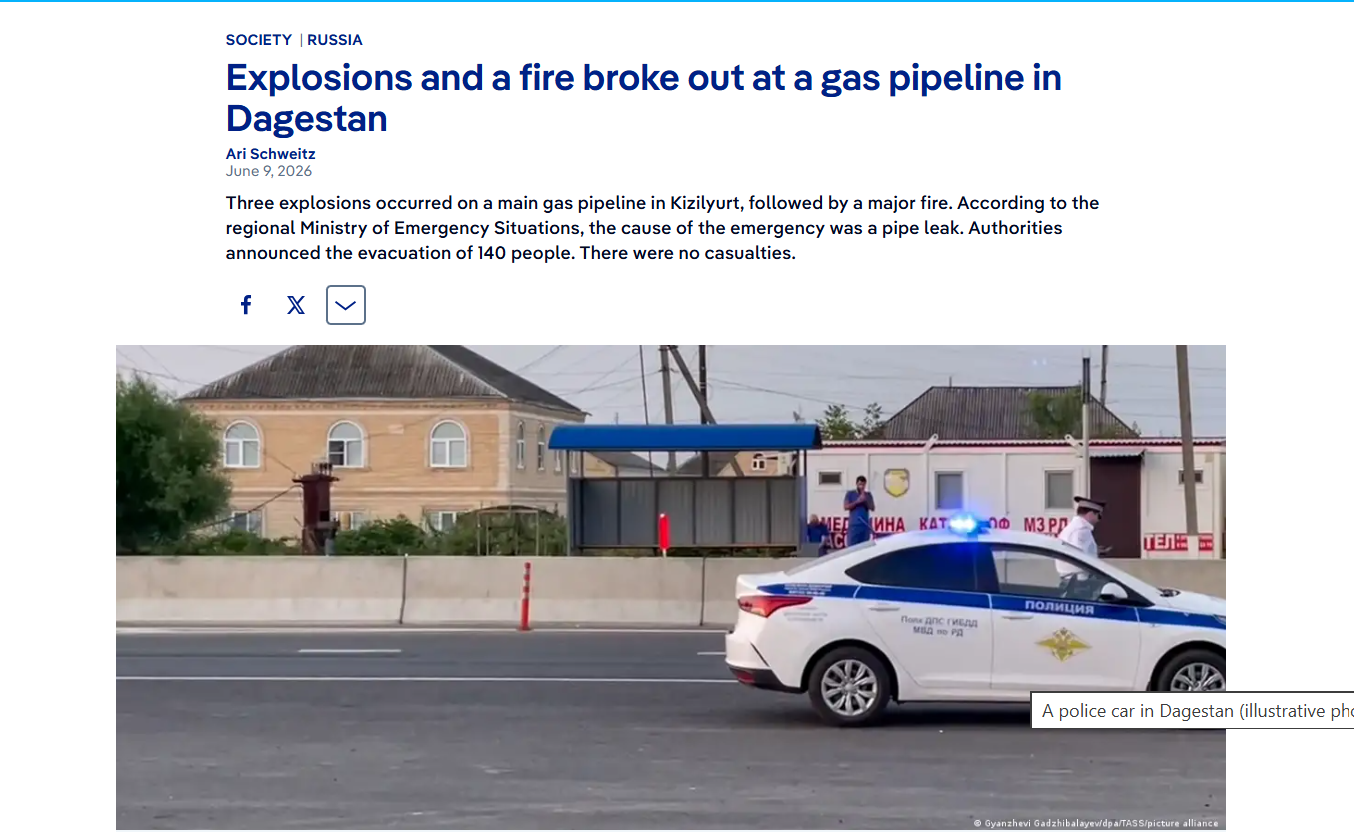
We also found a report published by DW on June 9, 2026, which stated that three explosions occurred on the Mozdok–Kazimagomed gas pipeline in Kizilyurt, Dagestan, resulting in a massive fire with flames rising up to 15 meters. According to local authorities, no casualties or injuries were reported..
https://www.dw.com/ru/na-gazoprovode-v-dagestane-progremeli-tri-vzryva-voznik-pozar/a-77481599
Conclusion:
The research clearly shows that the viral video is unrelated to the Israel-Iran conflict. It actually depicts a gas pipeline fire in Russia’s Dagestan region, which has been falsely shared as a recent Israeli strike on Iran.

Executive Summary
A video of Indian cricketer Rohit Sharma is being widely shared on social media, purportedly showing him saying, “If you want me to play in the next World Cup and you are with me, then share and like this video.” However, CyberPeace Research Wing found the viral claim to be false. Our research found that the viral video is not authentic but AI-generated and is being circulated with a misleading claim.
Claim:
A Facebook user shared the viral video on September 28 with the caption, “If you want me to play in the next World Cup and you are with me, then share and like this video.” The post link, archived link and screenshot are provided below.
https://www.facebook.com/reel/27349791221308658

Fact check
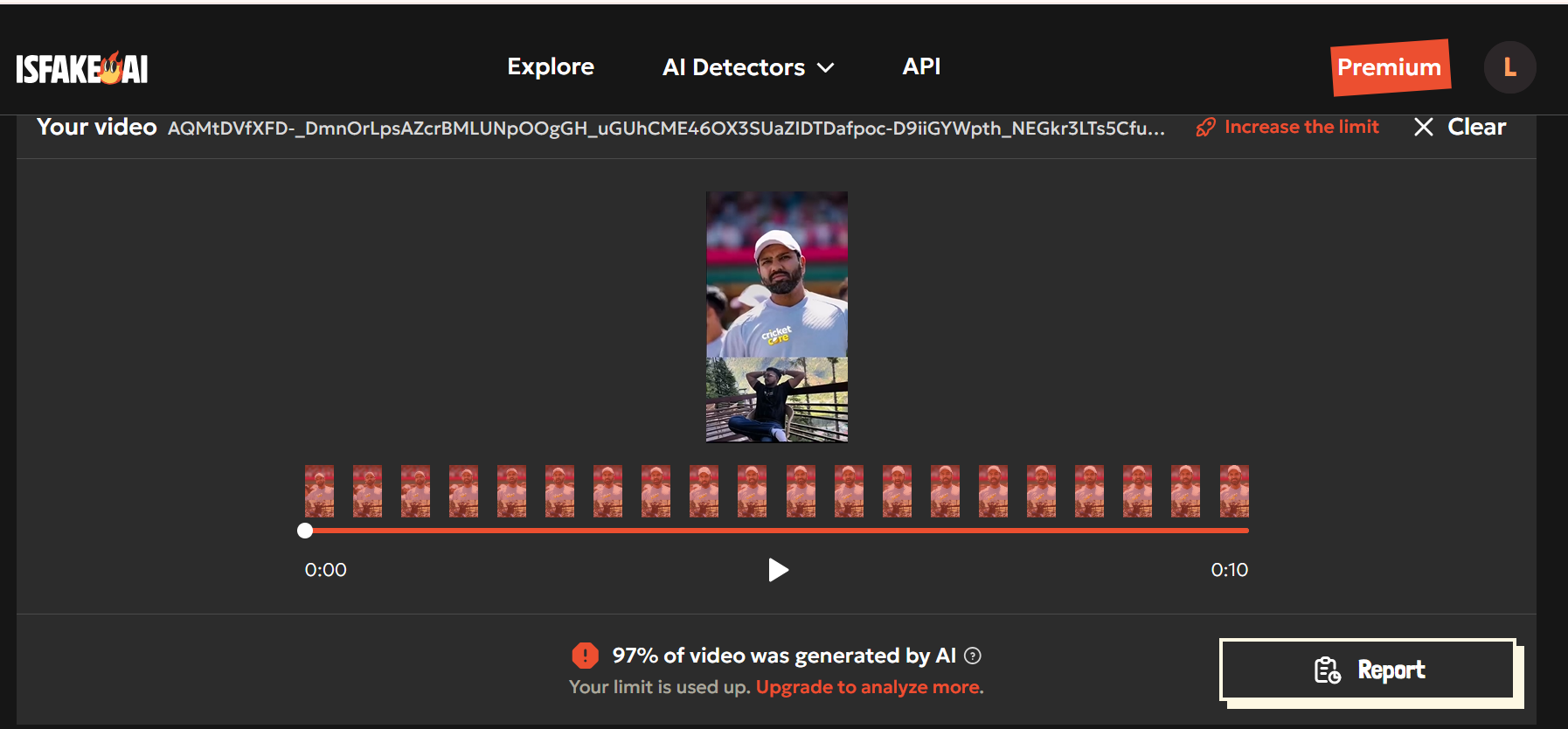
To verify the viral claim, we conducted a Google search using relevant keywords. During the search, we did not find any credible media reports corroborating the claim. As part of our research, we scanned the viral video using the AI detection tool ISFAKEAI. According to the tool’s results, the video was 97 per cent AI-generated.
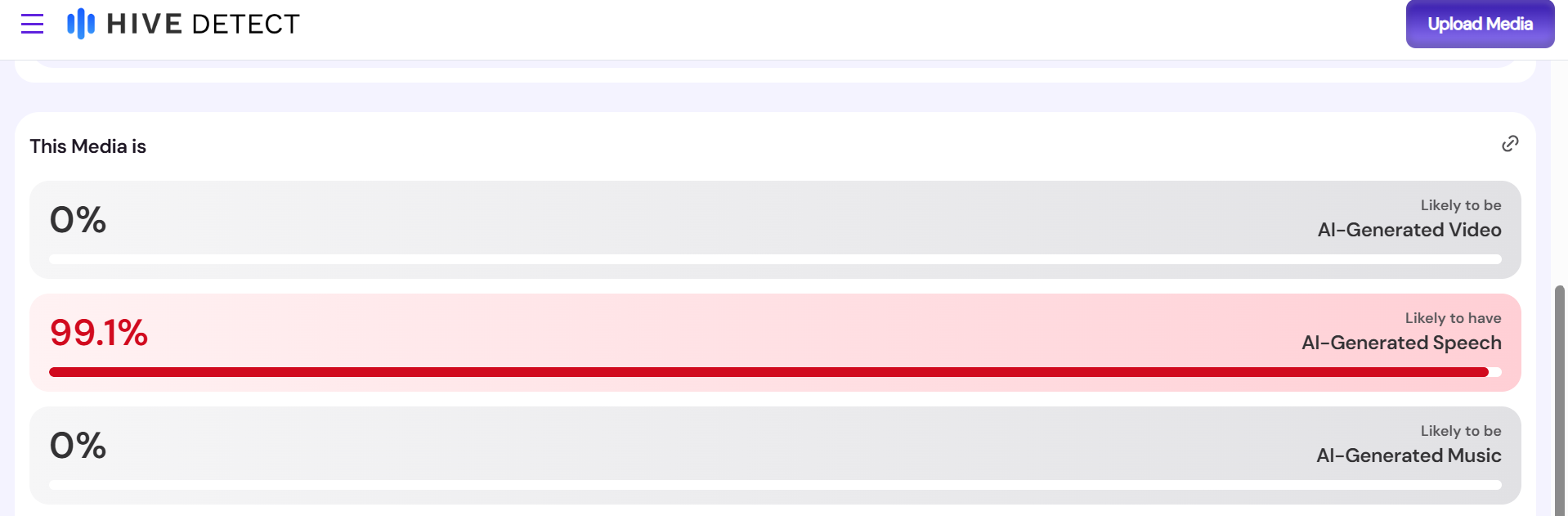
We further analysed the video using Hive Detect, which found that the speech in the viral video was 99 per cent AI-generated.
Conclusion:
Our research found that the viral video is not authentic but AI-generated. The video is being circulated on social media with a misleading claim that it shows an aeroplane being affected by the alleged ‘Arnab’ cyclone in Ahmedabad.
