
#FactCheck: Video of Jagannath Rath Yatra in Puri Falsely Shared as Anti-Reservation Protest at Jantar Mantar
Executive Summary
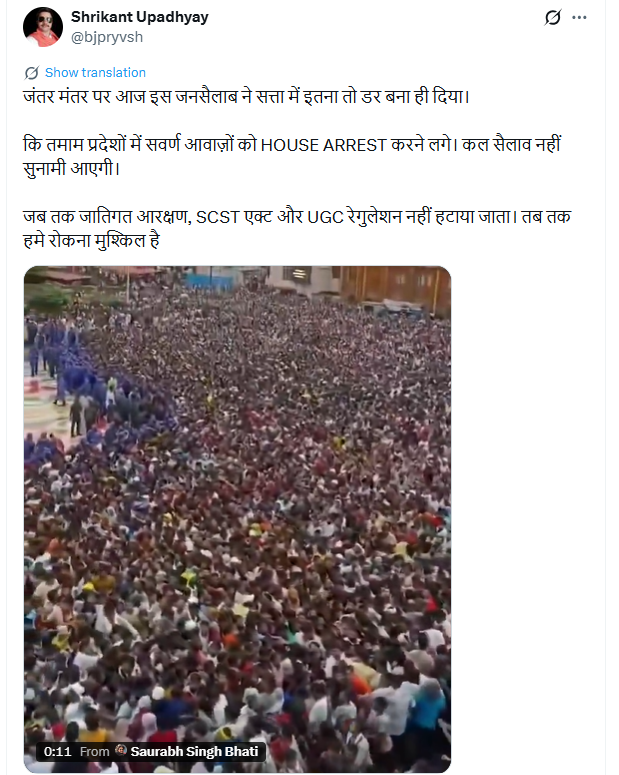
A video showing a massive crowd is being shared on social media with the claim that it shows an anti-reservation protest held at Jantar Mantar. However, a research done by the research wing of the CyberPeace revealed that the video is not from any anti-reservation protest at Jantar Mantar, but from the Jagannath Rath Yatra organized in Puri, Odisha.
Claim:
The video is being shared on X (formerly Twitter) with a viral caption that translates to: “Today, this massive gathering at Jantar Mantar created so much fear in the ruling government that upper-caste voices are being put under HOUSE ARREST across various states. Tomorrow will bring a tsunami, not just a surge. Until caste-based reservation, the SC/ST Act, and UGC regulations are removed, it will be difficult to stop us.”
https://x.com/bjpryvsh/status/2091554860785438887?s=20
Fact Check:
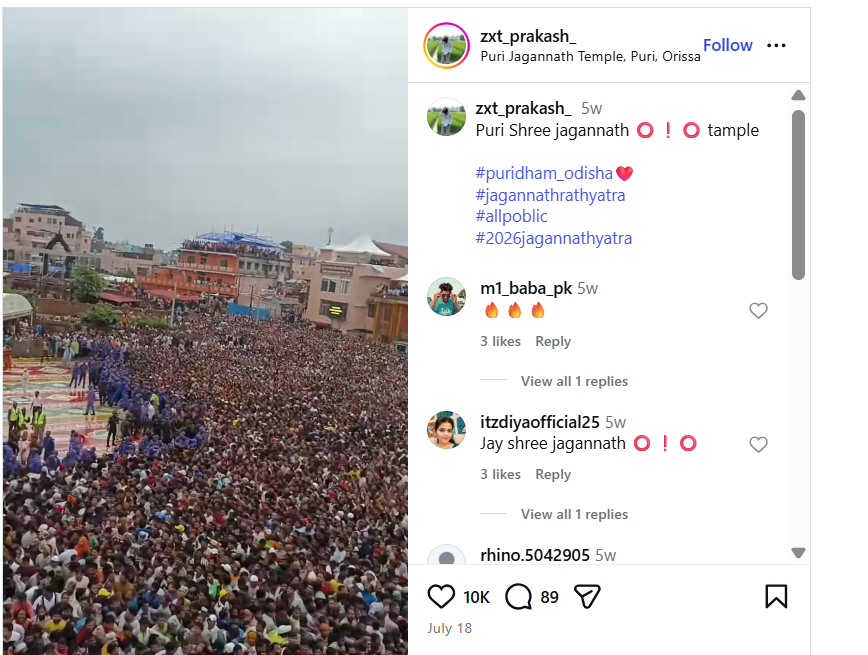
To investigate the viral video, reverse image searches were conducted using keyframes extracted from the clip. This led to an Instagram post uploaded on July 18. The caption accompanying the video clearly identified the footage as being from the Jagannath Rath Yatra in Puri, Odisha.
https://www.instagram.com/p/Da7tF2Etiae/
The visuals in the video were matched with the surroundings of the Jagannath Temple in Puri available on Google Maps Street View, confirming beyond doubt that the location in the video is near the Jagannath Temple in Puri.
https://www.google.com/maps/place/JAY+JAGANNATH+HANDICARFTS/@

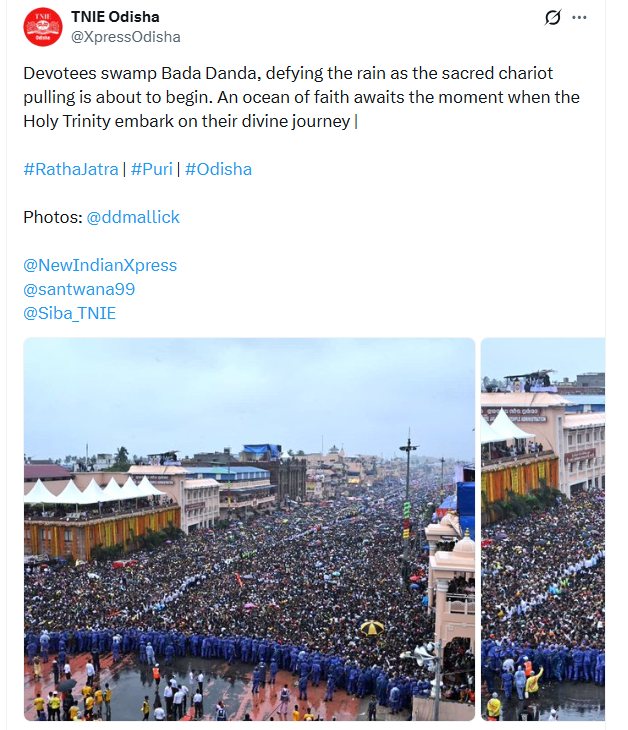
Similar visuals were found in photos uploaded by the X account of The New Indian Express Odisha on July 16, 2026. The imagery in these photographs closely matched the scenes in the viral video, and the caption stated that they were captured during the Jagannath Rath Yatra in Puri.
https://x.com/XpressOdisha/status/2077697637688775015
Conclusion:
Based on the evidence gathered during our research, it is clear that the video being falsely circulated as an anti-reservation protest at Jantar Mantar is actually footage of the Jagannath Rath Yatra in Puri, Odisha.

Related Blogs
Introduction
In real-time warfare scenarios of this modern age, where actions occur without delay, the relevance of edge computing emerges as paramount. By processing data close to the source in the battlefield with the help of a drone or through video imaging from any military vehicle or aircraft, the concept of edge computing allows the military to point targets faster and strike with accuracy. It also enables local processing to relay central data, helping ground troops get intelligence inputs to act rapidly in critical mission scenarios.
As the global security landscape experiences a significant transformation in different corners of the world, it presents unprecedented challenges in the present scenario. In this article, we will try to understand how countries can maintain their military capabilities with the help of advanced technologies like edge computing.
Edge Computing in Modern Warfare
Edge computing involves the processing and storage of data at the point of collection on the battlefield, for example, through vehicles and drones, instead of relying on centralized data centers. This enables faster decision-making in real-time. This approach creates a resilient and secure network by reducing reliance on potentially compromised external connections, supporting autonomous systems, precision-based targeting, and data sharing among military personnel, drones, and command centers amidst a challenging environment.
A report released by the US Department of Defence in March 2025 found a crucial reality surrounding the operation of hardware relying on outdated industrial-age processes in the digital era. In the case of applications with video, edge computing helps to deliver significant advantages to a wide range of crucial military operations, which include:
- Situational awareness with real-time data processing that provides improved battlefield visibility and proper threat detection.
- Autonomous warfare systems such as drones, which use a tactical edge cloud computing to get the capability to navigate faster.
- Developing a strong communication and networking capability to secure low-latency communication for troops to stay connected in challenging environments.
- Ensuring predictive maintenance with the help of effective sensors to carry out edge detection and attrition at an early point, thereby reducing equipment failures.
- Developing effective targeting and weapons systems to ensure faster processing to enable precision-based targeting and response, besides a strong logistics and supply chain that can provide real-time tracking to improve delivery accuracy and resource management.
This report also highlighted that the DoD is rapidly updating its software and investing in AI enablers like data sets or MLOps tools. This also stresses the breaking down of integration barriers by enforcing MOSA (Modular Open Systems Approaches), APIs (Application Programming Interface), and modular interfaces to ensure interoperability across platforms, sensors, and networks to make software-defined warfare an effective strategy.
Developing Edge with Artificial Intelligence for Future Warfare
A significant insight from the work of the US Department of Defense is its emphasis on the importance of edge computing in shaping the future of warfare. In that context, the Annual Threat Assessment Report highlights a key limitation of traditional AI strategies that rely on centralised cloud computing, since these might not be suitable for modern battlefields with congested networks and limited bandwidth. The need for real-time data processing requires a distributed and edge-based AI solution to address contemporary threats. This report also directly supports the deployment of effective edge with AI in a defined, disrupted, intermittent, and limited-bandwidth (DDIL) environment. In that case, when the communication networks fail, the edge servers at the edge of the network offer crucial advantages that cloud-dependent systems cannot. This ability to analyse data and make decisions without consistent connectivity and operate with limited computational resources is a strategic necessity.
The scenario of warfare is a phenomenon that requires maintaining a strong strategic and tactical approach, which, in the present times, is being examined through the domain of digital platforms. Modern warfare patterns demand faster decision-making and edge computing deliveries by shifting the power of distant servers to the frontlines. The US military is already moving in the direction of deploying edge-enabled systems to prove the nature of sensors and networks to compute at the tactical edge to transform warfighting.
However, it can be understood with the help of an example, as creating fusion in the skies with F-35s. As they have showcased the capability of edge computing by fusing sensor data with MADL (Multi-Functional Advanced Data Link) to create a unified picture, making the squadrons a force multiplier. An example of this was visible when an F-35 relayed real-time tracking data, enabling a navy ship to neutralise a missile beyond its range.
Conclusion: The Way Ahead
As the changing nature of warfare moves towards adopting software-defined systems, where edge computing thrives as a futuristic military technology, it calls for the need for integration across all domains of warfighting. But at the same time, several imperatives do emerge, such as:
- Developing an open architecture that enables both flexibility and innovation.
- Ensuring an effective connectivity that actually combines a confluence of legacy systems.
- Developing interoperability among the systems that can function in synergy with all platforms and can function across all domains.
- Prioritising edge-native AI development systems, where it is also necessary to ensure the shift to adopting cloud-based AI models to create solutions optimised from the ground up for edge deployment.
- Investing in edge infrastructure to establish a robust edge computing infrastructure that enables rapid deployment by testing and updating AI capabilities across diverse hardware platforms. Like the way the military training academies in India are developing training infrastructures for training officer cadets or personnel to handle drones and all forms of advanced warfare tactics emerging in this age.
- Fostering talent and expertise by embracing commercial solutions where software talent could be enabled across the enterprises with expertise in edge computing capabilities and AI. In this case, the role of the commercial sector can help to drive innovations in edge AI, and the only way to move in this direction is by leveraging these advances through partnerships and collaborative efforts.
Taking the example of the ARPANET, which once seeded the modern internet, edge computing can also help to create a transformative network effect within the digital battlespace. In conclusion, future conflicts will be defined by the speed and accuracy provided by the edge, as nations integrating AI and robust edge infrastructures can hold a strong advantage in the multi-domain battlefields in the future.
References
- https://www.idsa.in/mpidsanews/rk-narangs-article-what-the-regions-first-drone-warfare-taught-us-published-in-the-new-indian-express
- https://latentai.com/blog/software-defined-warfare-why-edge-ai-is-critical-to-americas-defense-future/
- https://www.boozallen.com/s/insight/blog/how-the-us-military-is-using-edge-computing.html
- https://capsindia.org/wp-content/uploads/2022/08/RK-Narang-3.pdf
- https://www.newindianexpress.com/opinions/2025/May/12/what-the-regions-first-drone-warfare-taught-us
- https://www.maris-tech.com/blog/edge-computing-in-the-military-challenges-and-solutions/#:~:text=In%20modern%20warfare%2C%20decisions%20need,enables%20precision%20targeting%20and%20response
- https://cassindia.com/digital-soldiers/

Executive Summary
A video is being shared on social media with the claim that a Dalit woman was raped inside the Ram Temple in Ayodhya. In the video, two women can be seen crying, while some people around them appear to be consoling them. CyberPeace Research Wing’s research found the viral claim to be false. Our research found that the viral video has been created by combining two separate clips. In the first part of the video, a woman can be seen staging a protest at Buddha Park in Haldwani and raising issues related to her in-laws. The second part shows a girl expressing her anger. Our research found that this clip has been available on the internet since December 27, 2025. Neither of the two videos is related to the alleged rape of a Dalit woman inside the Ram Temple in Ayodhya.
Claim:
A Facebook user shared the viral video on September 21, 2026, with the caption, “Dalit woman raped inside the Ram Temple.”The post link, archive link and screenshot are provided below.
https://www.facebook.com/watch/?v=1420442086956519

Fact Check
To verify the authenticity of the viral image, we conducted a Google search using relevant keywords. However, we did not find any credible media report related to the viral image during the search. To verify the claim, we conducted a reverse image search of the keyframes from the video. During the search, we found the same video on the Facebook page of Punjab Kesari - Uttarakhand, where it was published on March 6, 2026. According to the post, the woman staged a protest at Buddha Park in Haldwani and raised issues related to her in-laws. The link and screenshot of the relevant post are provided below.
https://www.facebook.com/watch/?v=897776589732940

Meanwhile, we found the second part of the viral video on LinkedIn, where the video was published on December 27, 2025.

Our research makes it clear that two old and unrelated videos are being shared with a misleading claim linking them to the Ram Temple in Ayodhya. The videos have no connection with the alleged incident on the temple premises, and based on the available evidence, there is no confirmation of any such incident taking place at the Ram Temple. Our research found that the viral video was created by combining two separate clips. In the first part of the video, a woman can be seen staging a protest at Buddha Park in Haldwani and raising issues related to her in-laws. In the second part, a girl can be seen expressing her anger. Our research found that this clip has been available on the internet since December 27, 2025. Neither of the two videos is related to the alleged rape of a Dalit woman inside the Ram Temple in Ayodhya.

Executive Summary:
Our research has determined that a widely circulated social media image purportedly showing astronaut Sunita Williams with U.S. President Donald Trump and entrepreneur Elon Musk following her return from space is AI-generated. There is no verifiable evidence to suggest that such a meeting took place or was officially announced. The image exhibits clear indicators of AI generation, including inconsistencies in facial features and unnatural detailing.
Claim:
It was claimed on social media that after returning to Earth from space, astronaut Sunita Williams met with U.S. President Donald Trump and Elon Musk, as shown in a circulated picture.

Fact Check:
Following a comprehensive analysis using Hive Moderation, the image has been verified as fake and AI-generated. Distinct signs of AI manipulation include unnatural skin texture, inconsistent lighting, and distorted facial features. Furthermore, no credible news sources or official reports substantiate or confirm such a meeting. The image is likely a digitally altered post designed to mislead viewers.

While reviewing the accounts that shared the image, we found that former Indian cricketer Manoj Tiwary had also posted the same image and a video of a space capsule returning, congratulating Sunita Williams on her homecoming. Notably, the image featured a Grok watermark in the bottom right corner, confirming that it was AI-generated.

Additionally, we discovered a post from Grok on X (formerly known as Twitter) featuring the watermark, stating that the image was likely AI-generated.
Conclusion:
As per our research on the viral image of Sunita Williams with Donald Trump and Elon Musk is AI-generated. Indicators such as unnatural facial features, lighting inconsistencies, and a Grok watermark suggest digital manipulation. No credible sources validate the meeting, and a post from Grok on X further supports this finding. This case underscores the need for careful verification before sharing online content to prevent the spread of misinformation.
- Claim: Sunita Williams met Donald Trump and Elon Musk after her space mission.
- Claimed On: Social Media
- Fact Check: False and Misleading
