
#FactCheck: US Senator Richard Blumenthal Did Not Call India a “Failed State”; Viral Statement Is Misleading
Executive Summary
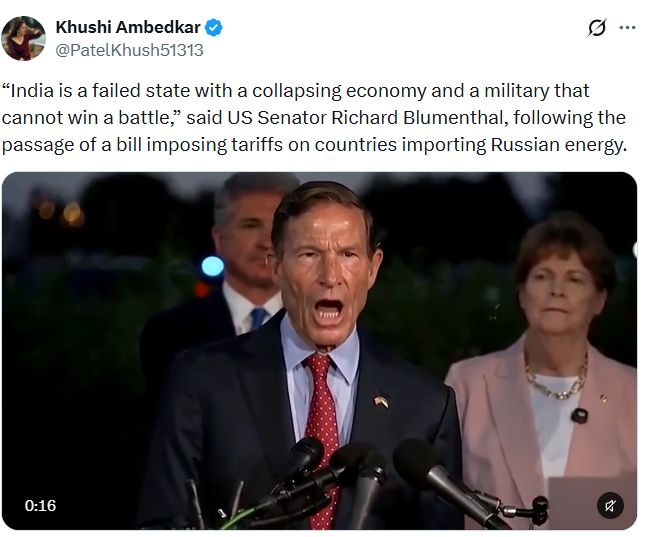
A statement attributed to US Senator Richard Blumenthal is going viral on social media, claiming that he described India as a “failed state” with a collapsing economy and a military that cannot win any battle. The statement is being linked to the passage of a bill imposing tariffs on countries importing Russian energy.
CyberPeace Research found that US Senator Richard Blumenthal did not make the viral statement describing India as a “failed state.” Blumenthal had expressed concerns over India and China purchasing Russian oil and gas, but the remarks attributed to him in the viral post do not match his actual statements. Therefore, the viral claim is misleading.
Claim
A social media user shared a statement attributed to US Senator Richard Blumenthal on X, claiming that he said, “India is a failed state with a collapsing economy and a military that cannot win a battle.” The statement is being portrayed as a remark made following the passage of a bill imposing tariffs on countries importing Russian energy.
https://x.com/PatelKhush51313/status/2112099213802869021?s=20
Fact Check
To verify the viral claim, we searched for relevant keywords but did not find any credible media reports supporting it.
As the next step in our research, we found the original video published on Business Today's YouTube channel on September 17, 2026. In the video, US Senator Richard Blumenthal can be heard commenting on India and China purchasing Russian oil and gas. However, he did not make the statement about India's economy and military that is being attributed to him in the viral post. Therefore, the viral claim is misleading.
https://www.youtube.com/watch?v=L2W30xSSYHc

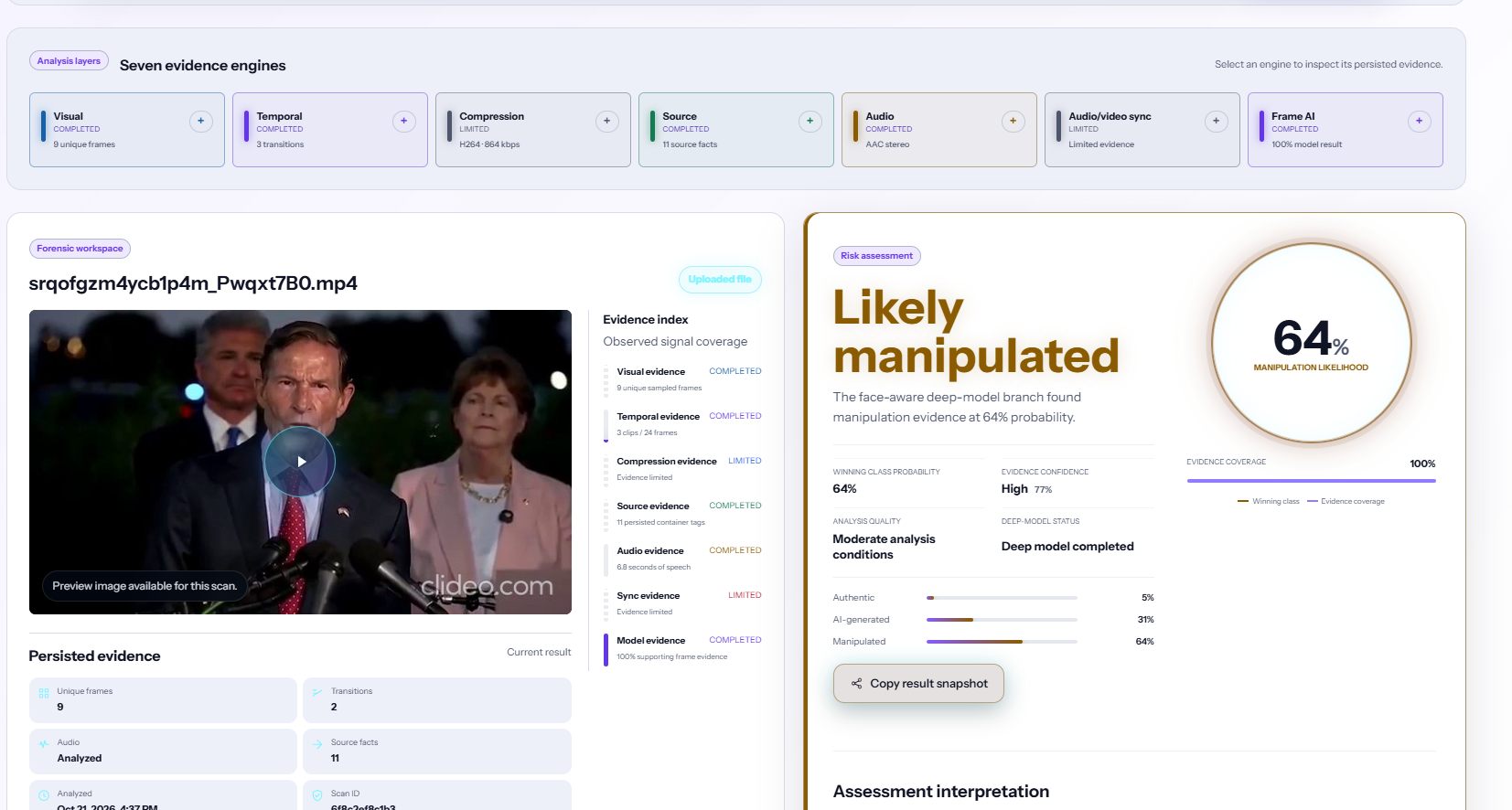
As the next step in our research, we scanned the viral video using the AI detection tool DETECT VIDEO AI. According to the results, the video is 64% AI-generated.
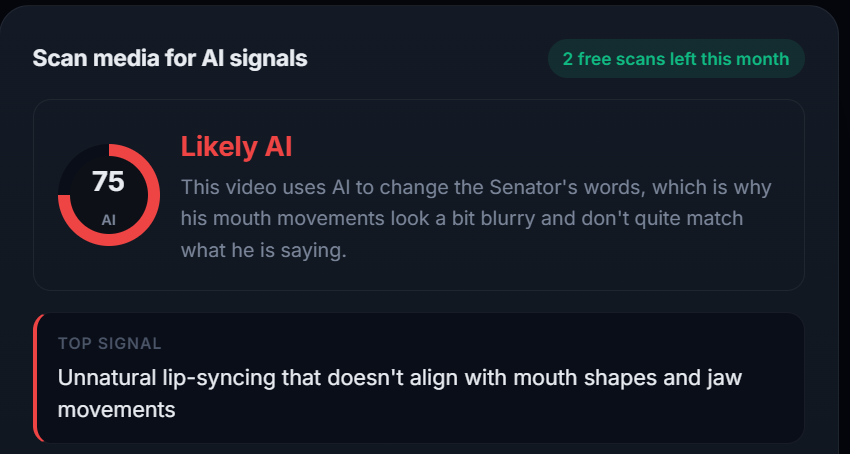
We scanned the viral video using another AI detection tool, HUMAN METER. According to the results, the video is 75% AI-generated.
Conclusion
Our research found that US Senator Richard Blumenthal did not make the viral statement describing India as a “failed state.” Blumenthal had expressed concerns over India and China purchasing Russian oil and gas, but the remarks attributed to him in the viral post do not match his actual statements. Therefore, the viral claim is misleading.

Related Blogs
Executive Summary
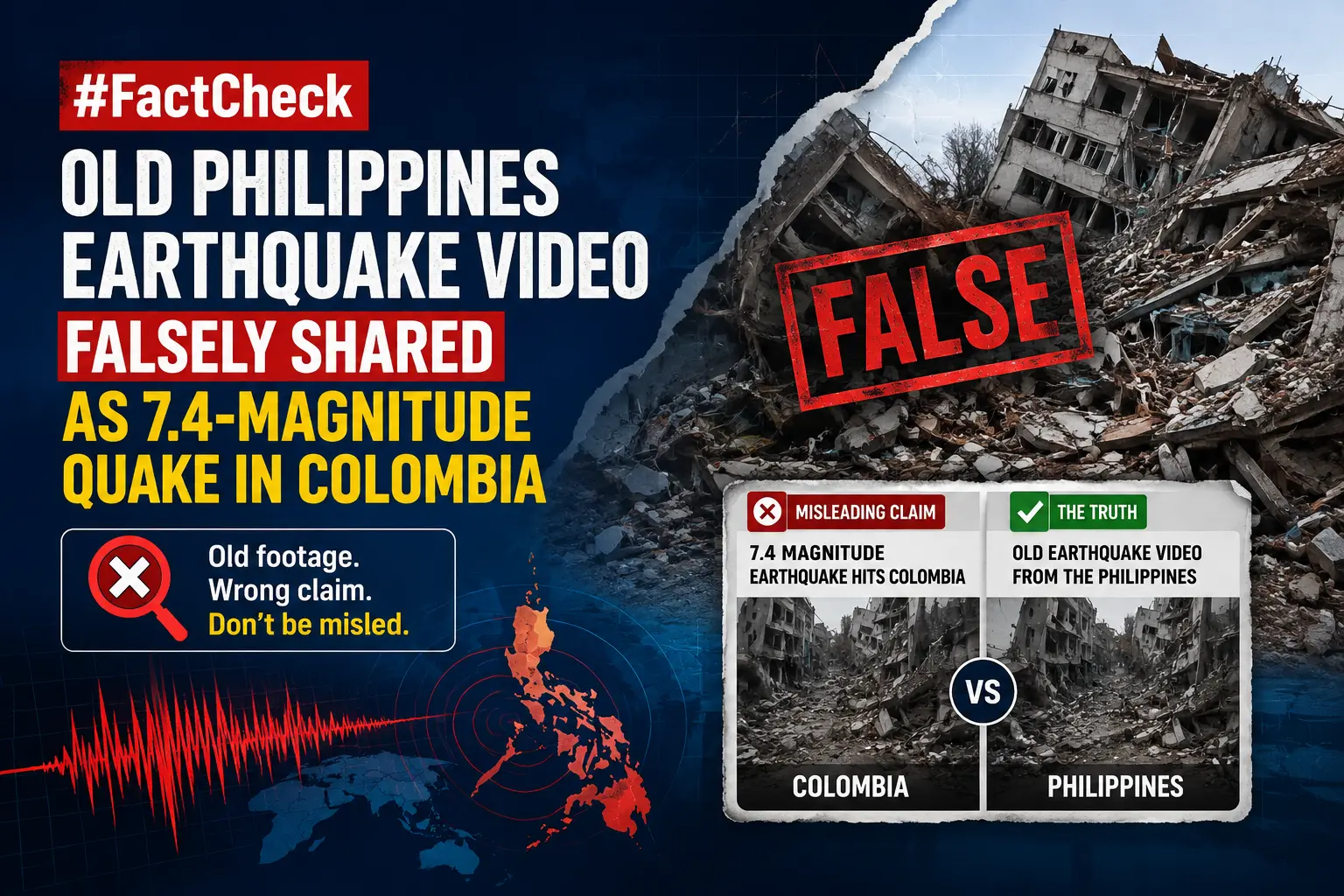
A video showing children crouching as the ground shakes violently is being widely shared on social media with the claim that it shows the aftermath of a devastating 7.4-magnitude earthquake that struck Colombia on August 10, 2026. However, the CyberPeace Research Wing found that the video is not from Colombia. The footage was recorded in the Philippines two months earlier during a more powerful earthquake.
Claim
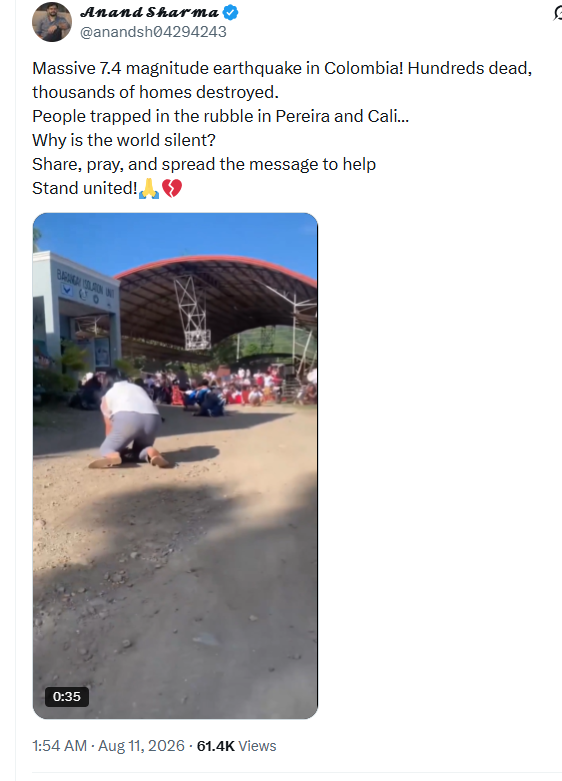
An X user shared the video on August 10, 2026, claiming that it showed a massive 7.4-magnitude earthquake in Colombia that killed hundreds of people and destroyed thousands of homes. “Massive 7.4 magnitude earthquake in Colombia! Hundreds dead, thousands of homes destroyed,” the post claimed.
https://x.com/anandsh04294243/status/2086911617938362779
Fact Check
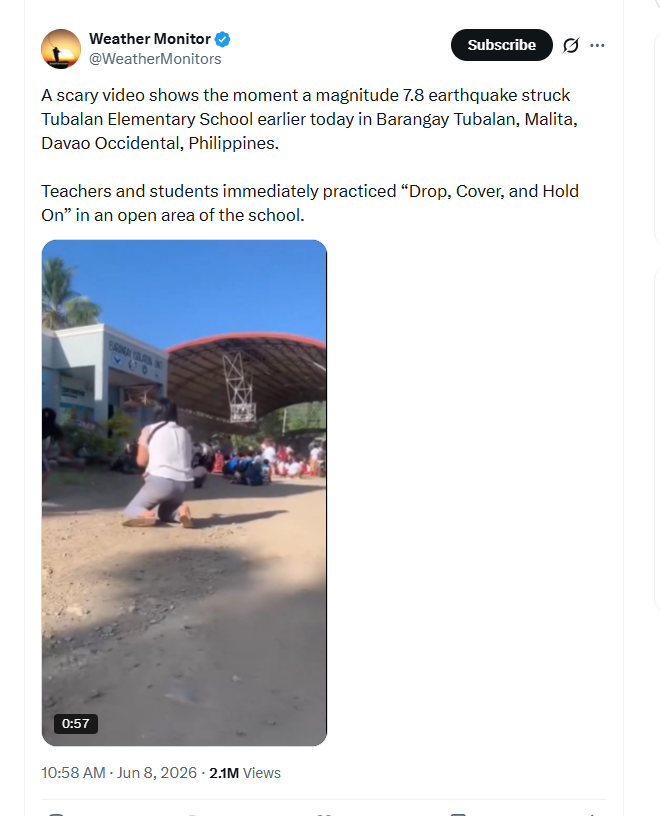
To verify the claim, the Desk conducted a reverse image search of keyframes from the viral video. The search led to the same footage being shared on social media on June 8, where it was linked to a powerful earthquake in the southern Philippines. The posts identified the footage as being related to a 7.8-magnitude earthquake that struck the region, causing buildings to collapse, triggering landslides and prompting tsunami warnings.
https://x.com/WeatherMonitors/status/2063855713223635055
Further research found that the video was recorded at Tubalan Elementary School in Malita, Davao Occidental province, Philippines.
According to the edit history of the Facebook post, the user initially stated that the footage showed the first day of school at Tubalan Elementary School. The user later updated the caption, urging viewers not to blame the teachers. The updated post stated that the students were outside near the school’s basketball court when the earthquake struck and were subsequently evacuated to safety without any injuries. The school also issued a separate post on Facebook to address what it described as a misconception arising from the video circulating on social media. The school clarified that the outdoor gymnasium was not being used as an evacuation area after the earthquake. It said the students were already inside the gymnasium for the scheduled flag ceremony when the earthquake occurred.
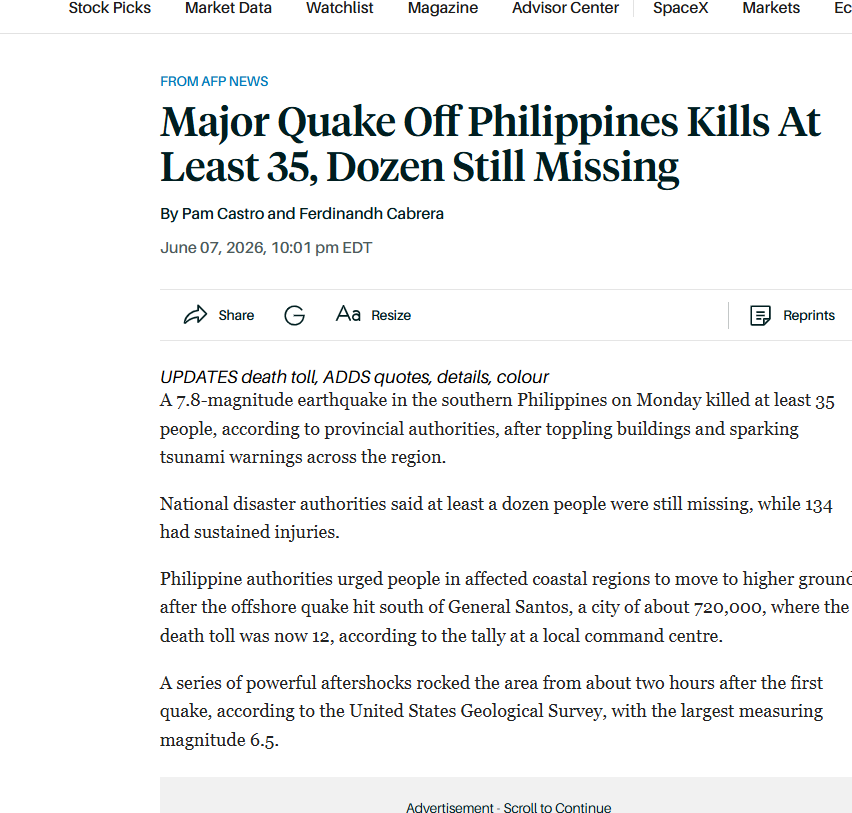
The Desk also searched for reports about the earthquake and found a detailed report published by Barron's, which confirmed the occurrence of a major earthquake off the southern Philippines. The report also mentioned casualties and tsunami warnings following the quake. https://www.barrons.com/news/major-quake-off-philippines-kills-one-triggers-tsunami-warnings-665c527c
Conclusion
The viral video does not show a 7.4-magnitude earthquake in Colombia. The footage was recorded at Tubalan Elementary School in the Philippines and was shared online in June 2026 in connection with a powerful earthquake that struck the southern Philippines. Therefore, the claim that the video shows the August 10, 2026 earthquake in Colombia is false.

Executive Summary:
In the age of virtuality, misinformation and misleading techniques shape the macula of the internet, and these threaten human safety and well-being. Recently, an alarming fake information has surfaced, intended to provide a fake Government subsidy scheme with the name of Indian Post. This serves criminals, who attack people's weaknesses, laying them off with proposals of receiving help in exchange for info. In this informative blog, we take a deep dive into one of the common schemes of fraud during this time. We will go through the stages involved which illustrates how one is deceived and offer practical tips to avoid the fall.
Introduction:
Digital communication reaches individuals faster, and as a result, misinformation and mails have accelerated their spread globally. People, therefore, are susceptible to online scams as they add credibility to phenomena. In India, the recently increased fake news draws its target with the deceptive claims of being a subsidy from the Government mainly through the Indian post. These fraudulent schemes frequently are spread via social networks and messaging platforms, influence trust of the individual’s in respectable establishments to establish fraud and collect private data.
Understanding the Claim:
There is a claim circulating on the behalf of the Government at the national level of a great subsidy of $1066 for deserving residents. The individual will be benefited with the subsidy when they complete the questionnaire they have received through social media. The questionnaire may have been designed to steal the individual’s confidential information by way of taking advantage of naivety and carelessness.
The Deceptive Journey Unveiled:
Bogus Offer Presentation: The scheme often appeals to people, by providing a misleading message or a commercial purposely targeted at convincing them to act immediately by instilling the sense of an urgent need. Such messages usually combine the mood of persuasion and highly evaluative material to create an illusion of being authentic.
Questionnaire Requirement: After the visitors land on attractive content material they are directed to fill in the questionnaire which is supposedly required for processing the economic assistance. This questionnaire requests for non private information in their nature.
False Sense of Urgency: Simultaneously, in addition to the stress-causing factor of it being a fake news, even the false deadline may be brought out to push in the technique of compliance. This data collection is intended to put people under pressure and influence them to make the information transfer that immediate without thorough examination.
Data Harvesting Tactics: Despite the financial help actually serving, you might be unaware but lies beneath it is a vile motive, data harvesting. The collection of facts through questionnaires may become something priceless for scammers that they can use for a good while to profit from identity theft, financial crimes and other malicious means.
Analysis Highlights:
- It is important to note that at this particular point, there has not been any official declaration or a proper confirmation of an offer made by the India Post or from the Government. So, people must be very careful when encountering such messages because they are often employed as lures in phishing attacks or misinformation campaigns. Before engaging or transmitting such claims, it is always advisable to authenticate the information from trustworthy sources in order to protect oneself online and prevent the spread of wrongful information
- The campaign is hosted on a third party domain instead of any official Government Website, this raised suspicion. Also the domain has been registered in very recent times.

- Domain Name: ccn-web[.]buzz
- Registry Domain ID: D6073D14AF8D9418BBB6ADE18009D6866-GDREG
- Registrar WHOIS Server: whois[.]namesilo[.]com
- Registrar URL: www[.]namesilo[.]com
- Updated Date: 2024-02-27T06:17:21Z
- Creation Date: 2024-02-11T03:23:08Z
- Registry Expiry Date: 2025-02-11T03:23:08Z
- Registrar: NameSilo, LLC
- Name Server: tegan[.]ns[.]cloudflare[.]com
- Name Server: nikon[.]ns[.]cloudflare[.]com
Note: Cybercriminal used Cloudflare technology to mask the actual IP address of the fraudulent website.
CyberPeace Advisory:
Verification and Vigilance: It makes complete sense in this case that you should be cautious and skeptical. Do not fall prey to this criminal act. Examine the arguments made and the facts provided by either party and consult credible sources before disclosures are made.
Official Channels: Governments usually invoke the use of reliable channels which can as well be by disseminating subsidies and assistance programs through official websites and the legal channels. Take caution for schemes that are not following the protocols previously established.
Educational Awareness: Providing awareness through education and consciousness about on-line scams and the approaches which are fraudulent has to be considered a primary requirement. Through empowering individuals with capabilities and targets we, as a collective, can be armed with information that will prevent erroneous scheme spreading.
Reporting and Action: In a case of mission suspicious and fraudulent images, let them understand immediately by making the authorities and necessary organizations alert. Your swift actions do not only protect yourself but also help others avoid the costs of related security compromises.
Conclusion:
The rise of the ‘Indian Post Countrywide - government subsidy fake news’ poses a stern warning of the present time that the dangers within the virtual ecosystem are. The art of being wise and sharp in terms of scams always reminds us to show a quick reaction to the hacks and try to do the things that we should identify as per the CyberPeace advisories; thereby, we will contribute to a safer Cyberspace for everyone. Likewise, the ability to critically judge, and remain alert, is important to help defeat the variety of tricks offenders use to mislead you online.

Introduction
India's largest lender is dealing with a serious data security scare. On October 21, 2026, the State Bank of India told the stock exchanges that it "has experienced an incident involving the loss of certain data" after customer records linked to the bank surfaced on the dark web, as The Hacker News reported. The bank says its core systems and customer funds are safe. Here is a clear look at what has been confirmed, what remains unknown, and what you can do right now.
How the leak came to light
The first event was on October 16. According to a hacker group called Siriusim, they put out the message on Breach Forums – a hacker group forum that specialises in sharing stolen data – claiming to have 375,000 customer records and 2,722 PDF files stolen from the State Bank of India (SBI).
On the same day, SBI received alerts from its threat intelligence provider, Defence Cyber Agency, and Cert-In (India's computer emergency response team) as per the Business Standard. This was followed by SBI submitting a disclosure to the BSE (Bombay Stock Exchange) and the NSE (National Stock Exchange) on October 21, under SEBI (Securities and Exchange Board of India) listing obligations, as per Money Life and Business Today.
What data was exposed
After a preliminary review of roughly 375,000 records circulating online, SBI identified 3,897 customer records containing personally identifiable information. The Free Press Journal reports that the exposed details include names, registered mobile numbers, dates of birth, gender, email addresses, residential addresses and branch details. The records also carry banking metadata such as customer information file numbers, lead IDs and information tied to loan applications and related files.
The difference between the two headline numbers matters. The 375,000 figure is the size of the dataset on offer, while 3,897 is the number of records the bank has so far found to hold real customer information. The Hacker News notes that the count is preliminary and that the bank has yet to establish whether the data is authentic or how far the exposure goes. Reports of the filing do not mention the 2,722 PDF documents the seller advertised, so that claim remains unverified.
What SBI has said
SBI says that it implemented its cyber incident response and containment process based on the alerts received. The bank has also engaged an independent cybersecurity agency (empanelled by CERT-In) to assess the extent and the nature of the breach. "From a business point of view, the bank has informed investors that it does not expect any material impact on the financials of the bank or on business continuity.
Customer funds or core banking transactions have not been impacted," the bank said, as per the Free Press Journal.
The customer notification debate
Banks often argue that data should be verified before customers are alerted, and SBI's investigation is still at a preliminary stage. Still, customers cannot protect themselves against a risk they have not been told about, and the gap between regulatory duty and customer interest is exactly what this episode has exposed.
Why it matters
For the 3,897 people identified so far, the main danger is probably not the loss of money directly from their accounts but targeted fraud. Scammers who know a person's name, phone number, address and loan history can sound very convincing when they pose as bank staff.
SBI has faced scrutiny of this kind before. In 2019, TechCrunch reported that an unprotected server in an SBI data centre in Mumbai had exposed two months of data from SBI Quick, a text message and call-based service, putting account information of millions of customers within reach of anyone who finds it.
What customers can do now
SBI has not issued customer-specific guidance beyond its public notice, so the following are general precautions that apply to any data exposure of this kind.
- Any suspicious communication, such as a call, SMS or WhatsApp message, claiming to be from SBI, should be treated as suspicious, especially if it talks about a loan, creates an urgency to act or asks you to click on a link.
- Do not share your OTP, PIN, CVV or online banking password with anyone, even if you are talking to a bank executive, since the bank staff will not ask for these details.
- Switch on the transaction alerts and regularly check your bank account statement, and report any unauthorised transactions to the bank and file a complaint through the national cybercrime portal or helpline 1930.
- To determine whether a person is impacted, call SBI at the numbers and through the modes listed on its official website or on your bank card or passbook.
Conclusion
This story is still developing, and the numbers may change as the independent investigation progresses. For now, the confirmed facts are narrower than the hacker's claims, and the bank's financial position is not in question. What remains in doubt is where the data came from, how fresh it is, and whether the bank will warn the people it affects. Watch for the independent agency's findings and whether SBI notifies customers directly.
Sources
- The Hacker News: State Bank of India Confirms Data Leak After 3,897 Customer Records Found on Dark Web
- Business Standard: From SBI to ICICI, Major Banking Data Breaches and Cyberattacks in India
- Business Today: 3.75 lakh records, 3,897 customers, SBI says address, mobile numbers, email ID leaked
- Moneylife: SBI Data Leak, 3,897 Customer Records Found in Preliminary Analysis, IFF Says Customers Not Informed
- Internet Freedom Foundation: SBI told investors its data breach does not matter. What about the 3,897 customers it affected?
- YourStory: SBI finds 3,897 customer records on dark web after hacker's claim
- Free Press Journal: SBI Data Leak, Names, Phone Numbers, Addresses of Nearly 3,900 Customers Exposed
- TechCrunch: India's largest bank SBI leaked account data on millions of customers
